-
Renata returned from church with the observation that a friend didn’t want an obituary that included “a valiant battle with cancer.” I understood. Simply enough, I felt the same way. The thing about cancer is that the only person who lost the battle with cancer is Henrietta Lacks. Her tumor survives, HeLa cells are in labs around the world, and have even traveled into space and back. Usually the cancerous tumor dies – sometimes along with the host, sometimes the host survives. Henrietta Lacks’ tumor seems to be immortal.
The same day, comments were flying about Zelensky and Ukraine. And I realized that the cancer experience provides an understanding that the Z-man lacks.
Staging is important – my melanoma was stage two. I recovered, with only a large, recognizable scar to mark the experience. I’ve known a couple of stage one breast cancer survivors – their scars aren’t nearly so impressive. My colon cancer was stage 3. The visible scars don’t show – but there are a lot of limits that make me say I survived the big C . . . recovery not so much.
Ukraine is like a stage 3 cancer. The good thing I learned from stage 3 was that I could survive – but in a lot more limited way than full recovery. The radiation hurt – but I recovered. The chemotherapy was basically putting enough heavy metal through my body that I could survive it and the metastasized cancer cells couldn’t. By the time the chemo was done, I had chemo-induced neuropathy – numb from the soles of my feet past my knees. I remember the impossibility of holding a bar of soap. I could no longer sign my name. There was some recovery from the neuropathy – I again have a recognizable signature – but the feet never got much feeling back. Walking on numb feet makes falling a whole lot easier.
The semi-colon I was left with after surgery reduced my outings – I can still get out and about, but it requires a lot more planning, deciding which meals to miss and when to swallow down imodium so I can spend time in public. I’m not complaining – I went through the surgery and chemo knowing what to expect. Even a reduced quality of life beats being dead. Ukraine can survive – but it’s going to survive without the Donbas or Crimea. Survival doesn’t mean recovery. On the other hand, it beats hell out of an obit that describes “a valiant battle with cancer.”
Someone, somewhere, may have fought that valiant battle. I didn’t. I looked at the statistics and knew I would survive. My Oncologist wasn’t so sure – but I was, and am, a whole lot better at statistics than he was. I was lucky – my cancer had just barely made it into stage 3. Others – one was in the econ department a floor below me – made it into stage 4. Perhaps he fought a valiant battle. At any rate, his carcinoma died with him. Call it a tie.
Zelensky is still in the valiant battle stage – he hasn’t accepted the losses required for survival. The thing is, it’s illogical to expect Putin to lose just because he’s an evil bastard. He’s a close evil bastard – and the rescuers are an ocean away. Recovery and survival aren’t synonyms.
-
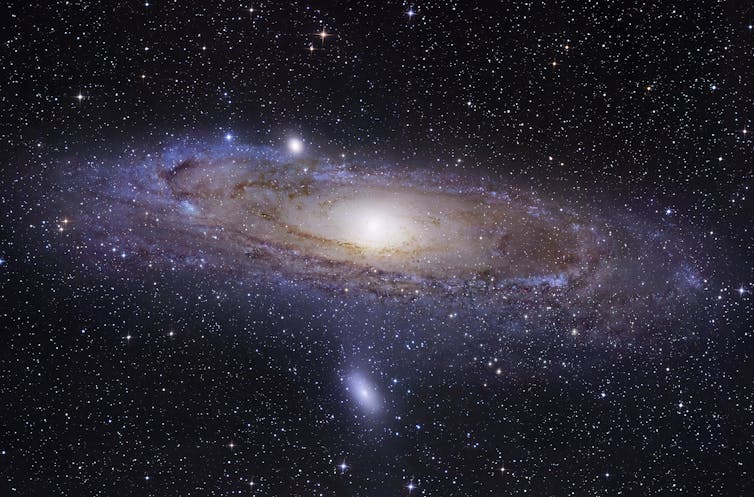
The Andromeda galaxy helped Edwin Hubble settle a great debate in astronomy. Stocktrek Images via Getty Images Chris Impey, University of Arizona
A hundred years ago, astronomer Edwin Hubble dramatically expanded the size of the known universe. At a meeting of the American Astronomical Society in January 1925, a paper read by one of his colleagues on his behalf reported that the Andromeda nebula, also called M31, was nearly a million light years away – too remote to be a part of the Milky Way.
Hubble’s work opened the door to the study of the universe beyond our galaxy. In the century since Hubble’s pioneering work, astronomers like me have learned that the universe is vast and contains trillions of galaxies.
Nature of the nebulae
In 1610, astronomer Galileo Galilei used the newly invented telescope to show that the Milky Way was composed of a huge number of faint stars. For the next 300 years, astronomers assumed that the Milky Way was the entire universe.
As astronomers scanned the night sky with larger telescopes, they were intrigued by fuzzy patches of light called nebulae. Toward the end of the 18th century, astronomer William Herschel used star counts to map out the Milky Way. He cataloged a thousand new nebulae and clusters of stars. He believed that the nebulae were objects within the Milky Way.
Charles Messier also produced a catalog of over 100 prominent nebulae in 1781. Messier was interested in comets, so his list was a set of fuzzy objects that might be mistaken for comets. He intended for comet hunters to avoid them since they did not move across the sky.
As more data piled up, 19th century astronomers started to see that the nebulae were a mixed bag. Some were gaseous, star-forming regions, such as the Orion nebula, or M42 – the 42nd object in Messier’s catalog – while others were star clusters such as the Pleiades, or M45.
A third category – nebulae with spiral structure – particularly intrigued astronomers. The Andromeda nebula, M31, was a prominent example. It’s visible to the naked eye from a dark site.
Astronomers as far back as the mid-18th century had speculated that some nebulae might be remote systems of stars or “island universes,” but there was no data to support this hypothesis. Island universes referred to the idea that there could be enormous stellar systems outside the Milky Way – but astronomers now just call these systems galaxies.
In 1920, astronomers Harlow Shapley and Heber Curtis held a Great Debate. Shapley argued that the spiral nebulae were small and in the Milky Way, while Curtis took a more radical position that they were independent galaxies, extremely large and distant.
At the time, the debate was inconclusive. Astronomers now know that galaxies are isolated systems of stars, much smaller than the space between them.
Hubble makes his mark
Edwin Hubble was young and ambitious. At the of age 30, he arrived at Mount Wilson Observatory in Southern California just in time to use the new Hooker 100-inch telescope, at the time the largest in the world.
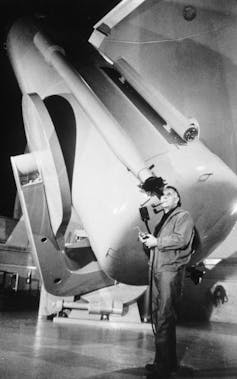
Edwin Hubble uses the telescope at the Mount Wilson Observatory. Hulton Archives via Getty Images He began taking photographic plates of the spiral nebulae. These glass plates recorded images of the night sky using a light-sensitive emulsion covering their surface. The telescope’s size let it make images of very faint objects, and its high-quality mirror allowed it to distinguish individual stars in some of the nebulae.
Estimating distances in astronomy is challenging. Think of how hard it is to estimate the distance of someone pointing a flashlight at you on a dark night. Galaxies come in a very wide range of sizes and masses. Measuring a galaxy’s brightness or apparent size is not a good guide to its distance.
Hubble leveraged a discovery made by Henrietta Swan Leavitt 10 years earlier. She worked at the Harvard College Observatory as a “human computer,” laboriously measuring the positions and brightness of thousands of stars on photographic plates.
She was particularly interested in Cepheid variables, which are stars whose brightness pulses regularly, so they get brighter and dimmer with a particular period. She found a relationship between their variation period, or pulse, and their intrinsic brightness or luminosity.
Once you measure a Cepheid’s period, you can calculate its distance from how bright it appears using the inverse square law. The more distant the star is, the fainter it appears.
Hubble worked hard, taking images of spiral nebulae every clear night and looking for the telltale variations of Cepheid variables. By the end of 1924, he had found 12 Cepheids in M31. He calculated M31’s distance as a prodigious 900,000 light years away, though he underestimated its true distance – about 2.5 million light years – by not realizing there were two different types of Cepheid variables.
His measurements marked the end of the Great Debate about the Milky Way’s size and the nature of the nebulae. Hubble wrote about his discovery to Harlow Shapley, who had argued that the Milky Way encompassed the entire universe.
“Here is the letter that destroyed my universe,” Shapley remarked.
Always eager for publicity, Hubble leaked his discovery to The New York Times five weeks before a colleague presented his paper at the astronomers’ annual meeting in Washington, D.C.
An expanding universe of galaxies
But Hubble wasn’t done. His second major discovery also transformed astronomers’ understanding of the universe. As he dispersed the light from dozens of galaxies into a spectrum, which recorded the amount of light at each wavelength, he noticed that the light was always shifted to longer or redder wavelengths.
Light from the galaxy passes through a prism or reflects off a diffraction grating in a telescope, which captures the intensity of light from blue to red.
Astronomers call a shift to longer wavelengths a redshift.
It seemed that these redshifted galaxies were all moving away from the Milky Way.
Hubble’s results suggested the farther away a galaxy was, the faster it was moving away from Earth. Hubble got the lion’s share of the credit for this discovery, but Lowell Observatory astronomer Vesto Slipher, who noticed the same phenomenon but didn’t publish his data, also anticipated that result.
Hubble referred to galaxies having recession velocities, or speeds of moving away from the Earth, but he never figured out that they were moving away from Earth because the universe is getting bigger.
Belgian cosmologist and Catholic priest Georges Lemaitre made that connection by realizing that the theory of general relativity described an expanding universe. He recognized that space expanding in between the galaxies could cause the redshifts, making it seem like they were moving farther away from each other and from Earth.
Lemaitre was the first to argue that the expansion must have begun during the big bang.
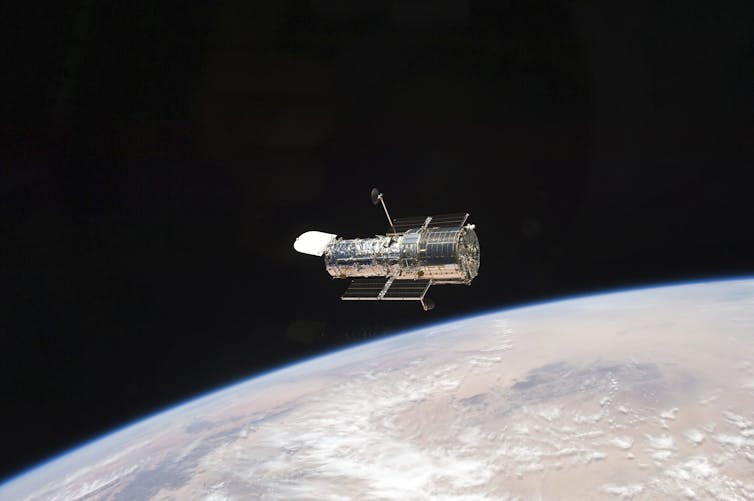
Edwin Hubble is the namesake for NASA’s Hubble Space Telescope, which has spent decades observing faraway galaxies. NASA via AP NASA named its flagship space observatory after Hubble, and it has been used to study galaxies for 35 years. Astronomers routinely observe galaxies that are thousands of times fainter and more distant than galaxies observed in the 1920s. The James Webb Space Telescope has pushed the envelope even farther.
The current record holder is a galaxy a staggering 34 billion light years away, seen just 200 million years after the big bang, when the universe was 20 times smaller than it is now. Edwin Hubble would be amazed to see such progress.
Chris Impey, University Distinguished Professor of Astronomy, University of Arizona
This article is republished from The Conversation under a Creative Commons license. Read the original article.
-
I won’t be serving another term on Trego’s school board. I’ve gone past 75, and the body just doesn’t have what it takes – the simplest way to describe it is that I can’t handle the heartburn anymore.
I see that, at the federal level, there’s a lot of commentary about waste in education – that the education complex hasn’t increased the number of teachers per student, but that we (the taxpayers) are paying a lot more for ‘overhead.’ The complaints have validity – and as I step from the board into another form of retirement, I’d like to describe what I see.
A hundred years have passed since my mother did her last year at Trego Elementary – she left at 11, and my grandparents moved to Mica, Washington in a covered wagon. The great depression arrived early in the Tobacco Valley – and few places still belong to the same families that were here a century ago. My grandfather did a heck of a job holding things together through the nation’s worst economic times – but the story is Trego School. If we think back a century, it was a one-room log school house. Since getting through the eighth grade was the expectation at the time, a one room school, a teacher with a normal school education (one year past high school) and a local school board and a county superintendent was all that was needed. Electricity would be another 20 years in coming – and, while flushing toilets would accompany that construction, the outhouses would still be on the school grounds into the mid-sixties.
I came into Trego school as a sixth grader in 1960. Three classrooms, three teachers, two apartments in the teacherage, Lil Shay was the school cook, Mrs. Ritter as school clerk, and Wilda B. Totten was the county superintendent. In my second year of high school, I learned that Trego’s school clerk, Mrs. Ritter, couldn’t type. It wasn’t a problem – Dad was on the school board, I was taking typing class in high school, and I was detailed to do all the board’s typing as they worked to get a new school built before the population impact that came into the community to build the tunnel and replace the railroad that was due to be flooded.
I was here when the first phones came into Trego – hell, I was here when the nearest phone was Osler Brothers Mill on Mud Creek. We had electricity but no telephone service at Trego School when I started – the phones came in about the time I completed the eighth grade. Our library was a monthly visit from Mrs. Herrig and the bookmobile (her father was our first forest ranger at Ant Flat – connecting with the ‘birth’ of Trego in 1903, with the construction of the Dam on Fortine Creek, and later the Great Northern Railroad.
Sixty years later, there are a lot more demands on the school board and the school staff. The bookmobile is long gone – but Trego’s board is looking at changing one of the classrooms into a school/community library. (The county’s present library funding really does provide less for the rural schools and communities than was available in 1960.
The school – built in 1965 – was wired for one office phone and intercoms to the classrooms. It was modern and up-to-date at the time, but in 1965, no one anticipated that Trego Elementary would be counting its computers by the dozen, and DARPA had not even begun to publish studies on the research program that would become the internet.
We’ve seen a tremendous increase in the regulations for special education over these past sixty years – though I haven’t seen a corresponding increase in the education our special ed students receive and demonstrate. We have many more regulations for the school cook in 2025 – but I think the meals Lil Shay served were every bit as good.
In 2025, we have more support staff – but we need those folks because the demands of technology – and the demands of increased county, state and federal bureaucrats have increased tremendously.
-
There’s a saying that you need to take an interest in government, because it will certainly take an interest in you. I’m not sure how active that interest is, but it’s certainly willing to step in and change your life in inconvenient ways without consulting you.
HB814 is another example of that. Last legislative session left us with a tuition bill forcing all of the local school districts, which had previously had a choice on whether or not to charge tuition for out of district enrollments, to charge tuition regardless of school board and community wishes.
HB814 is even worse for ignoring the preferences of local voters. HB814 would force the merger of all elementary districts with their associated high school districts. Now, the thing is, consolidation has always been an option. Our district has voted on it (not recently)- Trego opposed the abolishment of LCHS and merger with Eureka Elementary into a unified school district. The vote passed elsewhere, as it happens, and that’s more or less why the high school board is the Eureka Elementary Board with add-ons.
Trego and Fortine could put a merger on the ballot whenever- all it takes is both school boards asking the county superintendent, or a petition of voters in both districts- not a huge petition, either. The option already exists.
HB814? Some condescending person elected into Helena has decided that it just doesn’t make sense for these little schools to be separate. So, they’re going to take that choice away from us. And Fortine. And Yak. And McCormick. And every other sufficiently rural community with a school in the state.
Can you ignore your government? Trust that your elected senator and representative won’t vote for something you believe is blatantly stupid, likely to negatively impact your community, or reduce freedom of choice for the population? You could. But if last legislative’s sessions tuition bill (which is going to increase school taxes all over the state, via permissive levies that you don’t get to vote on) is any indication, you probably shouldn’t.
-
Most of the comments I see about the war in Ukraine are from people younger than I. It kind of makes sense – most people are younger than I. Still, there are some friends posting comments about standing with Ukraine that I can recall protesting the VietNam war. I don’t believe I have changed – I’m opposed to US involvement in Ukraine for the same reasons I was opposed to VietNam.
Still, most people are younger than I – so let’s look at the reasons. First, there’s a big ocean between us and them. VietNam didn’t have enough seapower to make a landing on the North American Continent – and the last Admiral of note that worked for Russia was John Paul Jones. Nothing personal – but it doesn’t make sense to cross the Atlantic or the Pacific just to get into a fight that can be avoided by staying home.
The second reason is that we don’t have a good record for getting out of these overseas wars. I might not be particularly proud of the way Biden ended the war in Afghanistan – but maybe, had someone asked how we were going to end it before we sent troops over there, we might have had more acceptable results. In VietNam, American soldiers and marines essentially won every battle -but that had nothing to do with winning the war. Nothing personal – but if we send people into a foreign war, we need to send them into a war where they have at least some chance of victory.
I should have a soft spot for Ukraine – my mother-in-law came from there. She grew up after the Russian Revolution – at the time of the Holodomor. Her father was classified as an enemy of the revolution. Then, a few years later, the Nazis marched in and she spent the second world war in Hitler’s camps. Never seemed like she saw a lot of difference between Stalin and Hitler.
It’s kind of like Gaza. If I recollect my bible correctly, Gaza was a problem area back in Samson’s day. History says it’s a good place to avoid. Same thing with Ukraine -I don’t know who struck the first blow, but these guys have grudges that are older than our country. It’s a good place to avoid.
Before the US got involved in VietNam, the French were there. As they fought the Viet Minh, their goal was to get them committed to one big fight, where the Viet Minh couldn’t run away. The place they selected was called Dien Bien Phu.
I don’t have the moral clarity of a pacifist. I just don’t see any purpose in signing on for a war that doesn’t offer a way to win. And the Russia-Ukraine war is a family squabble – both sides figure that they’re descendants from the Kievan Rus. It’s a good idea not to step into the middle of a family fight. -
Editor’s Note: Mike originally wrote this in 2023- we’ve had an election since, but with three candidates for two positions, Mike won’t be the last school board member elected by acclamation; Fawnette Richard ran unopposed last election after her opponent stepped out of the race, and was thus elected by acclamation.
I don’t know how long it’s been since we actually had an election for the school board trustees. The ballots stashed in Trego School’s records date back to the 1900s. It may be that children have been born, graduated from college, certified to teach, and been granted tenure in the time since Trego’s last election. If the district doesn’t get two candidates to run, a single candidate will win “by acclamation.” Eureka already has 4 candidates running for two positions – and the LCHS board has Raymond Flanagan running for the Fortine position unopposed. Since five of the high school board positions are filled by Eureka Elementary trustees, this election cover three of the seven high school trustees. Fortine has three 3-year terms up this year, and no filings yet.
Nothing personal – but we need to get back in the habit of having elections . . . and the school district is the place to start. To run for school board, you need to be a registered voter in the school district and get your form filled out and notarized by March 23. On the other hand, if you miss getting the form in by the 23rd, you can still file as a write-in candidate until March 30 – and, in districts where we’re not accustomed to an actual election, a write-in candidate probably has as good a chance as a candidate whose name is on the ballot.
My term runs out in a little more than two years. I’d like to be the last school board member elected by “acclamation.” The lack of elections does not improve the quality of our schools.
Here are some of the laws governing school elections, the whole list is available at leg.mt.gov
Regular School Election Day And Special School Elections — Limitation — Exception
20-20-105. Regular school election day and special school elections — limitation — exception. (1) Except as provided in subsection (5), the first Tuesday after the first Monday in May of each year is the regular school election day.
(2) Except as provided in subsections (4) and (5), a proposition requesting additional funding under 20-9-353 may be submitted to the electors only once each calendar year on the regular school election day.
(3) Subject to the provisions of subsection (2), other school elections may be conducted at times determined by the trustees.
(4) In the event of an unforeseen emergency occurring on the date scheduled for the funding election pursuant to subsection (2), the district will be allowed to reschedule the election for a different day of the calendar year. As used in this section, “unforeseen emergency” has the meaning provided in 20-3-322(5).
(5) In years when the legislature meets in regular session or in a special session that affects school funding, the trustees may order an election on a date other than the regular school election day in order for the electors to consider a proposition requesting additional funding under 20-9-353.
Poll Hours
20-20-106. Poll hours. (1) The polls for any school election in any district shall open not later than noon. The trustees may order the polls to open earlier, but no earlier than 7 a.m.
(2) If the school election is held on the same day as an election held by a political subdivision and at the same polling place pursuant to 13-1-305, the polls must be opened and closed at the times required for the school election.
(3) If the school election is held on the same day as a general or primary election, the polls must be opened and closed at the times required for the general or primary election under 13-1-106.
(4) Once opened, the polls must be kept open continuously until 8 p.m., except that whenever all the registered electors at any poll have voted, the poll must be closed immediately.
Election Judges — Qualifications — Training
20-20-109. Election judges — qualifications — training. (1) Election judges must be qualified registered electors of the school district in which they serve.
(2) An election judge may not be:
(a) the candidate;
(b) an ascendant, descendant, brother, or sister of a candidate; or
(c) the spouse of the candidate or of any of the individuals listed in subsection (2)(b).
(3) School election judges must meet the training and certification requirements of 13-4-203.
There are some other laws available, but these are the significant ones.
-
With the first of March, Stahl Peak is back to 96% of average snowpack. The chart shows how the snow water equivalent was above average in January, fell below average through February, and came close to average for March 1. As you can see, the month of March is the most significant time in determining how much water will be sitting up in the mountains.
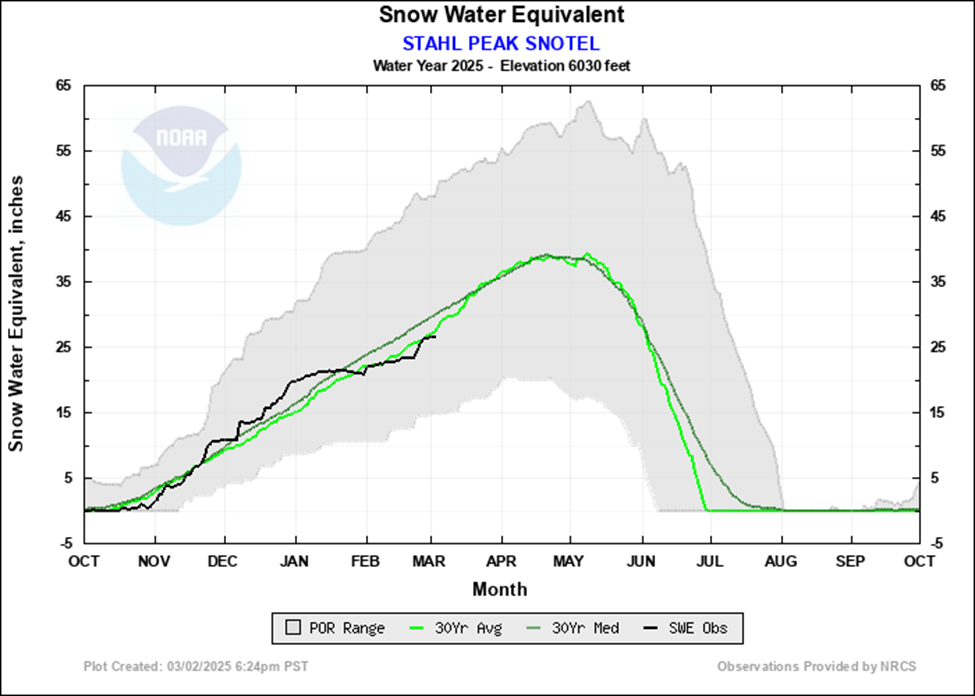
The basin index – available at Montana SNOTEL Snow/Precipitation Update Report shows that Grave Creek is the only pillow reporting above average. It is fun to be able to see all the measurements from an easy chair, compared with the oversnow trips we made with the Alpines fifty years ago.
Basin Site Name Elev (ft) Snow Water Equivalent Water Year-to-Date Precipitation Current (in) Median (in) Pct of Median Current (in) Median (in) Pct of Median KOOTENAI RIVER BASIN Banfield Mountain 5580 12.7 14.2 89 16.4 20.9 78 Bear Mountain 5460 40.2 45.2 89 43.9 57.3 77 Garver Creek 4250 -M 8.5 * -M 15.4(24) * Grave Creek 4350 13.9 13.7 101 21.0 26.8 78 Hand Creek 5040 8.9 9.4 95 11.0 14.4 76 Hawkins Lake 6460 18.0 21.0 86 23.6 25.6 92 Poorman Creek 5050 24.1 30.7(22) 79 32.0 47.0(22) 68 Stahl Peak 6040 26.4 27.2 97 27.6 31.4 88 Basin Index (%) 89 79 -
A young woman who published as DataRepublican has been doxxed – outed with her address, etc. Not necessarily a big deal, except she’s a bit autistic and deaf, communicating in ASL, and she’s a bit uncertain about her language skills. This post shows me that her written command of the English language is good – and her thinking skills are equally good:

It’s a simple concept – somewhere along the line, the government ceased to deal with citizens and started dealing with revenue sources. Here’s a link to an interview with the lady. She describes her next project – and it’s basically a sociology research technique. It’s worth clicking the link and seeing the lady communicate.
As I recall, it was Lincoln who started the income tax (and the draft), so it’s been with us for quite a while. The idea that the role of citizen changed to revenue source – well, the concept isn’t alien to me, but she expressed it very well. It’s a lot easier to mistreat your revenue sources than your fellow citizens.
-
I read that Americans pay an estimated 400 billion dollars to cover the cost of complying with the income tax. With 330 odd million Americans, and a billion equalling a thousand million, that translates to something over a thousand dollars for every man, woman and child before any taxes are paid.
About 60 percent of American households paid income tax in 2022 – so it’s not out of line to SWAG (scientific wild-ass guess) that the average cost of compliance is in the neighborhood is closer to two thousand per head.
For well over a half-century, I’ve been receiving W2 forms – which I then combined with the tax form to determine how much to pay the IRS. Most of the time there wasn’t a whole lot of difference between the standard deduction and the itemized deduction (when there was, like the year when I encountered cancer, there was an obvious reason for it).
So a simple proposition would be that a computer in the IRS basement would be set up to add all of the W2 forms and all of the 199 forms, and arbitrarily fill out my 1040 for me and calculate my tax obligation. It might even have a spare page to let me report why a standard deduction just didn’t apply this year. Better accounting minds than mine could work out the form.
The thing is – if it costs my wife and I four thousand to get all the calculations in for compliance, and the difference between itemizing and taking the standard deduction doesn’t look anywhere close to $4,000 for the household, it could be a lot easier to file the income taxes – and both the state and the fed have that data. The little bit of lumber and hay sales could go on that extra page, and the labor of paying taxes could be greatly reduced.
-
So I ran across an X post by John Ringo, showing similarities between the current political situation and that of Andy Jackson. Ringo’s whole article is here . If you’re not ready to click immediately and read the whole thing, here are a few comments taken from his essay:
Wilsonians are the Clinton wing of the Democratic party. They are also all through the State Department and to a great extent the the ‘permanent bureaucracy’ in DC. (Though they’ve lately been overtaken by Jeffersonians in that.)
Madisonians are the Bush wing of the Republican party. They’re all about ‘Government exists to create a better business climate especially for my friends.’
Jeffersonians for a very long time were sort of in the background of the Democrat party, pushing it left but not controlling it, then started to take over under Obama and are the ‘woke’ part that’s controlling it now.
Jacksonians have ALWAYS been the silent majority in the US political system. They mostly were ‘leave me alone and I’ll just vote D/R whichever.’ And, like Jeffersonians, often didn’t vote because neither party represented them very well. (Nor cared much about them at all.)
These observations are outside my expertise – there is some relationship between sociology and political science, but I’ve kind of specialized in studies that could be expressed numerically. On the other hand, I’m comfortable believing that neither party has done a good job of representing me. Hell, Zooey Zephyr, Missoula’s transexual state representative, did a better job with my two issues last session than either Mike Cuffe or Neil Duram. Alexander Pope’s 9th Beatitude -”Blessed is he who expects nothing, for he shall not know disappointment.” By Ringo’s analysis, I’m either Jeffersonian or Jacksonian.
His analysis comes from applying an essay written by Walter Russell Mead – you can get to a copy at thoughtsaloud.com
If you haven’t clicked the link, this excerpt may convince you that Mead’s analysis is worth reading:
Suspicious of untrammeled federal power (Waco), skeptical about the prospects for domestic and foreign do-gooding (welfare at home, foreign aid abroad), opposed to federal taxes but obstinately fond of federal programs seen as primarily helping the middle class (Social Security and Medicare, mortgage interest subsidies), Jacksonians constitute a large political interest.
In some ways Jacksonians resemble the Jeffersonians, with whom their political fortunes were linked for so many decades. Like Jeffersonians, Jacksonians are profoundly suspicious of elites. They generally prefer a loose federal structure with as much power as possible retained by states and local governments. But the differences between the two movements run very deep—so deep that during the Cold War they were on dead opposite sides of most important foreign policy questions. To use the language of the Vietnam era, a time when Jeffersonians and Jacksonians were fighting in the streets over foreign policy, the former were the most dovish current in mainstream political thought during the Cold War, while the latter were the most consistently hawkish.
One way to grasp the difference between the two schools is to see that both Jeffersonians and Jacksonians are civil libertarians, passionately attached to the Constitution and especially to the Bill of Rights, and deeply concerned to preserve the liberties of ordinary Americans. But while the Jeffersonians are most profoundly devoted to the First Amendment, protecting the freedom of speech and prohibiting a federal establishment of religion, Jacksonians see the Second Amendment, the right to bear arms, as the citadel of liberty. Jeffersonians join the American Civil Liberties Union; Jacksonians join the National Rifle Association. In so doing, both are convinced that they are standing at the barricades of freedom.
It does give me an appreciation of the differences – I recall attending a couple of ACLU organizational meetings in Bozeman, and finally walking out after explaining that, by excluding the second amendment, the ACLU was picking and choosing which civil liberties they wanted to support. I guess part of it is that I took an oath to preserve and protect the constitution – and I still believe that it meant the whole thing. I guess that makes me leaning toward life in the Jacksonian camp.
Ringo ends with:
This is also MASSIVELY confusing on the international front because NOBODY ever lets the Jacksonians near international politics. They are strictly invisible.
Now, all of a sudden, the international community is seeing this snarling pit bull of Jacksonianism rising in the US and it has no clue how to react.
Anything absolutely new is terrifying. And Jacksonianism is pretty scary. When we get mad, we don’t think in terms of ‘negotiated settlements.’
The near future appears to continue to be the Jacksonians and Jeffersonians fighting it out with the Wilsonians and Madisonians increasingly sidelined.
What the long term holds will be interesting to see.
But the world had better get used to the Jacksonians.
Click both links – read both essays. Ringo has a framework that provides a way to understand today’s political happenings and the past dozen years of increasing political animosity.


Want to tell us something or ask a question? Get in touch.

Recent Posts
- Computer Repair by Mussolini
- Getting Alberta Oil to Market
- Parties On Economics
- Thus Spake Zarathustra – One More Time
- Suspenders
- You Haven’t Met All The People . . .
- Play Stupid Games, Win Stupid Prizes
- The Ballad of Lenin’s Tomb
- An Encounter With a Lawnmower Thief
- County Property Taxes
- A Big Loss in 2025
- Thinking of Clovis

Rough Cut Lumber
Harvested as part of thinning to reduce fire danger.
$0.75 per board foot.
Call Mike (406-882-4835) or Sam (406-882-4597)
Popular Posts
Ask The Entomologist Bears Books Canada Census Community Decay Covid Covid-19 Data Deer Demography Education Elections Eureka Montana family Firearms Game Cameras Geese Government Guns History Inflation life Lincoln County Board of Health Lincoln County MT Lincoln Electric Cooperative Montana nature News Patches' Pieces Pest Control Politics Pond Recipe School School Board Snow Taxes travel Trego Trego Montana Trego School Weather Wildlife writing
 Trego's Mountain Ear