-
In 1869, the Supreme Court ruled (Texas v. White) that unilateral secession by a state was illegal. President James Buchanan, in 1860, argued that secession wasn’t legal, but that the federal government didn’t have the constitutional authority to prevent the southern states from seceding. It reads to me like General Grant made the decision that secession was illegal sometime around 1865.
The Constitution is kind of blank on the topic – and few people would condemn Robert E. Lee for violating a Supreme Court ruling 8 years before it was made. Still, it might be that the founding fathers missed another thought at the Constitutional Convention – How do we kick a state out of the union?
As I think about it, since South Carolina first threatened secession in 1776, the folks who wrote the Constitution had ample time to include it before writing the Bill of Rights. Jefferson Davis thought the topic covered by the tenth amendment: “The powers not delegated to the United States by the Constitution, nor prohibited by it to the States, are reserved to the States respectively, or to the people.” If that was the case, it seems that Buchanan and Jefferson Davis were right. Three states, New York, Virginia, and Rhode Island had included statements permitting themselves the option of secession when they ratified the constitution. On the other hand, by 1865, Yankee muskets and bayonets had made a fairly convincing argument that secession wouldn’t be tolerated.
So I’ve been reading opinions – usually stated as facts – that Confederate troops, bearing arms against Union armies, were traitors. But there was a strong opinion at the time that secession was legal.
I can’t really consider the war between the states a civil war. The southern states wanted to go their own way – but they didn’t want to take over the rest of the nation.
Andrew Jackson was President just 24 years before the War Between the States. He said, “After eight years as President I have only two regrets: that I have not shot Henry Clay or hanged John C. Calhoun.”
I reckon the point I’m trying to make is that our nation has been more divided, had more political animosity (or at least as much) in the past as we have today. Maybe the best answer is just to vote the bastards out and then conscientiously try to get along with our fellow Americans. After all, we should at least try to have a level of tolerance equal to Andy Jackson’s.
-
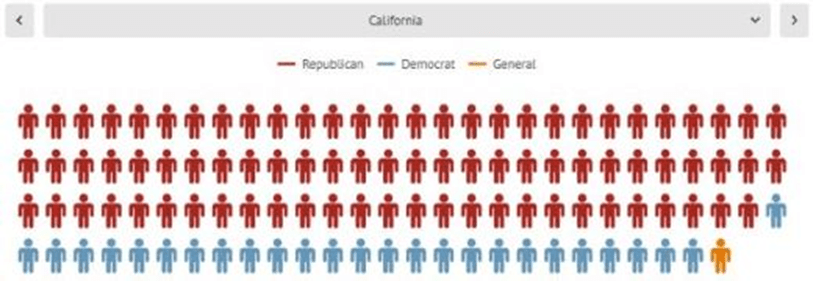
This chart show voting patterns of folks who migrated from California to Tennessee – kind of supports my feel that our own immigrants from California are more conservative than the Montanans they are becoming. In Montana, you don’t have to register as Repugnant or Dim.
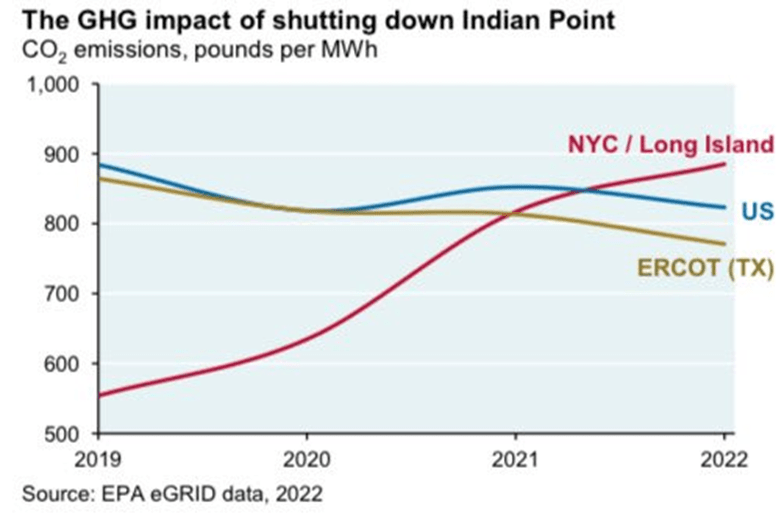
The environmental impact from closing the nuclear plants:
And, this chart from Canada gives an interesting perspective on who receives the benefits of protesting taxation:
-
by Wade Rathke, The Daily Yonder
May 19, 2016Rural electric cooperatives have a history dating back to Franklin Delano Roosevelt and the New Deal. Congressional action fueled by federal loans and grants enabled membership cooperatives to connect the “last mile” and bring electricity to almost all of rural American within the early years of their organization. The goals and principles of the cooperatives were idealistic, high-minded, and membership-based.
More than 75 years later, rural electric cooperatives in many areas where they operate are often a significant economic presence and employer with assets and sales throughout the South of billions dollars annually. The U.S. Department of Agriculture … sees the cooperatives as primary intermediaries for economic development and social services, and continues to invest loans and grants in the cooperatives accordingly as a fundamental component of the U.S. policy and program for rural Americans.
A look at the cooperatives today in the 12-state region of the South offers another picture entirely. There is too much evidence of democracy lost and discrimination found. Transparency is rare and too many rules and procedures are designed to maintain a status quo that seems more frozen in the 1950s before the advent of the civil rights and women’s rights’ movements in the South and nationally, than equipped to fairly service and deliver progress to all members of the cooperatives equitably.
The Rural Power Project, a joint project of Labor Neighbor Research and Training Center and ACORN International, examined all available records on all 313 cooperatives in the South. The project found that of the 3,051 supposedly democratically elected board members, 2,754 are men or 90.3% while 297 members are women or 9.7%. This figure is in spite of the fact that the gender distribution in South is 48.9% men and 51.1% women. Examining participation by African-Americans in the governing process of the cooperatives where information was available and verifiable, we found that 1,946 of the members were white or 95.3% throughout the South, while only 90 or 4.4% of the members were black. Of the more than 2,000 governing positions for which we had information, only six were Hispanic or 0.3% of the total. These figures compare to the fact that throughout the 12 Southern states, only 69.23% are white, while 22.32% are black, and 10.19% identify as Hispanic.
Half of the states (Arkansas, Florida, Kentucky, Louisiana, Mississippi, and Tennessee) had three or fewer African-American members with Louisiana and Kentucky having only one and Arkansas, Mississippi, and Tennessee having only two. Despite the fact that Florida counts almost one-quarter (24.1%) of its population as Hispanic and Texas has more than one-third (38.6%) of its population who are Hispanic, there was only one Hispanic board member in Florida and five in the entire state of Texas.
It matters. Not only because such undemocratic procedures and lack of representation invariably disempowers the very people who should be empowered by the cooperatives, but also because it raises questions about whether such radically unrepresentative leadership can possibly deliver jobs, loans, scholarships, and other opportunities equally without regard to race, gender, ethnicity and other reasons, when the leadership has been so committed to the opposite practice in the rules and procedures governing their own affairs and elections.
As the report shows, it also matters if members are elected who are willing to embrace energy conservation and move away from the predominant reliance on coal generation to supply rural electric cooperatives which continues to be the case.
Efforts over and over again throughout the history of the cooperatives in the South have tried to challenge these practices and lack of diversity but whether temporarily successful or soundly defeated, the record indicates that permanent reform has not been achieved or sustained. Meanwhile most cooperatives are allowed to be self-regulated without sufficient due diligence practiced by the USDA and its Rural Utilities Service arm, the Internal Revenue Service, or, for the most part, state utility regulators. The fiction of membership-control is overriding the facts of membership disempowerment.
The federal government needs to stop providing loans or grants without guarantees of full transparency and equal representation in both rules and reality for consumer-members in every Southern service area. States need to pass legislation like Colorado has done to guarantee transparency, end proxy voting, and provide access for participation to members. Congress and state legislators need to resist lobbyists and trade associations and protect cooperative members.
Wade Rathke is a community and labor organizer who founded Association of Community Organizations for Reform Now (ACORN). He is currently chief organizer of ACORN International. This article is excerpted from the report “Democracy Lost and Discrimination Found: The Crisis in Rural Electric Cooperatives in the South.”
This article first appeared on The Daily Yonder and is republished here under a Creative Commons license.

-
I’m looking at an article that pummels the dems “Kamunist” candidate for president and stresses that Harris’ father was a Marxist economist. Now communism in the US is as old as the bloody pilgrims at Plymouth colony – and that was over 20 years before Karl Marx.
The Plymouth Colony was founded on communism – look it up: Occupy Plymouth Colony: How A Failed Commune Led To Thanksgiving. The Pilgrims spent their first 2 ½ years operating on a charter that called for communal property and labor. They damned near all starved before the decision to ditch their communist roots and go for private property. Our nation didn’t start with a bunch of capitalists – Plymouth colony was communist to the core, and it took a couple of years of starvation to change their approach. Like I said – Look it up. The link is there to click – look it up. I’ll wait.
Karl, on the other hand, was a student of Capitalism. His life work- Das Kapital is three volumes that analyzed Capitalism – the first volume published in 1867, the final volume, after his death, in 1894. The Communist Manifesto was a pamphlet published in 1848. We think of Karl and remember the pamphlet while ignoring the quarter-century of work studying Capitalism that resulted in Das Kapital. We remember Marx for the 6 weeks of effort he put in (as a young man) writing a pamphlet, and ignore the quarter century he spent researching and writing on Capitalism.
Personally, I spent several years studying outmigration in America’s real communist culture – South Dakota’s Dariusleut Hutterites. Among the discoveries was a feeling that several colonies were so much on the edge that publishing more than the dissertation would have been irresponsible. The Hutterites are a truly communal people, living in a capitalist society, and without the religious aspect, their communism would not work. Even with the religious mandate their existence is a bit shaky. Still, among other pieces of knowledge I acquired was an understanding of communism – fair warning here: the “communism” practiced in China comes a lot closer to meeting the definition of fascism than it does communism. I don’t consider myself a great student of communism – but 10 years after my retirement, the dissertation continues to get academic citations.
Even with a religious component, the Pilgrims couldn’t make communism work – but their communal legacy continues to show political strength in Massachusetts.
Donald Harris delved into economics from a “Post-Keynesian” perspective. It does match Marx’ view of Capitalism -the system Marx studied will not, can not, provide equality of income and benefits, without government intervention. It may be a Post-Keynesian perspective, but it still shows Keynes’ fingerprints. It’s worth mentioning that Richard Nixon made some very Keynesian decisions back when he was a president.
It’s easy to be Marxist in either economics or sociology. In sociology, you can be called Marxist if you follow the social conflict paradigm . . . Karl pointed social conflict out at a time when most theorists followed the functionalist paradigm. In economics, just about any approach that includes government messing with the economy can show some Marxist roots.
-
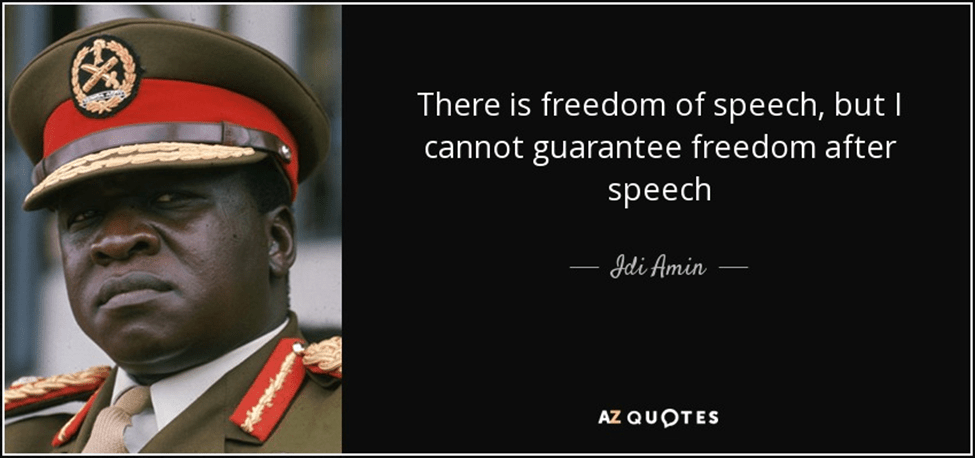
For the benefit of our younger readers, Idi Amin Dada was President of Uganda through most of the 1970’s. He did walk across the world stage – and here are some of his thoughts, presented to demonstrate that there could be a worse choice for President than we are watching this election.
I have to keep law and order and it means that I have to kill my enemies before they kill me.
It’s not for me. I tried human flesh and it’s too salty for my taste.
The problem with me is that I am fifty or one hundred years ahead of my time. My speed is very fast. Some ministers have had to drop out of my government because they could not keep up.
Sometimes people mistake the way I talk for what I am thinking.
My mission is to lead the country out of a bad situation of corruption, depression and slavery. After I rid the country of these vices, I will then organize and supervise a general election of a genuinely democratic civilian government.
In any country there must be people who have to die. They are the sacrifices any nation has to make to achieve law and order.
I propose getting rid of conventional armaments and replacing them with reasonably priced hydrogen bombs that will be distributed equally throughout the world.
I’m a good Muslim and I’m only interested in Islam.
I do not want to be controlled by any superpower. I myself consider myself the most powerful figure in the world, and that is why I do not let any superpower control me.

-
As our election approaches, the largest advertiser I see is Jon Tester. I’m tempted to rewrite that sentence, but it’s correct on so many aspects. A 2006 NY Times article describes him as ‘just under 300 pounds in his boots’. Open Secrets shows that his PAC has raised just under 43 million dollars – my rough math shows that to be somewhere on the close order of $40 bucks per Montanan. And I’ve just looked at this graph (and I saw it on a Canadian blog):

The ad that barrages me is that Sheehy wants to sell off public lands. I’ve seen the ad so often that I burned out on it – and then, a Kennedy-quality brain worm brought a simple question: What other asset does the US have that can pay off the national debt and preserve the dollar? It’s something like $268,000 per taxpayer. 35 trillion dollars and rising.
Jon Tester is a master of looking positive while funding the nastiest attack ads – and that’s probably what it takes to be a successful politician at his level. That 2006 NY Times article described the economics of his Big Sandy farm – not having made $20,000 a year. A senator’s salary is $174,000 per year, so it might be difficult to keep things up if he just went back to farming. But my thoughts run to paying off the national debt.
The graph shows that interest payments were under 3% when Jon was elected to the Senate, and in those ensuing 18 years, it’s gone up to about 4%. When Jon went to Washington, the National Debt was at 8 ½ trillion – now it’s 4 times that.
I’m a westerner. I like public lands. Tester’s ad resonated with me the first couple of times I saw it. After a dozen exposures, I came to the sad realization that Jon Tester and his associates in Congress, in irresponsible budgeting, have condemned our nation’s public lands to the auction block. That probably doesn’t bother congresscritters from New York or Rhode Island – but it does bother an old man who grew up with public land available. Term limits for our nation’s congresscritters can’t come soon enough – one term in Congress, then the next term in prison.
-
Read the whole thing – It looks like, in Kansas, for the time being, possession of machine guns is legal. I figure Judge Broomes is going to see some serious efforts at having his decision overruled at the circuit court level. Still, it is rather pleasant to see the second amendment treated as a serious right. Like Toto, I’m not in Kansas, so this doesn’t affect me – but the links are both worth clicking.
The ruling is available at uscourts.gov
“A Kansas US District Court judge has tossed an illegal machine gun possession charge on Second Amendment grounds. The court found that the machine guns in question are clearly “bearable arms,” and in this case at least, the government failed to show a historical tradition to justify their ban.
The court finds that the Second Amendment applies to the weapons charged because they are “bearable arms” within the original meaning of the amendment. The court further finds that the government has failed to establish that this nation’s tradition of gun regulation justifies the application of 18 USC § 922(0) to Defendant.
That’s the portion of the 1986 Firearm Owners Protection Act that outlaws civilian possession of machine guns.
District Judge John Broomes ruled that the the government failed to meet its burder under Bruen and Rahimi to show historical analogues for banning the kind of machine guns possessed by the defendant (a converted AR platform rifle and a GLOCK switch-equipped pistol). In fact, it doesn’t sound like they tried very hard.
Indeed, the government has barely tried to meet that burden. And the Supreme Court has indicated that the Bruen analysis is not merely a suggestion.”
L. Neil Smith would have approved. Personally, I was raised to be cheap with ammunition (I still have a partial box of 32 Specials left me from my grandfather, and he died 70 years ago). Believing in one shot, one hit leaves me far removed from wanting machine guns or bump stocks – but the present crop of court rulings is interesting.
-
From the Daily Wire ( Tim Walz’s Misleading Claims About Winning Teaching Awards ) comes this statement:
“Walz’s 2018 campaign website reportedly claimed he won the 2003 Minnesota Teacher of Excellence award, according to On The Issues, which cites the website. The website no longer exists, and instead redirects visitors to Vice President Kamala Harris’ main campaign website.
But Walz was never selected as a Minnesota Teacher of the Year recipient. A website for the award includes a list of past nominees – and Walz’s name does not appear.”
I’m not about to chime in on Walz’s military record – heck, Rodger Young was National Guard, and that’s enough to keep me from slamming anyone in the Guard. On the other hand, claiming a teaching award that I didn’t receive isn’t something I would take pride in.
Still, I think it might be part of the narcissism that it takes to run for high public office. I’ve received some minor accolades for teaching that I could have inflated over the years – except I generally worked with better teachers than I. Colleagues like Connie Malyevac at Libby, and Bob Mendelsohn and Ron Stiver at SDSU tend to keep me a little humble. Belay that – I’ve worked with teachers whose memories keep me a lot humble.
But they identified a new type of narcissist since I got my Masters – The Communal Narcissist: A New Kind of Narcissist? | Psychology Today describes them:
In a 2012 paper, Gebauer and colleagues proposed an agency-communion model, arguing that there are two types of narcissists: agentic narcissists (i.e. typical narcissists) and communal narcissists.3
The authors were not suggesting that some narcissists are highly cooperative and trustworthy. No, communal narcissists have grandiose self-related needs too. However, the authors proposed that communal narcissists differ from agentic ones in that they use communal means to meet those same grandiose needs.
To illustrate this difference, let us use an example to see how these two types of narcissists justify their sense of entitlement.
Imagine the case of a man who always expects his friends’ gatherings planned according to his availability and preferences—even though he rarely stays long and sometimes does not attend at all.
If he is an agentic narcissist (i.e. typical narcissist), he might justify the current state of affairs by saying “I deserve special treatment because I am exceptionally smart. I am an expert on almost any topic of conversation.”
A communal narcissist, however, may reason this way: “I deserve special treatment because I am extraordinarily warmhearted, trustworthy, and helpful; everyone feels at ease telling me all their problems.”
Looking at the description – the article includes much more – makes me wonder if this sort of narcissism isn’t more common in educators and politicians than the humdrum standard, run of the mill, everyday narcissist. The communal narcissism inventory Narcissism (16-item version) gives a choice between two paired statements to determine the level of narcissism. You can read through the pairs, and I won’t have to help describe which is which:
– When people compliment me I sometimes get embarrassed
– I know that I am good because everybody keeps telling me so– I prefer to blend in with the crowd
– I like to be the center of attention– I am no better or worse than most people
– I think I am a special person– I don’t mind following orders
– I like having authority over people– I don’t like it when I find myself manipulating people
– I find it easy to manipulate people– I usually get the respect that I deserve
– I insist upon getting the respect that is due me– I try not to be a show off
– I am apt to show off if I get the chance– Sometimes I am not sure of what I am doing
– I always know what I am doing– Sometimes I tell good stories
– Everybody likes to hear my stories– I like to do things for other people
– I expect a great deal from other people– It makes me uncomfortable to be the center of attention
– I really like to be the center of attention– Being an authority doesn’t mean that much to me
– People always seem to recognize my authority– I hope I am going to be successful
– I am going to be a great person– People sometimes believe what I tell them
– I can make anybody believe anything I want them to– There is a lot that I can learn from other people
– I am more capable than other people– I am much like everybody else
– I am an extraordinary personI’ve been a good teacher – but I’ve worked with great teachers. Makes it hard to inflate the small awards I have received. I would prefer to know that Tim Walz hadn’t inflated his awards . . . but it may just be part of the personality that you need to have if you’re willing to run for president or vice-president.
-
I note that the Dem candidate for VP has been called a Fudd. As I look at the pictures, there seems to be a distinct similarity. In Montana, the Dems have fielded a candidate for governor who claims to be a firearms expert. Two of the pictures below are campaign photographs. One is Elmer Fudd. There is a certain commonality to all.


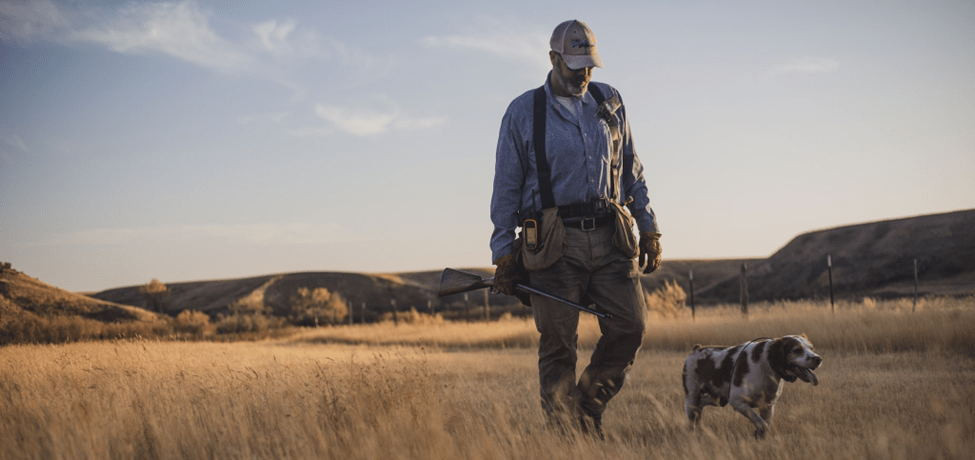
The bald head and the shotgun do seem to help show the similarity to Elmer on both candidates – and yet a career with Kimber, and 24 years as a weekend warrior artilleryman should have given each man a bit of credibility on guns.
P. O. Ackley – called America’s Gunsmith – started the gunsmithing program at Trinidad State. Ackley never accepted the classification as an expert. If Ackley wouldn’t call himself a firearms expert, I surely won’t claim the title – though I did test a rifle I had rechambered in a test chamber Ackley built 30 years before I arrived at TSJC.
So what’s a Fudd? The Urban Dictionary Urban Dictionary: Fudd definition is:
“Slang term for a “casual” gun owner; eg; a person who typically only owns guns for hunting or shotgun sports and does not truly believe in the true premise of the second amendment. These people also generally treat owners/users of so called “non sporting” firearms like handguns or semiautomatic rifles with unwarranted scorn or contempt.”
Reagan didn’t look like a Fudd in this picture, though the right hand ejection on an AR might be a bit hard for a lefty.


Want to tell us something or ask a question? Get in touch.

Recent Posts
- You Have To Beat Darwin Every Day
- Computer Repair by Mussolini
- Getting Alberta Oil to Market
- Parties On Economics
- Thus Spake Zarathustra – One More Time
- Suspenders
- You Haven’t Met All The People . . .
- Play Stupid Games, Win Stupid Prizes
- The Ballad of Lenin’s Tomb
- An Encounter With a Lawnmower Thief
- County Property Taxes
- A Big Loss in 2025

Rough Cut Lumber
Harvested as part of thinning to reduce fire danger.
$0.75 per board foot.
Call Mike (406-882-4835) or Sam (406-882-4597)
Popular Posts
Ask The Entomologist Bears Books Canada Census Community Decay Covid Covid-19 Data Deer Demography Education Elections Eureka Montana family Firearms Game Cameras Geese Government Guns History Inflation life Lincoln County Board of Health Lincoln County MT Lincoln Electric Cooperative Montana nature News Patches' Pieces Pest Control Politics Pond Recipe School School Board Snow Taxes travel Trego Trego Montana Trego School Weather Wildlife writing
 Trego's Mountain Ear