-
Let’s start this by going to the BATF to make sure I get the story straight: The Whiskey Rebellion | TTB: Alcohol and Tobacco Tax and Trade Bureau
As part of the compromises that led to the adoption of the United States Constitution in 1789, the new Federal government agreed to assume the Revolutionary War debts of the 13 States. In early 1791, to help pay off the resulting national debt, Congress used its new constitutional authority to “lay and collect Taxes, Duties, Imposts and Excises” and passed the first nationwide internal revenue tax—an excise tax on distilled spirits.[1] Congress took this action at the urging of the first Secretary of the Treasury, Alexander Hamilton.
Unlike tariffs paid on goods imported into the United States, the excise tax on distilled spirits was a direct tax on Americans who produced whiskey and other alcohol spirits. The 1791 excise law set a varying six to 18-cent per gallon tax rate, with smaller distillers often paying more than twice per gallon what larger producers paid. All payments had to be made in cash to the Federal revenue officer appointed for the distiller’s county.
Large, commercial distillers in the eastern United States generally accepted the new excise tax since they could pass its cost onto their cash-paying customers. However, most smaller producers west of the Appalachian and Allegheny Mountains, then the Nation’s frontier, opposed the “whiskey tax.”
Frustration on the Frontier
While eastern farmers could readily transport their grain to market, westerners faced the hard task of moving their crops great distances to the east over the mountains along poor dirt roads. Given this difficulty, many frontier farmers distilled their surplus grain into more easily transportable whiskey. In doing so, their grain became taxable distilled spirits under the 1791 excise law, and western farmers opposed what was, in effect, a tax on their main crop. Usually cash-poor, frontier residents also used whiskey to pay for the goods and services they needed. Naturally, many westerners quickly came to resent the new excise tax on their “currency.”
Other aspects of the excise law also caused concern. The law required all stills to be registered, and those cited for failure to pay the tax had to appear in distant Federal, rather than local, courts. In Pennsylvania, for example, the only Federal courthouse was in Philadelphia, some 300 miles away from the small frontier settlement of Pittsburgh. In addition, many were upset by what they saw as the National government’s inattention to continuing Indian attacks along the frontier and, with Spain’s control of New Orleans, westerners were frustrated with the failure of the Government to open the Mississippi River to free American trade.
Court Holds Federal Ban on Home-Distilling Exceeds Congress’ Enumerated Powers Yesterday, in Hobby Distillers Association v. Alcohol and Tobacco Tax and Trade Bureau, a federal district court in Texas held that federal laws banning distilled spirits plants (aka “stills”) in homes or dwellings exceed the scope of Congress’ enumerated powers. Specifically, the court concluded that the prohibitions exceed the scope of the federal taxing power and the Interstate Commerce Clause, even as supplemented by the Necessary and Proper Clause. The court further entered a permanent injunction barring enforcement of these provisions against those plaintiffs found to have standing (one individual and members of the Hobby Distillers Association.)
Now, back to the government’s story:
Despite the President’s plea and Congressional modification of the excise law, [3] violent opposition to the whiskey tax continued to grow over the next two years. This was especially true in the four counties of southwestern Pennsylvania —Allegheny, Fayette, Washington, and Westmoreland—the location of up to one-fourth of the Nation’s stills. In the summer of 1794, U.S. Marshal David Lennon arrived in the area to serve writs ordering those who had refused to pay the whiskey tax to appear in Federal court in Philadelphia. In Washington County, Federal revenue officer John Neville acted as Lennox ‘s guide. On July 15th, the two men served a writ on William Miller, but, after leaving the paper with the angry frontiersman, they were met by an armed group of his neighbors. A shot was heard as Lennox and Neville rode off, but neither man was injured.
Matters came to a head on July 16th when a group of angry farmers, including members of the extended Miller family, marched on Neville’s house in the belief that Marshal Lennox was there. Confronted by these armed men, Neville shot and killed Oliver Miller. A shootout ensued, and Neville’s slaves joined the fight by firing on the mob from their quarters. The protesters fled, but returned to Neville’s house on July 17th with a force of 500 local militiamen. The tax collector, however, had slipped away earlier with the aid of a small squad of Federal soldiers from Fort Pitt who had come to guard his property. A shootout with the soldiers left rebel leader James McFarlane dead, but the greatly outnumbered Federals later surrendered. The rebels then burnt the Neville’s house and barn to the ground. Several days later, David Bradford, deputy county attorney for Washington County, took command of the rebels in the county.
In the mean time, almost 13,000 militiamen had gathered at Carlisle, Pennsylvania, and prepared to march west to end the rebellion. On September 19, 1794, George Washington became the only sitting U.S. President to personally lead troops in the field when he led the militia on a nearly month-long march west over the Allegheny Mountains to the town of Bedford.
On September 25th, the President issued a proclamation declaring that he would not allow “a small portion of the United States [to] dictate to the whole union,” and called on all persons “not to abet, aid, or comfort the Insurgents.” [7] After leading the troops to Bedford, Washington returned to Philadelphia in late October and placed General Henry “Lighthorse” Lee, a Revolutionary War hero and governor of Virginia, in command. Washington left a letter with Lee with instructions to combat those “who may be found in arms in opposition to the National will and authority” and “to aid and support the civil Magistrate in bringing offenders to justice.” [8] Secretary of the Treasury Alexander Hamilton also remained with General Lee and the troops.
In late October 1794, the Federalized militia entered the western counties of Pennsylvania and sought out the whiskey rebels. By mid-November, the militia had arrested 150 rebels, including 20 prominent leaders of the insurrection. Under the President’s authority, General Lee issued a general pardon on November 29th for all those who taken part “in the wicked and unhappy tumults and disturbances lately existing” with the exception of 33 men named in the document. [9] While most of the militia returned home, a regiment occupied the area until the following spring, and organized opposition to the tax evaporated.
Of the whiskey rebels who were arrested, many were released due to a lack of evidence. Only a few men were tried and just two were convicted of treason. In July 1795, President Washington pardoned the two convicted men and those still in custody or under indictment. Several rebels sought for arrest fled the area, but most were later pardoned as well. President John Adams pardoned David Bradford, who escaped to Spanish-controlled New Orleans, in March 1799.
And now, we have a District Court explaining that the federal government is out of line when it taxes a man on his personal home-distilled whiskey. Since I am neither an attorney or historian, I’ll wait and watch to see how this new ruling is handled by the federal appeals court and my neighbors on Pinkham Creek – and that is a story we covered in a previous article.
-
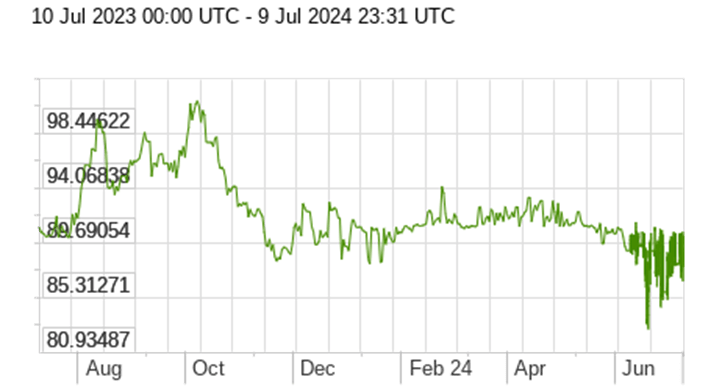
US Dollar against the Russian Ruble 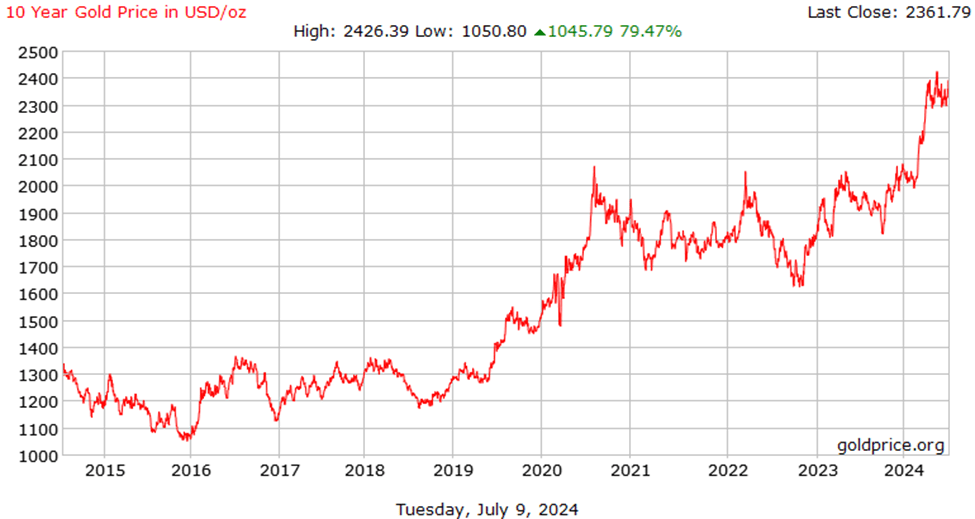
-
Our lawn has became a favored spot for wildlife – Gander has made the decision that it’s a good place for short flights of his gosling trainees – maybe 15 to 25 feet from takeoff to landing as they first begin to learn to fly from a running start. That’s the mornings for the youngest flocks – the older goslings are now into full flights to nearby lakes and return flights. It’s impressive to wander through the field and see how many of the seed heads they have harvested from the grass.
Evenings are becoming the domain of fawns – with the water from the Spring rains, the grass in the hayfield is too tall for good sporting runs by fawns, so the short grass on the lawn provides a better place for their cavorting – even if the doe would prefer they stay further from the house. Last night the twins’ run included the cat, who was fast, but not particularly pleased. While he did run from the fawns, he seemed to lack an appreciation for his inclusion as he went under the porch. The little dog barks at the vehicles stopping by the pond – one doe has left her fawn in the tall grass between the water and the pond, and the little fellow keeps stepping out onto the road. I appreciate the drivers who stop.
The cat’s specialty is voles. While I am thinking about setting out my vole bait stations, he seems to have made a real dent in their population. The voles take to the water like miniature muskrats, so I think part of the vole problem is that the pond provides a great habitat. The marsh hawk (Northern Harrier is the up-to-date name) also does his best for vole control. The hawk’s life is becoming easier as I mow the hayfield and reduce the vole’s cover.
-
During most of my lifetime, the Supreme Court has disagreed with me. I’m not quite a single issue guy, but I have often wondered just what part of ‘shall not be infringed’ is so hard to understand. Lately, I’ve been looking at a collection of legal minds that can understand ‘shall not be infringed.’
When I was young, there were billboards reading “Impeach Earl Warren.” Warren was a Republican – elected governor of California 3 times running – and when he ran for California Attorney General, he was both the Republican and the Democrat candidate. He won, too. As the Chief Justice of the Supreme Court, he managed to keep the civil rights decisions (notably Brown v Board of Education and Loving v. Virginia) unanimous, 9-0 decisions. I kind of liked Earl Warren, but not everyone did. Now I see Occasio-Cortez wanting to impeach Supreme Court justices. The John Birch folks were the ones who wanted to impeach Earl Warren.
There seems to be a majority who would term the Birchers “right wing wackos.’ Likewise, there are few in my neighborhood who would argue against AOC’s status as a “left wing wacko.” The problem is the left and the right have moved further from the center. Perhaps we need to simplify the terminology and just admit a wacko is a wacko. The extreme right and extreme left have more in common with each other than either has with moderate, middle-of-the road folks. Perhaps we need to recognize that more frequently.
I think we need the Supreme Court decisions – even if they don’t always go the way I prefer. Lately, they’ve been going as I prefer – it is nice to have a majority that read the second amendment similarly to the way I read it. The problem is that narrow decisions – the 5 to 4 sort – have a much better chance of being reversed years down the line than the 9 to 0 decisions.
I took an undergrad course in constitutional law – and the best I can say is that it taught me to read the opinions. It surely didn’t make me an expert. But socially, we need an institution that makes that call – and that’s the Supreme Court’s call. I may not always agree, but we need a place where the buck stops.
I pretty much support the Warren court’s decisions on civil rights – and admire the fact that they were mostly 9-0. AOC wants to impeach justices on a 6 – 3 call. Seems to me that if the decisions go along with what I want 80% of the time, they’re doing pretty well by me. Heck, even Ruth Bader Ginsberg didn’t like the reasoning in Roe v Wade.
-
Raymond Aron was a French sociologist who opposed all totalitarian governments. Here are some of his thoughts;
“In politics the choice is never between good and evil but between the preferable and the detestable.
Despotism has so often been established in the name of liberty that experience should warn us to judge parties by their practices rather than their preachings.
Communist interpretation is never wrong. Logicians will object in vain that a theory which exempts itself from all refutations escapes from the order of truth.
There is no correlation between the cause and the effect. The events reveal only an aleatory determination, connected not so much with the imperfection of our knowledge as with the structure of the human world.
Rational action is merely a question of calculating the chances.
What passes for optimism is most often the effect of an intellectual error.
Foreknowledge of the future makes it possible to manipulate both enemies and supporters.
Freedom is not the last word. Freedom is only part of the story and half of the truth. Freedom is but the negative aspect of the whole phenomenon whose positive aspect is responsibleness.
The essential vice, the utmost evil, is Pride. Unchastity, anger, greed, drunkenness, and all that, are mere fleabites in comparison. It was through Pride that the devil became the devil: Pride leads to every other vice: it is the complete anti-God state of mind.
The greatest danger for most of us is not that our aim is too high and we miss it, but that it is too low and we reach it.
Conventions are not rules; they are not absolute and unchanging. They are habits of the mind, widely shared. Therefore they can be changed; indeed, they should be changed when circumstances require.
Freedom and responsibility are inseparable. Whoever renounces freedom must give up responsibility as well. He who refuses it does not remain free; he escapes responsibility only to be crushed under a load of chains.
The very fact that there is a bureaucracy is an argument against its importance.
Politics is an art like any other. But with one essential difference: its operations must not be clouded by personal ambition. Its purpose is the public good, not private gain.
In a world of change, the clever survive, the bold prosper, and the ignorant flourish.
Ideas have consequences, and bad ideas have a high human cost.
The true measure of a man is not his intelligence or how high he rises in this freak establishment. No, the true measure of a man is this: how quickly can he respond to the needs of others and how much of himself he can give?
Democracy is less an ideology than a form of government. It is less concerned with what people ought to think than with how their rights can best be protected.”
-

The Orion capsule from NASA’s Artemis I mission splashes down. NASA via AP Marcos Fernandez Tous, University of North Dakota
For about 15 minutes on July 21, 1961, American astronaut Gus Grissom felt at the top of the world – and indeed he was.
Grissom crewed the Liberty Bell 7 mission, a ballistic test flight that launched him through the atmosphere from a rocket. During the test, he sat inside a small capsule and reached a peak of over 100 miles up before splashing down in the Atlantic Ocean.
A Navy ship, the USS Randolph, watched the successful end of the mission from a safe distance. Everything had gone according to plan, the controllers at Cape Canaveral were exultant, and Grissom knew he had just entered a VIP club as the second American astronaut in history.
Grissom remained inside his capsule and swayed on the gentle ocean waves. While he waited for a helicopter to take him onto the USS Randolph’s dry deck, he finished recording some flight data. But then, things took an unexpected turn.
An incorrect command in the capsule’s explosives system caused the hatch to pop out, which let water flow into the tiny space. Grissom had also forgotten to close a valve in his spacesuit, so water began to seep into his suit as he fought to stay afloat.
After a dramatic escape from the capsule, he struggled to keep his head above the surface while giving signals to the helicopter pilot that something had gone wrong. The helicopter managed to save him at the last instant.
Grissom’s near-death escape remains one of the most dramatic splashdowns in history. But splashing down into water remains one of the most common ways astronauts return to Earth. I am a professor of aerospace engineering who studies the mechanisms involved in these phenomena. Fortunately, most splashdowns are not quite that nerve-racking, at least on paper.
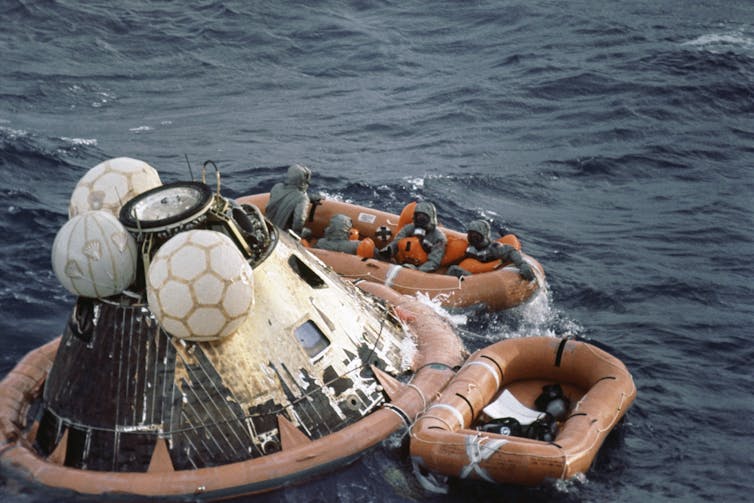
Navy personnel retrieve the crew from the Apollo 11 return capsule after splashdown on July 24, 1969. AP Photo/Barry Sweet Splashdown explained
Before it can perform a safe landing, a spacecraft returning to Earth needs to slow down. While it is careening back to Earth, a spacecraft has a lot of kinetic energy. Friction with the atmosphere introduces drag, which slows down the spacecraft. The friction converts the spacecraft’s kinetic energy to thermal energy, or heat.
All this heat radiates out into the surrounding air, which gets really, really hot. Since reentry velocities can be several times the speed of sound, the force of the air pushing back against the vehicle turns the vehicle’s surroundings into a scorching flow that’s about 2,700 degrees Fahrenheit (1,500 degrees Celsius). In the case of SpaceX’s massive Starship rocket, this temperature even reaches 3,000 degrees Fahrenheit (nearly 1,700 degrees Celsius).
Unfortunately, no matter how quickly this transfer happens, there’s still not enough time during reentry for the vehicle to slow down to a safe enough velocity not to crash. So, the engineers resort to other methods that can slow down a spacecraft during splashdown.
Parachutes are the first option. NASA typically uses designs with bright colors, such as orange, which make them easy to spot. They’re also huge, with diameters of over 100 feet, and each reentry vehicle usually uses more than one for the best stability.
The first parachutes deployed, called drag parachutes, eject when the vehicle’s velocity falls below about 2,300 feet per second (700 meters per second).
Even then, the rocket can’t crash against a hard surface. It needs to land somewhere that will cushion the impact. Researchers figured out early on that water makes an excellent shock absorber. Thus, splashdown was born. https://www.youtube.com/embed/E-Vd75Ptg9I?wmode=transparent&start=0 The Apollo 15 command module splashes down into the Pacific Ocean on Aug. 7, 1971.
Why water?
Water has a relatively low viscosity – that is, it deforms fast under stress – and it has a density much lower than hard rock. These two qualities make it ideal for landing spacecraft. But the other main reason water works so well is because it covers 70% of the planet’s surface, so the chances of hitting it are high when you’re falling from space.
The science behind splashdown is complex, as a long history proves.
In 1961, the U.S. conducted the first crewed splashdowns in history. These used Mercury reentry capsules.
These capsules had a roughly conical shape and fell with the base toward the water. The astronaut inside sat facing upward. The base absorbed most of the heat, so researchers designed a heat shield that boiled away as the capsule shot through the atmosphere.
As the capsule slowed and the friction reduced, the air got cooler, which made it able to absorb the excess heat on the vehicle, thereby cooling it down as well. At a sufficiently low speed, the parachutes would deploy.
Splashdown occurs at a velocity of about 80 feet per second (24 meters per second). It’s not exactly a smooth impact, but that’s slow enough for the capsule to thwack into the ocean and absorb shock from the impact without damaging its structure, its payload or any astronauts inside.
Following the Challenger loss in 1986, when the space shuttle Challenger broke apart shortly after liftoff, engineers started focusing their vehicle designs on what’s called the crashworthiness phenomena – or the degree of damage a craft takes after it hits a surface.
Now, all vehicles need to prove that they can offer a chance of survival on water after returning from space. Researchers build complex models, then test them with laboratory experiments to prove that the structure is sturdy enough to meet this requirement.
Onto the future
Between 2021 and June 2024, seven of SpaceX’s Dragon capsules performed flawless splashdowns on their return from the International Space Station.
On June 6, the most powerful rocket to date, SpaceX’s Starship, made a phenomenal vertical splashdown into the Indian Ocean. Its rocket boosters kept firing while approaching the surface, creating an extraordinary cloud of hissing steam surrounding the nozzles.
SpaceX has been using splashdowns to recover the Dragon capsules after launch, with no significant damage to their critical parts, so that it can recycle them for future missions. Unlocking this reusability will allow private companies to save millions of dollars in infrastructure and reduce mission costs. https://www.youtube.com/embed/CrkYmUoOMOQ?wmode=transparent&start=0 SpaceX’s Starship splashes down in a cloud of steam on June 6, 2024.
Splashdown continues to be the most common spacecraft reentry tactic, and with more space agencies and private companies shooting for the stars, we’re likely to see plenty more take place in the future.
This article has been updated to correct that SpaceX has been recovering their Dragon capsules during splashdown.
Marcos Fernandez Tous, Assistant Professor of Space Studies, University of North Dakota
This article is republished from The Conversation under a Creative Commons license. Read the original article.
-
Looking at Joe Biden’s senility challenges, I remember back to an earlier Joe who kept insisting that he was definitely smarter than the average bear (sorry, Yogi – I couldn’t resist the quote). Even to the point of challenging people to an IQ test to prove his intelligence. And it got me thinking about folks who think of themselves as “really smart.” And Donald Trump isn’t the only person who describes himself as “really smart.”
I’ve heard some sneer at “book smarts,” as if there is a difference between intelligence applied in the real world and in the academy. I’m not so sure – I have met quite a few who managed to get an advanced degree without possessing advanced intelligence – when I took the Graduate Record Exam I was seated alongside a woman who was taking it for the third time. She had to score at the 25th percentile to be admitted to a graduate program for which she had already completed all the coursework. If I recall correctly, the 25th percentile on the GRE correlated with an IQ of 90.
The military uses the ASVAB – Armed Service Vocational Aptitude Battery – to determine what training recruits may receive. The higher the score, the better the training opportunities.
The thing I’m getting at is that a lot of our opportunities can be limited by a low test score – whether it’s the GRE or the ASVAB – both correlate to IQ scores with fairly high reliability.
So far as correlating IQ with politics, Rinderman found that Brazilians who support Center-Right parties averaged about 105 on IQ, those who supported left or right parties averaged about 94. Both numbers are in the normal range. I recall reading a study that we tend to vote for candidates who are no more than a standard deviation above our own score (in IQ, figure that a standard deviation is 15 points).
Both Trump and Biden have made comments that show each believes himself to be in the “really smart” category. I’d feel better if each just took the same IQ test and released the score. Come to think of it, I’d like it better if everyone who laid claims to being “really smart” would provide the test results that verified the claim.
The rarity of high IQ scores?
158 One in 18,120 – statistically there should be one in Lincoln County
150 One in 2,330
145 One in 741
140 One in 261
135 One in 102
130 One in 44
125 One in 21
120 One in 11
115 One in 6
110 One in 4
Being “really smart” isn’t all that uncommon.
-
For eight years, I’ve watched Gander train his offspring for the Fall migration. He isn’t quite domestic, but he uses the floating dock to train the goslings to jump into the water before they can fly. I mow a walking trail around the ponds and channels, and he organizes goslings to follow him flapping their wings – I think this qualifies as ground school for lesser Canadian geese.
It’s July 3, and he has a new use for my lawn – mowed and relatively smooth, it is apparently well suited for short flights – eight or ten feet – that get off the ground and then land again. Flight school has started. This year he has about ten goslings of his own, and as the younger adults start bringing their hatches in with his, he will be leading a fairly large flight.
From this beginning flight, in a couple of weeks, they’ll be learning to fly in formation to Rattlebone lake, then longer trips in the neighborhood, and then, in the Fall, the large flock descending on the small pond so everyone knows where home is next Spring. It has been a good year for geese – the bald eagle has taken several, but not so many as last year.
The little Mallards have been hatching. They spend most of their time in the shallows, hidden by Reed canarygrass. They’ll replace the Canada geese for viewing in the last half of Summer.
Fawns continue to bed down in the tall grass of the hayfield. It’s wet enough from the Spring rains that they’ll have another 2 or 3 weeks growth on them by the time I start mowing hay.
-
In our Senate election, we may have a choice – Tim Sheehy has a position entry on fiscal responsibility, explaining that we need to “rein in out-of-control” government spending. He emphasizes that he can balance a checkbook.
I have hopes for Tim – but I have evidence that Jon Tester can balance a checkbook. I figure that if Jon had been as irresponsible with his own money as Congress has been with ours, he wouldn’t have a farm in Big Sandy anymore. If he spent his own funds with Congressional abandon, he’d be running with an address that read Park Bench, Missoula, Montana.
The problem is that it’s easy to spend other people’s money. If I vote for Sheehy, I’m voting for hope that he’ll keep that position on fiscal responsibility. At the lowest level of government – the school board – I have observed how much easier it is to spend other people’s money.
If the Senate election did not have the distinction of one candidate campaigning with a pledge toward fiscal responsibility, if it were just a choice of how “likable” each candidate is, I’d probably vote for Tester. We have a fair share of politicians that have come into Montana, and Jon Tester does have deeper roots in the state . . . but some of our finest Montanans came from other states. Granville Stuart, whose attitudes got him the title of Mister Montana, grew up in Iowa, and came to Montana after an extended tour in California. A lot of our California immigrants have turned out to be good Montanans. Anyway, I’ll be casting a ballot based on a single issue – fiscal responsibility. One candidate promises it – and I will vote with the hope that he lives up to that promise.
-
In general, I won’t make the effort to lie to a pollster. On the other hand, I just set the phone down after providing 100% dishonest answers to a robo-caller. And I’ll do it again when they call back.
I put the phone in the house for my convenience – not some polling group. Simply enough, I have a bum knee, and don’t like answering robo-callers. I like it less when the robo-caller phones 3 or 4 numbers at a time and doesn’t answer my hello – and I included caller ID for my convenience, too. The first call identified the caller as in Helena and got me to walk to the phone for a call they dropped. The second call asked me to stay on the line to answer political questions, and I replied “No.” and hung up the phone.
Then the third call came. Since these bastards lack courtesy and decency, the only way to get them to stop bothering me is to add inaccuracy to their product – in short, answer each question with a lie, making their product inaccurate and something no one would buy. Leave me alone and we’re fine. Keep bothering me and I’ll do my part to damage the quality of your product. If the only way to be left alone is to give answers that nudge your company toward bankruptcy, so be it. My leg hurts, I want to be left alone – but if you want answers, I’ll provide the answers that help make your product unmarketable.
This time I answered as a 35 to 40 year old American Indian female with a 2 year college degree, driving an electric car and making $200,000 per year. I thought Biden won the debate, and that Trump’s next spot needs to be prison in New York, and all congress critters should drive a Prius like Jon Tester.
I could go on – but you get the idea. Now, polls are set up to get a good approximation for a state the size of Montana with about 800 responses. The cheapest, rudest way to get those responses is a robo-caller. My untruthful responses aren’t enough to swing the needle on their survey. They can handle an error rate of 2 or 3%. On the other hand, if I can get 24 people to lie to these bastards when they call, we eat up their margin of error and leave them with an unmarketable product. If they can’t sell the results of their research, they’ll quit bothering people. Since they bother people, getting them to stop is a morally correct act.
So if I can get two dozen people to start lying to pollsters, we can change the world for the better. Wait for the call, then lie to the polls. It doesn’t take many of us to make their product unreliable – and once they earn the unreliable reputation, they’ll quit calling.

Want to tell us something or ask a question? Get in touch.

Recent Posts
- You Have To Beat Darwin Every Day
- Computer Repair by Mussolini
- Getting Alberta Oil to Market
- Parties On Economics
- Thus Spake Zarathustra – One More Time
- Suspenders
- You Haven’t Met All The People . . .
- Play Stupid Games, Win Stupid Prizes
- The Ballad of Lenin’s Tomb
- An Encounter With a Lawnmower Thief
- County Property Taxes
- A Big Loss in 2025

Rough Cut Lumber
Harvested as part of thinning to reduce fire danger.
$0.75 per board foot.
Call Mike (406-882-4835) or Sam (406-882-4597)
Popular Posts
Ask The Entomologist Bears Books Canada Census Community Decay Covid Covid-19 Data Deer Demography Education Elections Eureka Montana family Firearms Game Cameras Geese Government Guns History Inflation life Lincoln County Board of Health Lincoln County MT Lincoln Electric Cooperative Montana nature News Patches' Pieces Pest Control Politics Pond Recipe School School Board Snow Taxes travel Trego Trego Montana Trego School Weather Wildlife writing
 Trego's Mountain Ear