-

The National Oceanic and Atmospheric Administration (NOAA) is predicting above average temperatures for the entire continental US. For our area, it’s giving us a 50%-60% likelihood of above average temperatures. Additionally, they’re predicting below average precipitation, though with somewhat less confidence. In short: Hot and Dry.

-
by Donna Kallner, The Daily Yonder
June 14, 2024Right now, there aren’t many properties for sale in my area. That’s true in many rural places, although here there may be a few more high-end listings — retirement dream homes built by people now needing to move nearer to family, health care providers and other services. With few comparables, those properties may sit on the market for a while. But there are few listings that might be affordable for a first-time buyer. And those get snapped up quickly – often by non-residents as second homes.
Don’t think I don’t appreciate neighbors who chose this area for their retirement. They are vital to the local economy, as are non-resident vacation homeowners. And I can’t blame a seller for wanting to get top dollar from whoever can pay it. But rural communities are feeling ripple effects as the lack of affordable housing options impacts everything from tourism to agribusiness, school districts and health care providers. Finding solutions that don’t rely on winning lottery tickets and fairy godmothers won’t be easy. But we need to make room for younger people to live, work, raise families and build lives in our communities. And we need to do it soon.
In Wisconsin, the median age is 39.9. In Langlade County, it’s 48.6. In the Town of Wolf River where I live (population 643), the median age is 65.4. The median value of owner-occupied housing units, while lower than statewide, is about 25% higher than the county as a whole. The median household income, though, is only about 80% of the county’s and 60% of the state’s.
My generation may have faced higher interest rates when buying property as young adults (my husband bought on land contract at age 30 at 10%). But today’s young would-be buyers face challenges beyond interest rates and the limited inventory of properties.
That makes me even more grateful for the young people I know who have bought into the community in recent years. Let me introduce a few of them.
Three members of our volunteer fire department are military veterans in their 30s who grew up elsewhere but chose to settle here. For anyone who hasn’t heard, rural fire departments are facing a critical shortage of volunteers. The contributions of these and other younger members of our department benefit the community in many ways, including what we pay for homeowners insurance (yes, it could be higher). I’m also grateful that there are other people willing and able to respond so my 73-year-old husband no longer feels he should put on 45 pounds of firefighter PPE and possibly do an entry into a burning building.
One of those young men is now a deacon in his church. His wife works for the school district, and provides emergency child care for at least one fire department member who may need to drop off a kid before responding to a call.
Two of those young men are active in the local American Legion post, taking on leadership roles that Vietnam-era vets took on as World War II and Korean conflict vets aged. One is able to join the older vets on Monday mornings when they convene at the local coffee shop to tell stories and banter with the knitters.
The knitting group includes a young mother of three. She and her late husband hoped to homestead on property they bought here. Plans changed when he died, but she and the kids are still here. She’s the kind of neighbor who brings soup when you’re sick, duck eggs when she has a surplus, a pie for no reason at all. She’s the person I text with prayer requests and queries that start with, “If you’re going to town…”
The barista at that coffee shop and her husband recently bought a home here. They had been renting a place from his employer and were grateful for it. But they couldn’t have a dog there, let alone start a family. The place they bought was owned by people they knew who were moving out of the area when they snapped it up. She’s the kind of person who brings a regular customer a cookie when they come in slightly frazzled by the commotion of a roofing crew working at their place.
On a recent Monday, I asked other younger friends I saw at the coffee shop about their experiences buying property here. One couple had hoped to buy a farm, but even 15 years ago the price of farmland was prohibitively expensive. They were able to buy a home but are only able to pasture their grass-fed grass-finished beef elsewhere through a lease agreement. I’ve lost count of how many other fulltime and parttime jobs they also work, and still they find time to serve in local government. But farmland ownership is still out of reach for them and many others who once could have bought on land contract.
At one time, farms around here were big enough to whittle off a corner for the kids to build on. Even if they had jobs off the farm it was handy to have them close by. But there aren’t that many places left where that’s an option. And there’s another market for those that remain.
Amish and Mennonite families are moving into this area. They aren’t necessarily all planning futures as subsistence farmers. But I would be surprised if their communities didn’t buy land that can be divided into smaller holdings for growing families. In the meantime, the young men on the roofing crew working on my place will bring down the median age in the county. I doubt they will join the volunteer fire department or serve on the school board. But they will make other contributions – including paying taxes.
I can’t help but think we might learn some lessons from the elders in Amish and Mennonite communities about the importance of making it possible for young families to put down roots through home ownership. Because outside those communities, young people who want to buy without competing against higher-income retirees and second home buyers are not just watching real estate listings. They’re also watching the obituaries.
I’m not proud to admit it, but I do, too. Last winter when a neighbor died, I texted contact information to someone I know is looking for property – someone who would likely join the volunteer fire department here and be a huge asset if they are able to find something both affordable and eligible for a VA-backed home loan.
I hope not to be the subject of an obituary for some time yet. But while we’re above ground, we’re contributing to the lack of “churn” in the rural housing market that limits supply and degrades housing stock. The longer elderly residents like us (ouch) stay in our homes, the more likely those homes will need extensive maintenance and rehabilitation when they do make it to market. I can’t argue with that: If we had a reliable crystal ball that said re-roofing could wait until we both kicked the bucket, that’s exactly what we would have done.
But as a community, I don’t think we can afford to defer action on the rural housing shortage. So I am following the League of Wisconsin Municipalities More Wisconsin Housing initiative, hoping to find ideas that can make a difference in my rural community.
And if we do happen to hit it big with a lottery ticket or find a fairy godmother, I have big plans for buying property we could parcel off. Because I would love to have young first-time buyers find affordable housing in my neighborhood without having to die to make that possible.
Donna Kallner writes from Langlade County in rural northern Wisconsin.
This article first appeared on The Daily Yonder and is republished here under a Creative Commons license.

-
I was the county agent at the time – and I had a telephone call from a woman who wanted to give me part of the information I needed to solve the problem. A second voice cut in, “I know that boy. He’s not going to take the story to the papers!” I guess it’s flattering to be pushing 50 and be referred to as a boy.
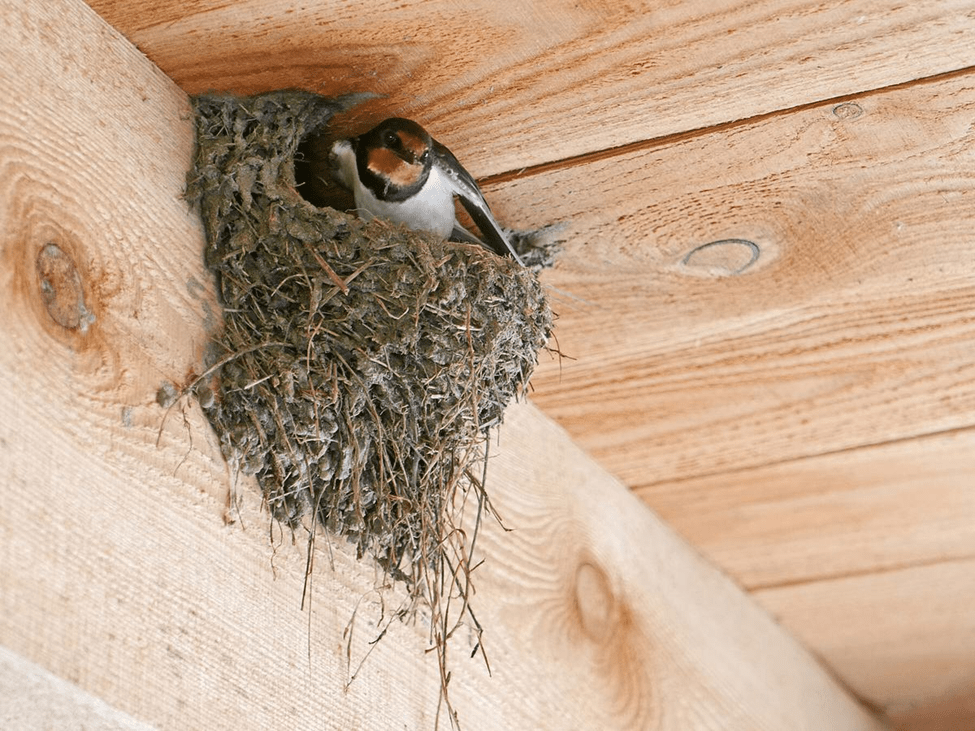
The woman taking care of Jeanette wanted information about bedbugs, but was protecting the old actress from the sort of publicity that might have occurred if it were known that she had bedbugs. As we talked, it became apparent that she didn’t have bedbugs – she probably had swallowbugs. They’re similar – but you don’t bring swallowbugs home from a motel visit. Swallows will deliver them to your rural home – particularly to your log home, or your natural looking home with board and batten siding.
Colorado’s Extension Service has published Bed Bug Lookalikes – Bat Bugs and Swallow Bugs in Colorado – 5.625 – Extension
It’s updated from the publication I shared a quarter-century ago – but it shows how to tell the differences between bed bugs and swallow bugs.
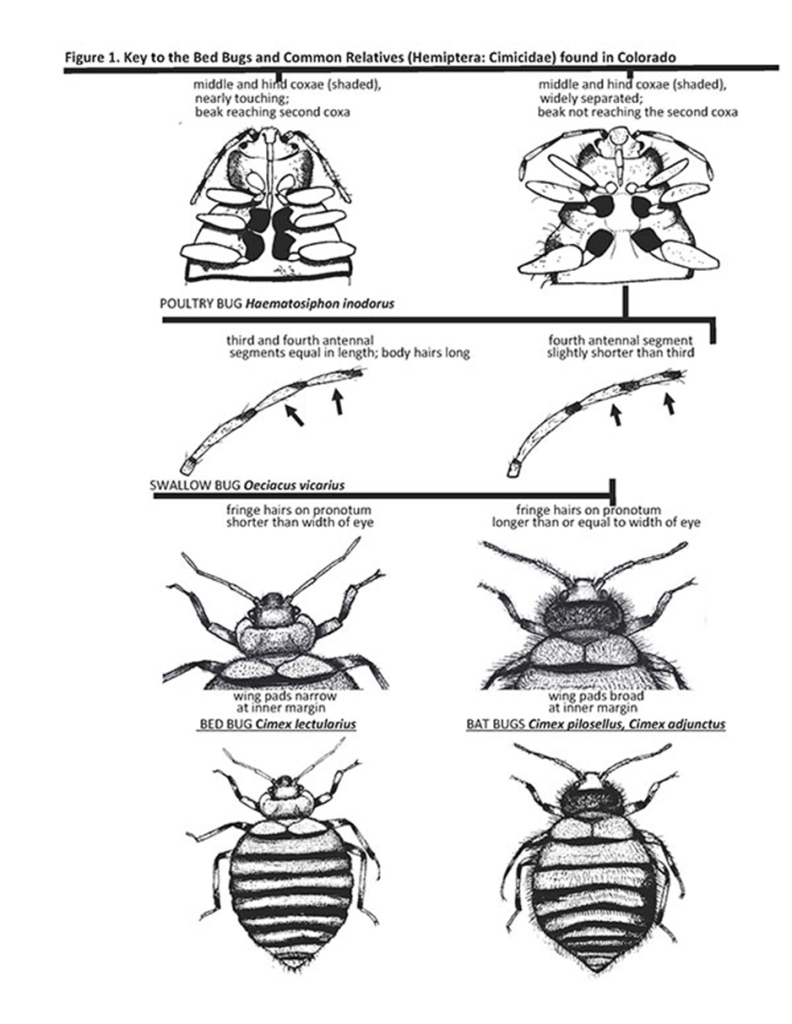
“Swallow bugs will readily bite humans. As with bed bugs, there are two periods of the year when bites will peak. One is in spring, shortly before migrant swallows return to nest on the building and the overwintered swallow bugs resume activity. Most survivors are adults and they are highly starved at this time, so they may aggressively seek alternate sources of a blood meal. Problems subside when the swallows are present and the swallow bugs migrate to the nest area. Swallow bugs will again be found more commonly within homes, and biting may occur, when the swallows abandon the nest.”
If you’re interested in the swallowbugs and batbugs that can impersonate bedbugs, click the link and download the whole publication. I really haven’t shared enough information to show how to control them – but mud nests under your eaves aren’t necessarily a good sign.
-
Editor’s Note: This seemed timely, so we’re running it again.
Why Did it Have to be … Guns?
by L. Neil Smith
lneil@lneilsmith.org
Over the past 30 years, I’ve been paid to write almost two million words, every one of which, sooner or later, came back to the issue of guns and gun-ownership. Naturally, I’ve thought about the issue a lot, and it has always determined the way I vote.
People accuse me of being a single-issue writer, a single- issue thinker, and a single- issue voter, but it isn’t true. What I’ve chosen, in a world where there’s never enough time and energy, is to focus on the one political issue which most clearly and unmistakably demonstrates what any politician—or political philosophy—is made of, right down to the creamy liquid center.
Make no mistake: all politicians—even those ostensibly on the side of guns and gun ownership—hate the issue and anyone, like me, who insists on bringing it up. They hate it because it’s an X-ray machine. It’s a Vulcan mind-meld. It’s the ultimate test to which any politician—or political philosophy—can be put.
If a politician isn’t perfectly comfortable with the idea of his average constituent, any man, woman, or responsible child, walking into a hardware store and paying cash—for any rifle, shotgun, handgun, machinegun, anything—without producing ID or signing one scrap of paper, he isn’t your friend no matter what he tells you.
If he isn’t genuinely enthusiastic about his average constituent stuffing that weapon into a purse or pocket or tucking it under a coat and walking home without asking anybody’s permission, he’s a four-flusher, no matter what he claims.
What his attitude—toward your ownership and use of weapons—conveys is his real attitude about you. And if he doesn’t trust you, then why in the name of John Moses Browning should you trust him?
If he doesn’t want you to have the means of defending your life, do you want him in a position to control it?
If he makes excuses about obeying a law he’s sworn to uphold and defend—the highest law of the land, the Bill of Rights—do you want to entrust him with anything?
If he ignores you, sneers at you, complains about you, or defames you, if he calls you names only he thinks are evil—like “Constitutionalist”—when you insist that he account for himself, hasn’t he betrayed his oath, isn’t he unfit to hold office, and doesn’t he really belong in jail?
Sure, these are all leading questions. They’re the questions that led me to the issue of guns and gun ownership as the clearest and most unmistakable demonstration of what any given politician—or political philosophy—is really made of.
He may lecture you about the dangerous weirdos out there who shouldn’t have a gun—but what does that have to do with you? Why in the name of John Moses Browning should you be made to suffer for the misdeeds of others? Didn’t you lay aside the infantile notion of group punishment when you left public school—or the military? Isn’t it an essentially European notion, anyway—Prussian, maybe—and certainly not what America was supposed to be all about?
And if there are dangerous weirdos out there, does it make sense to deprive you of the means of protecting yourself from them? Forget about those other people, those dangerous weirdos, this is about you, and it has been, all along.
Try it yourself: if a politician won’t trust you, why should you trust him? If he’s a man—and you’re not—what does his lack of trust tell you about his real attitude toward women? If “he” happens to be a woman, what makes her so perverse that she’s eager to render her fellow women helpless on the mean and seedy streets her policies helped create? Should you believe her when she says she wants to help you by imposing some infantile group health care program on you at the point of the kind of gun she doesn’t want you to have?
On the other hand—or the other party—should you believe anything politicians say who claim they stand for freedom, but drag their feet and make excuses about repealing limits on your right to own and carry weapons? What does this tell you about their real motives for ignoring voters and ramming through one infantile group trade agreement after another with other countries?
Makes voting simpler, doesn’t it? You don’t have to study every issue—health care, international trade—all you have to do is use this X-ray machine, this Vulcan mind-meld, to get beyond their empty words and find out how politicians really feel. About you. And that, of course, is why they hate it.
And that’s why I’m accused of being a single-issue writer, thinker, and voter.
But it isn’t true, is it?
“Permission to redistribute this article is herewith granted by the author—provided that it is reproduced unedited, in its entirety, and appropriate credit given.”L. Neil Smith passed away recently – for folks who are unfamiliar with his writings, many are available at https://lneilsmith.org/ It’s worth checking out. I’ve learned that few of these blogs live longer than a year past the author, and Neil Smith was worth reading.
-
Aging has its own epiphanies. Some come from having seen similar things happen before, and realizing that “Here it comes again.” But a greater breakthrough is a situation where you can begin to recognize the quiet courage that has been shown by people you didn’t recognize.
I’d like to write about Tommy Warren. In his career as a fireman, I’m certain Tommy had his dramatic occasions around flame – a certain level of calm courage is necessary when the most effective way to control a fire is for people to get close to it. But I never saw Tommy in that obvious, dramatic display of courage.
Instead, I saw Tommy as a man, no longer young, facing both physical and mental decline as he described his shrinking brain. People with Alzheimer’s generally live four to eight years after diagnosis. Tommy, with the diagnosis, left Trego in an attempt to live in the Bakersfield of his youthful successes – but found no place remaining there for an old man. He returned to Trego, where he had enjoyed his move into retirement, and hadn’t outlived his friends.
In the decline, his world also got smaller. The need for handrails increased. My aging Pomeranian looked forward to visiting Tommy – perhaps dogs are more able to appreciate people for what they were than what they are. Tommy quit driving. He no longer built pontoons. Boats and fishing were no longer there as favorite pastimes.
Instead of being central to the conversation, he held back, searching for the words that no longer came easily – still enjoying companionship, but taking a smaller role. Again, the little dog recognized his old friend Tommy, and the idea that you can’t find the right word never bothers a dog.
Tommy died after a fall. I recall him pressing hands on both walls to climb the stairs to my second story – so that he could see if the view matched my plans. Looking back, I realize his world was shrinking even then. You don’t notice the courage it takes to unflinchingly face a world that has less space for you every day – but Tommy showed it, enjoying the good parts that were left to him, sometimes standing aside, pained, as he searched for forgotten words that could contribute to a half-understood conversation. I suspect each of us knows someone who is going through the same loss to Alzheimer’s shrinking brain that Tommy had. And I suspect each goes through that same unnoticed courage until the loss of abilities overcomes the ability to cope.
-
We know the difference- one is a location with lots of sand and the other appears on your plate with lots of sugar. But why do we suffer with such disparate things which look and sound so similar when we read them?
Desert is French in origin. It comes from the French word for serve and the prefix des meaning undo/remove. So, the literal meaning is something along the lines of clearing the table of plates. Which makes good sense for what is typically a final course meal.
Dessert in the sense of the sandy unpleasant region is from Latin. The originating bit of Latin is desertum, which is the noun form of a verb meaning ‘forsake’. The sandy version was added in, and eventually became the main use of the word. The verb form has a similar origin, but goes from Latin to French before it reaches us.
The two words share a prefix, but despite how similar the rest of the word seems, the root of the words is actually different.
-
2-2-302. Appointment of relative to office of trust or emolument unlawful — exceptions — publication of notice. (1) Except as provided in subsection (2), it is unlawful for a person or member of any board, bureau, or commission or employee at the head of a department of this state or any political subdivision of this state to appoint to any position of trust or emolument any person related or connected by consanguinity within the fourth degree or by affinity within the second degree.
(2) The provisions of 2-2-303 and this section do not apply to:
(a) a sheriff in the appointment of a person as a cook or an attendant;
(b) school district trustees if all the trustees, with the exception of any trustee who is related to the person being appointed and who must abstain from voting for the appointment, approve the appointment of a person related to a trustee;
This is what happened Tuesday night, when Sam was selected as Trego’s District Clerk. I sat and abstained.
It was in the early nineties when I pointed out nepotism at Trego School to Mary Hudspeth, then county superintendent. Mary’s reply was that Trego’s clerk was the only one who completed the required reports perfectly, and that enforcing the anti nepotism law wasn’t worth dealing with screwed up reports. A low (like below sea level) attitude toward enforcing 2-2-301 lasted until Mary’s secretary, Nancy, retired as county treasurer twenty-odd years later.
Five years on the school board have taught me quite a bit – Mark Twain’s comment: “In the first place God made idiots. This was for practice. Then he made school boards.” came before the Office of Public Instruction was created. Over a century of legislation has changed things – the volunteer board has all the responsibility only when acting collectively. Serving on the board of a small school, without an administrator, shows that sometime in the past century, the concept of a school board without a hired school administrator became outdated.
So, instead of spending time on the school’s needs, my existential question has become simpler – to end any appearance of nepotism (a practice that spent years as part of Trego school) is it enough just to follow the law?
-
I think it was high school that set me on the path to libertarian thought. At 13, I encountered an environment that limited most of my time to other people’s activities. The hardest one to take was the mandatory pep rallies. Somehow, they always seemed to interrupt more pleasant activities.
I guess high school was really the closest I ever came to what Irving Goffman called a “Total Institution.” Other folks I have known have had more experience with total institutions – but a 1-Y deferment kept me from immersion in boot camp, and I never got so crossed up with the legal system to get familiar with the prison system.
Goffman viewed the total institution as having very established boundaries and being set up to change human behavior. Since I started high school at 13, I traveled on the bus, which took me to a campus in Eureka. As one grew older, a driver’s license and a set of wheels provided release from the confined area – but that didn’t occur for me, as the youngest of my class, until my junior year.
The definition of a total institution, taken from What Is a Total Institution? is “a closed social system in which life is organized by strict norms, rules, and schedules, and what happens within it is determined by a single authority whose will is carried out by staff who enforce the rules.” Kind of matches the description of my high school days. Get on the bus, transported to a confined location, and be controlled by a single authority. The difference between high school then and a real total institution is that you can go home at night.
When I started studying Goffman – a mainstay in symbolic interaction – I got to the point of trying to understand what they were trying to do with pep rallies. Still haven’t figured out why it was included, mandated, in my high school experience. The authorities must have thought that the pep rallies would resocialize me – since resocialization is part of what total institutions do.
I suppose students are supposed to be socialized into identifying with the school teams. I don’t see how that benefits them – and that gets me into libertarian thought. Folks who were trying to teach me what to think, what identity to hold, actually pushed me into valuing personal liberty.
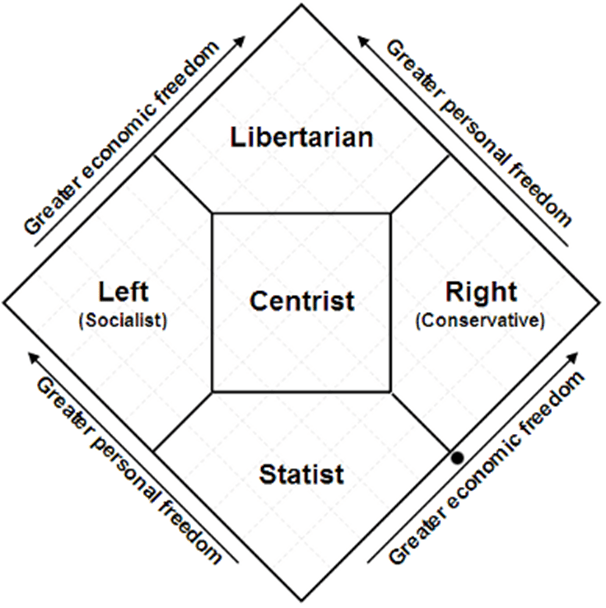
The problem is that it is easy to organize statists into political parties, while its a real challenge in finding a payoff for people who place independence as their highest value. And I think mandating my attendance at pep rallies put me on the road to libertarian views. So this chart may explain what I learned in high school (where they limited my personal freedom):
-
In wet years, the first mosquito bite usually brings the comment that the swallows aren’t doing their job. This has been a wet Spring, and I’ve received three mosquito bites so far – which is probably fewer than folks who see the pond would predict. The swallows really do a good job of mosquito control – though I’ve thought about building a bat house on the hill to share the task.
The reference I called up explains that 99% of a swallow’s diet is insects, and that they usually eat about 60 insects per hour. Generally speaking, they do a great job of mosquito control over the pond and hayfield, but don’t do so well in the woods. Here we get both barn swallows and tree swallows sharing the task. The difference is the tail:

Tree Swallow 
Barn Swallow The swallows that build lots of mud nests on buildings are Cliff Swallows – not particularly different from these guys, except that as winter comes, swallow bugs from those mud nests start moving into log homes and homes with board and batten siding – and swallow bugs look a lot like bed bugs. To be fair, if your barn swallow nests on your log or board and batten home, the bugs can come from their nests too – but they don’t nest in colonies. Swallowbugs can go through a year between feedings. And if they get into your house, you can be forgiven for mistaking them for bedbugs – but they’re a little smaller, usually grey, and you can see their antennae. There’s more to it than that, but that was my Extension Agent criteria to share with panicked homeowners. Swallowbugs in general aren’t much of a problem. Of course, neither are bedbugs as long as they live somewhere else.
-
I read a line from an old poem – “Utterly whelmed was I” and realized I had never read or heard the word ‘whelmed’ when it wasn’t part of ‘overwhelmed’ or ‘underwhelmed’. I found these 3 phrases online under the definition of whelm:
- To cover with water; submerge.
- To overwhelm.
- To cover with water or other fluid; to cover by immersion in something that envelops on all sides; to overwhelm; to ingulf.
Obviously, a word that was specific to being covered with a liquid has changed.
Another word, out of a history of the Napoleonic wars in Europe was ‘advert’ – a word I know from what appears to be its expansion ‘advertise’. The online dictionary gives the answer:
advert
- To turn the mind or attention; to refer; to take heed or notice; — with to.
“he adverted to what was said”
I can see how it relates to advertisement – but we have lost a powerful word sometime in the last couple of centuries. The online definitions went on to suggest that in England, the word advert is now becoming short for advertisement.
As I drove into the school parking lot the other day, a word that confused me 40 or more years ago came to mind as I saw a red Jeep parked in the lot. Years back I had been told to watch for “ an old heapdero by the turn.” When I got to the turn, I recognized the blend of English and Spanish that confused me – the Spanish J is pronounced as the English H, so the jeep was a heep. De simply means of, and rojo means red (and the second syllable was slurred). Consequently the heepdero was actually a jeep de rojo – a red jeep. Later I heard of a heep de azul – but that was easier to understand as a blue jeep.
Want to tell us something or ask a question? Get in touch.

Recent Posts
- You Have To Beat Darwin Every Day
- Computer Repair by Mussolini
- Getting Alberta Oil to Market
- Parties On Economics
- Thus Spake Zarathustra – One More Time
- Suspenders
- You Haven’t Met All The People . . .
- Play Stupid Games, Win Stupid Prizes
- The Ballad of Lenin’s Tomb
- An Encounter With a Lawnmower Thief
- County Property Taxes
- A Big Loss in 2025
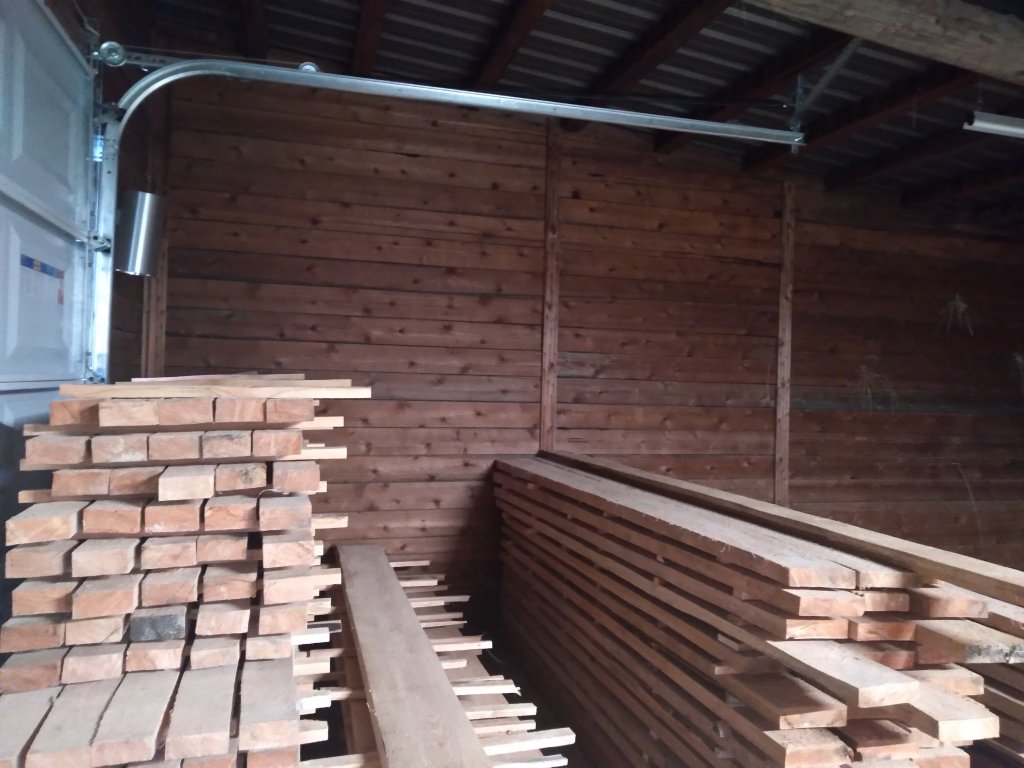
Rough Cut Lumber
Harvested as part of thinning to reduce fire danger.
$0.75 per board foot.
Call Mike (406-882-4835) or Sam (406-882-4597)
Popular Posts
Ask The Entomologist Bears Books Canada Census Community Decay Covid Covid-19 Data Deer Demography Education Elections Eureka Montana family Firearms Game Cameras Geese Government Guns History Inflation life Lincoln County Board of Health Lincoln County MT Lincoln Electric Cooperative Montana nature News Patches' Pieces Pest Control Politics Pond Recipe School School Board Snow Taxes travel Trego Trego Montana Trego School Weather Wildlife writing
 Trego's Mountain Ear