-
The board met Monday afternoon and the County Superintendent of Schools attended in order to swear in newly elected board members. Fawnette Richards was elected to a two year term by acclamation, and won with 98 votes. Clara Mae Crawford was elected to a three year term with 69 votes. There were 378 ballots sent out, 112 of which were returned. The majority of voters were not in favor of a four day school week.
While a voter turnout of slightly more than 20% seems poor, especially in a state that can expect 70-80% turnout in November of a presidential election year, it’s actually pretty good for a school board election. Nationally, 5-10% is much more typical for school board elections.
The organizational meeting began with the certifying of elections, then the swearing in of board members, followed by nominations for School Board Chair and Vice Chair. Board member Nancy Wilkins was appointed board chair, while Mark Spehar was nominated for Vice Chair. Mark accepted the position of vice chair, though he did so after voting against himself as vice chair (he had nominated former chair Clara Mae for the position of vice chair).
The board then proceeded with the approval of minutes, addressing a backlog of minutes, many of which needed corrections. After, there were various reports- bus repairs, school accreditation (going well- waiting to hear back), grant writing (Kelly Kiser is expecting to hear back in the fall about a $4,000 grant for the purchase of new library books), etc.
The meeting closed with interviews, which amusingly began with the board realizing that not all positions had actually been advertised officially, so that while interviews were possible, hiring definitely wasn’t.
-
by Sarah Melotte, The Daily Yonder
May 7, 2024A Daily Yonder analysis of Census data shows that rural Americans don’t have outsized voting power in the U.S. House of Representatives, despite an oft-repeated assertion that congressional apportionment gives rural voters undue influence.
If you have even a passing familiarity with political news this election year, you know that the rural voter has been a focal point of debates as stereotypes about bigotry, hatred, and taste for political violence fuel fears of a collapsing democracy. One popular talking point about rural voters is the insistence that rural voters wield too much political power in Congress and the Electoral College.
Leaving aside the Senate and Electoral College for the time being, let’s focus on the assertion that the average rural voter has more power in the House of Representatives than the average suburban or urban voter.
Using U.S. Census data, I found that rural voters don’t have that kind of advantage. And arguments that rural voters are more powerful than other geographic blocs rely on fuzzy definitions of what it means to be rural.
The Myth of Rural Malapportionment
Political scientists refer to unequal representation in Congress as malapportionment.
In its simplest form, equitable apportionment means that each congressional district should have roughly the same number of residents. In practice, the population size of congressional districts varies a bit because the Constitution says each state must have at least one representative, no matter its population. Apportionment must also account for fractional changes in population; you can’t assign half a representative to one district and 1.5 to another, even though that’s theoretically what is necessary to maintain perfect equity in apportionment.
So the voter in the district with the smallest population has more power at the ballot box than the voter in the largest congressional district. With fewer voters, each vote has a greater theoretical chance of affecting the results.
Take Delaware and Montana, for example. Because Delaware is a small state, it only has one congressional district. The population of that district, which is equivalent to the size of the state, is close to 1 million residents.
Montana, on the other hand, with a population of about 1.1 million, has two congressional districts, each of which has a smaller population than Delaware’s single congressional district. Montana’s first district is the smallest by population in the U.S., with about 542,100 residents. That’s about half the size of Delaware’s district, according to the latest U.S. congressional maps. Is it fair that Montana’s first district and Delaware both get one representative? Maybe not. But that problem has nothing to do with how rural or urban Montana is.
How Does the Census Define Rural?
Federal agencies use over a dozen definitions of rural. But at their core, those definitions are generally variations on two predominant categorization systems — one, the OMB’s Metropolitan Statistical Area, which goes down to the county level, and two, the Census definition, which is based primarily on population density. The Census definition subdivides counties down to the census block level, meaning that parts of a county may be rural and other parts urban.
The Census Bureau uses the smallest scale at which we can measure rurality. The census block is about the size of a neighborhood block. The Census definitions, which were revised for the 2020 census, says census blocks with a population of 5,000 residents or 2,000 housing units are urban. Everywhere that is not urban is rural. Using the Census definition, these rural places can range anywhere from an uninhabited desert to a small community.
Because the census definition of rural is the most granular definition available, it captures more detail than other measures. It’s also one of the more generous estimates of rurality that exist, biasing estimates in favor of rural malapportionment.
Given Montana’s frontier history, cowboy culture, and wilderness areas, it might come as a surprise that the majority of residents in Montana’s first district aren’t even rural, according to the Census definition, which is based on population and housing density at the block level. There might be a lot of wide open spaces in Montana, but that doesn’t mean that the majority of the state’s residents live in the most remote corners of it.
Just over half of the residents in Montana’s first district live in metropolitan areas, like the small city of Billings. Notice that we start running into problems when we conflate small population sizes with rurality.
Rhode Island’s first district is another good example. Within the borders of this district is about half of the capital city of Providence and other small cities like Pawtucket and Newport. With a population of 548,000 residents, Rhode Island’s first district is the third smallest district in the country, but only about 2.5% of residents in this district live in a Census-defined rural community.
!function(){“use strict”;window.addEventListener(“message”,(function(a){if(void 0!==a.data[“datawrapper-height”]){var e=document.querySelectorAll(“iframe”);for(var t in a.data[“datawrapper-height”])for(var r=0;r
So, where do the majority of rural voters live, if not in the nation’s smallest (overrepresented) districts?
The majority of rural voters live in districts composed primarily of urban and suburban voters. Only about 28% of rural voters live in a district where over half of the population in the district is also rural. That means that 72% of rural voters live in urban or suburban districts. And only 10% of districts are majority rural.
Not All Definitions of Rural Were Created Equal
I’ve been referring to the Census definition of rurality for this analysis so far. But there isn’t one right definition of rural.
In their book on rural voters, Tom Schaller and Paul Waldman say that rural voters hold outsized political power in the House of Representatives by controlling more than their fair share of house seats.
Waldman and Schaller use the Congressional Density Index, or the CDI, to define rural, which is based on population density at the census tract level. (Census tracts are larger in area than blocks, and they can vary widely in size.)
The CDI first categorizes census tracts by population density, then places those tracts into congressional districts that are given one of the following labels: pure rural, rural-suburban mix, sparse suburban, dense suburban, urban-suburban, and pure urban.
The CDI is a widely used index, and journalists refer to it for all kinds of congressional analyses. It might be helpful to understand how population density predicts voting patterns, but it’s just not a good way to describe rurality. To illustrate, let’s take a look at some of the districts in the CDI’s pure rural category.
(Note that the CDI was created in 2018 and is based on congressional maps from that year, not the current maps.)
One of the most egregious examples in the CDI’s pure rural category is New Mexico’s third district, which includes the entire city of Sante Fe, Farmington, and most of Rio Rancho. According to the Census, however, only 34% of this district is rural.
Another one of the CDI’s pure rural districts is North Carolina’s eighth, which includes half of the city of Fayetteville and the northeastern suburbs of Charlotte, among other smaller metropolitan areas. This district is only 33% rural according to the Census definition.
The average pure rural category in the CDI is only 53% rural according to the Census, but it contains districts that are up to 78% urban. Geographers don’t always agree on what definition of rural is best, but in what universe is a 78% urban district purely rural?
Flipping a Myth on Its Head
The CDI definition of rural distorts the reality of congressional representation because it inflates the number of districts controlled by rural voters. Under the CDI system, 42% of districts are either pure rural or a rural-suburban mix, something that Waldman and Schaller point out in their book. Compare that number to the 10% of districts that are rural based on the Census definition.
Look at it this way. If rural Americans make up 20% of the population, but only 10% of districts are majority rural, that would seem to suggest that the rural vote is actually diluted by the votes of their urban and suburban neighbors. That flips the myth of rural malapportionment on its head.
How can a rural minority, whose vote is further diluted by urban and suburban voters, dominate the House of Representatives and pose an existential threat to American democracy?
Similar myths about rural representation are also abundant in malapportionment conversations about the Senate and the Electoral College. Subscribe to our newsletter, “The Latest from the Daily Yonder,” to stay tuned for our upcoming analyses of rurality in the Senate and Electoral College.
Daily Yonder reporter Sarah Melotte lives in Western North Carolina and focuses on data reporting.
This article first appeared on The Daily Yonder and is republished here under a Creative Commons license.

-
There’s a slowdown in the traffic by the pond. I think we’re on the fifth hatch of goslings, and it reminds me that, while I may pay the taxes, the ponds are actually owned by the ducks and geese. It looks like there have been five successful hatches so far, and the customary travel speeds are slowing down to watch the geese and ducks.
There are a couple of interesting things to watch for. One is a little diving duck with a single duckling. Since both dive, it takes some time to actually find them in a mother-duckling pose. Mother duck has a lot of white on her, and if you want to watch the pair it might be better to come to a complete stop – duckling has good lungs and can stay under water quite a while already.
One of the goslings is Daddy’s baby – this is in one of the large broods . . . I think the total is eight. Most of the time there are seven little ones between goose and gander, and the eighth little one seems to be hanging out more with the gander. Imprinting, I suppose – but it has made it hard to get a count. There is still one goose nesting on the island, so I anticipate a sixth hatch soon.
The turtles are showing up most where the circle pond intersects with the drainage channel. The smallest is about half-again the size of a silver dollar, while the large ones make it up to the size of a plate. We’ve seen one that seems too large for the painted turtles we usually watch, so I’m wondering if we have a migrant, or a strange turtle that someone has rehomed. As slow as turtles are reputed to be, on a warm Spring day they’re still faster than an old man.
The first Hummingbird of Spring is wandering around the house – it seems to know full well that all houses are equipped with feeders and that we’re negligent in not having one up yet. The swallows have returned, taking up their essential role in keeping the area around the house and pond mosquito free.
Drive carefully – and if you stop to watch the little ducks and geese, we’re happy that we’re not the only folks who enjoy them.
-
I glanced at Viking pundit this morning and read: “Social Security Has About One Decade Left.”
“That is, about ten years from now, the automatic benefit cuts kick in leading to a reduction of 21% in promised benefits.”
The linked article is at a site called Hot Air, so I make no representations about the quality of the data or the need for concern. Hot Air refers to an article at NPR: Congress has less than a decade to fix Social Security before it runs short of cash by Scott Horsley. It’s a 2 minute listen.
It isn’t surprising.
“SCOTT HORSLEY, BYLINE: The annual checkup on Social Security’s finances actually offers some good news. Thanks to workers’ higher productivity and a drop in disabilities, the popular program isn’t burning through cash quite as fast as trustees expected a year ago. But that only delays the inevitable. With tens of millions of baby boomers retiring and starting to draw benefits, and fewer people in the workforce paying taxes for each retiree, Social Security is expected to run short of cash in just over nine years. If that happens, almost 60 million retirees and their families would automatically see their benefits cut by 21%.”
Social Security wasn’t started as some Ponzi scheme – it was based on good actuarial and demographic principles. According to Life Expectancy for Social Security, “ Life expectancy at birth in 1930 was indeed only 58 for men and 62 for women, and the retirement age was 65.” The article goes on to explain that the important thing wasn’t life expectancy at birth, but life expectancy at 21. This chart, based on life expectancy at 21, shows the expectations when social security was created in 1935.
Year Cohort Turned 65 Percentage of Population Surviving from Age 21 to Age 65 Average Remaining Life Expectancy for Those Surviving to Age 65 Male Female Male Female 1940
1950
1960
1970
1980
199053.9
56.2
60.1
63.7
67.8
72.360.6
65.5
71.3
76.9
80.9
83.612.7
13.1
13.2
13.8
14.6
15.314.7
16.2
17.4
18.6
19.1
19.6The problem is that each year, more people have survived to retirement age, and then, to compound the issue, they have lived longer. Even so, the old guys who did the calculations wound up with unanticipated additions to the system – in 1939, the program was expanded to cover survivors and dependents, and in 1956, another mission creep led to disability coverage for workers over 50 and disabled adult children. In 1960, the rules were changed to cover disabled workers of any age and their dependents. Supplemental Social Security was added in 1972.
All told, those civil service employees back in the thirties did a great job with the actuarial and demographic tools at hand. I can’t necessarily say the same for the congresscritters and senators who have followed them
-
Nothing in the world is more dangerous than sincere ignorance and
conscientious stupidity. -Martin Luther King, Jr.Stupidity consists in wanting to reach conclusions. We are a thread, and we want to know the whole cloth. -Gustave Flaubert
Never underestimate the power of stupid people in large groups. -George Carlin
Only two things are infinite, the universe and human stupidity, and I’m not sure about the former. -Albert Einstein
Albrecht’s Law – Intelligent people, when assembled into an organization, will tend toward collective stupidity. -Karl Albrecht
Stupidity is far more dangerous than evil, for evil takes a break from time to time, stupidity does not. -Anatole France
Stupidity makes you dangerous-to yourself and everyone around you. -Jennifer Lee Carrell
Life is tough, but it’s tougher when you’re stupid. -John Wayne
Earth has its boundaries, but human stupidity is limitless. -Gustave Flaubert
In view of the fact that God limited the intelligence of man, it seems unfair that He did not also limit his stupidity. -Konrad AdenauerAnyway, no drug, not even alcohol, causes the fundamental ills of society. If we’re looking for the source of our troubles, we shouldn’t test people for drugs, we should test them for stupidity, ignorance, greed and love of power. -P. J. O’Rourke
In politics stupidity is not a handicap. -Napoleon Bonaparte
Stupidity is a blockage in the ability to receive, integrate and transmit new signals. -Robert Anton Wilson
If you pretend to be good, the world takes you very seriously. If you pretend to be bad, it doesn’t. Such is the astounding stupidity of optimism. -Oscar Wilde
Ours may become the first civilization destroyed, not by the power of our enemies, but by the ignorance of our teachers and the dangerous nonsense they are teaching our children. In an age of artificial intelligence, they are creating artificial stupidity. -Thomas Sowell
One man alone can be pretty dumb sometimes, but for real bona fide stupidity, there ain’t nothing can beat teamwork. -Edward Abbey
The only way to comprehend what mathematicians mean by Infinity is to contemplate the extent of human stupidity. -Voltaire
Never attribute to malice that which can be adequately explained by stupidity. Never underestimate the power of human stupidity. -Robert A. Heinlein
-
An article in the National Library of Medicine assures me that 65% of Americans ( https://www.ncbi.nlm.nih.gov/pmc/articles/PMC6029792/ ) “65% of Americans believe they are above average in intelligence: Results of two nationally representative surveys”
Business insider had another sub-headline: “AAA released a study showing that 8 of 10 men think they’re above-average drivers.”
As I age, I’m more willing to face a few realities – my strength is not what it once was. My reflexes aren’t as quick as they once were. It’s hard to face my own physical decline and then look at numbers that show more than half of the folks in my world figure that they’re above average.
Intelligence is an easy thing to check – ask the survey question, then give the test. The test is set up so that the median and the mean are the same. Basically 50% are above average, and 50% are below. It’s that simple. And 65% thinking that they’re above average really isn’t that far off – the 65%/35% cutoff is somewhere between 94 and 95 IQ – very solidly in the normal range.
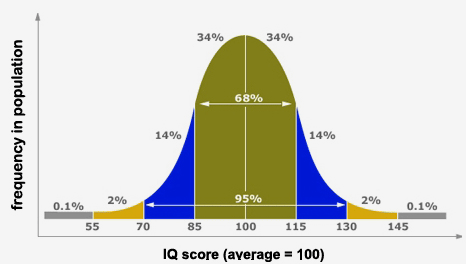
“Despite the fact that more than 90% of crashes involve human error, three-quarters (73 percent) of US drivers consider themselves better-than-average drivers. Men, in particular, are confident in their driving skills with 8 in 10 considering their driving skills better than average.”
businessinsider.comDriving ability is probably a little harder to analyze. I’m probably above average on snow and ice – particularly if we do the test in Florida or Texas. Still, I’d feel a lot safer on the road if 80% of the folks who shared it with me really were above average. Still, I had a blepharoplasty a few years back – in my case it was plastic surgery to correct blind spots caused by sagging eyelids. After the surgery I no longer asked myself “Where did that SOB come from?” It doesn’t take much to reduce your driving ability.
I recall a retarded guy I met on a bus – he made a living from his bus pass. The job was driving used cars from one dealership where the model wasn’t moving to another where they were. I am certain that he was probably an above average driver despite being below average on intelligence.
-
It was essentially a well organized public board meeting. Casey Fuson facilitated the meeting with a powerpoint and did a wonderful job of providing the public with updates on the New Law HB 203, which will obligate districts to charge tuition for out of district students. The current estimate is that this will require Trego to send around $12,000 to other districts.
The meeting also provided some explanation of how school taxes work (mostly, they go to Helena and we get a smaller portion of them back). The public was reminded that our taxes are lower than those of our neighboring districts (the railroad provides significantly less of our school’s tax base than it once did, but it still provides about a third of district funding). As a consequence, even if the board does pass a permissive levy to cover the tuition it will pay as a result of HB 203, taxes will remain lower than neighboring districts. The continued operation of Trego School does keep school taxes lower for Trego residents.
Casey also provided information about Early Childhood Education. There’s ongoing work to expand the current transitional kindergarten program, and grant writing in progress to support creating a preschool that will operate within the school. The preschool will be operated by a nonprofit board, entirely separate from the school board.
Mark Spehar spoke briefly about programs the school is hoping to implement in the future: Weapons safety, Archery, 4-H, and Outdoor Education.
There was a brief discussion of the upcoming election. Current Board Chair Clara Mae (running for reelection) lamented the number of ballots she observed in the post office trash. It will be interesting to see how many ballots are returned.
The meeting also included a call for volunteers. The district has a volunteer packet that interested folks can pick up, and requires background checks for volunteers.
Casey provided a balanced overview of the benefits and costs of a four day school week, and public opinions of those present were mixed. There was no feedback for the board on meeting times, which will remain at 4:30 on the second and fourth Mondays. Nancy Wilkins expressed that the board hopes eventually to return to having a single meeting a month.
The meeting itself was rather poorly attended, though the folks present were engaged, asking questions throughout, and offering suggestions. There were no school-age children present, and only one parent of a school-age child.
-
Not many years ago, if you were faced with a cluster of unacceptable clowns on your ballot, you could write a name in and cast a protest vote. Hell, I guess you still can – the thing is, your write-in protest vote won’t be counted or reported. With the elimination of subsection 7 last year, the last remaining method of voting against an unopposed, unacceptable candidate was taken away.
Time was when we laughed about unopposed Soviet candidates being elected with no votes for the opponent. We’re at that same stage now. When the next primary comes out, we’ll be faced with a bunch of zero choice positions.
P.J. O’Rourke wrote “Don’t Vote – It Only Encourages the Bastards.” He may have been Prescient. Our current system mandates that, in order to run for office, you must pay filing fees based on this schedule:
From How to run for office in Montana – Ballotpedia
Filing fees Office sought How the fee is determined For offices earning an annual salary of $2,500 or less and members of the state legislature $15 For offices (except county-level) earning an annual salary of more than $2,500 1% of salary For offices in which compensation is paid in fees $10 By keeping the filing fee at $15 for state legislature, they – it’s more polite than O’Rourke’s tag (The Bastards) state representatives and senators don’t have to face the fact that our filing fees keep a lot of people out of the running.
Montana County Elected Official Salary Survey shows the salaries of elected officials in most Montana counties. It’s a year old, but I don’t have any better source to cover the state. In Lincoln County, you can get the current salaries here.
Probably the most interest is for the County Commissioner at $64,232.94 – so the 1% filing fee is a bit higher than $642. It’s the same for sheriff – and the rest of the full-time elected positions are $62,232.94. (This is the base salary, commissioners and sheriff get $2,000 more.
We could go on to elected state positions – but that’s for a future issue.
It’s expensive just to file for these positions. Write-in votes are no longer counted . . . so it is no longer possible to vote against a single candidate that you find unacceptable. If you vote for him or her, it only encourages the bastards. Worse, it discourages the folks who might run against them.
Since the bastards have made it impossible to vote against an unopposed and unacceptable candidate, they have made voting less effective. Our elections are essentially the same as the Soviet system we once mocked. Still, the bastards have left us an alternative, and it’s a simple exercise in Irish democracy:
If a candidate is unopposed, don’t mark that part of the ballot. The unopposed candidate is going to win the election – so make him or her or it win with the smallest number of votes possible. It won’t be possible to make the courthouse clique candidates win with single digit numbers – I’ll get into the socially constructed reality of the courthouse and the annex later – but it would be a beautiful protest if the county treasurer or clerk won re-election with less than half of the ballots cast. That would encourage the opposition.
P.J. O’Rourke was right. They have screwed with the elections so much that voting can only Encourage the Bastards. He didn’t take it far enough – if enough of us leave the boxes next to the unopposed candidates unfilled, it will encourage opponents. The first step in getting the vote back is remembering P.J. – Don’t Vote – It Only Encourages the Bastards. But don’t forget to cast your ballot!
-
Whether as a public employee or an elected official, I’ve always thought I should be as careful with public funds as I am with my own wallet. That may not translate – heck, I know it doesn’t translate – the same way I mean it to everyone. Davy Crockett may have described the problem in 1828 – the Congressional records show that he made comments on the topic that year – but a verbatim transcript isn’t available. According to an article accessed at radicalreference, “All evidence points to the Bunce/”Not Yours to Give” story as a fabrication – as are so many tales about Crockett, including many he told himself.”
Despite that, I found Crockett’s excellent, though non-existent, speech at explorersfoundation It’s worth reading, even if Davy Crockett never said it.
Bunce may, or may not have existed. According to the non-existent speech, Bunce said: ‘It is not the amount, Colonel, that I complain of; it is the principle. In the first place, the government ought to have in the Treasury no more than enough for its legitimate purposes. But that has nothing to do with the question. The power of collecting and disbursing money at pleasure is the most dangerous power that can be entrusted to man, particularly under our system of collecting revenue by a tariff, which reaches every man in the country, no matter how poor he may be, and the poorer he is the more he pays in proportion to his means. What is worse, it presses upon him without his knowledge where the weight centers, for there is not a man in the United States who can ever guess how much he pays to the government. So you see, that while you are contributing to relieve one, you are drawing it from thousands who are even worse off than he. If you had the right to give anything, the amount was simply a matter of discretion with you, and you had as much right to give $20,000,000 as $20,000. If you have the right to give to one, you have the right to give to all; and, as the Constitution neither defines charity nor stipulates the amount, you are at liberty to give to any and everything which you may believe, or profess to believe, is a charity, and to any amount you may think proper. You will very easily perceive what a wide door this would open for fraud and corruption and favoritism, on the one hand, and for robbing the people on the other. No, Colonel, Congress has no right to give charity. Individual members may give as much of their own money as they please, but they have no right to touch a dollar of the public money for that purpose. If twice as many houses had been burned in this county as in Georgetown, neither you nor any other member of Congress would have thought of appropriating a dollar for our relief. There are about two hundred and forty members of Congress. If they had shown their sympathy for the sufferers by contributing each one week’s pay, it would have made over $13,000. There are plenty of wealthy men in and around Washington who could have given $20,000 without depriving themselves of even a luxury of life. The congressmen chose to keep their own money, which, if reports be true, some of them spend not very creditably; and the people about Washington, no doubt, applauded you for relieving them from the necessity of giving by giving what was not yours to give. The people have delegated to Congress, by the Constitution, the power to do certain things. To do these, it is authorized to collect and pay moneys, and for nothing else. Everything beyond this is usurpation, and a violation of the Constitution. “’So you see, Colonel, you have violated the Constitution in what I consider a vital point. It is a precedent fraught with danger to the country, for when Congress once begins to stretch its power beyond the limits of the Constitution, there is no limit to it, and no security for the people. I have no doubt you acted honestly, but that does not make it any better, except as far as you are personally concerned, and you see that I cannot vote for you.’
Crockett’s response – which probably never actually happened – well, click the link and read it for yourself. On one hand, it’s unadulterated BS. On the other hand, it does address how we should spend the funds that are raised through taxes – basically with responsibility and frugality.
I listened to a friend explain that he was going to have to vote against Josh Letcher, since Josh has voted to raise salaries for county employees.
If you look at public employees, I believe they should be highly qualified, well paid, and extremely productive. I was cautioned about one man who worked for me – let’s call him Seamus (only because I’ve never supervised a Seamus, so we can preserve the anonymity). The reports were that Seamus was a terrible drunk and lazy – which would suggest that he didn’t meet the standards I’ve just described.
Still, nobody should be evaluated on rumors. I looked through his work history, and Seamus’ production had been in the top quarter for each of the preceding 10 years. Nothing personal, but if that’s lazy, more of his sort of laziness might be helpful. I found out he didn’t drink in his home county – only at the required state meetings. Having sat through more than my share of faculty and staff meetings, that seemed understandable, even if not praiseworthy. Seamus performed well for me – but a few years later, when I had moved to a different department, he lost his job. The rumors were entrenched. If there’s a moral to this story, you can write it.
It’s easy to spend other people’s money. We can feel good about our kindness- but the challenge is to do it more responsibly than we spend our own dollars. Even if Davy Crockett didn’t make the speech, public money is not mine to spend casually or frivolously. The title of his not-given speech is “Not Yours To Give.” When it comes to the taxpayers funds, I can’t come up with a better argument than the one Davy Crockett never made.
-
Over the past few years, my sign of Spring has moved from daffodils to goslings. As I write, our first two hatches have moved from the nest to the ponds – and they had to move, because there is an adolescent bald eagle who classifies them as prey. When they’re on the water, the goslings are safe. When they’re on shore, they’re in danger.
Along with the nesting geese, we have ducks – very rarely do I see two coots together, so I’m fairly certain she is working on a hatch of little coots. There is a tremendous difference – the geese work hard at their parental responsibilities, while the coots couldn’t be more lackadaisical. One year the only reason the coot hatchlings survived is because they attached themselves to the goose family. Those little coots were resilient. Hopefully, this year will be good for the coots.
Gander is aging. He continues to face off the eagle that threatens his family, but now he is a bit slower. General protection of waterfowl is left for other geese, he stays close to his own. This year one of the goslings seems more firmly imprinted on him than on mother goose – a small group between the pair, then Daddy’s gosling beside him.
This year has a gorgeous cinnamon teal on the pond. I’m not certain whether his mate is nesting or not. I think I’ve seen two mallard hens nesting – but the grass is growing around them, and it will be some time before they move out into the pond’s center with this year’s hatchlings.
Nearly 30 deer fill the little field each evening. There are a lot more deer than there were in my youth. And many more turkeys. Somehow, it’s hard for me to understand what people see in hunting turkeys.
And as Spring comes along, I wait for the lions and bears of Summer. I’ve always lived outside of town – and I think I know why.
Want to tell us something or ask a question? Get in touch.

Recent Posts
- You Have To Beat Darwin Every Day
- Computer Repair by Mussolini
- Getting Alberta Oil to Market
- Parties On Economics
- Thus Spake Zarathustra – One More Time
- Suspenders
- You Haven’t Met All The People . . .
- Play Stupid Games, Win Stupid Prizes
- The Ballad of Lenin’s Tomb
- An Encounter With a Lawnmower Thief
- County Property Taxes
- A Big Loss in 2025
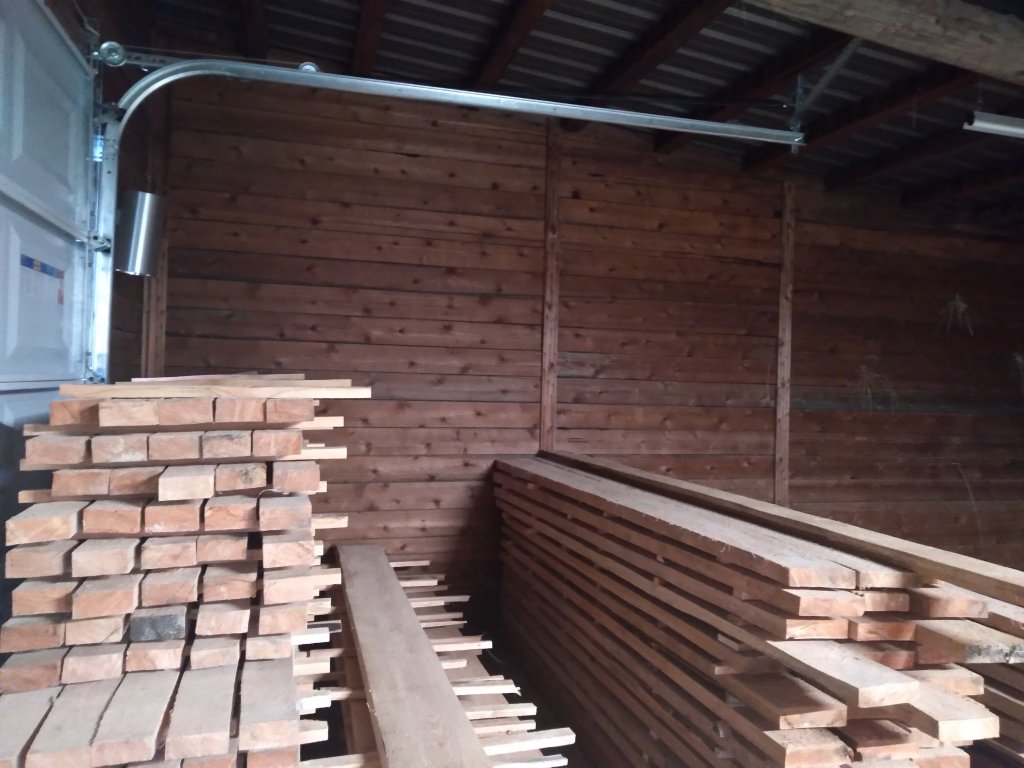
Rough Cut Lumber
Harvested as part of thinning to reduce fire danger.
$0.75 per board foot.
Call Mike (406-882-4835) or Sam (406-882-4597)
Popular Posts
Ask The Entomologist Bears Books Canada Census Community Decay Covid Covid-19 Data Deer Demography Education Elections Eureka Montana family Firearms Game Cameras Geese Government Guns History Inflation life Lincoln County Board of Health Lincoln County MT Lincoln Electric Cooperative Montana nature News Patches' Pieces Pest Control Politics Pond Recipe School School Board Snow Taxes travel Trego Trego Montana Trego School Weather Wildlife writing
 Trego's Mountain Ear