-
Murder for Hire Charges Dismissed
James R. Houchin stopped by right after we’d finished last week’s edition. He had with him a copy of Judge R. D. McPhillips’ order releasing him.
Houchin had, along with DeBoar, been busted for ‘conspiracy to commit the offense of Deliberate Homicide’. As McPhillips noted, “the person to be killed was a fictitious person and did not in fact exist.”
The Judge explained that “the attempt statute… provides that impossibility for the accused to commit the defense is not a defense.” and that conspirators must act with “the purpose that an offense be committed.” He ended that paragraph with “It is not possible to kill a person that doesn’t exist, or is already dead when the conspirators make their agreement.”

Judge McPhillips ruled that, since deliberate homicide “requires the causing of adeath of a human being. A human being is defined as a person who has been born and is alive. In this case the person to be killed does not exist. The requirement that a offense be factually possible is built into the statute.
McPhillips decision didn’t rule on guilt or innocense –He determined that, so far as Montana is concerned, you can conspire to kill imaginary people or dead people toyour heart’s content. Since the offense is impossible to commit, there is no crime in the conspiracy.
Houchin expressed intent to sue the county for the inconvenience of his 38 days incarceration over this non-crime.
Want to learn more? It’s actually possible to find details about the State v. Houchin case online.
-
Sometimes, things look like they’re doing one thing, but are secretly doing something else. Those internet CAPTCHA tests are a good result.
Identify some warped sequence of letters and numbers, or more recently pick out items in pictures, and that proves you aren’t a robot? Not quite.
What actually proves you aren’t a robot is clicking that little box, which gives the CAPTCHA test permission to look at your recent activities. Which ones? Everything from your cursor movement to your recent browsing history.
Who are you giving permission to do this to? Probably google, since google is the major provider of CAPTCHA tests.
And did you have to do one of those to efile your taxes with the state of Montana this year? Sure did. Online CAPTCHA tests are pretty much ubiquitous; even our state government is asking us to give google permission to look at our browsing history.
-
The Montana Free Press has a nice article on the topic: What we know about the arrest of superintendent candidate Sharyl Allen.
Sharyl Allen is one of the candidates on the republican primary ballot. She’s running against Susan Hedalen, and whichever of the two wins the primary next Tuesday (June 4th) will face Democrat Shannon O’Brien in November.
And this isn’t speeding tickets. Because Allen’s a current employee of the Montana Office of Public Instruction, she’s managed to run afoul of the law professionally. She’s been charged with obstructing a peace officer, and her campaign is framing it as a parents/students rights issue.
-
To explain why a 100% inheritance tax is an absolutely terrible idea (and it becomes terrible well before 100%) requires knowing the answer to a rather different question: Why do plant trees? Especially, why do old people plant trees?
The apples I planted will bear fruit some years from now. The oaks we planted this year may produce acorns in my lifetime, but certainly not any large harvest. They are not for me.
Why do plant trees the fruits of which we will never see? The answer is simple. We plant trees for the future.
If you cannot give your labor to the future when you are old, what reason have you to work any more than to meet your own needs? Taxation is a system of incentives and disincentives. The higher the tax on something, the more it is discouraged. This is an obvious principle when applied to sin taxes, as occur on cigarettes and alcohol.
It is less obvious with sales taxes, because all of us must purchase things occasionally. But if we have a choice on where to make that purchase, there are some things cheaper to buy in Kalispell or Eureka than Whitefish, because of Whitefish’s resort tax. And we will buy less, simply because we can afford to buy less. Maybe it isn’t much, in any single grocery run. A pack of gum, or perhaps a loaf of bread, but sales tax does reduces purchasing.
Do income taxes provide an incentive to earn less income? At some point, yes. Taxes lower your effective wage. Everyone knows, or learns painfully on their first real job, that $15 an hour does not actually mean you get $15, not after the government gets its cut. High taxes can mean that working a few more hours brings very little money. And if, for example, the net gain is only $10, you might choose to spend that time another way.
An inheritance works the same way. Why would anyone choose to accumulate wealth for the purposes of handing it to the government? Certainly it hasn’t proved itself a responsible spender of other people’s money in the past. It doesn’t really matter if you’re planning on passing your wealth on to a kid, or to a charity for cats, you don’t want to work extra just for that to go to government. If everything you leave behind goes to the government, there’s no real reason to accumulate anything beyond the minimum to live in your preferred lifestyle.
Why is that a bad thing? From a national perspective, wealth isn’t actually dollars. Rather, it’s units of human production. When government creates incentives to work a minimum amount, it will reduce national productivity, which is an economic issue much better avoided.
-
In 1971, gold went for $35 an ounce – until Nixon took us off the gold standard as a way to combat inflation. Today, the price of gold is $2,425.55 – if we just look at gold, that January 1971 dollar had the purchasing power of $69.30 today. But gold isn’t the only item we buy – matter of fact, I can go a long time without buying gold. The chart below shows typical costs for items we can’t go long without purchasing.
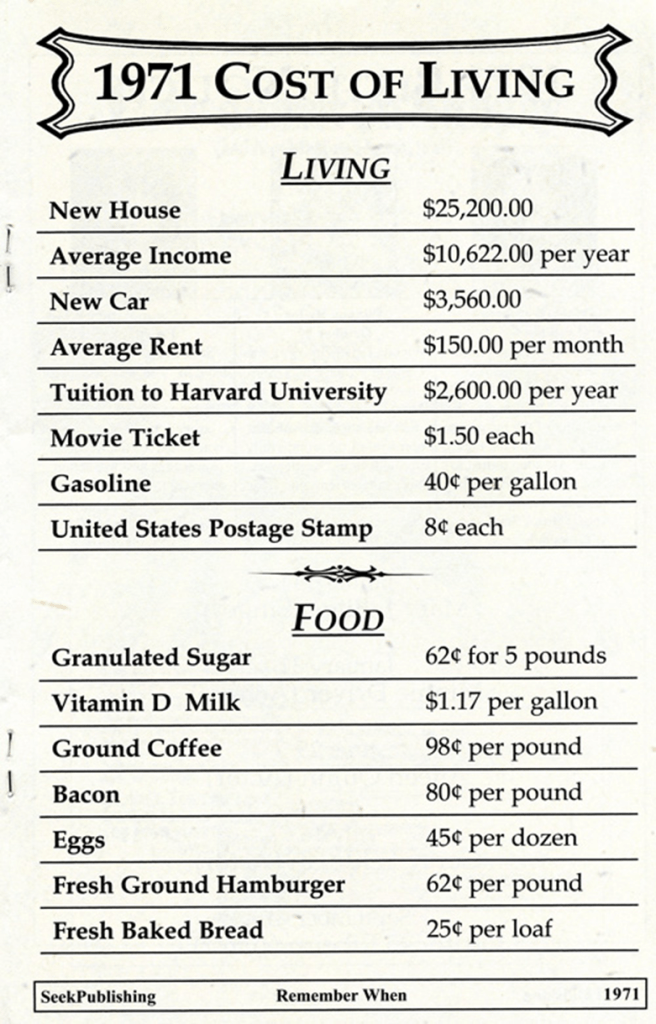
Gasoline was 40 cents per gallon. Now it’s somewhere between three and four dollars per gallon, and adulterated with alcohol. Then it was adulterated with tetraethyl lead. We aren’t buying the same gasoline. Basically, that dollar in 1971 bought the same amount of gasoline as $10 does today – not nearly so inflationary as the gold spot price might indicate. This old ad gives an idea of the cost of groceries when I turned 21:

I don’t know if I can still buy a roll of film – the camera in the cell phone may have totally replaced that, with deflation. In 1971, you had to be a university or a large corporation to buy a computer. The Brown Box of Happiness delivered my computer for $210 – to the door. No amount of money could have bought that simple HP back in 1971 – my Texas Instruments TI50 cost $150 back in 1974. It would do most of the things my slide rule did.
Glancing at a 1964 advertisement, I see a Colt AR-15 listed at $189.50 – and back then you could get the things through the mail. Today, Cheaper than Dirt lists an AR-15 at $419.
It’s easy to look at inflation as both higher and lower than it is. There are a lot of products that didn’t exist fifty years ago, and others, like film, that we no longer purchase. One of these days I’ll do the math to see exactly what return on investment I missed by not buying an ounce of gold back in 1971.
-
I hadn’t thought about how the Greens and Libertarians affect my primary voting strategy. I’m looking at my four potential ballots – and knowing that the only ones with a realistic chance of winning are the Dims and the Repugnants, yet there’s another choice affecting my ballot. Do I want one of the small parties to continue?
Of course I do. In 1856, James Buchanan beat Republican John Fremont and Know Nothing Millard Fillmore. It was the first time Republicans fielded a candidate for President . . . and the next time around they won. Ignore the fact that a bunch of Democrat pols were so aggravated they seceded. Third parties tend to replace established parties once in a while.
So I carefully examine the Democrat ballot. Nobody is running against Slow Joe. If I wanted to vote against John Tester, I could vote for a guy named Hummert – but I’ll get a chance to vote for or against Tester this Fall. The Dems have two candidates for governor – but while Ryan Busse is worth voting against, I figure if he can beat Jim Hunt, I’ll get another chance in the Fall. With a ballot otherwise filled with unopposed candidates, it’s time to examine the Repugnants.
No choice at the top of the ticket. For Senator I have 3 choices – the Republican Tim Sheehy (I have a fertilizer spreader that has been in Montana longer than Tim has . . . just saying), Charles Walking Child (He’s a tribal member of the Anishinaabe), and Brad Johnson (long-term republican politician, not the actor or the football player). Zinke is running against Mary Todd (I think she married Abe Lincoln – “Besides that, Mary, How did you like the play?”) Yep. I have a lot more choices on the Republican Ballot.
The Greens have two candidates running for Senate (Michael Downey and Robert Barb) I know of nothing good or bad about either candidate. The Libertarians have two running for the House of Representatives (Ernie Noble and Dennis Hayes). Noble’s paused his campaign to let Hayes win. Dennis Hayes – spelled with 2 N’s – should not be confused with the single N Denis Hayes who founded Earth Day.
It looks like it’s time to cast a Republican ballot in the primary – I can vote against so many more candidates. I’ll leave blanks alongside the unopposed Neil Duram and Christi Jacobsen – ideally, unopposed candidates will win with a single vote. Remember, if a candidate is unopposed, don’t vote – it only encourages the bastards.
-
I noticed some polling results: 47% want Joe Biden, 48% want Donald Trump, and 49% wish that both would just quit the race and give us a couple of different candidates. I may not be phrasing things quite like the poll – but I think the gist is correct.
Interpreting the poll – and I’m using Occam’s Razor – gives me another descriptor. Half of Biden’s support comes from people who flat can’t stand Donald Trump. Half of Trump’s support comes from people who can’t stand Joe Biden. Half the nation (49% + 2%) is going to be dissatisfied whichever one is elected.
My primary ballot gives me a choice – a candidate despised by about half the nation or “no preference.” That’s the fault of our local pols – the ones we send to Helena. I don’t want ‘no preference’. I want “none of the above.” The Trump-Biden choice can only be ‘no preference for the majority when it’s a forced choice. The voters deserve a ballot that looks like this:
Trump
Biden
Neither of the above is acceptable
I’m close to being a member of the majority when 49% would already prefer a do-over. Come to think of it, this is a do-over from 2020. It really makes me understand the sort of candidates that drove those old Athenians to develop ostracism: Ancient Greeks Voted to Kick Politicians Out of Athens if Enough People Didn’t Like Them
“In the 1960s, archaeologists made a remarkable discovery in the history of elections: they found a heap of about 8,500 ballots, likely from a vote tallied in 471 B.C., in a landfill in Athens. These intentionally broken pieces of pottery were the ancient equivalent of scraps of paper, but rather than being used to usher someone into office, they were used to give fellow citizens the boot. Called ostraca, each shard was scrawled with the name of a candidate the voter wanted to see exiled from the city for the next 10 years.
From about 487 to 416 B.C., ostracism was a process by which Athenian citizens could banish someone without a trial. “It was a negative popularity contest,” says historian James Sickinger of Florida State University. “We’re told it originated as a way to get rid of potential tyrants. From early times, it seems to be used against individuals who were maybe not guilty of a criminal offense, so [a case] couldn’t be brought to court, but who had in some other way violated or transgressed against community norms and posed a threat to civic order.” Athenians would first take a vote on whether there should be an ostracophoria, or an election to ostracize. If yes, then they would set a date for the event. A candidate had to have at least 6,000 votes cast against him to be ostracized and historical records suggest that this occurred at least a dozen times.”
Click the link – it’s a good story about bad elections when democracy was just being invented. We couldn’t get by without a functioning president – or are we?
-
Aunt Faye had an Eig revolver. I have seen, and used, some mediocre pistols, but Saul Eig went beyond mediocre when he marketed these little guns. The poor little pistol was unreliable and slightly less hazardous to its shooter than its target. My tests, back in the sixties, showed it was more dangerous to the guys alongside than to the target. I suppose part of the Eig safety plan was stamping it for 22 short, to have as little explosive as possible under the hammer when the little gun failed.
It looked like this, only Faye’s grips had been carved from soft pine:

I found this photo online at David Condon’s site – and it looks to me as if he sold it for $150.
The cylinder in Faye’s Eig just kind of floated around. Sometimes when you fired it, it was lined up with the bore and might hit what you aimed at. Usually it was misaligned, and small pieces of lead and debris would come out to the right or left from the cylinder gap, to annoy (or worse) anyone who shared a firing line.
After the Bobby Kennedy assassination, the Eig moved into a prominent position as an example of a Saturday Night Special. They’re historical – but not so historical I’d want to keep one around.
-
The sign sort of begs the question: What’s going on? Despite the vast number of vacancies, Trego’s newly elected school board members did not fire a bunch of people. There were a couple instances of contract nonrenewal, but the majority were people choosing to move on to different things. That said, it might be easier to list the positions Trego School isn’t hiring: It is not currently hiring a teacher’s aide, a teacher for the upper grades, or a bus driver.
What’s available? Substitute Bus Driver. Trego school is chronically looking for substitutes, for all positions. Amusingly, what happened this time was that the board went to interview an applicant, only to realize they hadn’t publicly posted the position recently and needed to do so in order to be able to legally hire.
Elementary Teacher: Mrs. Kiser gave the board notice at a meeting last month that she’s accepted a position elsewhere, so Trego School is looking for a teacher for the lower grades.
School Cook: The former cook resigned and the position is being filled by a substitute cook for the remainder of the school year.
Maintenance/Custodial: This was actually two separate jobs, and it’s not entirely clear if the board is hoping to hire one person to fill the role or two.
District Clerk. District Clerk is essentially a political job, appointed yearly at the reorganization meeting that follows the school board election. It’s not eligible for tenure, and is probably the worst position in the district for job security, by virtue of the laws that outline how it is filled. However, it is a hard job to be fired from.
Generally, what seems to happen is nonrenewal at the reorganizational meeting. This is what happened, but as the clerk stated at the last meeting (Monday, May 13th), when the minutes were being corrected, that she wasn’t sure whether it was the custodian or clerk position that she had previously stated she didn’t want, it seems unlikely that anyone was particularly upset by the outcome.
-
by Liz Carey, The Daily Yonder
May 14, 2024While intimate-partner violence is a problem in all areas of the country, victims in rural communities need more resources and support, a new study has found.
The study from the University of Minnesota’ Rural Health Research Center found that rural victims of intimate-partner violence, or IPV, face more barriers and resource limitations that could affect their health and well-being. Attempts to address intimate-partner violence in rural areas should be tailored to the specific needs of the people and places in those areas, the study said.
Alyssa Fritz, the lead researcher on the study, said her team spoke with 15 state and national advocacy organizations, some serving rural communities directly, to determine what barriers rural victims face and what opportunities exist to address those challenges.
“The advocates that we talked to said, across the board, increasing funding that is accessible to smaller and rural organizations is needed,” she said in an interview with the Daily Yonder. “And I think funding training, specifically in detecting and responding to IPV, training for health care providers, and law enforcement and judges, is important.”
All of the respondents said rural victims lack access to services like shelters, advocacy, legal services and law enforcement. Most frequently, the organizations said there was a shortage of support services and shelters in rural communities, and if programs that address intimate-partner violence exist, they are underfunded and understaffed.
Another issue facing rural victims, Fritz said, was a lack of access to health care. Many respondents also said poor health care access, especially for victims who are pregnant and postpartum, was a challenge in IPV intervention. Many times, the respondents said, if victims were able to access health care, there was a lack of IPV-specific and trauma-informed knowledge or training amongst the professionals who interacted with IPV victims in rural areas.
“We did find that pregnant victims of IPV were less likely to be screened (for IPV),” Fritz said. “Anecdotally, we’ve also heard that to be the case (for non-pregnant victims). It’s possibly driven by the fact that there might be less training for rural health care providers… They’re covering lots of different conditions and they might not see things like IPV as often, and don’t have training in it.”
And rural residents tend not to report IPV, the researchers found, because of the lack of anonymity. Nearly half of the organizations brought up a lack of privacy and confidentiality in small communities as an extra challenge that rural victims have to consider when they weigh whether or not to reach out for help or leave. In other cases, attitudes and societal norms in some rural communities may justify or normalize violence and victim-blaming.
“So you [a rural victim] may be much more enmeshed in your community, you may know the lawyer, the judge, the police officer, the abusive partner’s job, family, associations and things like that,” one national advocacy organization was quoted as responding in the study.
In a different study focused on IPV survivors in Vermont, Anna Mullany, a postdoctoral student at Emory University, found that even organizations that were supposed to help victims sometimes did harm. Prior to her doctoral studies she worked as a crisis counselor for many years. Many of the IPV survivors she talked to said those attitudes were sometimes more damaging than the violence, creating further barriers for victims in getting help.
“I ended up doing 32 interviews with survivors of violence in rural Vermont and a number of them would tell me instances of violence happening out in the community,” Mullany said in an interview with the Daily Yonder. “Not just something that was gossip or that people knew about, but that they actually witnessed… There’s a stigma and judgment they experience that is so detrimental. I actually had one survivor tell me that the judgment she felt after she left the relationship… almost did more damage than the actual abuse.”
Mullany said that, in many cases, victims could not rely on law enforcement to help, either. In remote areas, law enforcement may take 15 or more minutes to respond. And if the officers know the accused, they may choose not to arrest them.
“One of my interviewees was in an extremely abusive situation and she had called the police on him a number of times,” Mullany said. “One of the times they showed up, they did not arrest him even though there had been a violent incident present. As soon as the police left, she was thrown up against a wall. So, sometimes, if the police are not skilled in that situation or don’t see the level of danger, it can actually cause more harm to the victim because a perpetrator will retaliate.”
Other studies have shown that IPV is more prevalent in rural communities. A 2011 study supported by the University of Iowa Social Research Center and the University of Iowa Injury Prevention Research Center found that women in small rural and isolated areas are more likely to experience IPV than women in urban areas, and generally are three times as far away from IPV resources than urban women. Over 25% of women in rural areas lived more than 40 miles from the closest program compared to less than 1% of urban women.
Respondents to the University of Minnesota research said IPV doesn’t happen in a vacuum, but instead happens because of the societal structure that exists and will be difficult to undo.
“People that hold power, you know, are perceived to have more rights to behave the way they want to, and how do you hold power accountable when you’re not in power?” one state advocacy coalition told researchers.
But combatting all those challenges, Fritz said, means more funding for entities outside of the advocacy organizations as well, she said.
“The American College of Obstetricians and Gynecologists recommends that all pregnant people be screened throughout their pregnancy and postpartum (for IPV),” she said. “But research shows that it does not happen nearly as often as it should. So, a response to that could be looking at reimbursement mechanisms to make sure that providers are incentivized to screen.”
Respondents to the study said IPV prevention initiatives, direct and discretionary financial support for victims, and policy making in rural communities that includes IPV victims and survivors are also needed.
“Imagine just a very low barrier, means-tested access to income supports, instead of the kind of hostile system that we have, where folks are having to get denied and then reapply; you know, SSI (Supplemental Security Income), those kinds of things, to be able to have their basic needs met. Absolutely fundamental, particularly for folks in rural areas,” one national advocacy organization told researchers.
But respondents said it was just as imperative to invest in rural community infrastructure to ensure that IPV victims have the resources they need to leave their abusers and to heal in safety. From rural housing access to affordable child care to investment in broadband internet and transportation infrastructure, providing rural IPV victims with resources, services and information was a key factor in helping ensure their safety and health, the study, Intimate-partner Violence in Rural Communities: Perspectives from Key Informant Interviews, published in March 2024 found.
This article first appeared on The Daily Yonder and is republished here under a Creative Commons license.

Want to tell us something or ask a question? Get in touch.

Recent Posts
- You Have To Beat Darwin Every Day
- Computer Repair by Mussolini
- Getting Alberta Oil to Market
- Parties On Economics
- Thus Spake Zarathustra – One More Time
- Suspenders
- You Haven’t Met All The People . . .
- Play Stupid Games, Win Stupid Prizes
- The Ballad of Lenin’s Tomb
- An Encounter With a Lawnmower Thief
- County Property Taxes
- A Big Loss in 2025
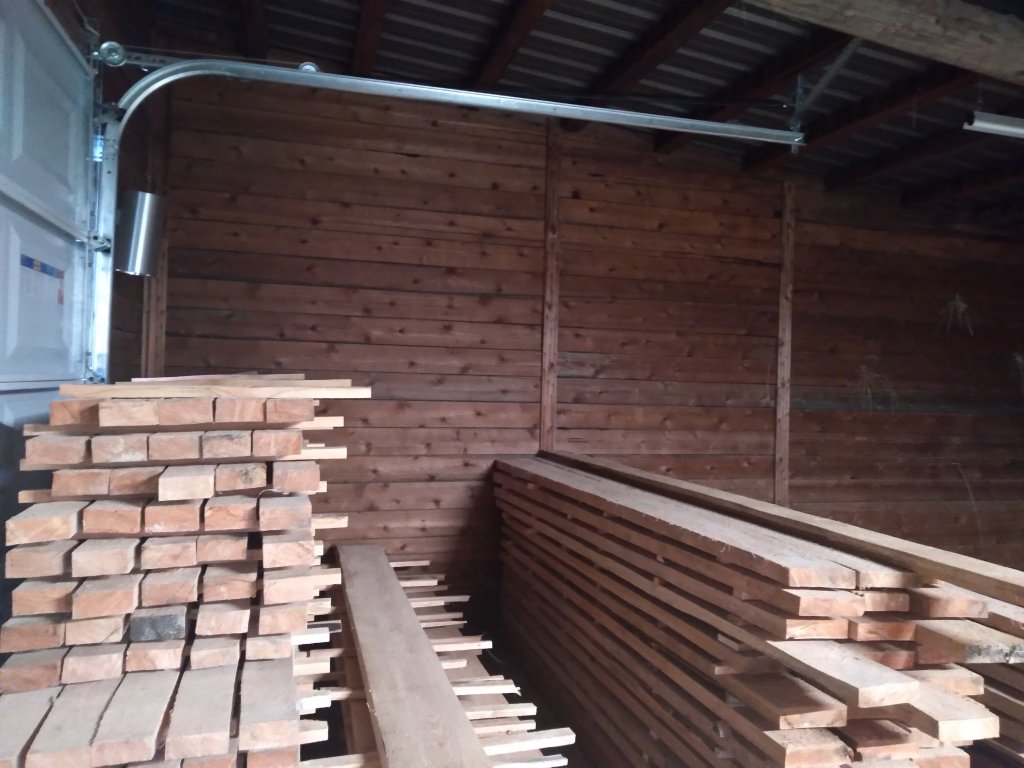
Rough Cut Lumber
Harvested as part of thinning to reduce fire danger.
$0.75 per board foot.
Call Mike (406-882-4835) or Sam (406-882-4597)
Popular Posts
Ask The Entomologist Bears Books Canada Census Community Decay Covid Covid-19 Data Deer Demography Education Elections Eureka Montana family Firearms Game Cameras Geese Government Guns History Inflation life Lincoln County Board of Health Lincoln County MT Lincoln Electric Cooperative Montana nature News Patches' Pieces Pest Control Politics Pond Recipe School School Board Snow Taxes travel Trego Trego Montana Trego School Weather Wildlife writing
 Trego's Mountain Ear