-
by Liz Carey, The Daily Yonder
April 22, 2024A new study from the American Academy of Family Physicians’ Robert Graham Center (AAFP), co-funded by the Milbank Memorial Fund and The Physicians Foundation, has found that communities across the country are struggling to meet the demand for primary care physicians, as well as to retain those physicians in their communities. While it’s difficult all over, Dr. Yalda Jabbarpour, lead researcher on the study, said, it is more difficult for rural communities.
“Ten years ago, we knew we had a problem with primary care physician density,” Jabbarpour said in an interview with the Daily Yonder. “Today, even though people are older, and therefore sicker, and the population is growing and the demands are higher, we actually have less physicians to fill that need.”
Rural communities tend to depend more on primary care clinicians, Jabbarpour said, especially family physicians.
In 2021, 37% of all physicians in training (residents) began training in primary care, yet only 15% of all physicians were practicing primary care three to five years after residency, the study found.
More than half of those residents with the potential to enter primary care subspecialized or became hospitalists instead, research showed. And only 15% primary care residents spent a majority of their time training in outpatient settings where a majority of the US population receives their care and fewer than 5% of primary care residents spent time training in rural and other underserved communities, the researchers found.
The AAFP study also found that there is a slightly higher density of primary care providers in rural and underserved areas. Looking at social drivers of health – like housing, transportation, income and education – and how they affect residents’ health status, the study found that people in areas that have more social disadvantages (less adequate housing, barriers to transportation, and lower income, for instance) had higher rates of chronic disease and worse health outcomes.
In 2021, the overall density of primary care in areas that had more social disadvantages was 111.7 per 100,000, while the density of areas with fewer social disadvantages was 99.5 per 100,000. However, researchers said, while those measures are hopeful, they still are insufficient.
“This finding may be attributed, in part, to the success of the community health center movement, which aims to place clinicians in areas of highest social need,” researchers said. “Still, this promising finding needs to be tempered by the reality that even this higher density of primary care clinicians may not meet patient demands given that people living in high-need areas tend to have higher levels of medical need.”
“Rural areas do much better at training and retaining a primary care workforce, but at the same time, it’s still not enough to meet the growing demand,” Jabbarpour said.
Family medicine, like any other medical specialty, she said, distributes itself the same as the U.S. population. Rural areas across the country, according to the U.S. Census Bureau, are home to 19.88% of the total U.S. population. Jabbarpour said that a correlating percentage of primary care physicians would be located in a rural area. But because rural communities tend to be statistically older and sicker, the need in rural communities is greater.
One way to resolve the issue would be for more investment into primary care, the study found. Changing the overall portion of health care spending done by the Centers for Medicare and Medicaid (CMS) on primary care would help invest more federal dollars into primary care, as would investment by the U.S. Department of Health and Human Services (HHS) into new rural health clinics, health centers and Indian Health Service (IHS) facilities in shortage areas, the report said.
“The United States is underinvesting in primary care, and Medicare’s fee schedule – which lists fees for services – is the chief culprit,” the report said. “It undervalues primary care services relative to specialty services and pays on a per visit basis, discouraging non-visit services like emails and phone calls as well as care from other members of the primary care team.”
Jabbarpour said another key to getting more primary care physicians into rural communities is for colleges to recruit from rural communities.
“Medical schools should be recruiting from those communities because people tend to go home to practice,” she said.
Bringing doctors into rural areas means helping their spouses find work as well.
“There are physicians who want to go into rural areas, but their partners don’t have opportunities for work in rural areas if they’re not also in medicine,” she said.
The biggest way to bring primary care physicians into rural areas, she said, was to expose them to it. The research has found that physicians who train in Teaching Health Centers and rural training tracks are more likely to practice in those communities.
“I know not every rural area is the same. In some rural areas, it’s probably an area that physicians would love to live and grow their families in if they knew about it,” she said. “I know that’s hard because that takes hospital systems really doing active recruitment or setting up rural training tracks, and reaching out to medical schools around the country and saying, hey, send your students here, we’ll give them housing and they can get exposure to this beautiful slice of heaven that we have and then they’ll want to come here.”
This article first appeared on The Daily Yonder and is republished here under a Creative Commons license.

-
Geese are back, we’re starting to hear the cranes occasionally, and it’s time to look for frog eggs. Enjoy the warmer weather!
Frog Eggs and Toad Eggs
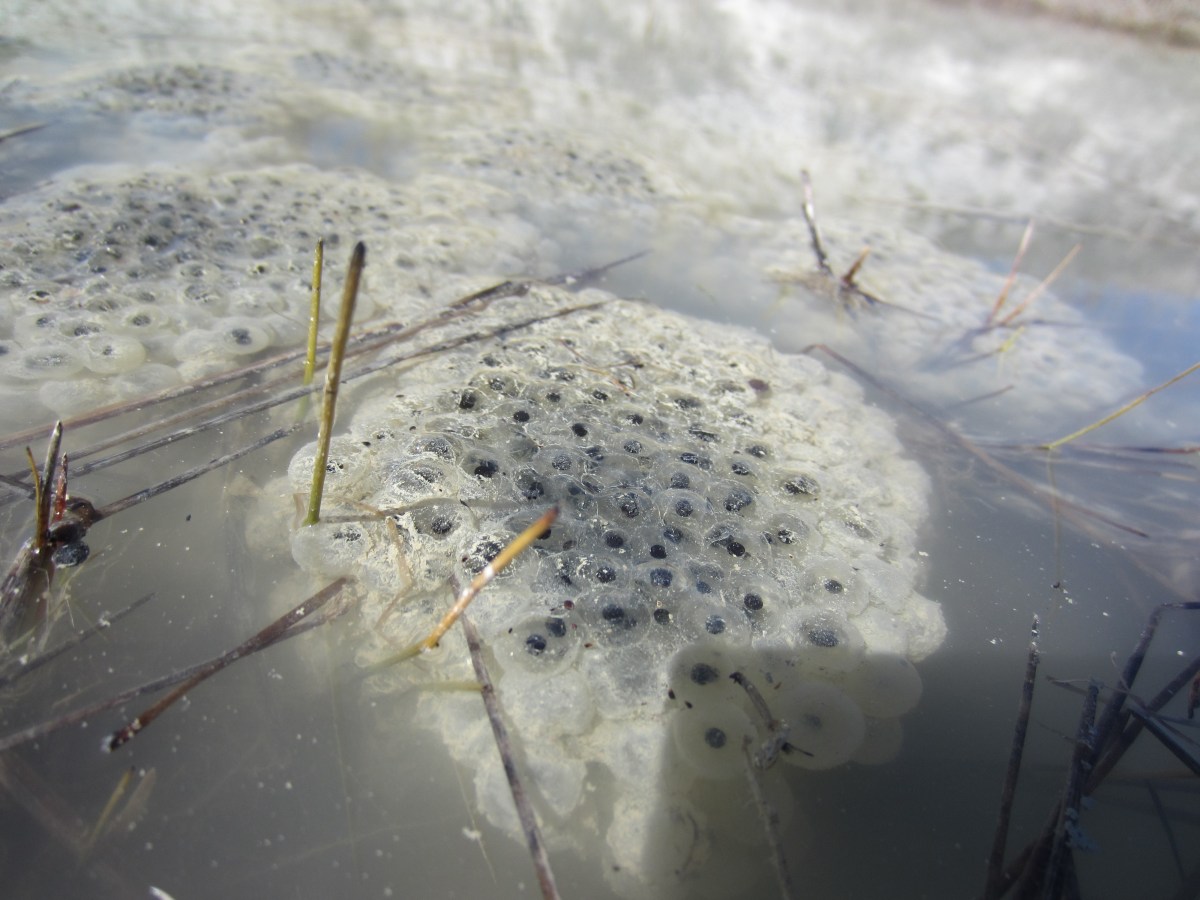
Spring seems to have finally arrived, and soon the pond will be full of little frogs. As it turns out, frog eggs and toad eggs are different, and far easier to tell apart than the tadpoles. Frog eggs typically form nice clumps. -this years batch are particularly muddy. Toad eggs, however, will generally be in strands. While the eggs will typically hatch within two weeks or so, it’s still possible to tell the difference in the next stage. Tadpoles: The frog version will typically school. Eating eggs (or smaller tadpoles) is less common in frogs, and so there’s…
Game Camera: Sandhill Cranes
Perhaps you’ve heard the distinctive call of the sandhill cranes recently? -Patches We’re actually in at the very south edge of the breeding range for Sandhill Cranes. They’re not particularly picky eaters- they’ll eat snakes, frogs, insects, seeds… Often, we’ll see them in the spring, hunting frogs in shallow water.
My life with Canada Geese
In the flyway, I saw geese as population, as statistics – an appropriate way for a demographer to view any group. As a retiree, back in northwest Montana, I saw geese as neighbors on about 3 ½ acres of pond. Watching individuals, and then families, began in 2015. Goose appropriated the island for her nest, and Gander made certain nothing shared it. In later years, mallards, teal and even coots would share the island’s safety for their nests – but in this first year, all other species were regarded as competition. When larger geese wouldn’t leave, Gander would…
Thatch Ants
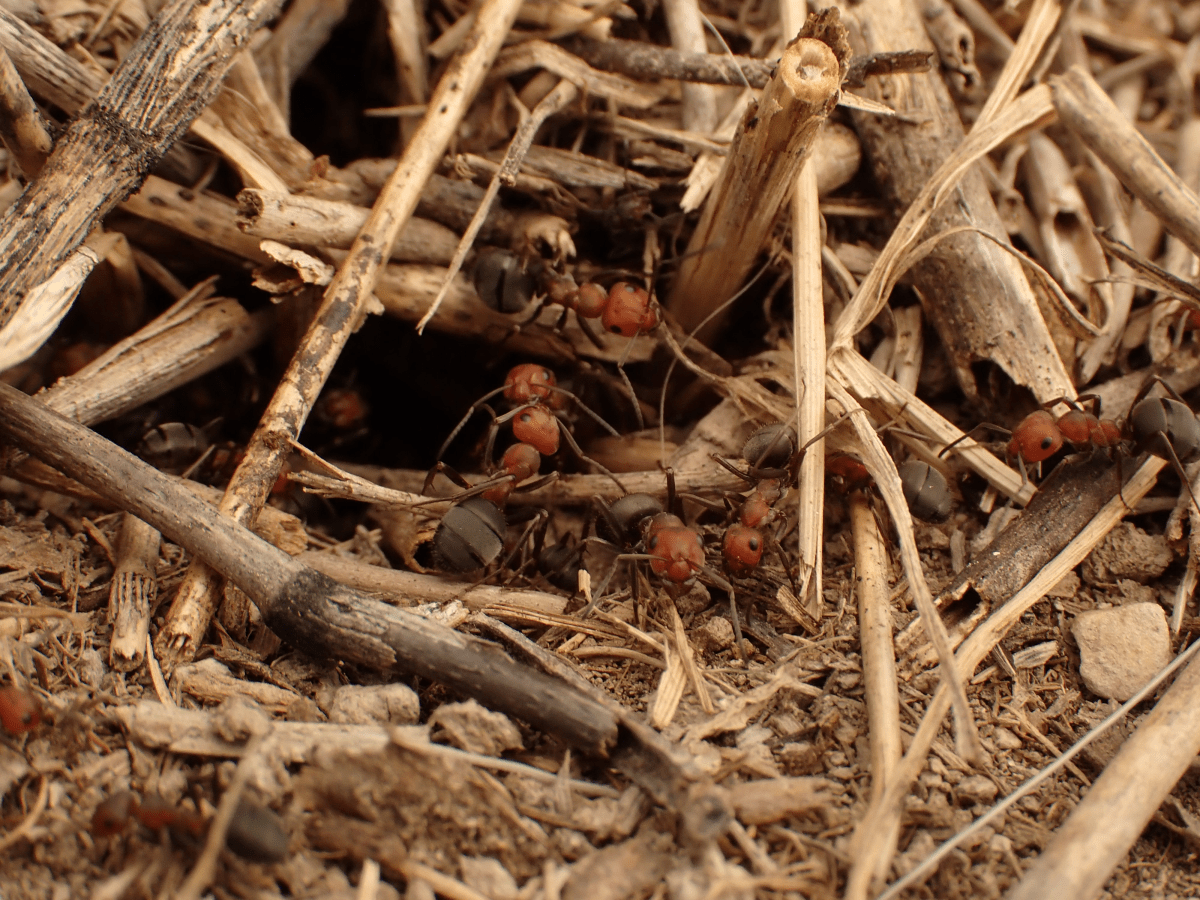
Our mound-building ants in this part of the country are Western Thatching Ants, Formica obscuripes.These ants are rather special because they generally have multiple active queens in a single colony – the young queens often help out and reproduce at home, instead of founding their own new colonies…
-
I had never had a Type 38 in my hands when I got to Trinidad State – remember, I was teaching soil conservation there at Gunsmith U. and, following in places developed by P.O. Ackley, I learned that the Japanese Arisaka was the strongest bolt action he tested. As I recall, he chambered the 6.5 mm barrel to 8mm Mauser, locked it in the test chamber, and somehow that 8mm bullet squeezed down and left the barrel without damaging the rifle.
So later, I got my hands on a Type 38 Arisaka – and learned that Jack Price had been hunting around Trego for years with one he brought back from the war in the Pacific. While we know the rifle as an Arisaka, the Type 38 was actually designed by Kinjiru Nambu. I remain underwhelmed by Nambu’s pistols – but he simplified and smoothed the Mauser bolt as he modified it for the type 38 – it’s down to six parts.

Some have called Nambu “Japan’s John Browning. So far as designers go, I tend to rank Finland’s Aldo Lahti as the only serious competition for John Moses Browning, and Kinjiru Nambu in a distinct third place. On the other hand, both Browning and Lahti came from serious gun cultures, while Nambu was born Samurai.
My first Type 38 rifles had the worst bores I have ever seen – keyholing at 15 feet. Bought cheap, sold cheap, but good experience. I wound up keeping one that had been sporterized by Bubba. Bubba had rechambered the rifle to 257 Roberts – and a .257 bullet rattles down a barrel that is sized for .264. Seven thousandths of an inch isn’t very much – but he could have rechambered it for a 6.5 Swede and actually had a proper bullet to barrel fit. Naturally, chambering the rifle for 257 Roberts left too much chamber and too little barrel to go back and rechamber for the 6.5 Swedish Mauser.
Bubba did a nice job trimming the barrel and rebluing it. It needed that work, since the emperor’s chrysanthemum had been ground away. Then Bubba installed a quality Redfield rear sight . . . backwards. I think I can correct the problems there with a little bit of drill press time – but the undersized bullets make me wonder if it’s really worth it.

The bolt has been elegantly changed to a butterknife style bolt. Looks great, but it doesn’t quite fit with a bolt that cocks on closing.
My type 38 probably looked like this one before Bubba started working on it.

Bubba didn’t try his hand at checkering – but he did set up a nice looking monte carlo stock, with an unusual schnabel forend and finger grooves around the wrist.

All told, it’s a decent looking rifle in need of a barrel that fits the cartridge. It does shoot better than the loose bore/bullet fit first made me think – but I probably should rebarrel the rifle for use in its second century.
-
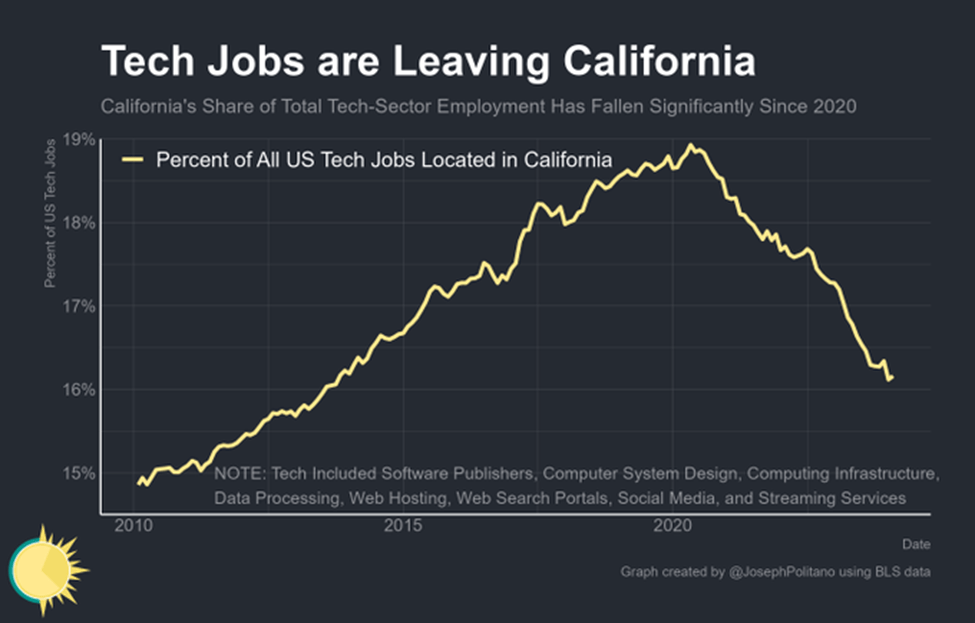
Some more graphs and charts that I’ve noticed:


-
Some years ago, we were pleased to make the acquaintance of a man willing to take the coat off of his back and give it to an injured pig. I’ve been reminded again of the quality of our neighbors.
I recently made a rather foolish mistake with a laptop, and came away from it with reminders of two realities. The first is that for all the evil in the world and for all the tragedy, there are some really good people too. The second is that there are people I think the world of that I cannot recognize.
I’ve been faceblind for a decade or so now, and I’ve become accustomed to not recognizing my loved ones. It doesn’t get easier, exactly, but one acclimatizes. The obvious reality then, is that the neighbors I think highly of and seldom see, I also do not recognize. This isn’t new- but I’ve been newly reminded how much I would like to be able to recognize those people.
Mel and Griz, whom you may remember from a fire several years ago, or for just being all around wonderful people, saved me the consequences of leaving a school board meeting with a computer on the roof of my car. The morning after I’d done it, they were at my door to return it, only slightly worse for wear.
A matter of luck, sure, that it didn’t break badly. But far better luck, I think, that we have people like Mel and Griz in our community. It’s easy to read the blotter, to get caught up in worry about thieves, poor drivers, and strangers joining our community. Perhaps easier for me, to whom everyone always appears a stranger. But I have often been reliant upon the kindness of strangers, and I have found we have many kind strangers in our community. Although, of course, some of them are people I know.
To Mel and Griz: My thanks. I am sorry I did not recognize you. I know that it is very unpleasant to be greeted as a stranger. Know that when you told me who you were, it seemed suddenly obvious that of course it was, and how could it be anyone else? We are fortunate to have the two of you in our community, and though my greeting did not reflect it, I think the world of you both.
-
Our Bill of Rights was argued and developed at the end of a period known as “the Enlightenment” – roughly 1600 to 1800. Even the beginning of the Enlightenment was a time of religious strife – the Thirty Years War, fought between 1618 and 1648, was basically a conflict between Catholic armies and Protestant Armies that killed off about half the population of Germany.
The battle of Breitenfeld (May 20,1631) is known for shifting the technology of war – but 200 years later, the defeat of Catholic General Tilly was marked there with a simple plaque declaring “Freedom of Belief for all the world.”
In England, it had been the war of the three kingdoms – 1639 to 1653 – won by Oliver Cromwell, followed by the Restoration, and then the Glorious Revolution of 1688.
It’s hard to look at these wars and recall that those European monarchs pretty well served only with the blessing of the established church – the concept of divine right of kings pretty well tells us that this was a time when there was no division between political and religious power. The Covenant, in Scotland, an agreement on how to run the Church of Scotland – in a manner contrary to the English King’s wishes – led to the War of the Three Kingdoms. Following the Glorious Revolution came the Jacobite rebellions – supporting the Divine Right of Kings. The last Jacobite uprising was 1745 – a single generation before Thomas Jefferson penned the Declaration of Independence.
And that gets us to the First Amendment: “Congress shall make no law respecting an establishment of religion, or prohibiting the free exercise thereof; or abridging the freedom of speech, or of the press; or the right of the people peaceably to assemble, and to petition the government for a redress of grievances.”
If we look at the perspective of the founding fathers, the First amendment used very few words to cover the topic. Stripped to the basics, the Federal government is not allowed to establish a religion or prohibit anyone’s free exercise of religion. We don’t have the same recent experience – personally, I’m four generations removed from folks who left Europe because of the orders to contribute to building a new church, and 10 generations removed from the Scot who came to America following the 1715 Jacobite uprising.
So at the school board meeting, we had a lot of discussion about adding an official prayer to board meetings. In the end, I think the decision was correct – if you want to pray, that’s your business. Officially sanctioned prayer isn’t to happen. I think that matches the founders intent – they were a lot closer to family members who had gotten caught up in the church and state bind.
Rudyard Kipling wrote “McDonough’s Song”:
Whether the State can loose and bind
In Heaven as well as on Earth:
If it be wiser to kill mankind
Before or after the birth—
These are matters of high concern
Where State-kept schoolmen are;
But Holy State (we have lived to learn)
Endeth in Holy War.Whether The People be led by The Lord,
Or lured by the loudest throat:
If it be quicker to die by the sword
Or cheaper to die by vote—
These are things we have dealt with once,
(And they will not rise from their grave)
For Holy People, however it runs,
Endeth in wholly Slave.Whatsoever, for any cause,
Seeketh to take or give,
Power above or beyond the Laws,
Suffer it not to live!
Holy State or Holy King—
Or Holy People’s Will—
Have no truck with the senseless thing.
Order the guns and kill!Saying—after—me:—
Once there was The People—Terror gave it birth;
Once there was The People and it made a Hell of Earth.
Earth arose and crushed it. Listen, O ye slain!
Once there was The People—it shall never be again!Perhaps English History has left a people who are (were?) more understanding of the problems that happen when Church and state are one?
-
Wealthier, urban Americans have access to more local news – while roughly half of US counties have only one outlet or less
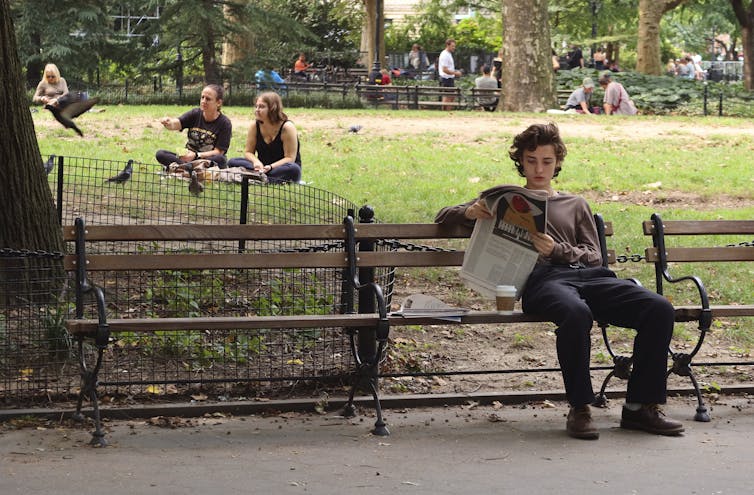
New York City could be described as a news oasis – the city’s density and wealth mean there are many news outlets competing. Gary Hershorn/via Getty Images Sarah Stonbely, Northwestern University
Is local news readily available in your town? Do reporters still cover your school board and other municipal meetings?
If you answered yes, you are likely wealthier than the average American, and you live in or near a metro area.
The State of Local News Project at Northwestern University documents the changing local news landscape across the country. Our latest report shows that where you live and how much money you make affect whether you live in a news desert or a news oasis. This divide is related to other factors affecting the health of our democracy, as analysis of our data by the nonprofit Rebuild Local News showed.
For more than a decade, I have worked in organizations that study and support local journalism, and I’m intimately familiar with both the challenges and the solutions for the local journalism landscape.
Inequity in local news
One of the most vexing problems, as our report shows, is the persistence of inequity between communities that are local journalism haves and have-nots.
The have-nots are news deserts with few, if any, journalists to do the daily newsgathering and reporting that people require to participate meaningfully in their local communities and democratic institutions.
The main challenge for news outlets in have-not communities is the migration of advertising money from the printed page – where it made up roughly 80% of news organizations’ income – to the screen, where it now makes up less than 20%. This decline in ad revenue, a trend for the last decade-plus, has forced many outlets to rely on audience funding, philanthropy, cost-cutting or some combination of the three.
In communities with little disposable income to put toward news subscriptions or donations and no local philanthropies, cost-cutting becomes the only option. This creates a self-reinforcing spiral of lower quality and declining readership and, ultimately, closure.
In 2023, the country lost more than 130 print newspapers, which continue to be the newsrooms most likely to produce original local content that other outlets circulate.
Since 2005, the U.S. has lost almost 2,900 papers.
New digital outlets are not being created fast enough to fill that huge void. The number of digital outlets has held steady at roughly 550 in recent years, with about 20 new outlets opening each year – and roughly the same number closing.
All told, 1,558 of the nation’s 3,143 counties have only one news outlet, while 203 are news deserts with zero, meaning there are likely thousands of communities that simply do not have access to local news.
For example, both Texas and Tennessee had four counties lose their only remaining newspaper last year. All eight papers were independently owned.
What it takes to thrive
Wealthier communities do better sustaining local news organizations.
Our data shows that counties with an average household income over US$80,000 can support a robust local journalism ecosystem – meaning 10 or more outlets. Those with an average household income of $54,000 or less are more likely to be news deserts. By the same token, the percentage of the population below the poverty line in news deserts averages more than 16%, versus 12% in counties with robust markets. This finding aligns with other research, including a previous study I did of local news in New Jersey.
In addition to household income, population density correlates to the number of outlets serving a local community. In our data, counties with 10 or more outlets are overwhelmingly urban or dense suburbia, while news deserts are usually rural – though news deserts also occur in low-income pockets of metro areas. Densely populated communities tend to include higher-income households and have network effects that come from the ability of businesses to reach a larger number of people in a relatively small footprint.
This phenomenon leads to the third factor related to number of outlets in a county: gross domestic product per capita. In any town, city or country, the GDP represents the amount of money netted from sales of services and merchandise, divided by population. For the news oases in our study, the average GDP per capita is $75,140. For the news deserts, it is just $8,964. This difference reflects the retail and services base, and the number of businesses that could buy advertising in their local news outlet, or create jobs that would allow residents to donate to one.
An example that highlights the importance of this factor is the newspaper Moab Sun News, which is thriving in the rural rocky highlands of Utah, thanks in part to a robust tourism industry and retail base. Though it serves a relatively small permanent population of 5,321, the Moab Sun News has built a sustainable business model through strong advertising revenue, a user-friendly website that welcomes subscriptions and donations, and creative collaborations with other community organizations in town.
The final factor that contributes to a community being a journalism have or have-not is access to high-quality broadband. Emerging metrics show that this near-necessity of contemporary life is not yet reliably available to rural Americans.
What’s working
Despite these seemingly intractable problems, solutions to local journalism inequality are becoming clearer.
One is collaboration. For example, in Colorado, the national nonprofit news outlet The Daily Yonder has hired a reporter based in a rural community to write stories about life there and share them out with both local and national organizations.
Another is philanthropy. The new Press Forward initiative has begun local chapters across the country, with at least one planning to serve rural communities. Organizations like the National Trust for Local News have been buying outlets that would likely otherwise be sold to hedge funds, and turning them into nonprofits that will continue to serve their communities.
Public policy should also play a role. At the state level, policies to support local news have seen success in New Jersey, California and elsewhere, and more bills are working their way through state legislatures. People seem to be realizing that having quality local news is just as vital as having public education and access to health care. With any luck, every community will have the opportunity to be a journalism “have.”
Sarah Stonbely, Director, State of Local News Project, Northwestern University
This article is republished from The Conversation under a Creative Commons license. Read the original article.
-
So I ran across an article written by a guy who first encountered Eric Hoffer’s book The True Believer in 2021. He described Hoffer as a “dockworker” – back in the sixties, when I first read the book, he was described as a longshoreman and a philosopher. I strongly suspect Hoffer was an illegal immigrant – his personal history pans out more as if he were concealing his past than revealing it. He did spend some time as an adjunct professor at Berkeley – a pretty good accomplishment for a man with no educational transcript.
I still have my copy of The Ordeal of Change from the sixties, but the paperback True Believer disassembled itself from overuse at least 35 years ago. It’s available online, so you can get a copy a lot easier now than when mine became unusable.
The insight I got from my first read (at 17) was a shock – Hoffer pointed out that there was little to no difference between communist true believers and nazi true believers – the ideology was unimportant to the personalities who would become true believers.
“The quality of ideas seems to play a minor role in mass movement leadership. What counts is the arrogant gesture, the complete disregard of the opinion of others, the singlehanded defiance of the world.”
“The permanent misfits can find salvation only in a complete separation from the self; and they usually find it by losing themselves in the compact collectivity of a mass movement.”
“The enemy—the indispensible devil of every mass movement—is omnipresent. He plots both outside and inside the ranks of the faithful. It is his voice that speaks through the mouth of the dissenter, and the deviationists are his stooges. If anything goes wrong within the movement, it is his doing. It is the sacred duty of the true believer to be suspicious. He must be constantly on the lookout for saboteurs, spies and traitors.”
“Faith in a holy cause is to a considerable extent a substitute for the lost faith in ourselves.”
My second read brought me this: “Jesus was not a Christian, nor was Marx a Marxist.” My classes in social theory pretty well supported that Marx believed in a social conflict approach to understanding society, and that he spent most of his life studying capitalism. Christianity as we know it was largely established by a guy named Paul – I think Hoffer would have classified Paul as a True Believer.
“An effective mass movement cultivates the idea of sin. It depicts the autonomous self not only as barren and helpless but also as vile. To confess and repent is to slough off one’s individual distinctness and separateness, and salvation is found by losing oneself in the holy oneness of the congregation.”
“Unless a man has the talents to make something of himself, freedom is an irksome burden. Of what avail is freedom to choose if the self be ineffectual? We join a mass movement to escape individual responsibility, or, in the words of the ardent young Nazi, ‘to be free from freedom.’ It was not sheer hypocrisy when the rank-and-file Nazis declared themselves not guilty of all the enormities they had committed. They considered themselves cheated and maligned when made to shoulder responsibility for obeying orders. Had they not joined the Nazi movement in order to be free from responsibility?”
“Nature of the Desire for Change:
There is in us a tendency to locate the shaping forces of our existence outside ourselves. Success and failure are unavoidably related in our minds with the state of things around us. Hence it is that people with a sense of fulfillment think it a good world and would like to conserve it as it is, while the frustrated favor radical change. The tendency to look for all causes outside ourselves persists even when it is clear that our state of being is the product of personal qualities such as ability, character, appearance, health and so on. “If anything ail a man,” says Thoreau, “so that he does not perform his functions, if he have a pain in his bowels even … he forthwith sets about reforming—the world.”
It is understandable that those who fail should incline to blame the world for their failure. The remarkable thing is that the successful, too, however much they pride themselves on their foresight, fortitude, thrift and other “sterling qualities,” are at bottom convinced that their success is the result of a fortuitous combination of circumstances. The self-confidence of even the consistently successful is never absolute. They are never sure that they know all the ingredients which go into the making of their success. The outside world seems to them a precariously balanced mechanism, and so long as it ticks in their favor they are afraid to tinker with it. Thus the resistance to change and the ardent desire for it spring from the same conviction, and the one can be as vehement as the other.”
I hope that these quotes can get you to click the link, and read The True Believer. I suspect Hoffer’s example nearly ruined me as an academic writer – but the old longshoreman/philosopher taught me a lot with his first small book.
-
Will Rogers was a Cherokee comedian who died in 1935. Known for his political comments, I wondered how pertinent, how relevant those observations would be today, almost 90 years after his death. As I looked at the quotations, I decided two things: Will Rogers observations remain valid and politics has a tendency to run downhill.
“There are men running governments who shouldn’t be allowed to play with matches.”
“Democrats are the only reason to vote for Republicans.”
“The short memories of the American voters is what keeps our politicians in office.”
“The taxpayers are sending congressmen on expensive trips abroad. It might be worth it except they keep coming back.”
“We always want the best man to win an election. Unfortunately, he never runs.”
“The more you read and observe about this Politics thing, the more you’ve got to admit that each party is worse than the other.”
“America has the best politicians money can buy.”
“With Congress, every time they make a joke it’s a law, and every time they make a law it’s a joke.”
“Lobbyists have more offices in Washington than the President. You see, the President only tells Congress what they should do. Lobbyists tell’em what they will do.”
“The only difference between death and taxes is that death doesn’t get worse every time Congress meets.”
“Invest in inflation. It is the only thing going up.”
“Anything important is never left to the vote of the people. We only get to vote on some man; we never get to vote on what he is to do.”
“There’s a simple solution to our traffic problems. We’ll have business build the roads, and government build the cars.”
“A Republican moves slowly. They are what we call conservatives. A conservative is a man who has plenty of money and doesn’t see any reason why he shouldn’t always have plenty of money. A Democrat is a fellow who never had any, but doesn’t see any reason why he shouldn’t have some.”
“The 1928 Republican Convention opened with a prayer. If the Lord can see His way clear to bless the Republican Party the way it’s been carrying on, then the rest of us ought to get it without even asking.”
“It would drive a person crazy to dope out really what does divide the two parties. Prosperity don’t divide the two parties, for under either administration the poor get poorer and the rich get richer.”
“You could transfer Congress over to run Standard Oil or General Motors, and they would have both things bankrupt in two years.”
“It costs ten times more to govern us than it used to, and we are not governed one-tenth as good.”
“There is not a man in the country that can’t make a living for himself and family. But he can’t make a living for them and his government, too, the way his government is living. What the government has got to do is live as cheap as the people.”
“There’s no way in the world you’re going to make a political party respectable unless you keep it out of office.”
“There ought to be one day – just one – when there is open season on senators.”
-
In Suriname, I saw the largest mosque in the Americas set peacefully next door to the country’s oldest synagogue. I was told that the parking lot is shared.

While I was there, the Hindu Holi Phagwa was going on – a festival of colors celebrated by tossing colored water and powders at each other. Knowing it was going on, I dressed in my grubbiest cut-offs and T-shirt . . . I don’t recall any Jews hitting me with color, but Hindus, Muslims and Protestants all seemed to take the Hindu practice with equal enthusiasm.
A photo of one of my graduate students and her daughters, taken recently in Hawaii, shows the Holi festival takes place in the US, too.
As I think of Israel and Gaza – a place we regard as the holy land – I remember that I have known tolerant people, in a spot where Christians, Muslims, Hindus, Animists and Jews can live together, in relative harmony, enjoying each other’s religious festivities.
I think of Bob Mendelsohn – Bob was Jewish, and he loved both Christmas – particularly the music -and deli ham. As I look at the Holy Land, I think of the actual tolerance I’ve seen and known in our country. Part of it is sharing the experience. I’ve been included in smudging by folks whose worship was directed to Wakan Tanka – and my best translation is “the great unknowable” or “the great mystery.”
And my thoughts go to Israel and Gaza – and my long ago Sunday school classes put Samson in Gaza. There’s a long history of strife and combat in that neighborhood. If I remember my Sunday school correctly, the Canaanites didn’t have a good time when Moses brought the children of Israel in.
Personally, if you’re happy with your religion, I’m happy for you. I’d just as soon not be victimized by missionaries – but different religious beliefs and practices just aren’t worth killing people over. Behavior is a different thing – on October 7, Hamas pulled some crap that earned them the hostility they’ve been experiencing. Rape and murder aren’t things a polite society should tolerate – whether the conflict is religion or not.
But I’m glad that I have seen the mosque and synagogue in Suriname – I know there is at least one place where the Abrahamic religions can get along.

Want to tell us something or ask a question? Get in touch.

Recent Posts
- You Have To Beat Darwin Every Day
- Computer Repair by Mussolini
- Getting Alberta Oil to Market
- Parties On Economics
- Thus Spake Zarathustra – One More Time
- Suspenders
- You Haven’t Met All The People . . .
- Play Stupid Games, Win Stupid Prizes
- The Ballad of Lenin’s Tomb
- An Encounter With a Lawnmower Thief
- County Property Taxes
- A Big Loss in 2025

Rough Cut Lumber
Harvested as part of thinning to reduce fire danger.
$0.75 per board foot.
Call Mike (406-882-4835) or Sam (406-882-4597)
Popular Posts
Ask The Entomologist Bears Books Canada Census Community Decay Covid Covid-19 Data Deer Demography Education Elections Eureka Montana family Firearms Game Cameras Geese Government Guns History Inflation life Lincoln County Board of Health Lincoln County MT Lincoln Electric Cooperative Montana nature News Patches' Pieces Pest Control Politics Pond Recipe School School Board Snow Taxes travel Trego Trego Montana Trego School Weather Wildlife writing
 Trego's Mountain Ear