-
To get to this data, click Montana SNOTEL Snow/Precipitation Update Report

I’ll admit, it’s a kick to be able to click the link and instantly get the data that I worked the entire week to bring back. The locations and their names all bring back memories – except Hand Creek, where nothing out of the ordinary either amusing or exciting happened to me.
-
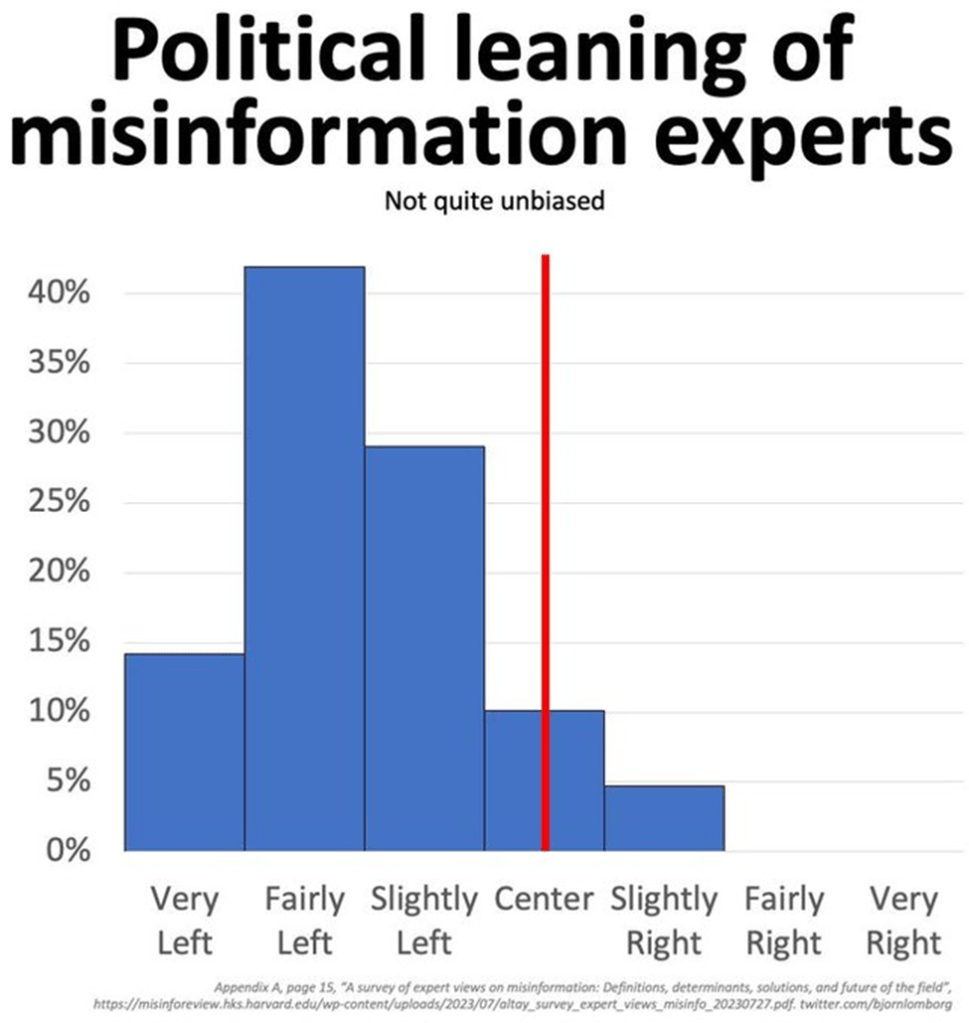
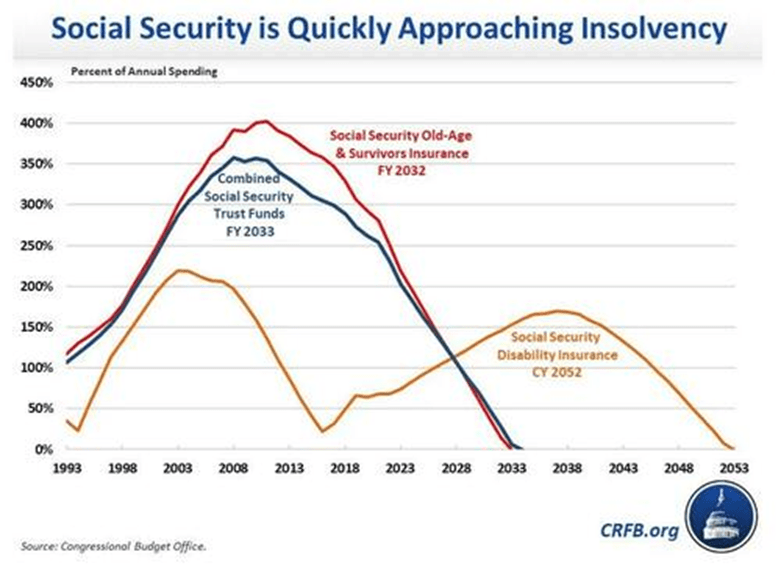
This graph suggests that it’s challenging to get a middle of the road fact checker.
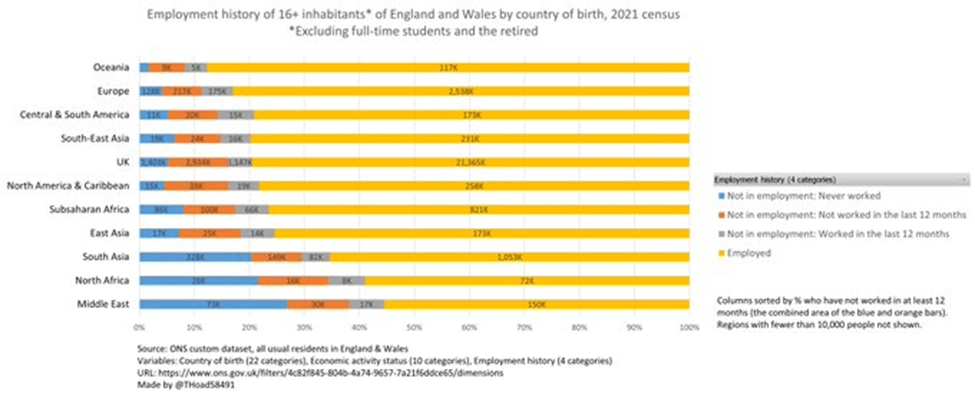
Denmark has quantified criminal convictions by nation of origin – when I looked for this sort of data in the US, I could only find it in Texas.


-
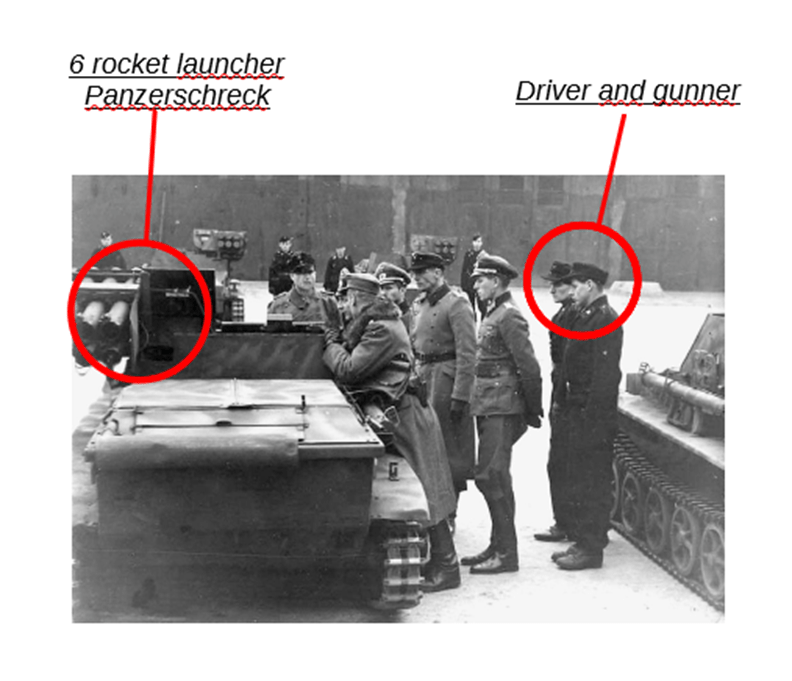
As I watched the Robotics kids show their robots, my thoughts went back to the Borgward Isabella I drove in college. It was a little car, advanced beyond its time – and the designer, Carl Borgward, had been building remote controlled tracked vehicles for the Germans in World War II.

This illustrates how the thing was used, and shows why I thought of this unit as the students put their robots through their paces. Goliath Tracked Mine: The Beetle That Started the ROV Craze

Obviously, the WW II technology didn’t include wifi – and I suspect driving a miniature tank through 2000 feet and 3 strands of wire, to park it under a tank, then explode it, probably had a lot of problems due to breaking wire. The 2 cylinder engine from this device became the powerplant for Borgward’s Goliath automobile.
Borgward’s larger remote controlled vehicle, in its most impressive iteration, looked like this:

It’s engine was hotted up and powered the post-war Borgward Isabellas.
In its most aggressive variant, it looked like this model:
Hemmings has this 59 Borgward Isabella listed for sale at $25,000 -with only 17 567 miles on it. The photo series at 1959 Borgward Isabella Saloon Bryn Mawr, Pennsylvania | Hemmings takes me back to some good memories in 1970.

-
It’s that time of the year again and Trego School has two trustee positions to fill. As ever, if there is only one candidate per position, they will be elected by acclamation with no election held.
When’s the deadline to file? Applicants must file no later than Thursday, March 28th.
Am I qualified? Are you a resident of the district? Qualified to vote? Then, yes! You are qualified.
What do I need to do? File an oath of candidacy and declaration of intent with the school clerk before the deadline. (Show up. Fill out paperwork)
When’s the election? Tuesday, May 7th. For mail-in elections, ballots will be sent out earlier.
How many vacancies? Despite the absence on the county website– two. A full term is three years, but one of the vacancies is shorter than that.
More information, from last year:
School Board Elections- How They Work
Or rather, how they should work. I should begin with the reminder that while the election should happen every year, it does not always (one might go so far as to say that having one is a rarity). Why not? Because an election is not required if there are not more candidates than vacancies. If…
Please, please, can we have an election this year?
-
When we started the special levy for Trego School’s Building Reserve Fund, in 2021, the levy was 2.88 mills and raised about $5,000. There are two reasons why a school needs a special levy for the building reserve – first, the building reserve doesn’t have to be spent during the fiscal year. The fund can continue to grow and eventually have enough for the big ticket items (roofs seem to be a large expense when they need replacement. The second reason – in Trego the School Major Maintenance Aid kicks in about $12,000 to go along with the $5,000 your taxes raise.
When we can raise $17,000 for adding a tax levy that brings in $5,000 – it kind of makes sense. Our Building Reserve Levy is a fairly new thing for Trego School – and hopefully, five or ten years down the road, when the building needs a major repair, the Building Reserve will cover it. The school was federally funded as part of the impact funding when the tunnel and railroad relocation came in – but that was back in 1966. The building is aging, and it seems more responsible to keep it in shape – the Federal government won’t come by with a new one again.
In 2021, it took 2.88 mills to raise that $5,000. Now, in 2024, the levy is down to 1.96 mills. At first glance, the levy is down 32% – but that doesn’t speak to financial management. The levy still raises about $5,000 – but the taxable evaluation of the land has increased, so a lower mill rate raises the same amount. The problem with tax rates is that the figures don’t lie.
I kind of like the building reserve – but just because the mill rate has gone down, the taxes stay the same. And that’s OK if you take the time to understand how mills and tax levies work.
-
Rural Employment Recovery Halts
by Sarah Melotte, The Daily Yonder
March 18, 2024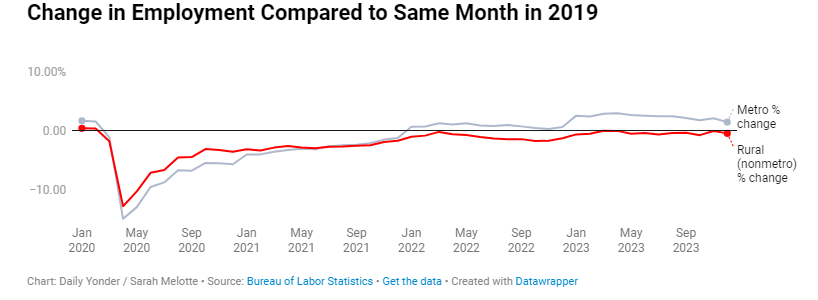
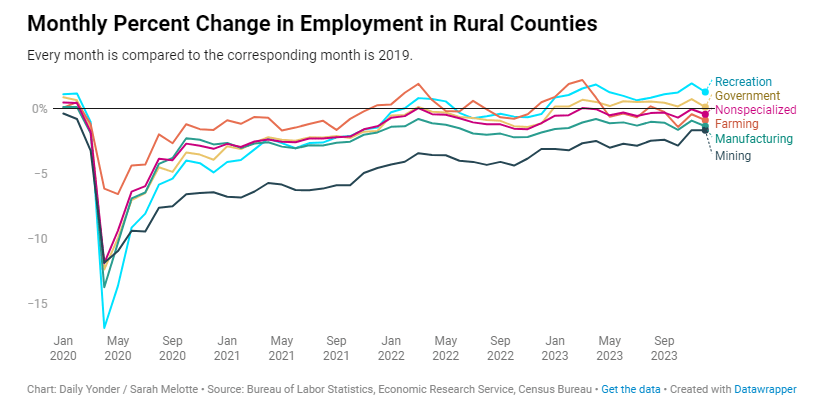
Rural America’s slow grind to replace the jobs it lost at the start of the Covid-19 pandemic took a turn for the worse at the end of 2023 after showing signs of improvement a month before, according to a Daily Yonder analysis of data from the Bureau of Labor Statistics (BLS).
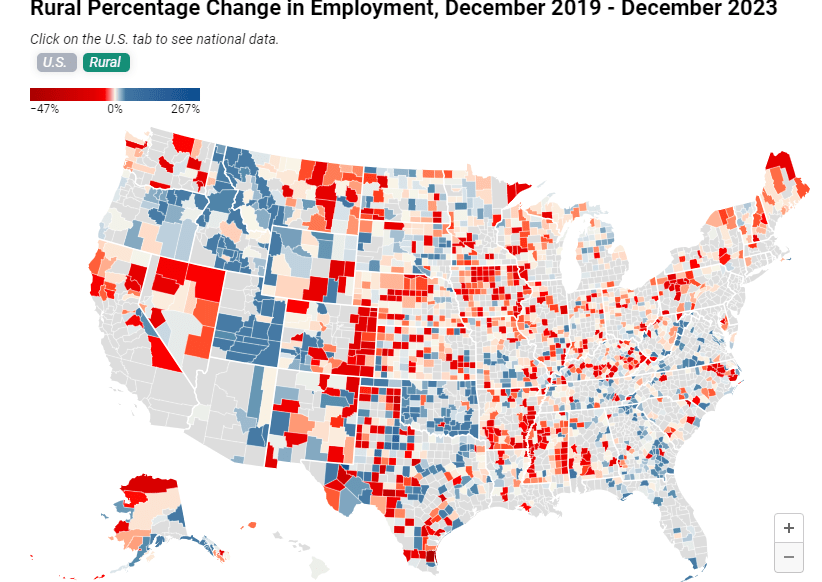
Total employment in rural (nonmetropolitan) counties in December 2023 was down 0.4% compared to December 2019, the last December before the economic shutdown in March 2020.
The graph above compares monthly total employment to the same month before the start of the pandemic. This method provides a way of measuring how well the job market has recovered since the pandemic while factoring out seasonal impacts on employment.
Metropolitan counties returned to pre-pandemic employment in January 2022 and remained in positive territory ever since. Rural counties, on the other hand, didn’t reach pre-pandemic employment levels until more than a year later, in March 2023. Since then, rural counties have been in positive territory only two other times, April and November 2023.
The latest monthly county-level numbers showed that rural America had 90,000 fewer jobs in December of 2023 than the same month in 2019. Metropolitan counties, meanwhile, saw a 1.5% increase in employment since December of 2019, which adds up to about 2.2 million jobs added to the urban economy. As a whole, the United States witnessed a 1.3% growth in employment.
In the graph at the top of the page, the massive dip in employment in March and April 2020 came from the pandemic-related economic shutdowns. The general trend over the last three and a half years has been toward gradual recovery, both for rural and urban areas.
Most Economic Industries Suffered to Recover Employment in Rural Places
Parts of rural America performed better than others, depending on regional variation and the dominant economic driver in each county.
In rural counties where government employers like federal agencies, prisons, or public schools were the primary economic force, employment grew by over 3,000 jobs, a 0.11% increase over December of 2019.
Rural counties where manufacturing was the dominant industry were down 1.36% from pre-pandemic employment.
Employment in farming-dependent counties dropped by 0.89%, or 11,400 jobs, while “nonspecialized” counties – places where no single industry dominates the local economy – were down about 31,600 jobs, or 0.44% of their pre-pandemic numbers.
Rural counties where mining and natural resource extraction drives the local economy showed the worst employment recovery compared to rural counties in other economic sectors. Between December of 2019 and December of 2023, rural mining communities lost 22,000 jobs, a 1.66% drop in employment.
In rural Lawrence County, Illinois, for example, employment dropped by nearly 900 jobs between December of 2019 and December of 2023. Because Lawrence County is relatively small (about 15,000 people), the change amounted to a whopping 16% decrease in employment since before the pandemic.
Employment in Delta County, Colorado, a rural mining town of 32,000 about 240 miles west of Denver, was down 1,300 jobs last December compared to pre-pandemic numbers. That’s almost a 10% drop.
The county economic types are based on categories created by the Economic Research Service (ERS), a branch of the USDA.
Towns Dependent on Tourism Gained Employment
In rural counties where the economy is built around natural amenities, tourism, and activities like hiking and skiing, recovery from pandemic employment loss tended to show greater promise.
Rural tourism counties witnessed a 1.27% increase in employment between December of 2019 and December of 2023. That’s equal to a loss of about 36,700 jobs. Although recreation-economy counties were harder hit during the early months of the pandemic when travel was curtailed, they have since recovered faster than rural America as a whole.
Westcliffe, Colorado, the county seat of Custer County, is a rural tourism town of 546 residents bordering the popular Sangre de Cristo mountain range about 75 miles south of Colorado Springs. Between December of 2019 and December of 2023, employment in Custer County, which has a population of about 5,300, grew by 21%, although the number of jobs increased by just 400.
In Navajo County, Arizona, a rural county of about 109,000 people, employment increased by 5% between December of 2019 and 2023. A popular tourist attraction in Navajo is Monument Valley Tribal Park, a 91,000 acre stretch of desert inside the Navajo Nation famous for its sandstone buttes. Data from 2017 showed that Monument Valley attracted over 250,000 visitors annually.
Notes
The Economic Research Service (ERS), part of the USDA devoted to analyzing economic trends, creates these economic types by assigning all U.S. counties into one of six mutually – exclusive categories that best describes the county’s economic dependence. A county can fall into one of the following categories – farming, government, recreation, mining, manufacturing, or “nonspecialized.”
We rely on the Office of Management and Budget (OMB) guidelines to categorize counties as either metropolitan or nonmetropolitan, using the nonmetropolitan category as a proxy for rural. We use the 2013 Metropolitan Statistical Area list, not the list released in 2023.
The analysis is based on monthly county-level job numbers from the BLS. The study compares monthly job figures to the same month in previous years, which factors out seasonal changes that can affect employment from one month to the next.
This article first appeared on The Daily Yonder and is republished here under a Creative Commons license.

-
I noticed an article that wrote of Russia using Mosin rifles in Ukraine. The 1891 Mosin may be a little outdated – but it is a common rifle with a lot of variants. One is the “US Rifle, 7.62mm, Model of 1916.” 280,000 were purchased by the US government, and some used by American troops in Murmansk and Archangel in 1918 – yes, we really did invade Russia. Silver Parish’s diary was published and provides a readable record of the event.
Years back, we picked up some surplus Finn Mosins – if memory serves we sold them for a little under $40 each back in the eighties. They were kind of fun to clean up – when disassembled, it looked like the Finnish armorers couldn’t resist the opportunity to try make them a little more accurate – mostly floating the barrels and a bit of muzzle work.
One rifle was not just different – it was a lot different. Instead of the standard dog collar sling attachments, its sling attachments were normal. When I removed the barrel from the stock, there was a surprise on the bottom:
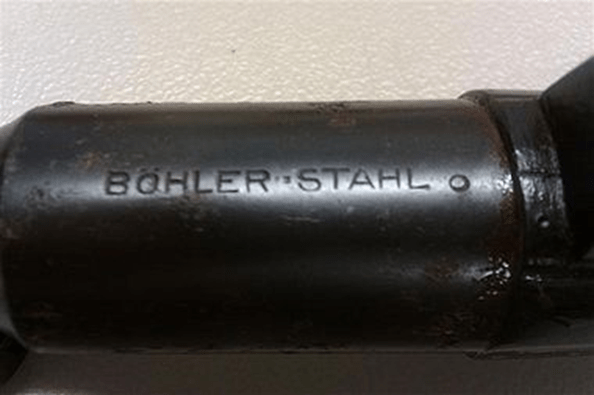
Turned out that the BOHLER – STAHL stamp was the only clue I needed – this was one of the rare 1924 Lotta’s rifles. Figure it was the first SAKO. The stamp on the barrel showed that the barrel was replaced with one that was purchased by the Lotta Svard – the women’s auxiliary of the Finnish Civil Guard.
The LottaKivaari – Lotta’s Rifle in Finnish – shot, even with old surplus Russian Ammo. It was a fun afternoon – since the bottom sight setting for the Lotta was 200, I set my targets at 200 yards. This turned out to mess with my results a little – the 200 meant meters. The non-modified Russians were set at 200 – but that meant arshins, a Russian unit of measurement meaning those sights were set at 155 yards. Lotta did better at 220 yards than the unmodified rifles did at 155. As you can see – Lotta is visibly different than the unmodified 1891 Mosin.

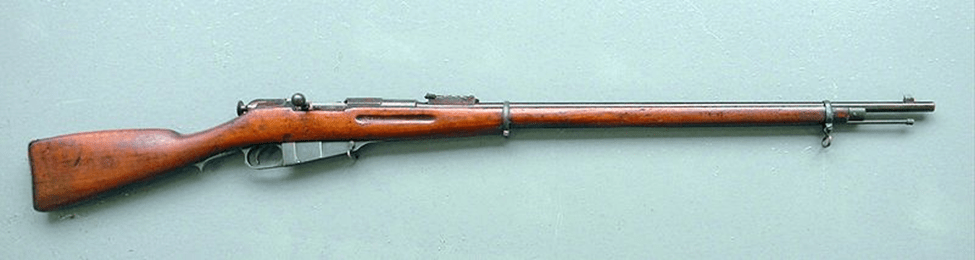
According to Model M24 Mosin Nagant rifle Information (click the link – I’m just sharing a little of the data available there)
“ The diameter of the barrel was increased by approximately 1mm to improve accuracy. These were produced with a “stepped barrel” near the muzzle to accommodate the standard bayonet. The M24 barrels are undated and have the Finnish Civil Guard crest, an S topped with three fir sprigs in a shield, on top of the chamber.
Included at this time were changes made to deepen the barrel channel in the forestock; a deeper handguard inlet; and also an improved trigger with a coil spring added to take up trigger slack and improve trigger pull. These design changes were instituted in mid 1925. Many rifles were also fitted with a cross bolt through the forestock just behind the nose cap to retain the front barrel band. This was done so the barrel band could be left loose thereby eliminating a pressure point on the barrel and increasing accuracy. Eventually the Finns did away with this modification in favor of using small wood screws to secure the loosened barrel bands.
Assembly of the M24 was done at Suojeluskuntain Ase-ja Konepaja Osakeyhtiö, the Finnish Civil Guard workshop that eventually would become known as SAKO. Funds for the refurbishment of the M24 rifles was raised by the civil guard women’s auxiliary known as the Lotta Svard. The M24 was nicknamed “Lottakivaari” or “Lotta’s rifle” by troops that carried it into battle in at least three wars.”
Townsend Whelen said “Only accurate rifles are interesting.” He just might have liked Lotta’s Rifle. Lotta’s rifle is interesting – both in accuracy and history. Picture, if you will, the ladies auxiliary raising money to fund new barrels for the militia rifles. I never shouldered the rifle without thinking of bake sales to build better rifles.
And yes – Lotta still shoots well . . . and the 1905 Czarist rifle that was the best stock Mosin 35 years ago still does a good job if I remember how long an arshin is.
-
It’s a wonderful world where a peasant can get Biden Quality drugs. I’m not talking about Hunter’s cocaine. I’m talking about the injection that takes you from Slow Joe mumbling to the animation of his State of the Union speech.
I know – for on March 8, I went on youtube to access the State of the Union speech. First I got 60 seconds of Slow Joe mumbling through a fundraising pitch. Then I got to listen to an enthusiastic, animated Joe Biden, talking about standing up to Russia and protecting Ukraine. It was impressive. Better things for better living through chemistry.
It was impressive, because I too received a Biden Quality injection. I had driven to the orthopedic place because I couldn’t get into the passenger seat with a bad left knee. It took at least ten minutes to get that bum leg into the driver’s side in my wife’s car – folks who know me, know I like manual transmissions. This was a time when I couldn’t walk or even drive my own car. It was Slow Mike that finally got out of the car and hobbled into the orthopedic place.
You know you’re not doing very well when the crippled patients in the orthopedic clinic are trying to help you get to a chair, to carry your book for you, help you to your seat – and you accept that help (the professional staff are more detached – after all, they see people in worse shape than themselves every day.)
About a half-hour later I got the painkiller/steroid injection into my knee. I walked out of a place that I all but crawled into. It’s a wonderful world that includes a walk-in clinic where you can get a Biden Quality drug injection without so much as an appointment. Only problem was that without the pain, tired began to overcome me around Olney. Renata had the task of keeping me alert enough to get back to Trego -had I been thinking better I would have gotten into the passenger seat in the clinic’s parking lot. The thing about drugs is that they make you feel better, not think better. Even Biden Quality Drugs don’t improve thinking.
But talk about feeling better. In less than a day, some of the Biden Quality drug had migrated to my shoulders – both were feeling better. The left had been all but frozen – but with the full-body steroids I powered through and got it moving my arm above my head again. It’s great.
My physician hadn’t heard the term “Biden Quality” drugs before – he may be a closet libertarian. Long story short, if the steroid injection every three months is enough to keep my knee going, I’ll walk with Biden Quality drugs. If it isn’t, I’ll wind up walking on an artificial knee. As I think of the number of crippling knee injuries the records show back in 1900 to 1920 – I live in a wonderful world and a great country. And from the easy chair in the living room, I’m watching Goose and Gander as they again establish their nest on the island, beginning another of their own summers of wonder.
-
Students from the Robotics team visited the Eureka Masonic Lodge on March 21 to demonstrate two of their robots. The lodge had contributed $1,000 to help with their trip to the Texas competition. After the Robotics presentation, School Superintendent Joel Graves explained the challenges in passing a bond to pay for a much-needed new school building.

-
Eureka Community Players (ECP) have undertaken a new challenge: writing plays. On Sunday, March 24th, these plays will be presented in an anthology format. Called “The Waiting Room” – An Afternoon of 10-minute Scenes Written by Local Writers begins at 3:00 p.m. at the Timbers Event Center.
In September 2023, The ECP hosted a workshop presented by Maud Powell entitled “Calling All Writers”. Maud founded the Little Apple Playwriters Guild, a collaborative playwriting group. Annually, they write and produce Anthologies of plays. Her workshop in Eureka was to engage writers and others in the process of writing plays as the first step in reaching the ECP goal of an oral history play about the Tobacco Valley. In the workshop, we set certain parameters: 10-12 minutes with 2-3 actors all set in a mutually agreed upon space: a waiting room. The writers also agreed to not direct their own scene or act in it. They met every two weeks with the final script done in January. According to Sharon LaBonty, “Working together, supporting each other, has been fun!”
The Performance:
- Act I
- Jeanne Jankovsky’s “Charlie”;
- JoAnn Bristol’s “A Chance Meeting”;
- Lisa Priller’s “The Waiting in Hell”;
- Lori Stoffer’s “Tire Store” make up Act I.
- Act II
- Sharon LaBonty’s “I Wanna Be A Star”;
- John LaBonty’s “WWII and Two Montana Women”;
- Adrian Miller’s “Ice Fishing Tale of Woe-begone”.
- Question and Answer session with the writers.
Many of Eureka’s favorite actors are bringing these original scenes to life. These actors include Heather Smith, Alan Guderjahn, Tigerlily Beamer, Loree Campbell, Cannon Pearson, Danica Cate, Kelley Comstock, Adrian Miller, John and Lisa Priller, Judy Russell and Lori Stoffer. New faces on stage are Bella Otto, Becky Gray, and Dessie Stoffer. The Players hope to make this anthology writing an annual event. The Eureka Community Players invite anyone that is interested to join on Sunday.
The Waiting Room: Sunday March 24th, 3 PM. Timbers Event Center. No ticket sales, but there will be a donation basket for anyone inclined to help the Eureka Community Players cover rent for the event.
- Act I

Want to tell us something or ask a question? Get in touch.

Recent Posts
- When Castro Was Cool
- You Have To Beat Darwin Every Day
- Computer Repair by Mussolini
- Getting Alberta Oil to Market
- Parties On Economics
- Thus Spake Zarathustra – One More Time
- Suspenders
- You Haven’t Met All The People . . .
- Play Stupid Games, Win Stupid Prizes
- The Ballad of Lenin’s Tomb
- An Encounter With a Lawnmower Thief
- County Property Taxes
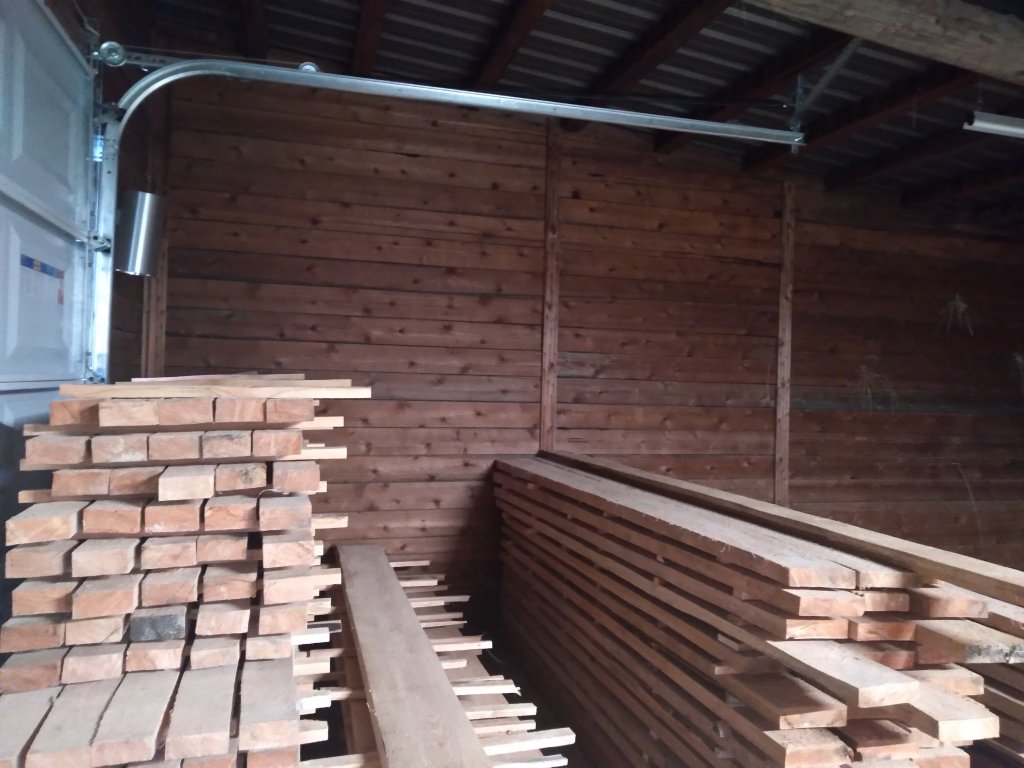
Rough Cut Lumber
Harvested as part of thinning to reduce fire danger.
$0.75 per board foot.
Call Mike (406-882-4835) or Sam (406-882-4597)
Popular Posts
Ask The Entomologist Bears Books Canada Census Community Decay Covid Covid-19 Data Deer Demography Education Elections Eureka Montana family Firearms Game Cameras Geese Government Guns History Inflation life Lincoln County Board of Health Lincoln County MT Lincoln Electric Cooperative Montana nature News Patches' Pieces Pest Control Politics Pond Recipe School School Board Snow Taxes travel Trego Trego Montana Trego School Weather Wildlife writing
 Trego's Mountain Ear