-
Remember that community choir from several weeks ago? Practice on Mondays? Well- now you get to see if the practice is paying off (it is!). Come listen on Sunday, at 3pm, at the Timbers Event Center.
There’s a variety of songs, both religious and secular. All excellent. Did you know that someone has put parts of the Jungle Book to music?

-
I keep seeing commentary about the need for a two-state solution in Israel – a separate state for Palestinians. Not every American realizes that we have hundreds of separate nations within our country – I don’t know of any Indian Reservations in Delaware or New Jersey, but If I drive west, I’ll go by the Kootenai Reservation in Bonners Ferry, heading south puts me through the Salish-Kootenai in Ronan, and driving east I travel through the Blackfeet in Browning.
While these are termed Indian Reservations, they are legally ‘domestic dependent nations’. Understanding Tribal Sovereignty gives us this description:
“The U.S. Supreme Court has acknowledged that tribal governments are the oldest sovereigns on the continent—Native American sovereignty predates the sovereignty of the U.S.—and as such, tribes and tribal people maintain some degree of control, though a diminished measure of sovereignty to be sure. Tribal sovereignty includes the right to govern one’s community, the ability to preserve one’s culture, and the right to control one’s own economy.
The sovereignty status (tribal sovereignty encompassing Native American military, social, and economic development) of Indian nations still remains today. As sovereign entities, Indian nations are guaranteed the power and/or right to determine their form of government, define citizenship, make and enforce laws through their own police force and courts, collect taxes, and regulate property use.”
The missing power that really emphasizes the ‘dependent’ part is the ability to keep and maintain their own military – but I have never seen a powwow that didn’t include an armed color guard. Still, our Native neighbors have all the rights of American citizens, plus some additional rights and obligations based on the individual tribe.
One of the ironies is that a tribal member has more forms of identification than the average American. Just having the blood quantum or DNA isn’t enough to qualify – it also takes the tribal membership, the recognition of being a member of a separate ‘domestic, dependent nation.’
Pappy Boyington – the WWII Marine Ace – had the blood quantum from his Sisseton mother – but was not a tribal member. Woodrow Keeble, on the other hand, was a member of the Sisseton-Wahpeton Oyate. Both men received the Medal of Honor for their service in the US military.
For anyone who may have missed the lesson, several of the tribes that are now ‘domestic, dependent nations’ had some fairly harsh encounters with other Americans. A brief review of the Comanche will show some atrocities that exceed those committed by Palestinians. The Iroquois name for George Washington was (probably still is) Town Destroyer:
“As a Mohawk citizen of the Haudenosaunee Confederacy – the oldest living democracy in the Western Hemisphere – when I see statues of Washington, like the towering equestrian monument at the Virginia Capitol in Richmond, or the colossus in front of Federal Hall in New York, I see not only a founding father, but also a genocidal one. The title by which Washington was known to Native nations, Hanödaga:yas or Town Destroyer, was one he inherited from his great-grandfather, John Washington, a slave-owning planter and colonel in the Virginia militia who, during Bacon’s Rebellion of 1676, had the chiefs of several tribes killed. His great-grandson lived up to the name of Town Destroyer in his treatment of Indigenous nations both during and after the Revolutionary War (1775–83). Wanting to remain neutral but forced to choose sides, some Haudenosaunee nations fought alongside the colonists during the war. Others, like the Mohawk, fought with their longstanding allies, the British.”
George Washington, Town Destroyer | FriezeI can’t say that our Reservations are a perfect solution – but I have met, and know some great people who are members of our ‘dependent domestic nations.’
-
Bacteria can develop resistance to drugs they haven’t encountered before − scientists figured this out decades ago in a classic experiment
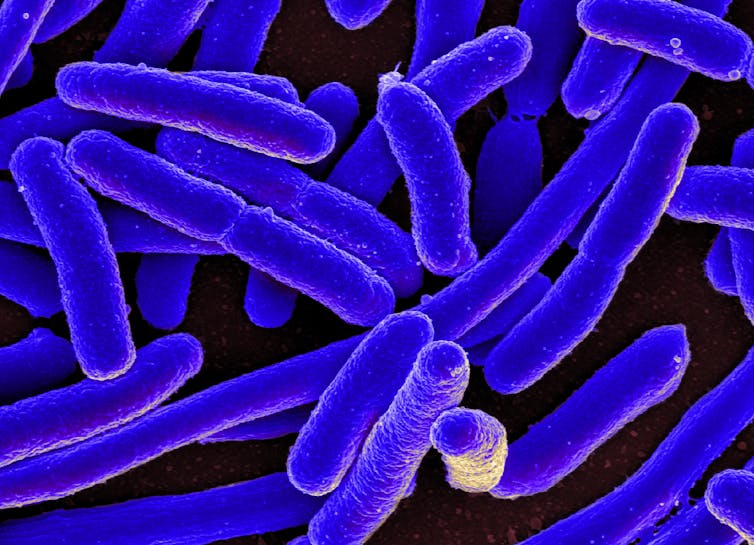
Bacteria are evolutionarily primed to outpace drug developers. National Institute of Allergy and Infectious Diseases, National Institutes of Health/Flickr, CC BY-NC Qi Zheng, Texas A&M University
Do bacteria mutate randomly, or do they mutate for a purpose? Researchers have been puzzling over this conundrum for over a century.
In 1943, microbiologist Salvador Luria and physicist turned biologist Max Delbrück invented an experiment to argue that bacteria mutated aimlessly. Using their test, other scientists showed that bacteria could acquire resistance to antibiotics they hadn’t encountered before.
The Luria–Delbrück experiment has had a significant effect on science. The findings helped Luria and Delbruck win the Nobel Prize in physiology or medicine in 1969, and students today learn this experiment in biology classrooms. I have been studying this experiment in my work as a biostatistician for over 20 years.
Decades later, this experiment offers lessons still relevant today, because it implies that bacteria can develop resistance to antibiotics that haven’t been developed yet.
Slot machines and a eureka moment
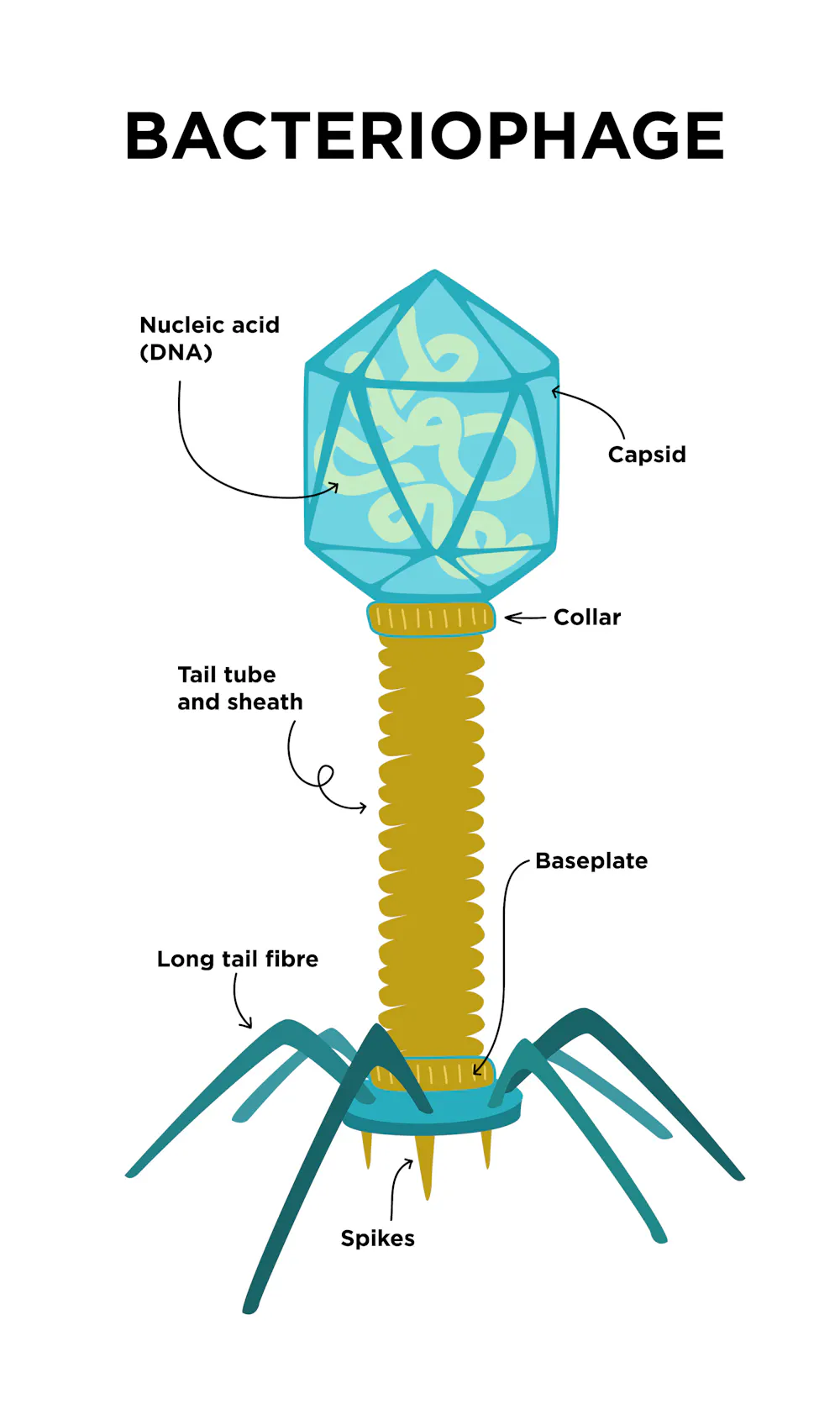
Imagine a test tube containing bacteria living in nutrient broth. The broth is cloudy due to the high concentration of bacteria within it. Adding a virus that infects bacteria, also known as a phage, into the tube kills most of the bacteria and makes the broth clear.

Bacteriophages are viruses that specifically infect bacteria. Kristina Dukart/iStock via Getty Images Plus However, keeping the test tube under conditions favorable for bacterial growth will turn the broth cloudy again over time. This indicates that the bacteria developed resistance against the phages and were able to proliferate.
What role did the phages play in this change?
Some scientists thought the phages incited the bacteria to mutate for survival. Others suggested that bacteria routinely mutate randomly, and the development of phage-resistant variants was simply a lucky outcome. Luria and Delbrück had been working together for months to solve this conundrum, but none of their experiments had been successful.
On the night of Jan. 16, 1943, Luria got a hint about how to crack the mystery while watching a colleague hit the jackpot at a slot machine. The next morning, he hurried to his lab.
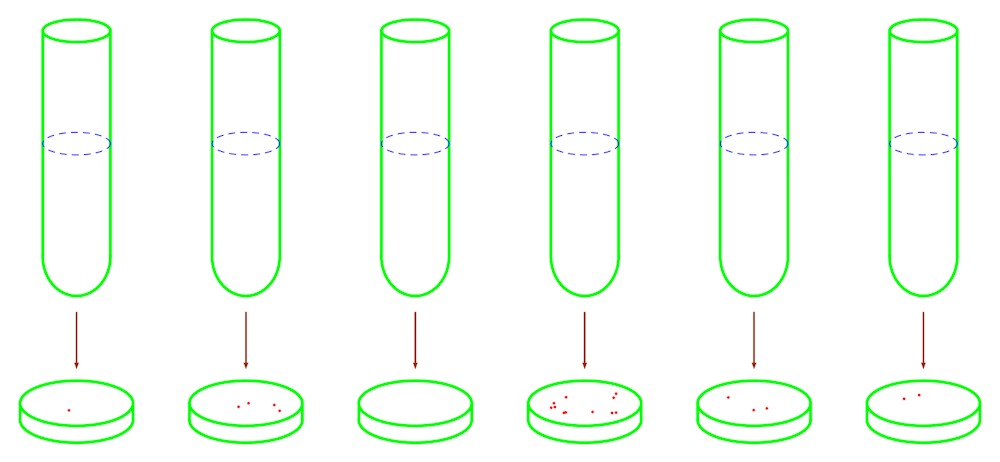
Luria’s experiment consisted of a few tubes and dishes. Each tube contained nutrient broth that would help the bacteria E. coli multiply, while each dish contained material coated with phages. A few bacteria were placed into each tube and given two opportunities to generate phage-resistant variants. They could either mutate in the tubes in the absence of phages, or they could mutate in the dishes in the presence of phages.
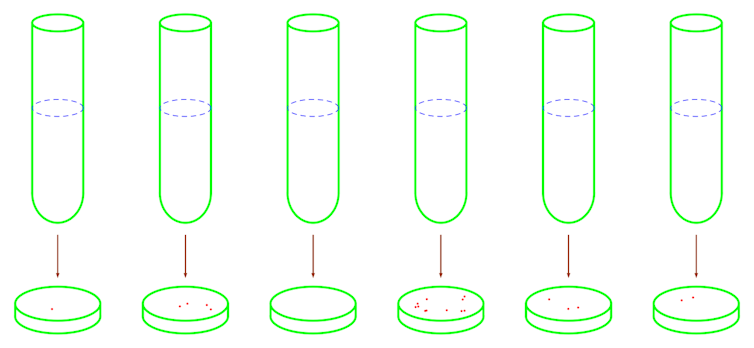
This diagram of the Luria-Delbrück experiment depicts colonies of phage-resistant variants of E. coli (red) developing in petri dishes. Qi Zheng, CC BY-SA The next day, Luria transferred the bacteria in each tube into a dish filled with phages. The day after that, he counted the number of resistant bacterial colonies in each dish.
If bacteria develop resistance against phages by interacting with them, none of the bacteria in the tubes should have mutations. On the other hand, only a few of the bacteria – say, 1 out of 10 million bacteria – should spawn resistant variants when they are transferred into a dish containing phages. Each phage-resistant variant would grow into a colony, but the remaining bacteria would die from infection.
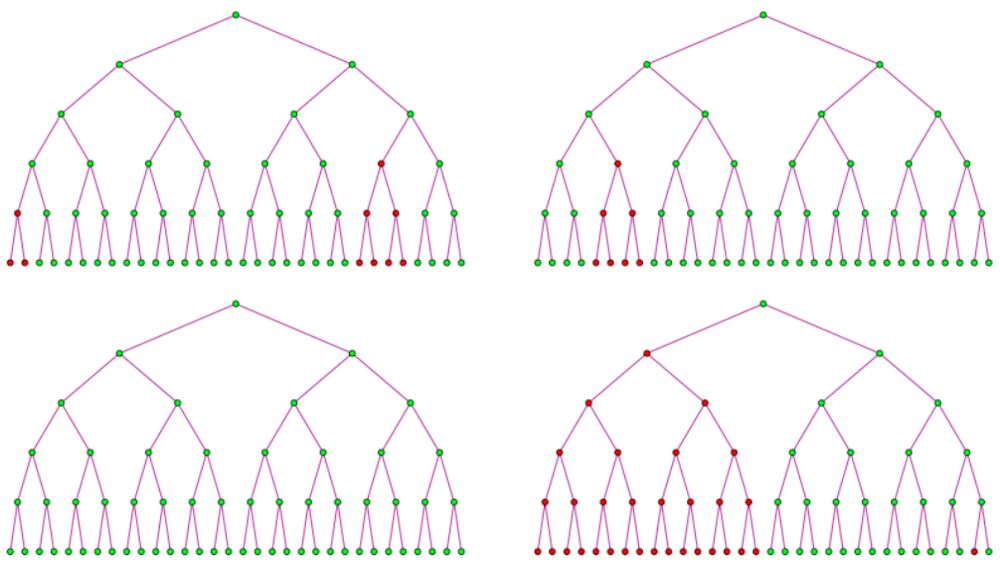
If bacteria develop resistance independently of interacting with phages, some of the bacteria in the tubes will have mutations. This is because each time a bacterium divides in a tube, it has a small probability of spawning a resistant variant. If the starting generation of bacteria is the first to mutate, at least half of the bacteria will be resistant in later generations. If a bacterium in the second generation is the first to mutate, at least an eighth of the bacteria will be resistant in later generations.
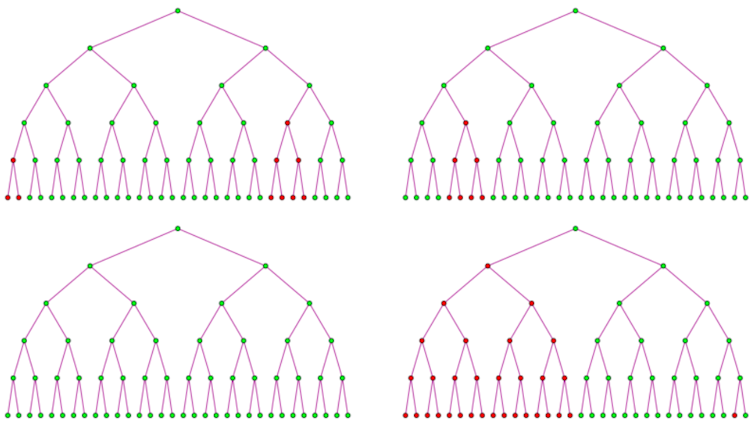
Mutations that confer resistance against phages (red) early on will spawn a large number of phage-resistant variants, while mutations that occur later on will spawn only a few resistant variants. Qi Zheng, CC BY-SA Like small-prize cash-outs in slot machines, late-generation mutations occur more often but give fewer resistant variants. Like jackpots, early-generation mutations occur rarely but give large numbers of variants. Early-generation mutations are rare because early on there are only a small number of bacteria available to mutate.
For example, in a 20-generation experiment, a mutation occurring at the 10th generation of bacteria would give 1,024 phage-resistant variants. A mutation occurring at the 17th generation would give only four phage-resistant variants.
The number of resistant colonies in Luria’s experiments showed a similar pattern to that of slot machine cash-outs. Most dishes contained no or small numbers of mutant colonies, but several contained a large number of mutant colonies that Luria considered jackpots. This meant that the bacteria developed resistant variants before they interacted with the phages in the dishes.
An experiment’s legacy
Luria sent a note to Delbrück after his experiment was completed, asking him to check his work. The two scientists then worked together to write a classic paper describing the experimental protocol and a theoretical framework to measure bacterial mutation rates.
Other scientists conducted similar experiments by replacing phages with penicillin and with tuberculosis drugs. Similarly, they found that bacteria did not need to encounter an antibiotic to acquire resistance to it.
Bacteria have relied on random mutations to cope with harsh, constantly changing environments for millions of years. Their incessant, random mutations will lead them to inevitably develop variants that are resistant to the antibiotics of the future.
Drug resistance is a reality of life we will have to accept and continue to fight against.
Qi Zheng, Professor of Biostatistics, Texas A&M University
This article is republished from The Conversation under a Creative Commons license. Read the original article.
-
I ran across a good article that explains the insecurity of Social Security. A lot of the time I run across articles written by alarmists. This one seems to just calmly describe why the Social Security system is facing major problems in the next 10 years, and how correcting those should have been done earlier.
If you don’t need excerpts to convince you to click the link, click it now. If you need convincing to click it, stay with me. It is really worth reading the whole thing.
Social Security started in 1935 – so, by the time it starts feeling the pinch (2033) it will have had essentially a hundred year run. As government programs go, that isn’t bad – generally politicians can’t see much further than the next election.
Here’s the first fact from the article: “In 2024, Social Security will collect $1.308 trillion in payroll taxes (and related revenues) and spend $1.459 trillion in benefits. The resulting $151 billion shortfall will be funded by deficit spending that contributes to the national debt. Because the Social Security system ran $3 trillion in surpluses from 1983 to 2009, it is legally entitled to run $3 trillion in deficits until these two figures balance out, which is currently expected to occur in 2033.” That’s 9 years down the road. It may or may not be in my lifetime – but 2033 is not all that long from today.
The second fact from the article: “Current law mandates that when the trust fund balance hits zero—which is when the $3 trillion in earlier surpluses has been repaid—the system will be legally forbidden from borrowing or receiving any more general revenues. Program spending must then fall to match the system’s revenues, and that will mean an automatic across-the-board 23 percent benefit cut.”
And a third brief fact to convince you to click the link and read the whole article: “From 2023 to 2053, Social Security is projected to collect $69 trillion in payroll and benefit taxes, while spending $92 trillion on benefits.” Click the link – it may take ten minutes to read the article, and it is well worth reading.
It’s been a long time since Ernest Ackerman got the first Social Security check (for 17 cents).
-
As I have watched the events lead up toward Presidential Election 2024, a few things are becoming clear. One is that right wing or left wing doesn’t make a lot of difference when both wings are attached to a buzzard.
Both parties are corporations. If you don’t own stock in a corporation, the corporation doesn’t have to pay attention to you – even if you vote straight party line and consider yourself a proud democrat or republican. Bernie Sanders supporters discovered that back in 2020 –DNC to Court: We Are a Private Corporation With No Obligation to Follow Our Rules | Independent Voter News
“A federal judge dismissed the DNC lawsuit on August 28. The court recognized that the DNC treated voters unfairly, but ruled that the DNC is a private corporation; therefore, voters cannot protect their rights by turning to the courts:
“To the extent Plaintiffs wish to air their general grievances with the DNC or its candidate selection process, their redress is through the ballot box, the DNC’s internal workings, or their right of free speech — not through the judiciary.”
So as I look at the upcoming election, I am remembering that both wings are attached to the same bird. Biden’s like 81 years old. Trump is 77. Nothing personal, but both of them are too old – entirely too old. At my age, I want my nation’s leaders (and my whisky) to be younger than I am.
Albert Jay Nock wrote Our Enemy the State in 1935 – when I was younger, it was hard to find a copy. Now, with the net, it’s only a click away: Our Enemy, The State .
“There are two methods, or means, and only two, whereby man’s needs and desires can be satisfied. One is the production and exchange of wealth; this is the economic means. The other is the uncompensated appropriation of wealth produced by others; this is the political means.”
“Uncompensated appropriation of wealth produced by others: this is the political means.” Albert Jay Nock would have had no problem recognizing the bird of state as a vulture – and yet the vulture preys only on the dead. The bird of state preys on the living.
Nock stresses the change from the church-state of 1500 to the modern, sectarian state.
“Another strange notion pervading whole peoples is that the State has money of its own; and nowhere is this absurdity more firmly fixed than in America. The State has no money. It produces nothing. It existence is purely parasitic, maintained by taxation; that is to say, by forced levies on the production of others. ‘Government money,’ of which one hears so much nowadays, does not exist; there is no such thing.”
Another concept – there is no ‘Government money’ – the State is parasitic, maintained by forced levies.
“The idea that the State originated to serve any kind of social purpose is completely unhistorical. It originated in conquest and confiscation – that is to say, in crime. It originated for the purpose of maintaining the division of society into an owning-and-exploiting class and a propertyless dependent class – that is, for a criminal purpose.”
Nock definitely was prescient – seeing the State as set up for a criminal purpose. That view seems to be supported by today’s news.
“When politicians say “I’m in politics,” it may or may not be possible to trust them, but when they say, “I’m in public service,” you know you should flee.”
“The State always moves slowly and grudgingly towards any purpose that accrues to society’s advantage, but moves rapidly and with alacrity towards one that accrues to its own advantage; nor does it ever move towards social purposes on its own initiative, but only under heavy pressure, while its motion towards anti-social purposes is self-sprung.”
“It is interesting to observe that in the year 1935 the average individual’s incurious attitude towards the phenomenon of the State is precisely what his attitude was toward the phenomenon of the Church in the year, say, 1500. It does not appear to have occurred to the Church-citizen of that day, any more than it occurs to the State-citizen of the present, to ask what sort of institution it was that claimed his allegiance.”
“Driving jobholders out of office is like the old discredited policy of driving prostitutes out of town. Their places are immediately taken by others who are precisely like them.”
“The State did not originate in any form of social agreement, or with any disinterested view of promoting order and justice. Far otherwise. The State originated in conquest and confiscation, as a device for maintaining the stratification of society permanently into two classes-an owning and exploiting class, relatively small, and a propertyless dependent class. . . . No State known to history originated in any other manner, or for any other purpose than to enable the continuous economic exploitation of one class by another.”
“Taking the State wherever found, striking into its history at any point, one sees no way to differentiate the activities of its founders, administrators and beneficiaries from those of a professional-criminal class.”
Now, it’s time to quit reading these Nock quotes and to click the link and read his book.
-
We take arabic numbers for granted, and rarely think how difficult multiplication and division would be with anything other than our positional system. If you glance at Roman numbers like IV and XXVI, and think how difficult division would be, then realize that Roman numerals were an improvement on what the old Greeks had to work with, the true brilliance of A squared plus B squared equals C squared comes through.

Still, the illustration suggests that the Pythagorean theorem was probably developed by working stiffs who knew that a triangle with sides in a 3:4:5 ratio would always have a right angle. The Sumerians built with right angles and a more unwieldy numbering system than even the ancient Greeks. Picture, if you will, doing multiplication and division with written words and not the numbers we regard as normal. Those early builders may not have had the theory – but they did know that the 3:4:5 ratio gave them right angles. Pythagoras and Euclid stood on the shoulders of those Sumerian craftsmen.
It has taken me most of a lifetime to realize that the great thinkers of classical Greece stood on the shoulders of those working stiffs who had developed particular aspects of thought but did not have a culture of science to integrate those discoveries. Pythagorus and Euclid harvested the low-hanging fruit that craftsmen and laborers discovered and left available over the preceding two millennia. The Sumerian math system was based on 12 and 60 – counting knuckles on one hand, and using individual thumb and fingers on the other to keep track of the dozens. Still, even that system was easier to use than the system Pythagorus had on hand. And the Sumerian system is still with us for measuring seconds, minutes and hours.
Pythagoras inheriting the unwieldy Greek system, invented a new system of numbering (from TRIANGULAR NUMBERS AND PYTHAGOREAN TRIPLES – A SURPRISING RELATIONSHIP which is worth clicking and reading for a great explanation)

While we think of Pythagoras as Greek, he lived and taught in southern Italy.
-
Early COVID-19 research is riddled with poor methods and low-quality results − a problem for science the pandemic worsened but didn’t create

The pandemic spurred an increase in COVID-19 research, much of it with methodological holes. Andriy Onufriyenko/Moment via Getty Images Dennis M. Gorman, Texas A&M University
Early in the COVID-19 pandemic, researchers flooded journals with studies about the then-novel coronavirus. Many publications streamlined the peer-review process for COVID-19 papers while keeping acceptance rates relatively high. The assumption was that policymakers and the public would be able to identify valid and useful research among a very large volume of rapidly disseminated information.
However, in my review of 74 COVID-19 papers published in 2020 in the top 15 generalist public health journals listed in Google Scholar, I found that many of these studies used poor quality methods. Several other reviews of studies published in medical journals have also shown that much early COVID-19 research used poor research methods.
Some of these papers have been cited many times. For example, the most highly cited public health publication listed on Google Scholar used data from a sample of 1,120 people, primarily well-educated young women, mostly recruited from social media over three days. Findings based on a small, self-selected convenience sample cannot be generalized to a broader population. And since the researchers ran more than 500 analyses of the data, many of the statistically significant results are likely chance occurrences. However, this study has been cited over 11,000 times.
A highly cited paper means a lot of people have mentioned it in their own work. But a high number of citations is not strongly linked to research quality, since researchers and journals can game and manipulate these metrics. High citation of low-quality research increases the chance that poor evidence is being used to inform policies, further eroding public confidence in science.
Methodology matters
I am a public health researcher with a long-standing interest in research quality and integrity. This interest lies in a belief that science has helped solve important social and public health problems. Unlike the anti-science movement spreading misinformation about such successful public health measures as vaccines, I believe rational criticism is fundamental to science.
The quality and integrity of research depends to a considerable extent on its methods. Each type of study design needs to have certain features in order for it to provide valid and useful information.
For example, researchers have known for decades that for studies evaluating the effectiveness of an intervention, a control group is needed to know whether any observed effects can be attributed to the intervention.
Systematic reviews pulling together data from existing studies should describe how the researchers identified which studies to include, assessed their quality, extracted the data and preregistered their protocols. These features are necessary to ensure the review will cover all the available evidence and tell a reader which is worth attending to and which is not.
Certain types of studies, such as one-time surveys of convenience samples that aren’t representative of the target population, collect and analyze data in a way that does not allow researchers to determine whether one variable caused a particular outcome.
Systematic reviews involve thoroughly identifying and extracting information from existing research.
All study designs have standards that researchers can consult. But adhering to standards slows research down. Having a control group doubles the amount of data that needs to be collected, and identifying and thoroughly reviewing every study on a topic takes more time than superficially reviewing some. Representative samples are harder to generate than convenience samples, and collecting data at two points in time is more work than collecting them all at the same time.
Studies comparing COVID-19 papers with non-COVID-19 papers published in the same journals found that COVID-19 papers tended to have lower quality methods and were less likely to adhere to reporting standards than non-COVID-19 papers. COVID-19 papers rarely had predetermined hypotheses and plans for how they would report their findings or analyze their data. This meant there were no safeguards against dredging the data to find “statistically significant” results that could be selectively reported.
Such methodological problems were likely overlooked in the considerably shortened peer-review process for COVID-19 papers. One study estimated the average time from submission to acceptance of 686 papers on COVID-19 to be 13 days, compared with 110 days in 539 pre-pandemic papers from the same journals. In my study, I found that two online journals that published a very high volume of methodologically weak COVID-19 papers had a peer-review process of about three weeks.
Publish-or-perish culture
These quality control issues were present before the COVID-19 pandemic. The pandemic simply pushed them into overdrive.
Journals tend to favor positive, “novel” findings: that is, results that show a statistical association between variables and supposedly identify something previously unknown. Since the pandemic was in many ways novel, it provided an opportunity for some researchers to make bold claims about how COVID-19 would spread, what its effects on mental health would be, how it could be prevented and how it might be treated.

Many researchers feel pressure to publish papers in order to advance their careers. South_agency/E+ via Getty Images Academics have worked in a publish-or-perish incentive system for decades, where the number of papers they publish is part of the metrics used to evaluate employment, promotion and tenure. The flood of mixed-quality COVID-19 information afforded an opportunity to increase their publication counts and boost citation metrics as journals sought and rapidly reviewed COVID-19 papers, which were more likely to be cited than non-COVID papers.
Online publishing has also contributed to the deterioration in research quality. Traditional academic publishing was limited in the quantity of articles it could generate because journals were packaged in a printed, physical document usually produced only once a month. In contrast, some of today’s online mega-journals publish thousands of papers a month. Low-quality studies rejected by reputable journals can still find an outlet happy to publish it for a fee.
Healthy criticism
Criticizing the quality of published research is fraught with risk. It can be misinterpreted as throwing fuel on the raging fire of anti-science. My response is that a critical and rational approach to the production of knowledge is, in fact, fundamental to the very practice of science and to the functioning of an open society capable of solving complex problems such as a worldwide pandemic.
Publishing a large volume of misinformation disguised as science during a pandemic obscures true and useful knowledge. At worst, this can lead to bad public health practice and policy.
Science done properly produces information that allows researchers and policymakers to better understand the world and test ideas about how to improve it. This involves critically examining the quality of a study’s designs, statistical methods, reproducibility and transparency, not the number of times it has been cited or tweeted about.
Science depends on a slow, thoughtful and meticulous approach to data collection, analysis and presentation, especially if it intends to provide information to enact effective public health policies. Likewise, thoughtful and meticulous peer review is unlikely with papers that appear in print only three weeks after they were first submitted for review. Disciplines that reward quantity of research over quality are also less likely to protect scientific integrity during crises.

Rigorous science requires careful deliberation and attention, not haste. Assembly/Stone via Getty Images Public health heavily draws upon disciplines that are experiencing replication crises, such as psychology, biomedical science and biology. It is similar to these disciplines in terms of its incentive structure, study designs and analytic methods, and its inattention to transparent methods and replication. Much public health research on COVID-19 shows that it suffers from similar poor-quality methods.
Reexamining how the discipline rewards its scholars and assesses their scholarship can help it better prepare for the next public health crisis.
Dennis M. Gorman, Professor of Epidemiology and Biostatistics, Texas A&M University
This article is republished from The Conversation under a Creative Commons license. Read the original article.
-
Hello,
I would like to share my concerns about the formation of a library district, and another increase in my taxes.
As you are aware our property appraisals went up 43%. That translates to quite an increase in our taxes. I am on a fixed income; I assure you no entity raised my income by 43%.
In addition to this, I understand we will be paying more taxes for schools in May because of an undercollection by the county. I also understand that we are very likely to start paying road taxes. And when will Eureka decide it needs a new high school, again? None of this reflects on the quality or value of our libraries.
I value the library. But the choice is becoming voting against more taxes vs the possibility of losing my home due to my inability to pay taxes. We are not there yet, but we are getting closer all the time. We are financially being squeezed from all sides (not just taxes).
Again, my concern has nothing to do with the library directly. In North Lincoln County we have watched our tax dollars go to Libby. A solution to budget problems regularly involves cutting services to North Lincoln County. The green boxes are a prime example: cut services while raising fees and increasing wages for that department. I fear over time a library district could follow the same path.
We live in very unstable financial times. Know that I value my library but I am very concerned.
-
I knew that I had measured the Kootenai’s lowest snowfalls. I didn’t realize that the 1977 record still stood. I don’t know if the record will still be standing in June – but right now, that seems to be the way to bet.
Back then, it was global warming – and I was measuring record lows as I did snow surveys. So I figured I should start reading a bit more about global warming. As the years went on, the readings got back toward normal, and it looked as if I didn’t have to get too worried . . . it looked like a black swan event, and besides, nobody remembers the guy who ran the stopwatch when Jesse Owens ran at the Olympics in Germany.
The geologists tell me that 12,000 years ago there was a mile or more of ice over the spot I call home. The Pleistocene is the word for the era we live in, when my home is ice-free for one season, and ice-free for part of the other season. (The two seasons are August and Winter . . . some confuse the issue by adding a third season called Construction. It is easy to be skeptical about global warming when your longest season is winter.)
My first calculation about global warming – from a Trego perspective – was that a longer growing season would have some advantages. Heck, we might get to a point where we could raise some short-season varieties of corn, melons – perhaps even blackberries. There’s a lot to be said for longer growing seasons. Perhaps we might get to three seasons – July, August and Winter. Shorter winters might demand less firewood? This global warming may have some advantages for folks who live at the 49th parallel.
Foresters introduced me to the concept of “climax species.” On the place in Trego most of the trees are Douglas Fir – but there are some awesome Ponderosa Pine, that, when we cored the tree, proved to be older. Even older are the snags and remnants that evidence a burn before settlement. Climate may change – either because of human activities or because of natural processes. The one thing that is fairly certain is change. Causality is, of course, subject to debate. Unfortunately, we infer causality from the data – we don’t prove it.
As I looked at it, global warming could have advantages in some places and disadvantages in others. The trick to dealing with any situation is to pick the place where you stand, a place where the advantages show up. I like the city of Paramaribo – but it’s just a touch north of the equator and just a couple feet above sea level. With a 365 day growing season, and a typical temperature of 84 degrees Fahrenheit, there just isn’t a whole lot that higher global temperatures can do for P-bo. On the other hand, a longer growing season, and more growing degree days is going to make the crops grow a little better.
The geological record suggests that climate, like weather, changes. I was there to measure the lowest Kootenai snowfalls on record – but my guess is that there were lower snowfalls that occurred earlier when nobody was hired to measure them. Things change. If I can find ways that those changes make my life better, it’s good.




Want to tell us something or ask a question? Get in touch.

Recent Posts
- When Castro Was Cool
- You Have To Beat Darwin Every Day
- Computer Repair by Mussolini
- Getting Alberta Oil to Market
- Parties On Economics
- Thus Spake Zarathustra – One More Time
- Suspenders
- You Haven’t Met All The People . . .
- Play Stupid Games, Win Stupid Prizes
- The Ballad of Lenin’s Tomb
- An Encounter With a Lawnmower Thief
- County Property Taxes

Rough Cut Lumber
Harvested as part of thinning to reduce fire danger.
$0.75 per board foot.
Call Mike (406-882-4835) or Sam (406-882-4597)
Popular Posts
Ask The Entomologist Bears Books Canada Census Community Decay Covid Covid-19 Data Deer Demography Education Elections Eureka Montana family Firearms Game Cameras Geese Government Guns History Inflation life Lincoln County Board of Health Lincoln County MT Lincoln Electric Cooperative Montana nature News Patches' Pieces Pest Control Politics Pond Recipe School School Board Snow Taxes travel Trego Trego Montana Trego School Weather Wildlife writing
 Trego's Mountain Ear