-
What do Muslims believe and do? Understanding the 5 pillars of Islam
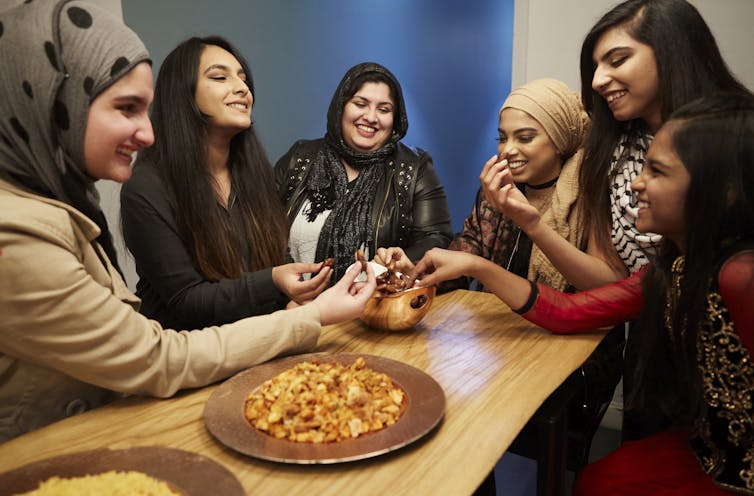
Muslim women break their fast during the holy month of Ramadan. Muslim Girl/ DigitalVision via Getty Images Kalpana Jain, The Conversation
For people who would like to learn more about Islam, The Conversation is publishing a series of articles, available on our website or as six emails delivered every other day, written by Senior Religion and Ethics Editor Kalpana Jain. Over the past few years she has commissioned dozens of articles on Islam written by academics. These articles draw from that archive and have been checked for accuracy by religion scholars.
When I was growing up in India, my father’s Muslim friends would get me new clothes for Eid al-Fitr, a festival that celebrates the end of the fasting month of Ramadan, just as they would for their own children. Later in the day, loads of sewain, a vermicelli dessert filled with nuts, would be sent to our home.
I learned about many cultural rituals in these interactions, but as someone who is not a Muslim, I did not have a deep theological understanding of the Islamic faith until reading the writings of our scholars as an ethics and religion editor.
Today, we will take you through some of the basic tenets of the Islamic faith.
For Muslims, Prophet Muhammad is the most revered of all men. He is the last and most authoritative in a line of prophets that includes Moses and Jesus and is believed to have received direct revelations from God through the archangel Gabriel.
These revelations form the basis of the Muslim holy text, the Quran. The Quran refers to God as Allah, which is the Arabic word for God.
Muslims belong to many different sects – including some you may have heard of, like Sunni and Shiite – but they all share these same fundamental beliefs.
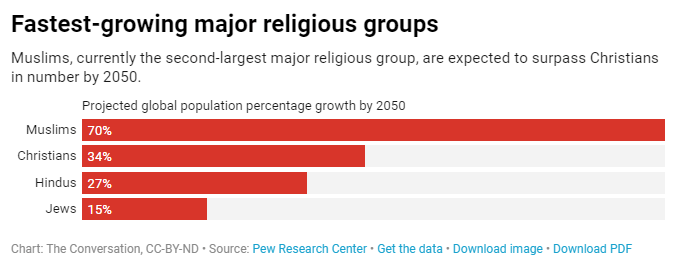
The Islamic faith
There are five pillars – or basic tenets – of the Islamic faith. These are professing one’s faith; praying five times a day; giving zakat, or donating a certain portion of one’s wealth; fasting during Ramadan; and making a pilgrimage to Mecca in Saudi Arabia.
Each of these pillars is an important part of being Muslim. As scholar Rose Aslan writes, “Many Muslims organize their days around the call to prayer and others stop what they are doing during the call and make supplications to God.”
In countries such as Turkey, Saudi Arabia and India, the call to prayer can be heard through loudspeakers mounted on minarets. The sacred text is recited by professionals to evoke piety in their listeners.
Muslims pray in the direction of Mecca in Saudi Arabia. Inside mosques, a prayer niche, a recess in the wall, known as the mihrab, indicates the direction of Mecca.
Scholars explain that for many Muslims, the practice of prayer helps them experience God in an intimate way. The 13th-century Persian Sufi poet Rumi spoke of his experience of prayer as a “delight,” that opened the “window” of his soul.
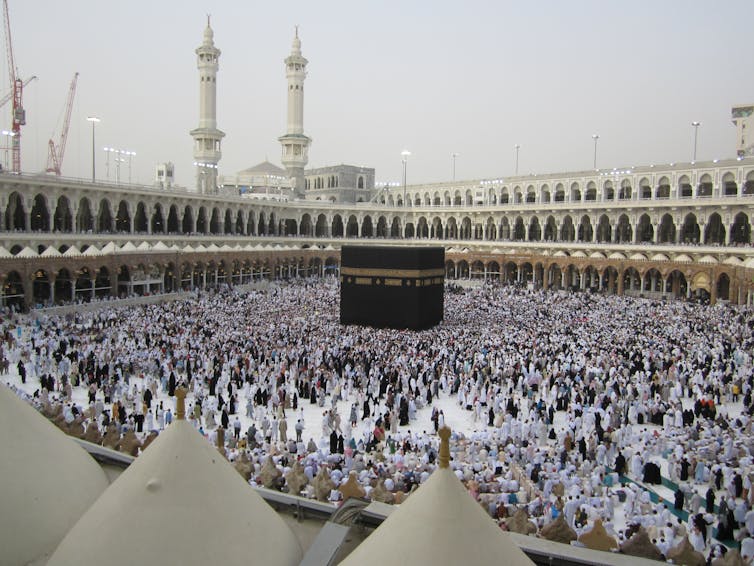
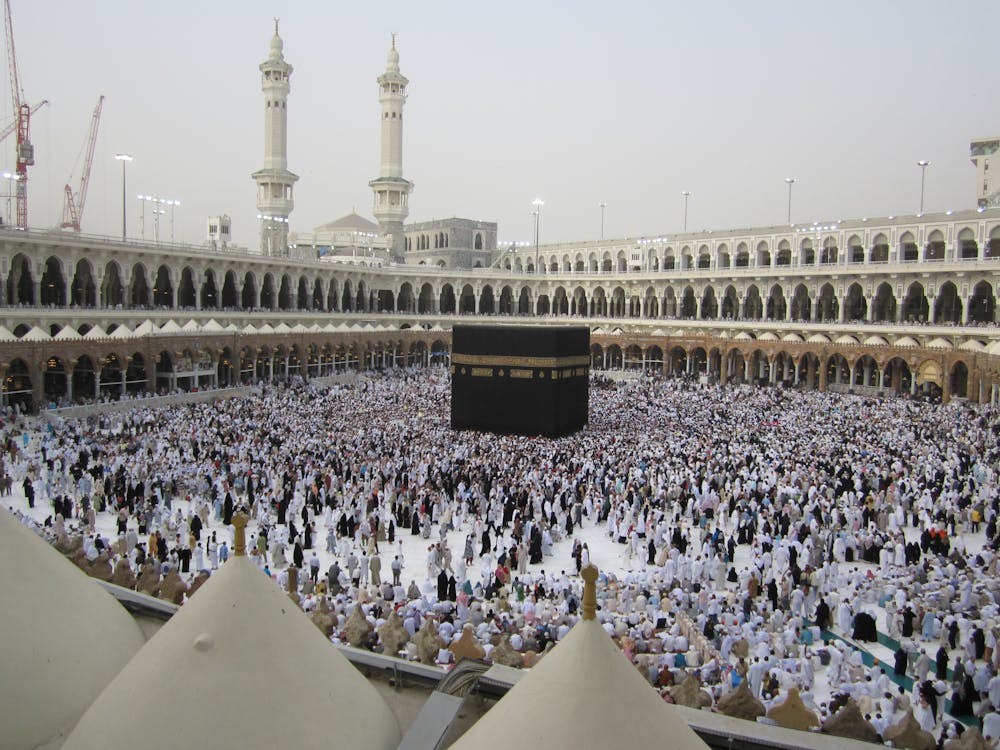
The Kaaba (black structure in middle) in Mecca, Saudi Arabia, has deep religious meaning to Muslims. UmmSqueaky/flickr, CC BY-NC For all Muslims who have the “physical and financial ability” to undertake the journey, the five-day pilgrimage to the Great Mosque of Mecca and the surrounding area is an obligation to be undertaken once in their lives. Inside the Great Mosque of Mecca is a black, cube-shaped structure, the Holy Kaaba.
The Kaaba holds a deep religious significance for Muslims. The Quran tells the story of Ibrahim, who, when commanded by God, agreed to sacrifice his son, Ismail. Scholar Ken Chitwood explains that Muslims believe the Kaaba holds the black stone upon which Ibrahim was to sacrifice Ismail.
The pilgrimage ends with Eid al-Adha, the “feast of the sacrifice.”
Fasts and feasts
If you have heard about or seen your Muslim neighbors fasting, then what they are observing is Ramadan. Muslims believe that the Quran was first revealed to Prophet Muhammad during the month of Ramadan.
Ramadan is the ninth month of the Islamic lunar calendar and lasts either 29 or 30 days. During Ramadan, Muslims observe a fast from sunrise to sunset each day, so they wake up early to share food before the sun appears and end it in later in the evening.
In the 12-month Gregorian calendar used in much of the world, the timing of Ramadan can vary from year to year. The dates depend on when the new crescent moon is visible.
The fasting, as scholar Mohammad Hassan Khalil explains, is a way for Muslims to be conscious of God. It is also meant to help them understand what it is like to be poor.
The fasting ends with the celebration of Eid al-Fitr. Muslim communities often organize large feasts for breaking the fast that are known as “Iftaar” (literally, “breakfast”) at which people from all religions are welcomed. I’ve often attended Iftaar feasts in India.
On Eid, Muslims gather in the mosque for prayers, which are followed by celebrations. In many South Asian countries, sewain are distributed around to friends and neighbors. But customs can vary, and Muslims from different countries and cultures will bring their unique food and traditions to the celebrations of this holy day.
This article was reviewed for accuracy by Ken Chitwood, a Postdoctoral Research Fellow at the Berlin Graduate School of Muslim Cultures & Societies at Freie Universität Berlin. He is also a journalist-fellow at the University of Southern California’s Center for Religion and Civic Culture.
Fact: The first Muslim to ever recite the call to prayer was Bilal Ibn Rabah, son of an enslaved Abyssinian woman, in the city of Medina in the seventh century. At the time, early Muslims were debating the best way to audibly announce the time for prayer so people would know when to gather at the mosque. – From an article written by Rose Aslan, Assistant Professor of Religion, California Lutheran University.
Do now: Listen to these sounds of the call to prayer, and ask yourself how they make you feel.
In the next issue: Who is an American Muslim?

You can read all six articles in this Understanding Islam series on TheConversation.com, or we can deliver them straight to your inbox if you sign up for our email newsletter course.
Articles from The Conversation in this edition:
- Explaining the Muslim pilgrimage of hajj
- What is the significance of Friday prayers in Islam?
- Why Ramadan is Ramadan: 6 questions answered
- On Eid 2017, a peek into the lives of Puerto Rican Muslims
Further Reading and Resources:
- Institute of Social Policy and Understanding: ISPU conducts research to help journalists and others better understand the lives of American Muslims.
- “Islam: An Introduction,” by Annemarie Schimmel: A comprehensive introduction to Islam by an influential Islamic scholar who was a professor at Harvard University from 1967 to 1992.
Kalpana Jain, Senior Religion + Ethics Editor/ Director of the Global Religion Journalism Initiative, The Conversation
This article is republished from The Conversation under a Creative Commons license. Read the original article.
-
The front page of the TVNews, November 1 states the following: The Montana Secretary of State election calendar gives Oct. 18 through Oct. 23 as valid ballot mailing dates, stating: “If conducting election by mail ballot, absentee ballots are sent during this period. A single mailing date must be chosen that is 20-15 days before the election.”
When I had not received a ballot, I decided to email the elections department about it – here’s the exchange:
To: lcelections
Greetings – as I write this, no ballot has arrived in the mail for Michael McCurry, of Trego. Ballots have arrived for my wife, my daughter, and my son-in-law last week, so my assumption is that something got fouled up.
Please get me a ballot in time for me to use it.
I am, respectfully
Michael McCurryGood morning, Michael.
Our system shows that your ballot was sent out 10/25/2023. If you would like us to void that ballot out and reissue you a new ballot, please let us know.
Sierra Gustin
Lincoln County
Elections Assistant
418 Mineral Ave
(406) 283-2304My mailbox still lacks a ballot on 10/30. My recommendation is to void the missing ballot and try get another ballot to me. Just to make sure all is well, my address is PO Box 508, Trego, MT 59934-0508.
let me know when it goes in the mail, and I will watch carefully.
mikeI will get a ballot in the mail for you tomorrow. Since it’s going out close to the election, we suggest you take it to the Eureka sheriff’s office and put it in the ballot drop box before election day so we can be sure it arrives at the election center in time.
Thank you,
Well, I got the ballot in time to rush it in to the cop shop – but in my rush to send it in forgot the privacy envelope, so I’m pretty sure my vote didn’t count. Still, even if I had received the ballot that was reported mailed on 10/25, the Secretary of State’s website last date to mail was 10/23. The names and faces at the Lincoln County Elections office change frequently, but the performance remains the same.
-
We tend to think that modern firearms all have serial numbers – but even the large manufacturers tended to avoid serial numbers before the Gun Control Act of 1968 made serial numbers compulsory. If your old 22 rifle doesn’t have a serial number, it probably just means it was built before 1968.
Remington serial numbered all their long guns before 1941 (even 22s), they had a system that would tell when any particular firearm was built. It’s a pair of letters stamped on the left side of the barrel – one letter tells the month it was built, the other the year.
It’s easy to remember the code for the month – BLACKPOWDERX – B means January, L means February, all the way through to X standing for December.
Years are a bit harder to remember – the first thing to remember is they didn’t use the letter O – it could be mistaken for a zero. The letter I wasn’t used because it could be mistaken for 1. Q could also be mistaken for a zero, so it wasn’t used. So the first thing to remember is that 1920 was L . . . so 1921 was M, 1922 was N, and (because there is no O) 1923 was P. This system went on until 1927 when they skipped U and went straight to V. The system moved on to Z in 1932, then 1933 started with A. Fortunately, in 1942, when L came around again, the nation was on a war footing and not turning out a lot of sporting rifles. 1943 introduced the double lettering for years – MM stands for 1943, and those paired letters continued until January of 1954 (except VV is skipped for some unknown reason) – then, in February, 1954, everything went back to single letters – A continued through 54, followed by B, etc. until 1976 – which was I, 1977 was U, and 1978 was Q. 1979 brought V back, and in 1980 Remington began at A and used the whole alphabet!
In 1999 Remington decided they could dispense with their unique dating system and just work from serial numbers.
My old single-shot is marked BJ5 – which translates to January (B), 1962 (J), Employee Sale (5). I know that the employee sale part is incorrect because my mother bought it for me at the Fairchild Air Base PX.
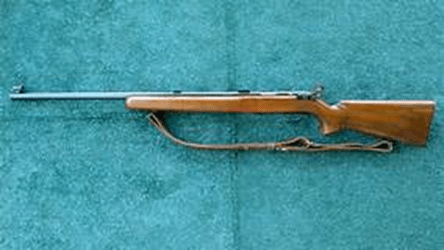
Just to add one more bit of confusion to the old Remington 22 rifles – the Remington 513T Matchmaster (a sweet little bolt action that I have never owned) when owned by the military was called a M-13. Made from 1940 to 1968, and frequently used by the military as a training rifle, it has both serial numbers and date codes.
For a more complete description of Remington’s date codes, click Remington Barrel date Code – it’s worth linking to if you are interested in dating the old Remingtons, and the charts are much more usable than my descriptions.
-
Louis Pasteur is credited with the observation that “Fortune favors the prepared mind.” I suppose I started preparing to identify Lonesome Charley Reynolds’ Sharps rifle before I was 10. I read my grandmother’s book Frontier and Indian Life by Joseph Henry Taylor, and the section on Lonesome Charley began “One day in the early summer of 1870, there appeared at the lower Painted Woods, of then Territory of Dakota, a young man about twenty-four years of age, singing a Sharps 44 calibre, 80 grain charge, rifle over his shoulder and leading a pony in pack. He ostentatiously gave his name as Charley Reynolds, and his occupation that of a professional huntsman.”
Taylor, in 1870, was a hunter and trapper living at the Painted Woods. As he grew older, he became a printer in Washburn, ND, and employed my then teen-aged or younger grandfather as his ‘printer’s devil’ – a phrase describing the job of a juvenile assistant.
When I taught at Trinidad State, I took advantage of the wonderfully complete gunsmithing library to learn more: that 44 calibre Sharps had to be an 1869 cartridge – technically, the 45-77 Sharps was a Remington cartridge first. The two-piece cartridge, part iron, part brass was designed to be cleaned and reloaded easily.
This rifle, sold in 2010 at auction, probably is very similar to the rifle Lonesome Charley carried on that day in 1870 when he met Joe Taylor – and probably similar in appearance before Lonesome Charley’s rifle had it’s stock smashed and barrel bent before being abandoned on the Reno attack section of the Little Bighorn Battlefield:

We ran across Lonesome Charlie’s rifle at the privately owned museum at Garryowen – not far from the spot where Lonesome Charley died at the Little Bighorn. The barrel has been bent, probably by Cavalry troopers who recognized the problem of finding cartridges for it, but didn’t want it left for that fortunate Lakota marksman who might find some.
This 1869 Sporting rifle, sold in 2018, included a factory letter that explained only 50 were made:
“Richard J. Labowskie notes that this rifle is “among the finest of the known examples of Model 1869 Sporting Rifles. . .” Only 50 of these New Model 1869 Sporting Rifles were manufactured in 1869-1872 according to Sharps firearms expert Frank Sellers in his book “Sharps Firearms.”

Lonesome Charley was Custer’s chief of scouts in both the Black Hills expedition and in Custer’s final chapter. Joseph Taylor described their last visit – “Through Reynolds influence with Custer, the writer of these sketches was tendered the position of assistant guide and Reynolds visited the Turtle Valley Ranch where I was then stopping. Holding some regard for the just rights of the Indians in the premises, and fearing a repetition of Chivington’s work at Sand Creek, or of Baker’s butchery of the Piegan small pox victims in Montana, or that of the General himself in the destruction of Black Kettle’s camp of southern Cheyenne’s, the flattering offer was respectfully declined.
In this interview at the Turtle valley – which so far as we two were concerned was destined to be our last – he said while Custer and his officers were of the opinion, basing it upon the attitude of these Indians during the invasion of their hunting grounds about the Black Hills and the various taunting military reconnaissance made from time to time in the Sioux country, that these refractory Sioux under Sitting Bull and Crazy Horse would not make much disturbance or resistance when confronted by military power.
Reynolds seemed of a different opinion. He had been making observations, he said, and he believed the Sioux would fight, and fight hard. He had noticed them quietly preparing for a long time – supplying themselves with plenty of ammunition and the best of Winchester rifles, and every move they were making meant fight, and while he did not believe the Sioux had the dashing courage of a Cheyenne or the stubbornness of a Modoc, there was fight in them and they would show it at the proper time. They expected to fight and he thought that summer would witness the greatest Indian battle ever fought on the continent.
The event of July 25th, of that year marked the chief guide’s prophecy as being nearly correct.”
This studio photograph is the picture of Charley Reynolds in Joseph Taylor’s book.

Reading Joseph Taylor’s book left me prepared for the more modern view of Custer – and learning the rarity of his rifle gives me confidence that the bent Sharps in the museum deserved a more prominent place in the museum – with only 50 made, probability is on my side.
-
I’m listening to the word islamophobia being tossed around the air waves. It seems as carelessly coined a word as homophobia – and years ago, I had to explain that homophobia was a word that misused the term phobia. Here’s the definition, copied directly from the net:
phobia /fō′bē-ə/
noun
- A persistent, abnormal, and irrational fear of a specific thing or situation that compels one to avoid it, despite the awareness and reassurance that it is not dangerous.
- A strong fear, dislike, or aversion.
- Any morbid uncontrollable dread or fear.
The critical thing about a phobia is that it has to be “persistent, abnormal and irrational.” My fear of rattlesnakes isn’t irrational if I am in an area where they are present – though my situational awareness makes me more likely to spot them than folks who aren’t so snake-scared. I blame my grandmother’s stories. I live in Grizzly country – yet I consider the .45 on my belt as caution, not a phobic reaction. One of the nice things about rattlesnakes is that you don’t have to concern yourself with a stray round – the legless critters usually are touching their backstops.
Anyway, Jackson was a great kid – I thought back to a comment I had heard in the Civil Rights days: “Would you want your sister to marry one?” Jackson was black – but my non-existent sister could have found a lot of whites that couldn’t match him as a human being. He was also gay as all hell, so I could never use him as an example to those long-deceased bigots.
With a generation between our ages, his question – “Why was your generation so afraid of gay people?” took a bit of thought to answer. He had accepted the word ‘homophobic’ as meaning a ‘persistent, abnormal and irrational’ fear of gays. After all, Jackson had been admitted to a Ph.D. program – years before he had learned the definition of phobia in a psych class.
Bottom line was that, as we talked about the word ‘homophobic’ I began to realize that it had been adopted in the academy with the psychological meaning, but originated with that second definition – ‘a strong fear, dislike or aversion.” Emphasis on the dislike or aversion. Over the generation that separated Jackson and I, the language, the meaning had changed.
So I’m kind of prepared to look at ‘islamophobia’. Around the year 612, Muhammed started preaching monotheism in Mecca – a rather polytheistic neighborhood. In 622, his uncle, the chief, dies, and Muhammed, whose neighbors aren’t accepting his message, bugs out for a little town called Medina. The neighbors had put a hit on him, so Mecca wasn’t safe anymore. Less than a year after he made it out of Mecca, Mo started raiding Meccan caravans. After graduating from caravan raids to outright war on his former neighbors, Muhammed eliminated the three Jewish tribes that lived in Medina. By the time he died, in the middle of 632, he was running the southern part of Arabia, and had missionaries sent out to Persia, the Eastern Roman Empire, and Axum (Ethiopia).
By 642, Islamic forces had taken Christian Egypt. By 710, the Muslim invasion of Spain began – it would be 1492, 782 years later, before the last Moor was driven from Spain.
I could go into the history in more detail – but the point I’m after is that fear of Islam in terms of warfare and invasion doesn’t qualify as persistent, abnormal and irrational. The argument that Muslims recall the Crusades only goes so far when you check the dates and see that the first Crusade started in 1096 – Abu Bakr took Jerusalem in 637, five years after Muhammed’s death and 550 years before the first crusade. A few of the incidents over the past half-century push my thoughts toward the belief that there are enough of those to make fear of Islam look more normal and rational.
Simple research yields a simple argument – the term islamophobic, like the term homophobic, misuses the term phobia.
-
Despite the fact that Montana’s legislature passed the sunshine protection act making daylight saving time permanent, clocks will still “fall back” next weekend. While federal law allows Montana to stay permanently on standard time, no such provision exists for daylight savings time.
While Montana and many of our surrounding states have voted to make daylight saving time permanent, actually doing so depends on the federal government. The Sunshine Protection act is introduced yearly at the federal level, but has yet to go anywhere.
In the meantime- this graph (shamelessly borrowed from the sleep foundation) suggests what things might look like if it ever does:
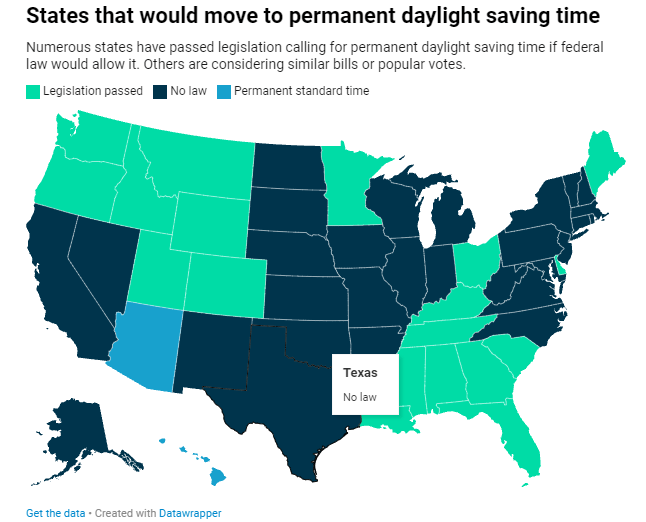
Some observations about what this would look like, if the federal government did allow the change:
- When a state that is always in daylight saving time called a state that is always on standard time, the difference would be constant
- Montana and Arizona would always be an hour different, despite sharing a time zone
- When a state that is always in daylight saving time called a state that is sometimes on daylight saving time, they would have the usual difference in time zone for part of the year (when daylight savings time is active)
- If the state on standard time is “ahead”, when they leave daylight saving time the difference will decrease by an hour
- During daylight saving time, Iowa would be an hour ahead of Montana. When daylight saving time ends, the time would be the same in both states.
- If the state on standard time is “behind”, when they leave daylight saving time the difference will increase by an hour
- During daylight saving time, California is an hour behind Montana. The rest of the year, California would be an additional hour behind Montana.
- If the state on standard time is “ahead”, when they leave daylight saving time the difference will decrease by an hour
- When a state that is always in daylight saving time called a state that is always on standard time, the difference would be constant
-
As a small boy, I heard tales about a Japanese industrial city that had been named Usa, so that products made in that city could be sold as “made in usa.” Later, studying demography at MSU, I visited the library, checked the files, and learned that the industrial powerhouse named Usa had a population of about 70,000. That knowledge got me to questioning some of the things grownups had taught me. Still, I kept an interest in Usa.
This week I saw an aerial photograph taken of Usa. Somehow, it looks like the sort of area that a kid raised in Trego would like:

Snopes says the whole story about “made in Usa” isn’t correct:
“In fact, the Japanese city of Usa (on the island of Kyushu) was not created by renaming an existing town; it was called Usa long before World War II. As well, nearly every country that imports goods requires them to be marked with the name of their country of origin, not a town or city”
https://www.snopes.com/fact-check/made-in-usa/A little more research shows that, in Japan, Usa is best known for being the hometown of Sumo wrestler Futabayama Sadaji, the 35th ranked in his class. Since I don’t follow Sumo, I have no idea why that ranking merits a museum.
Still it remains a good story about bad information – and a beautiful piece of scenery.
-
The hydrological year starts on the first of October. As I write, we’re about a month into the new year – back when I started doing snow surveys, we monitored the fall snows and rains by a small barrel, placed inside a large one, started with several gallons of antifreeze, topped with a touch of transformer oil to prevent evaporation. Bonneville provided the used transformer oil, so it was free. We had a reducing cone over the antifreeze barrel so it wouldn’t overflow.
Now, I can get online in the evening and view the cumulative precipitation – tonight, October 26, it stands at 2.2 inches, and has gone up 80% in the past 48 hours. And the information is available to anyone who wants to click Snow Station Information – STAHL PEAK SNOTEL Life is a whole lot easier now.
NOAA predictions for the coming winter are one of those good news and bad news type of things – the good news is that the Climate Prediction Center is projecting less precipitation and warmer temperatures for the upcoming winter. The bad news is the same:


Projections for the later parts of our upcoming winter aren’t particularly different:
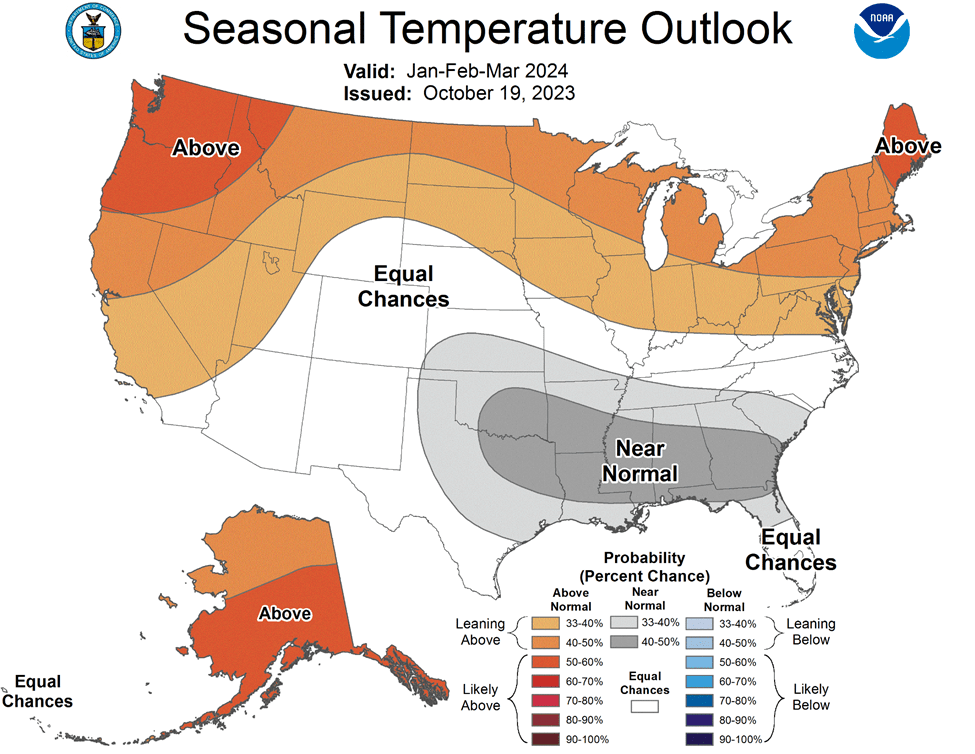

As with Stahl Peak, the Climate Prediction Center projections are available to all at
-
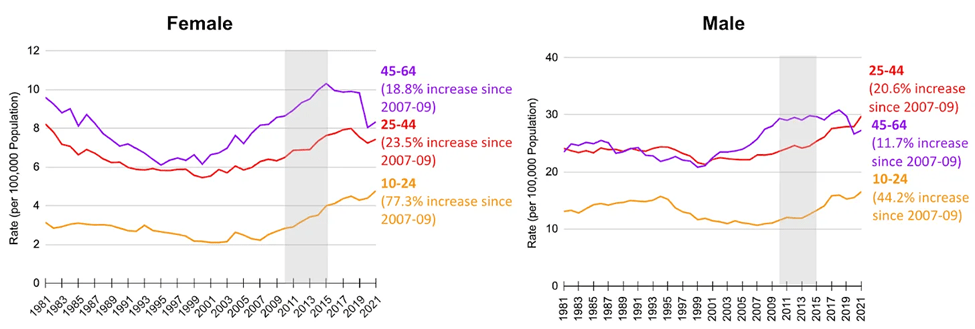
Jonathan Haidt has published an article on suicide rates, contrasting different English speaking nations. I’ve excerpted his US graphs – but the whole article covers a lot more, and is well worth reading. Look at the graphs here, and if they get your attention, click the link and read his article.
Suicide Rates – US – Ages 10 to 64


-
My mother-in-law was a refugee. She lived through the Russian Revolution, the Holodomor, and did a long stretch in Hitler’s camps. She came to the United States in 1947 – Stalin’s decree would have put her doing a tour in Siberia for practicing medicine in those German camps. She was a refugee – her next-door neighbors were a Jewish family who had fled Germany, and the couple across the street were refugees from Poland. But that refugee status belonged to a single generation. Their kids were Americans of the Baby Boom.
Israel declared independence on May 14, 1948. The next day, armies from Egypt, Iraq, Jordan and Syria invaded Israel. The war went on for the next 13 months. The number of refugees from that conflict: 804,766. A 2000 census shows the survivors of that original group of refugees and their descendants number 5,248,185. The Mid-East Monitor shows the number at 6.4 million in 2022. In Jordan, most of the Palestinian refugees are Jordanian citizens. This is not the case in other nations.
Latest Population Statistics for Israel shows:
The Jewish population is 7,181,000 (73.3%), and 2,065,000 (21.1%) are Arabs.
In 2022, the population by religion was roughly 18% Muslim (1,728,000), 2% (184,400) Christian, and 2% Druze (149,400).
From those numbers, my guess is that over 6 million Palestinian refugees were born refugees – never living in the area we call Israel. The dates show that the oldest of those born with refugee status are around 75 years old. One of the horrors of being stateless is the inability to emigrate to a nation where you can build a home.
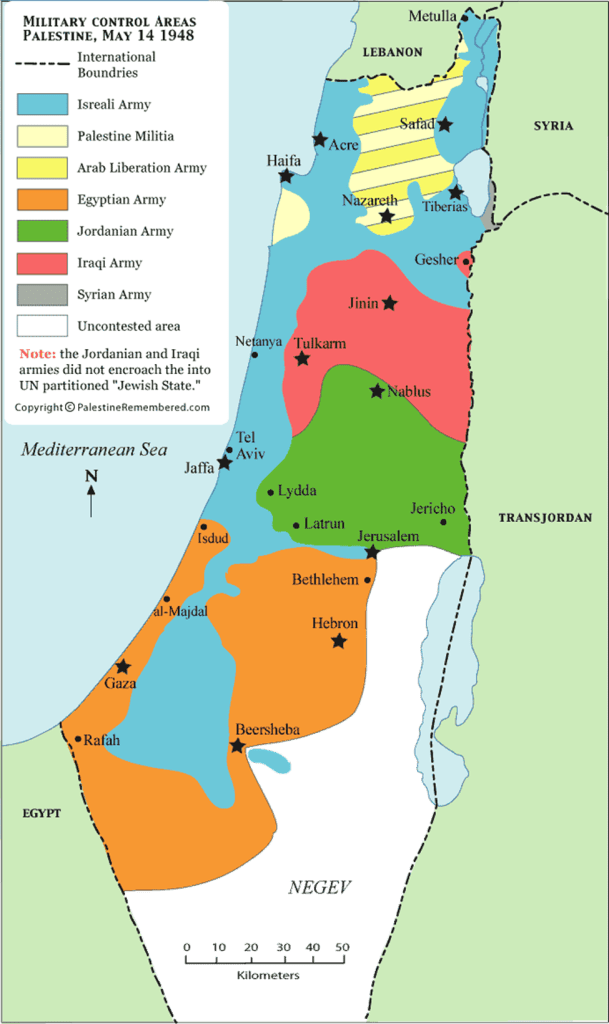
In 1947, the decolonization movement succeeded in splitting Pakistan and India away from British Rule. Victims of History: The Untold Story of Pakistani Hindu Refugees in India At that time, roughly a quarter of Pakistan was Hindu. Today, that’s 2% and shrinking. India now has over 100,000 Pakistani Hindu refugees. Contrast that with 6 million Palestinian refugees.
I don’t have refugee experience – I remember Willi explaining to me that Americans don’t have an understanding of what it is like to flee with only what you can stuff into your pockets. I recall hearing a European refugee explain the wonderful thing about Canada: “There is always enough to eat.”
The Arab nations have not, in general, been willing to absorb the Palestinian refugees – I think back to Yassar Arafat – born in Cairo, Egypt, yet head of the Palestinian Liberation Organization. I recall Palestinian students in the mid-eighties, telling that their families still kept the keys to the houses they had locked and abandoned in 1948 . . . as if, 40 years later they would still be standing.
Finding a place that will accept Palestinians was difficult in 1950 – so they were left in camps, and the population increased. Now, the world needs a location for over 6 million Palestinians . . . and if that number were instantly moved into Israel and granted citizenship, Israel would instantly tip to a Muslim majority country. I can understand why Israelis tend to regard that as an unsatisfactory solution.
Jordan accepted Palestinians as citizens – and Black September is the name for the Jordanian Civil War between the Hashemite forces of King Hussein and Yassar Arafat’s Palestinian Liberation Organization. Fifty Years after “Black September” in Jordan provides an explanation of just how close the balance was for that nation – which makes the reluctance of other Arab states to accept Palestinians fairly understandable.
I can see that letting a problem grow for 75 years leaves future generations with an unsatisfactory solution to a situation none of the present generation created. That thought isn’t original to me – I heard it in slightly different form from a Pakistani economist years ago. I am reasonably sure that there are rational Palestinians and Israelis who would prefer a peaceful solution. I am also reasonably certain that the rational people aren’t in charge – and that continues the unsatisfactory solution of generational refugees.
Want to tell us something or ask a question? Get in touch.

Recent Posts
- Recovery Time for a Retiree
- Venn Diagram and DSM
- When Castro Was Cool
- You Have To Beat Darwin Every Day
- Computer Repair by Mussolini
- Getting Alberta Oil to Market
- Parties On Economics
- Thus Spake Zarathustra – One More Time
- Suspenders
- You Haven’t Met All The People . . .
- Play Stupid Games, Win Stupid Prizes
- The Ballad of Lenin’s Tomb

Rough Cut Lumber
Harvested as part of thinning to reduce fire danger.
$0.75 per board foot.
Call Mike (406-882-4835) or Sam (406-882-4597)
Popular Posts
Ask The Entomologist Bears Books Canada Census Community Decay Covid Covid-19 Data Deer Demography Education Elections Eureka Montana family Firearms Game Cameras Geese Government Guns History Inflation life Lincoln County Board of Health Lincoln County MT Lincoln Electric Cooperative Montana nature News Patches' Pieces Pest Control Politics Pond Recipe School School Board Snow Taxes travel Trego Trego Montana Trego School Weather Wildlife writing
 Trego's Mountain Ear