-
100 years later, the madness of daylight saving time endures

Unfortunately, there’s not an unlimited amount of daylight that we can squeeze out of our clocks. igorstevanovic/Shutterstock.com Michael Downing, Tufts University
One hundred years after Congress passed the first daylight saving legislation, more and more people are doubting the wisdom of changing the clocks.
In August, the EU Commission proposed ending the biannual practice.
Last winter, lawmakers in Florida passed the “Sunshine Protection Act,” which will make daylight saving a year-round reality in the Sunshine State.
If approved by the federal government, this will effectively move Florida’s residents one time zone to the east, aligning cities from Jacksonville to Miami with Nova Scotia rather than New York and Washington, D.C.
The cost of rescheduling international and interstate business and commerce hasn’t been calculated. Instead, relying on the same overly optimistic math that led the original proponents of daylight saving to predict vast energy savings, crisper farm products harvested before the morning dew dried and lessened eye strain for industrial workers, Florida legislators are lauding the benefits of putting “more sunshine in our lives.”
It’s absurd – and fitting – that a century later, opponents and supporters of daylight saving are still not sure exactly what it does. Despite its name, daylight saving has never saved anyone anything. But it has proven to be a fantastically effective driver of retail spending.
Making the trains run on time
For centuries people set their clocks and watches by looking up at the sun and estimating, which yielded wildly dissimilar results between (and often within) cities and towns.
To railroad companies around the world, that wasn’t acceptable. They needed synchronized, predictable station times for arrivals and departures, so they proposed splitting up the globe into 24 time zones.
In 1883, the economic clout of the railroads allowed them to replace sun time with standard time with no legislative assistance and little public opposition. The clocks were calm for almost 30 years, apart from an annual debate in the British Parliament over whether to pass a Daylight Saving Act. While proponents argued that shoving clocks ahead during summer months would reduce energy consumption and encourage outdoor recreation, the opposition won out.
Then, in 1916, Germany suddenly adopted the British idea in hopes of conserving energy for its war effort. Within a year, Great Britain followed suit. And despite fanatical opposition from the farm lobby, so would the United States.
From patriotic duty to moneymaking scheme
A law requiring Americans to lose an hour was confounding enough. But Congress also tacked on the legal mandate for the four continental time zones. The patriotic rationale for daylight saving went like this: Shifting one hour of available light from the very early morning (when most Americans were asleep) would reduce the demand for domestic electrical power used to illuminate homes in the evening, which would spare more energy for the war effort.
On March 19, 1918, Woodrow Wilson signed the Calder Act requiring Americans to set their clocks to standard time; less than two weeks later, on March 31, they would be required to abandon standard time and push their clocks ahead by an hour for the nation’s first experiment with daylight saving.
It didn’t go smoothly. In 1918, Easter Sunday fell on March 31, which led to a lot of latecomers to church services. Enraged rural and evangelical opponents thereafter blamed daylight saving for subverting sun time, or “God’s time.” Newspapers were deluged by letter writers complaining that daylight saving upset astronomical data and made almanacs useless, prevented Americans from enjoying the freshest early morning air, and even browned out lawns unaccustomed to so much daylight.
Within a year, daylight saving was repealed. But like most weeds, the practice thrived by neglect.
In 1920, New York and dozens of other cities adopted their own metropolitan daylight saving policies. The Chamber of Commerce spurred along this movement on behalf of department store owners, who had noticed that later sunset times encouraged people to stop and shop on their way home from work.
By 1965, 18 states observed daylight saving six months a year; some cities and towns in 18 other states observed daylight saving for four, five or six months a year; and 12 states stuck to standard time.
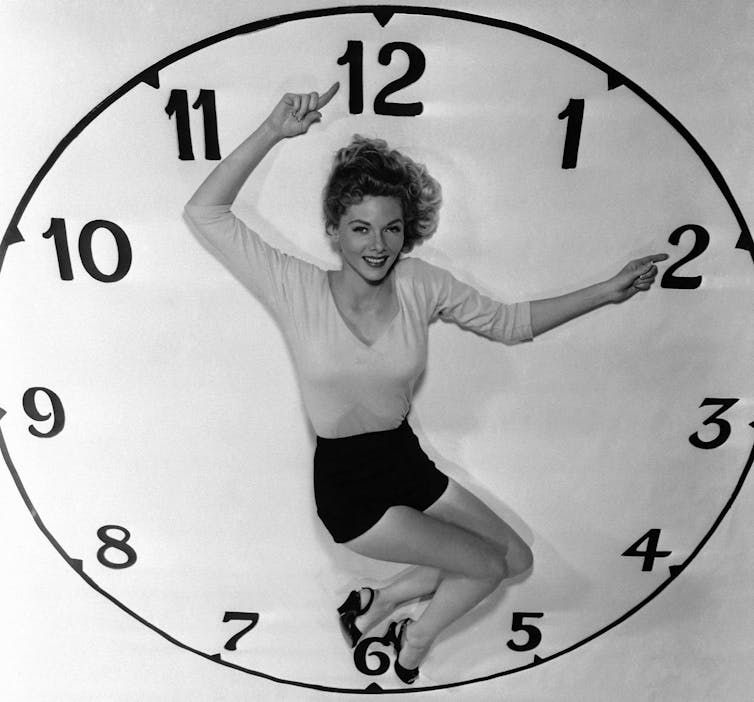
Actress Barbara Lawrence reminds television viewers to set the clock ahead, from 1 a.m. to 2 a.m., on April 29, 1956. AP Photo This wasn’t exactly ideal. A 35-mile bus trip from Steubenville, Ohio, to Moundsville, West Virginia, passed through seven distinct local time zones. The U.S. Naval Observatory dubbed the world’s greatest superpower “the world’s worst timekeeper.”
So, in 1966, Congress passed the Uniform Time Act, which mandated six months of standard time and six of daylight saving.
Great for golf – but what about everyone else?
Why do we still do it?
Today we know that changing the clocks does influence our behavior. For example, later sunset times have dramatically increased participation in afterschool sports programs and attendance at professional sports events. In 1920, The Washington Post reported that golf ball sales in 1918 – the first year of daylight saving – increased by 20 percent.
And when Congress extended daylight saving from six to seven months in 1986, the golf industry estimated that extra month was worth as much as US$400 million in additional equipment sales and green fees. To this day, the Nielsen ratings for even the most popular television shows decline precipitously when we spring forward, because we go outside to enjoy the sunlight.
But the promised energy savings – the presenting rationale for the policy – have never materialized.
In fact, the best studies we have prove that Americans use more domestic electricity when they practice daylight saving. Moreover, when we turn off the TV and go to the park or the mall in the evening sunlight, Americans don’t walk. We get in our cars and drive. Daylight saving actually increases gasoline consumption, and it’s a fallacious substitute for genuine energy conservation policy.
Lawmakers in Florida, of all places, ought to know that year-round daylight saving is not such a bright idea – especially in December and January, when most residents of the Sunshine State won’t see sunrise until about 8 a.m.
On Jan. 8, 1974, Richard Nixon forced Floridians and the entire nation into a year-round daylight saving – a vain attempt to stave off an energy crisis and lessen the impact of an OPEC oil embargo.
But before the end of the first month of daylight saving that January, eight children died in traffic accidents in Florida, and a spokesperson for Florida’s education department attributed six of those deaths directly to children going to school in darkness.
Lesson learned? Apparently not.
Editor’s note: This is an updated version of an article that originally was published March 9, 2018.
Michael Downing, Lecturer in Creative Writing, Tufts University
This article is republished from The Conversation under a Creative Commons license. Read the original article.
-
To the Lincoln County Election Administrator:
Greetings,
Since House Bill 536, which was signed into law this past April, changes the rules regarding write-in candidates, I am requesting that our primary ballots be amended to accommodate these changes.
House Bill 536 ensures that votes for undeclared write-in candidates are not valid. Consequently, I would like to request that the write-in option be removed for races without declared candidates. If this is not feasible, I would ask that instead the ballots include a disclaimer stating that undeclared candidates cannot be elected and that votes for undeclared candidates will not be counted.
Without these changes, our ballots will be designed to deceive voters into believing we have a choice. If there is only one candidate in a race, it should be clear that there is only one possible vote. Anything else is a deception.
Thank you,
Sam McCurry
-
I can look at 1976 through 1980 as the Carter years – but I have to recall that Wilson’s book, influenced largely by the stagflation that was occurring as he wrote, was written during the Nixon-Ford years. Yes, Carter was bad on inflation – but we have to admit, Nixon set the stage. Both parties like to spend money they don’t have.
KYFHO stands for “keep your (expletive not shown) hands off”. Some of the descriptors of KYFHO philosophy that Wilson uses in his book follow:
“There used to be high priests to explain the ways of the king – who was the state – to the masses. Religion is gone and so are kings. But the state remains, as do the high priests in guise of Advisers, Secretaries of Whatever Bureau, public relations people, and sundry apologists. Nothing Changes. FROM THE SECOND BOOK OF KYFHO”
“Never initiate force against another. That should be the underlying principle of your life. But if someone should do violence to you, retaliate without hesitation, without reservation, without quarter, until you are sure that he will never wish to harm – or never be capable of harming – you or yours again. FROM THE SECOND BOOK OF KYFHO (Revised Eastern Sect Edition)”
“Pity the poor diseased politician. Imagine: to spend your days and expend your efforts making rules for others to live by, thinking up ways to run other lives. Actually to strive for the opportunity to do so. What a hideous affliction! FROM THE SECOND BOOK OF KYFHO”
“. . . no government, so called, can reasonably be trusted for a moment, or reasonably supposed to have honest purposes in view, any longer than it depends wholly on voluntary support.” from NO TREASON by Lysander Spooner.”
“The paternalistic state does give its people a sense of security. But a snug, secure people tends to resist movement – especially forward movement. From THE SECOND BOOK OF KYFHO”
Wilson emphasized the economy, and how the creation of more money from nothing fuels ever increasing inflation. My old paperback suggests I first encountered An Enemy of the State back in 1976. KYFHO, economics and libertarian revolution in a plausible interstellar future: F. Paul Wilson’s Healer and An Enemy of the State, the 1990-1991 Prometheus Hall of Fame winners offers what is probably a better take on the topic than mine – definitely more professionally written.
Inflation Calculator can do a good job of showing how inflation has treated the Yankee dollar since 1913, or any period between then and now.
-
I’ve been reading about artificial intelligence and how well it works when you replace a human writer with artificial intelligence. Forbes Magazine had an article on this topic about 3 years ago.
“Back in 2014, the Los Angeles Times published a report about an earthquake three minutes after it happened. This feat was possible because a staffer had developed a bot (a software robot) called Quakebot to write automated articles based on data generated by the US Geological Survey. Today, AIs write hundreds of thousands of the articles that are published by mainstream media outlets every week.
At first, most of the Natural Language Generation (NLG) tools producing these articles were provided by software companies like Narrative Science. Today, many media organisations have developed in-house versions. The BBC has Juicer, the Washington Post has Heliograf, and nearly a third of the content published by Bloomberg is generated by a system called Cyborg. These systems start with data – graphs, tables and spreadsheets. They analyse these to extract particular facts which could form the basis of a narrative. They generate a plan for the article, and finally they craft sentences using natural language generation software.
These systems can only produce articles where highly structured data is available as an input, such as video of a football match, or spreadsheet data from a company’s annual return. They cannot write articles with flair, imagination, or in-depth analysis. As a result, they have not rendered thousands of journalists redundant. Instead they have sharply increased the number of niche articles being written.”
forbesOther articles show Artificial Intelligence articles that are unable to survive fact-checking – with articles based on a reality that doesn’t exist, on social situations that aren’t correct. While that is problematic, it really isn’t unique to artificial intelligence in journalism – I’ve seen the differences between right-wing and left-wing articles.
It reminds me of comments I heard from a journalist many years ago. He described how a journalist had to be able to quickly understand a very specialized topic, then rephrase it in a way that makes it possible for the average man to understand it. It was a great description of journalistic responsibility – but it was something that personally, he hadn’t achieved.
I’m not sure we’re looking at it the right way – maybe we need to compare artificial intelligence with natural, organic stupidity. And that gets me back into the realm of confirmation bias. As I listen to the stories on Gaza, and the concept of the Israelis marching in, and how much collateral damage will occur, a few basic thoughts occur:
Israel offered to give Gaza back to Egypt. Egypt refused – the Egyptian government didn’t want the challenge of keeping the Palestinians in line.
Jordan allowed the Palestinians in as refugees. Three years later, the Palestinians were rising against the Jordanian government – the name for that uprising is Black September. The story is available at Fifty Years after “Black September” in Jordan . As a general statement, Muslim countries that have accepted Palestinian refugees have encountered tremendous unrest. The simplest explanation is that neither Israel nor Egypt wants the inhabitants of Gaza. And I can find flesh and blood journalists who write their articles without including that fundamental problem.
Whether the author is artificial or flesh and blood, we have to read critically. Anyone who offers his, her, or its authoritative statement and doesn’t provide the support for that statement – well, it doesn’t matter. We can encounter at least as many problematic, unreliable articles from flesh and blood authors as from artificial intelligence. The problem may be that natural stupidity also infects artificial intelligence.
-
This past week, a representative of the county health department joined the Learn and Play to offer Healthy Home Kits, Emergency Kits, and Carseat assistance. Lincoln County’s Zero to 5 program was present as well.
The Health Home Kits (purchased with grant funding) include a gun lock, a fire extinguisher, a carbon monoxide detector, and a meat thermometer. The Emergency Supply Kits include a first aid kit, N95 masks, a can opener, card games, matches, and an emergency whistle.
Additionally, they provided information on safe sleep and narcan.
While they were at the Trego Learn and Play, the emergency kits and health home kits are more broadly available. Contact the county health department if interested.
-
How much time do kids spend on devices – playing games, watching videos, texting and using the phone?

Today, nearly all U.S. teens have a smartphone. MoMo Productions/Digital Vision via Getty Images David Rosenberg, Wayne State University and Natalia Szura, Wayne State University

Curious Kids is a series for children of all ages. If you have a question you’d like an expert to answer, send it to curiouskidsus@theconversation.com.
How many hours does the average American spend on devices each year? – Maxwell P., age 10
Think about your favorite devices – your smartphone, laptop, tablet, computer or console – the things you use to play cool games, watch hilarious videos and connect and chat with friends.
Many young people spend a lot of free time looking at them. Turns out that teens spend an average of 8½ hours on screens per day, and tweens – that’s ages 8 to 12 – are not far behind, at 5½ hours daily.
Keep in mind those numbers are for only social media, gaming and texting. They do not include the time that kids used screens for schoolwork or homework.
What’s more, much of the time taken up by social media and texting is apparently not even enjoyable, much less productive. A 2017 study of teens ages 13 to 18 suggests they spend most of those hours on the phone in their bedroom, alone and distressed.
These lonely feelings correlate with the rise in the use of digital media. In 2022, 95% of teens had smartphones compared with only 23% in 2011. And 46% of today’s teens say they use the internet almost constantly, compared with 24% of teenagers who said the same in 2014 and 2015.
Our team of psychiatrists who treat young people with digital addiction have many patients who spend over 40 hours per week on screens – and some, up to 80 hours.
Think about it: If you spend “just” an average of 50 hours per week on devices from ages 13 to 18 – the total time you will spend on screens equates to more than 12 years of school!
The U.S. surgeon general says too much screen time can increase anxiety and depression in teens and tweens.
Find the right balance
All this is not to say that everything about devices is bad. In this digital age, people embark on exciting journeys through the screens of their devices. Sometimes, screens are the windows to a magical adventure.
But too much screen time can lead to problems. As human beings, we function best when we’re in a state of balance. That happens when we eat well, exercise regularly and get enough sleep.
But spending too much time using digital devices can cause changes in the way you think and behave. Many teens and tweens developed the “fear of missing out” – known as FOMO. And one study shows some people develop nomophobia, which is the fear of being without your phone, or feeling anxious when you can’t use it.
Moreover, digital addiction in high school may predict serious depression, anxiety and sleep disruption in college.
Rates of depression and anxiety are skyrocketing among college students. The fear of missing out is pervasive, resulting in sleep disruption; too many college students sleep with smartphones turned on and near their bed – and wake up to respond to texts and notifications during the night. Sleep disruption itself is a core symptom of both depression and anxiety.
How to avoid device addiction
A 2016 poll indicated that half of teens felt they were addicted to their mobile devices.
Getting hooked on screens means missing out on healthy activities. To achieve a better balance, some experts recommend the following: Turn off all screens during family meals and outings. Don’t complain when your parents use parental controls. And turn off all the screens in your bedroom 30 to 60 minutes before bedtime – this step will improve sleep.
You may be a “screen addict” if you:
- Feel uneasy or grumpy when you can’t use your device.
- Don’t take breaks while spending hours on your device.
- Ignore other fun activities you enjoy, like going outside or reading a book.
- Have trouble sleeping, or falling asleep, because your screen time is too close to bedtime.
- Experience eye, lower back and neck strain.
- Struggle with weight gain or obesity because you’re inactive.
- Have difficulty with real-life, face-to-face social interactions.
If you notice these signs, do not dismiss them. But also realize you’re not alone and help is out there. You can find balance again.
A kid breaks his addiction to gaming and social media.
A healthy approach
Exercise – riding a bike, playing sports, lifting weights or going for a jog or walk – keeps your brain healthy and protects it against depression and anxiety, as well as limiting your screen time.
Another way to be happier and healthier is to spend time with people – face to face, not via a screen. Seeing people live and in person is the best way to bond with others, and it may be even better for life span than exercise.
Creative hobbies are good, too. Cooking, playing an instrument, dancing, any arts and crafts, and thousands of other fun things make people happier and more creative. What’s more, hobbies make you well rounded and more attractive to others – which leads to more face-to-face interactions.
It’s also critical for parents to practice healthy screen habits. But about one-third of adults say they use screens “constantly.” This is not exactly a great example for kids; when adults take responsibility to minimize their own screen time, the whole family gets better.
Our research team used magnetic resonance imaging, also known as MRI, to scan the brains of teens who had digital addiction. We found impairment in the brain’s decision-making, processing and reward centers. But after a digital fast – meaning the addicted teens unplugged for two weeks – those brain abnormalities reversed, and the damage was undone.
Our findings also showed that kids with a desire to overcome digital addiction did better with a digital fast than those who were less willing or who denied their addiction.
A balanced lifestyle in the digital age is all about finding joy in screenless activities – being active, connecting with others and exploring your offline interests.
Hello, curious kids! Do you have a question you’d like an expert to answer? Ask an adult to send your question to CuriousKidsUS@theconversation.com. Please tell us your name, age and the city where you live.
And since curiosity has no age limit – adults, let us know what you’re wondering, too. We won’t be able to answer every question, but we will do our best.
David Rosenberg, Professor of Psychiatry and Neuroscience, Wayne State University and Natalia Szura, Research Assistant in Psychiatry, Wayne State University
This article is republished from The Conversation under a Creative Commons license. Read the original article.
-
Our county commissioners have some control over the filing fees, if only indirectly. MCA 13-20-202 determines the filing fees for various offices. The filing fee for the legislature is set, only $15, but for other positions it’s a percentage of the salary.
The County Commissioners adjusted the salary of elected officials back in June. Here are the salaries, and the filing fees as determined by state law (for county offices with a salary of more than $2,500 the fee is 0.5% of the salary)
Position Salary Filing Fee Clerk and Recorder $62,232.94 $311.16 Clerk of Court $62,232.94 $311.16 County Attorney $62,232.94 $311.16 County Comissioner $64,232.94 $321.16 County Coroner $18,669.88 $93.35 Deputy County Coroner $5,600.96 $28.00 County Treasurer $62,232.94 $311.16 Sheriff $64,232.94 $321.16 Superintendent of Schools $62,232.94 $311.16 The US Census estimates the average household income for the county at $41,922. That amounts to about $3,493.50 a month. The filing fee for most of the county positions is a little less than 10% of the median household income.
The estimates for housing costs are somewhere between $719 and $1,267, which frankly seems like it might be on the low end. So, if we assume the higher number, that leaves $2,226.50 after that expense. Thinking about food and gas, that number gets even higher. The point being that as a percentage of what’s left after the essentials are payed- that filing fee is high.
And frankly, it’s hard to imagine paying 10% of a month’s wages just for the privilege of losing an election.
But wait- what about write-ins? Those don’t have to file, right? Formerly right, as it happens. One of the things our state legislature did this year was to abolish the section of law that allowed for undeclared write-in candidates to be elected in the primary. So, only declared write-ins, those that have paid the fee, count.
We aren’t just pay to play, we’re pay 10% of a month’s income to play. It’s little wonder that our ballots look so empty each November. As long as there is no way to run without paying that substantial fee, elections by acclamation will be inevitable.
-
The rising cost of living is eroding brand loyalty as consumers seek more cost-effective alternatives

Cutting back on pricier food items and focusing on more affordable staple foods could help consumers deal with rising food costs, but these strategies affect brand loyalty. (Shutterstock) Seung Hwan (Mark) Lee, Toronto Metropolitan University and Omar H. Fares, Toronto Metropolitan University
As Canadians grapple with the rising cost of living, many consumers are reevaluating their daily choices and purchase habits. The cost of groceries is forcing many households to make difficult decisions, like having to choose between food quality and affordability.
Amid these economic pressures, the concept of brand loyalty — the preference consumers have for a particular brand over others — is undergoing a significant shift. Brand loyalty is the result of a mix of factors, including trust, habit and the perceived value of goods.
Brand loyalty significantly benefits retailers by boosting sales. Not only do existing customers spend more money than new customers, but brand loyalty also reduces the amount brands need to spend on advertising. Effective loyalty programs increase customer retention and result in positive word-of-mouth, meaning companies can spend less on marketing.
Losing loyalty, on the other hand, can result in a competitive disadvantage for retailers. It can lead to revenue loss, increased marketing and customer acquisition costs and negative word-of-mouth.
Once a cornerstone for many food retailers, brand loyalty is eroding as consumers prioritize immediate cost savings over long-term brand relationships. https://www.youtube.com/embed/tslEy_u8jhk?wmode=transparent&start=0 Nearly seven million Canadians are struggling to put food on the table. (Global News)
Adapting to rising food costs
Inflation is impacting a wide range of income groups: 81 per cent of lower-income, 50 per cent of middle-income and 35 per cent of high-income earners in Canada are impacted by inflation, spending less on clothing, beauty products and big-ticket items.
Consumers have been adopting various strategies to manage their budgets. Three-quarters of Canadians say they dine out less often because of the rising cost of living, and 70 per cent say inflation has shifted the way they cook.
Despite rising grocery prices, eating at home is still more budget-friendly than eating out and allows for better control over the cost of ingredients.
Some Canadians are also modifying their eating habits by altering portion sizes, cutting back on pricier food items and focusing on more affordable staple foods. While these changes help consumers deal with rising costs, they also come at the expense of brand loyalty.
The digital landscape is also playing a key role in this shift. Consumers are increasingly turning to digital platforms to find economical food options. The convenience of online marketplaces and food delivery services exposes them to a wide array of product choices and competitive pricing.
Consumers also use online tools like coupons and price comparison options to seek discounts. Loyalty programs lose their appeal when consumers prioritize immediate savings.
This transparency and the ease of comparing prices online encourage consumers to explore various brands, making it more challenging for traditional food brands to sustain customer loyalty.
Changing consumer priorities
As prices rise and budgets tighten, consumers are more inclined to seek out more cost-effective options, which often means abandoning favourite brands in pursuit of better value.
One report found that 42 per cent of consumers now seek sales or shop clearance, 40 per cent adhere to a budget, 28 per cent buy less overall and 25 per cent prefer bulk stores or warehouse retailers.
In pursuit of cheaper alternatives, consumers become more open to trying private-label or store-brand products, discounted brands and generic or unbranded options. These alternatives provide shoppers with a practical way to cope with rising prices, allowing them to manage their expenses while maintaining a satisfactory level of product quality.
Inflation also leads to changes in spending habits in a phenomenon known as consumption smoothing. This often involves delaying the purchase of durable goods, prioritizing the purchase of necessities and opting for store-brand products.
In essence, consumers shift their priorities toward cost management, which in turn reduces their loyalty to specific brands. Food companies need to adapt to these changing consumer needs by recognizing affordability and value take precedence in an inflationary market.
What can retailers do?
The shift away from brand loyalty can pose challenges for business owners and retailers who depend on consumer spending. Aside from the most obvious solution to the issue — lowering prices — there are other things retailers can do to win back customers.
First, retailers can use dynamic pricing, allowing them to adjust prices based on factors like supply and demand, inventory and competition. This approach enables them to offer competitive prices and discounts while also minimizing food waste.
Second, retailers can also introduce loyalty programs that go beyond conventional point-based systems. By using personalized data from consumers, retailers can tailor rewards and incentives to match individual shopping habits, experiences and preferences. Retailers can also collaborate with other businesses and incorporate gamification elements to further enhance loyalty.
Lastly, retailers should consider using a value-oriented marketing approach to elevate consumer experiences. Retailers should communicate the value of their products, emphasizing quality, nutritional benefits and unique features to justify their price points.
Simultaneously, investing in exceptional customer experience, both in-store and online, can foster strong emotional connections between retailers and consumers. When consumers feel valued by brands, they are more likely to stay committed to that brand’s products. By assuring customers of their commitment to value, retailers can play a crucial role in guiding consumers through these challenging times.
Seung Hwan (Mark) Lee, Professor and Associate Dean of Engagement & Inclusion, Ted Rogers School of Management, Toronto Metropolitan University and Omar H. Fares, Lecturer in the Ted Rogers School of Retail Management, Toronto Metropolitan University
This article is republished from The Conversation under a Creative Commons license. Read the original article.
-
As I write this, I think of how few facts I have about Palestinians and about Gaza. I’ve had Palestinians in the classroom, and found them both pleasant and disruptive. We lack some points of common beliefs. The Koran can be confusing, if you don’t know that, if two verses are in disagreement, the most recently written verse is the correct one. That’s worth remembering when you read the peaceful writings of Mohammed – he was peaceful before he went to war, not after. The style of interpreting the Koran is termed “abrogation” – the last written abrogates the earlier writing.One of the great resources for data regarding geographic areas is the CIA World Factbook – the link relevant to Gaza is Gaza Strip – The World Factbook. When you click the link, and look at the satellite photo, you see a barren area – and the data available in the Factbook supports the visual impression. It’s nice to have a way that the ordinary American can get something back for supporting the CIA.Gaza – 139 square miles – 25 miles long. Roughly equivalent to a strip running from downtown Trego to scenic Roosville, say 2 ½ miles to either side of highway 93. Over 2 million people in Gaza . . . we have just over a million in Montana. Electricity? Gaza is 100% powered by fossil fuels – the Factbook shows 215,000 kilowatts generating capacity. Libby Dam is listed at 525 megawatts (multiplied by 1000 = 525,000).Population? Gaza is pushing at 2.3 million people, and the median age is 18. The CIA World Factbook is online, and just a click away.The Factbook also covers Israel: Israel – The World Factbook Looking at the two entries emphasizes the differences.


Want to tell us something or ask a question? Get in touch.

Recent Posts
- Recovery Time for a Retiree
- Venn Diagram and DSM
- When Castro Was Cool
- You Have To Beat Darwin Every Day
- Computer Repair by Mussolini
- Getting Alberta Oil to Market
- Parties On Economics
- Thus Spake Zarathustra – One More Time
- Suspenders
- You Haven’t Met All The People . . .
- Play Stupid Games, Win Stupid Prizes
- The Ballad of Lenin’s Tomb

Rough Cut Lumber
Harvested as part of thinning to reduce fire danger.
$0.75 per board foot.
Call Mike (406-882-4835) or Sam (406-882-4597)
Popular Posts
Ask The Entomologist Bears Books Canada Census Community Decay Covid Covid-19 Data Deer Demography Education Elections Eureka Montana family Firearms Game Cameras Geese Government Guns History Inflation life Lincoln County Board of Health Lincoln County MT Lincoln Electric Cooperative Montana nature News Patches' Pieces Pest Control Politics Pond Recipe School School Board Snow Taxes travel Trego Trego Montana Trego School Weather Wildlife writing
 Trego's Mountain Ear