-
Elections don’t have to offer a choice between two crap sandwiches – but if you have voted for the lesser of two evils, you have voted in a crap sandwich election. In 2016, I voted in a crap sandwich election – the Democrat candidate was Hillary Clinton, the Republican was Donald Trump, and the Libertarian was Gary Johnson. Johnson never met a government program he didn’t like except for making marijuana illegal – a single topic libertarian, I guess.
I knew what Hillary Clinton offered. I knew Johnson didn’t make my standards as a libertarian. My choice was to hope Trump would be better – it wouldn’t take much. Well, he did well on the Supreme Court and Second Amendment – but he led us into Covid with some awful government controls. He asked BATF for a bump-stock ban that was recently found unconstitutional. Still, I’m sure he was better for my preferences than Hillary.
Then came 2020 – I had thought Mike Dukakis took Biden out of the running for president. Obviously I was wrong . . . and there were a lot of people who regarded Trump like I did Hillary. As 2024 comes up, it looks like we will have a choice between Trump and Biden again. Too old – entirely too old. Both of them. Another crap sandwich election.
Montana has, in many districts, created elections that don’t even offer a choice. As our regular readers will recall, during the last election, we noted MCA 13-10-211. Declaration of intent for write-in candidates. (1) Except as provided in subsection (7), a person seeking to become a write-in candidate for an office in any election shall file a declaration of intent. The neat thing about section 7 was that in unopposed elections, write-in votes did not have to file a declaration of intent. We saw it as a way to keep elections contested – in 2022, out of 100 state representative districts, 31 representatives were elected without opposition in the general election. Seven of the 25 candidates for state senate were elected without opposition in the general election. This is definitely a crap sandwich election – and you don’t even get a choice of crap sandwiches.
Obviously, we had some effect – Our legislature passed HB 536 on April 20th – eliminating voters’ ability to write in a candidate when there was no opposition. That’s not quite right – you can still write in a candidate, your vote just won’t be counted. Interestingly enough, only 3 representatives and one senator voted against HB 536 – all of the unopposed bastards, from both parties, voted to eliminate section 7. The three representatives who voted against this legislation that removed the voters last chance of competitive elections were Frank J. Smith, Katie Sullivan and Zooey Zephyr (all Democrats). The only Senator to vote against HB 536 was Brad Molnar (Republican).
As I calculate it, 97% of our House of Representatives voted to strengthen laws mandating crap sandwich elections, and 98% of our state senate.
-
I’m pretty sure I misspelled the word in my undergrad notes – but the notes are long gone, so I’m taking the definition from the net, not from Professor Carmichael: Miriam Webster says
“völkerwanderungen -ŋən
: the migration of nations
especially : the movement into southern and western Europe of the Teutonic peoples, Huns, and Slavs from the 2d century a.d. to about the 11th century reaching the peak in the 5th and 6th centuries and closing with the settling of Norsemen in England and France”
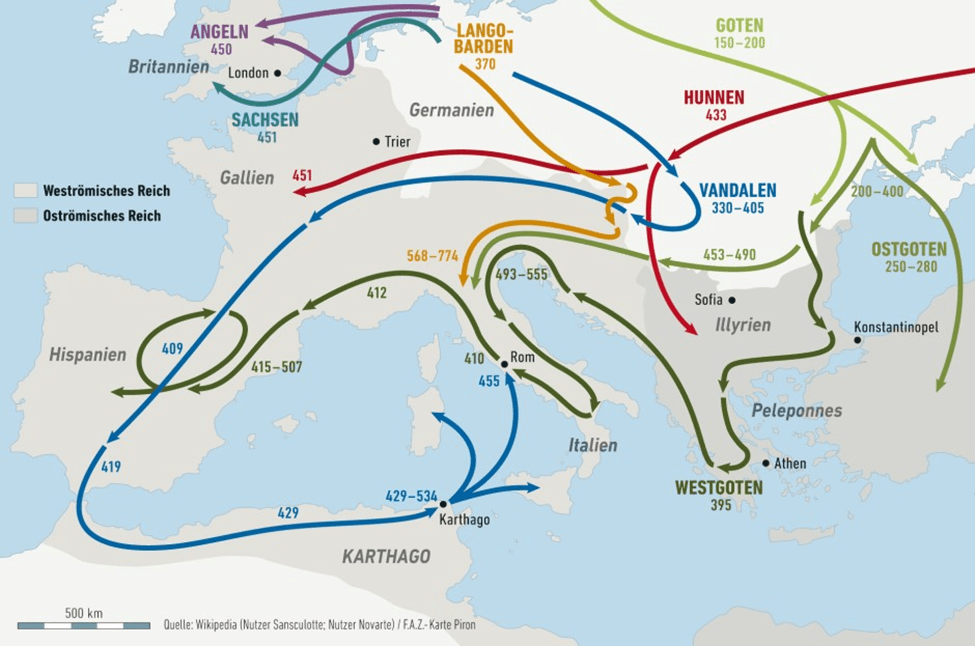
I’m looking at this historical migration of nations and thinking about the immigration crisis along our southern border, and the photographs of jam-packed boats crossing the Mediterranean from Africa to Europe. Sure, the immigrants we see are mostly young men . . . but that may have been the case in the first years of the volkerwanderungen. The rule may be women and children first in lifeboats, but in folk migrations, the tendency runs single men first, then married couples with no kids.
Crossing the Rio Grande is a simple decision – Mexico looks better than Venezuela or Honduras – but the US is still the land of the big PX. I’ve relocated for better jobs and opportunities several times. Never had to leave the US for employment, but I have considered it, and know people who have. In my own limited way, I understand the motivation of migrants.
Southern Europe must look a lot better than the nations these folks have left behind – and the photo suggests that the vast majority of these migrants are young men. As I think of American history, I recollect that the Lewis & Clark expedition was also composed of young, single men – until they added Sacajawea.
Folks have been crossing the southern border for over a century, with or without papers. It’s a more mature folk-wandering than Europe – complete with women and children.
The original Volkswanderung occurred as the Roman Empire went into full decline – I can’t say if there was a causal relationship or not. Still, historians tend to give a lot of credit to Rome losing battles with the barbarians – 8 Reasons Why Rome Fell | HISTORY :
“The most straightforward theory for Western Rome’s collapse pins the fall on a string of military losses sustained against outside forces. Rome had tangled with Germanic tribes for centuries, but by the 300s “barbarian” groups like the Goths had encroached beyond the Empire’s borders. The Romans weathered a Germanic uprising in the late fourth century, but in 410 the Visigoth King Alaric successfully sacked the city of Rome.
The Empire spent the next several decades under constant threat before “the Eternal City” was raided again in 455, this time by the Vandals. Finally, in 476, the Germanic leader Odoacer staged a revolt and deposed Emperor Romulus Augustulus. From then on, no Roman emperor would ever again rule from a post in Italy, leading many to cite 476 as the year the Western Empire suffered its death blow.”
The Barbarian attacks on Rome partially stemmed from a mass migration caused by the Huns’ invasion of Europe in the late fourth century. When these Eurasian warriors rampaged through northern Europe, they drove many Germanic tribes to the borders of the Roman Empire. The Romans grudgingly allowed members of the Visigoth tribe to cross south of the Danube and into the safety of Roman territory, but they treated them with extreme cruelty.
According to the historian Ammianus Marcellinus, Roman officials even forced the starving Goths to trade their children into slavery in exchange for dog meat. In brutalizing the Goths, the Romans created a dangerous enemy within their own borders. When the oppression became too much to bear, the Goths rose up in revolt and eventually routed a Roman army and killed the Eastern Emperor Valens during the Battle of Adrianople in A.D. 378. The shocked Romans negotiated a flimsy peace with the barbarians, but the truce unraveled in 410, when the Goth King Alaric moved west and sacked Rome. With the Western Empire weakened, Germanic tribes like the Vandals and the Saxons were able to surge across its borders and occupy Britain, Spain and North Africa.”
Just conjecture, and recalling a lecture from over 50 years ago – but the articles at the links may be worth reading.
-
As a western American, the guns I’ve seen and the people who introduced me to them incline me to think of John Moses Browning as the world’s greatest gun designer. This poster is from an article at The Guns of John Moses Browning | Armory Blog that does a pretty good job of convincing me that John Moses Browning was America’s greatest firearms designer.

The list of guns he designed is long – and most of the folks who are my age have used more than one of his products . . . yet Finland’s Aimo Lahti could also be a contender for the greatest.
Kevin O’Brien probably said it best “The spiteful Soviets, whose troops had been shot full of holes by many Lahti designs, demanded that that the Finn retire from arms design, and he did, living on a pension until 1970.” O’Brien has a lengthy post about Lahti and his accomplishments at weaponsman.com.
Lahti’s career was shorter than Brownings – he signed on with the Finnish Army as a master armorer in 1921, and began design work on the Suomi 31 the following year. 22 years after starting the Suomi 31 design – in 1944 – Lahti’s retirement was demanded by the Soviet Union as part of the peace treaty. He did retire on a major general’s salary.

In more peaceful Utah, Browning built his first rifle in 1868, and continued producing more designs until his death in 1926. I have a lot of respect for John Moses Browning – but he did have 58 productive years compared to Lahti’s 23, and he was never explicitly written into a peace Treaty.
Historical Firearms — The Guns of Aimo Lahti Between 1922 and 1940,… provides some photos of the many guns Lahti designed. Unlike Browning, I have not fired the Lahti guns – the US is a lot bigger place than Finland, and many Browning designs were for civilian markets. The only Lahti I had a chance to acquire was the Lahti pistol – and at the time I believed more in 45 than 9mm.

As a youngster, I saw advertisements for his anti-tank rifles (but a hundred dollars was lot of money back then):

To end the story – most of you have heard of Simo Hayha and his Mosin Nagant rifle – but he also used Lahti’s Suomi M31 in his sniping career. Lahti designed a submachine gun that would shoot to one minute of angle . . . and Simo Hayha took advantage of it.
So I’m not sure if Lahti outdid Browning as a designer – but the two men deserve to be mentioned on the same page.
-
The phrase “permanent solution to temporary problems” reminded me of Canada’s government sanctioned solution.
The Canadian government has sort of gone “all-in” with it’s assisted suicide program, termed MAiD (Medical Assistance in Dying) which has expanded in scope several times since it was initially passed in 2016.
Initially, Maid was fairly limited. Patients had to have a serious illness or disability, be in irreversible decline, experiencing unbearable physical or mental suffering, and at the point where natural death was reasonably foreseeable.
The reasonably foreseeable requirement was removed in 2021. The latest discussion is regarding extending those eligible to include “mature minors” and those with mental disorders (and no accompanying physical illness). The Atlantic has a pretty thorough article on the topic.
In 2021, 3.3% of all deaths in Canada were due to MAid.
Some of the headlines are pretty remarkable:
- Why is Canada euthanizing the poor?
- How Poverty, not pain, is driving Canadians with disabilities to consider medically-assisted death
- Paediatric euthanasia in Canada: New challenges for end of life care (From the National Library of Medicine)
- Paralympian trying to get wheelchair ramp says Veterans Affairs employee offered her assisted dying
- Canada will soon allow medically assisted dying for mental illness. Has there been enough time to get it right?
- First, Do No Harm: New Canadian Law Allows for Assisted Suicide for Patients with Psychiatric Disorders (Psychiatric Times)
-
Flesh-eating bacteria infections are on the rise in the US − a microbiologist explains how to protect yourself

Vibrio vulnificus infections are spreading across the U.S. because of climate change. CDC/Janice Haney Carr Bill Sullivan, Indiana University
Flesh-eating bacteria sounds like the premise of a bad horror movie, but it’s a growing – and potentially fatal – threat to people.
In September 2023, the Centers for Disease Control and Prevention issued a health advisory alerting doctors and public health officials of an increase in flesh-eating bacteria cases that can cause serious wound infections.
I’m a professor at the Indiana University School of Medicine, where my laboratory studies microbiology and infectious disease. Here’s why the CDC is so concerned about this deadly infection – and ways to avoid contracting it.
What does ‘flesh-eating’ mean?
There are several types of bacteria that can infect open wounds and cause a rare condition called necrotizing fasciitis. These bacteria do not merely damage the surface of the skin – they release toxins that destroy the underlying tissue, including muscles, nerves and blood vessels. Once the bacteria reach the bloodstream, they gain ready access to additional tissues and organ systems. If left untreated, necrotizing fasciitis can be fatal, sometimes within 48 hours.
The bacterial species group A Streptococcus, or group A strep, is the most common culprit behind necrotizing fasciitis. But the CDC’s latest warning points to an additional suspect, a type of bacteria called Vibrio vulnificus. There are only 150 to 200 cases of Vibrio vulnificus in the U.S. each year, but the mortality rate is high, with 1 in 5 people succumbing to the infection.
Climate change may be driving the rise in flesh-eating bacteria infections in the U.S.
How do you catch flesh-eating bacteria?
Vibrio vulnificus primarily lives in warm seawater but can also be found in brackish water – areas where the ocean mixes with freshwater. Most infections in the U.S. occur in the warmer months, between May and October. People who swim, fish or wade in these bodies of water can contract the bacteria through an open wound or sore.
Vibrio vulnificus can also get into seafood harvested from these waters, especially shellfish like oysters. Eating such foods raw or undercooked can lead to food poisoning, and handling them while having an open wound can provide an entry point for the bacteria to cause necrotizing fasciitis. In the U.S., Vibrio vulnificus is a leading cause of seafood-associated fatality.
Why are flesh-eating bacteria infections rising?
Vibrio vulnificus is found in warm coastal waters around the world. In the U.S., this includes southern Gulf Coast states. But rising ocean temperatures due to global warming are creating new habitats for this type of bacteria, which can now be found along the East Coast as far north as New York and Connecticut. A recent study noted that Vibrio vulnificus wound infections increased eightfold between 1988 and 2018 in the eastern U.S.
Climate change is also fueling stronger hurricanes and storm surges, which have been associated with spikes in flesh-eating bacteria infection cases.
Aside from increasing water temperatures, the number of people who are most vulnerable to severe infection, including those with diabetes and those taking medications that suppress immunity, is on the rise.
What are symptoms of necrotizing fasciitis? How is it treated?
Early symptoms of an infected wound include fever, redness, intense pain or swelling at the site of injury. If you have these symptoms, seek medical attention without delay. Necrotizing fasciitis can progress quickly, producing ulcers, blisters, skin discoloration and pus.
Treating flesh-eating bacteria is a race against time. Clinicians administer antibiotics directly into the bloodstream to kill the bacteria. In many cases, damaged tissue needs to be surgically removed to stop the rapid spread of the infection. This sometimes results in amputation of affected limbs.
Researchers are concerned that an increasing number of cases are becoming impossible to treat because Vibrio vulnificus has evolved resistance to certain antibiotics.
How do I protect myself?
The CDC offers several recommendations to help prevent infection.
People who have a fresh cut, including a new piercing or tattoo, are advised to stay out of water that could be home to Vibrio vulnificus. Otherwise, the wound should be completely covered with a waterproof bandage.
People with an open wound should also avoid handling raw seafood or fish. Wounds that occur while fishing, preparing seafood or swimming should be washed immediately and thoroughly with soap and water.
Anyone can contract necrotizing fasciitis, but people with weakened immune systems are most susceptible to severe disease. This includes people taking immunosuppressive medications or those who have pre-existing conditions such as liver disease, cancer, HIV or diabetes.
It is important to bear in mind that necrotizing fasciitis presently remains very rare. But given its severity, it is beneficial to stay informed.
Bill Sullivan, Professor of Pharmacology & Toxicology, Indiana University
This article is republished from The Conversation under a Creative Commons license. Read the original article.
-
Trainings were held in both Libby and Eureka and were put on by the Local Government Center, a part of the Extension Service at MSU. The Eureka training was held at the fairgrounds, and the building felt rather large and vacant for the size of the group. Attendees were members of public county boards as well as private nonprofits.
The presenter provided folders with handouts, including relevant sections of law and a cheat sheet for parliamentary procedure. Additionally, attendees were referred to a free course in parliamentary procedure developed by the Local Government Center and available on their website. People with questions are encouraged to reach out to the folks at the Local Government Center.
It was a good training, and would be worth repeating, though if Lincoln County is sponsoring it again, we ought to consider arranging a more welcoming venue for our presenters, and perhaps a coffee pot.
-
Rising number of ‘predatory’ academic journals undermines research and public trust in scholarship
Eric Freedman, Michigan State University and Bahtiyar Kurambayev, KIMEP University
Taxpayers fund a lot of university research in the U.S., and these findings published in scholarly journals often produce major breakthroughs in medicine, vehicle safety, food safety, criminal justice, human rights and other topics that benefit the public at large.
The bar for publishing in a scholarly journal is often high. Independent experts diligently review and comment on submitted research – without knowing the names of the authors or their affiliated universities. They recommend whether a journal should accept an article or revise or reject it. The piece is then carefully edited before it is published.
But in a growing number of cases, these standards are not being upheld.
Some journals charge academics to publish their research – without first editing or scrutinizing the work with any ethical or editorial standards. These for-profit publications are often known as predatory journals because they are publications that claim to be legitimate scholarly journals but prey on unsuspecting academics to pay to publish and often misrepresent their publishing practices.
There were an estimated 996 publishers that published over 11,800 predatory journals in 2015. That is roughly the same number of legitimate, open-access academic journals – available to readers without charge and archived in a library supported by a government or academic institution – published around the same time. In 2021, another estimate said there were 15,000 predatory journals.
This trend could weaken public confidence in the validity of research on everything from health and agriculture to economics and journalism.
We are scholars of journalism and media ethics who see the negative effects predatory publishing is having on our own fields of journalism and mass communication. We believe it is important for people to understand how this problem affects society more broadly.
In most cases, the research published in these journals is mundane and does not get cited by other academics. But in other cases, poorly executed research – often on science – could mislead scientists and produce untrue findings.
Misleading practices
Publishing in journals is considered an essential part of being an academic because professors’ responsibilities generally include contributing new knowledge and ways of solving problems in their research fields. Publishing research is often a key part of academics keeping their jobs, getting promoted or receiving tenure – in an old phrase from academia, you publish or perish.
Predatory publishers often use deception to get scholars to submit their work. That includes false promises of peer review, which is a process that involves independent experts scrutinizing research. Other tactics include lack of transparency about charging authors to publish their research.
While fees vary, one publisher told us during our research that its going rate is $60 per printed page. An author reported paying $250 to publish in that same outlet. In contrast, legitimate journals charge a very small amount, or no fee at all, to publish manuscripts after editors and other independent experts closely review the work.
These kinds of journals – about 82.3% of which are located in poor countries, including India, Nigeria and Pakistan – can prey on junior faculty who are under intense pressure from their universities to publish research.
Low-paid young faculty and doctoral students, who may have limited English language proficiency and poor research and writing skills, are also especially vulnerable to publishers’ aggressive marketing, mostly via email.
Authors who publish in fraudulent journals may add these articles to their resumes, but such articles are rarely read and cited by other scholars, as is the norm with articles in legitimate journals. In some instances, articles are never published, despite payment.
Predatory publishers may also have an unusually large breadth of topics they cover. For example, we examined one Singapore-based company called PiscoMed Publishing, which boasts 86 journals in fields spanning religious studies and Chinese medicine to pharmacy and biochemistry. Nonpredatory publishers tend to be more focused in the breadth of their topics.
The Conversation contacted all of the journals named in this article for comment and did not receive a response regarding their work standards and ethics.
Another journal, the International Journal of Humanities and Social Science, says it publishes in about 40 fields, including criminology, business, international relations, linguistics, law, music, anthropology and ethics. We received an email from this journal, signed by its chief editor, who is listed as being affiliated with a U.S. university.
But when we called this university, we were told that the school does not employ anyone with that name. Another person at the school’s Art Department said that the editor in question no longer works there.
It is extremely difficult for people reading a study, or watching a news segment about a particular study, to recognize that it appeared in a predatory journal.
In some instances, these journals’ titles are almost identical to titles of authentic ones or have generic names like “Academic Sciences” and “BioMed Press.”
Scholars deceived
In a 2021 study, we surveyed and interviewed scholars in North America, Africa, Asia, Australia and Europe listed as editorial board members or reviewers for two predatory journalism and mass communication journals.
One company, David Publishing, gives a Delaware shipping and mailbox store as its address and uses a Southern California phone number. It says it publishes 52 journals in 36 disciplines, including philosophy, sports science and tourism.
Some scholars told us they were listed as authors in these journals without permission. One name still appeared as an author several years after the scholar’s death.
Our latest, forthcoming study conducted in 2023 surveyed and interviewed a sample of authors of 504 articles in one of those predatory journals focused on journalism and mass communication.
We wanted to learn why these authors – ranging from graduate students to tenured full professors – chose to submit their work to this journal and what their experience was like.
While most authors come from poor countries or other places such as Turkey and China, others listed affiliations with top American, Canadian and European universities.
Many people we contacted were unaware of the journal’s predatory character. One author told us of learning about the journal’s questionable practices only after reading an online posting that “warned people not to pay.”
A lack of concern
Some people we spoke with didn’t express concern about the ethical implications of publishing in a predatory journal, including dishonesty with authors’ peers and universities and potential deception of research funders. We have found that some authors invite colleagues to help pay the fees in exchange for putting their names on an article, even if they did none of the research or writing.
In fact, we heard many reasons for publishing in such journals.
These included long waits for peer review and high rejection rates from reputable journals.
In other cases, academics said that their universities were more concerned with how much they publish, rather than the quality of the publication that features their work.
“It was very important for me to have it at that time. I never paid again. But I got my promotion. It was recognized by my institution as a full publication. I profited … and it did the job,” one author from the Middle East told us in an interview.
Why it matters
Predatory publishing creates a major obstacle in the drive to ensure that new research on critical topics is well-founded and truthful.
This can have implications in health and medical research, among other areas. As one health care scholar explained, there is a risk that scientists could incorporate erroneous findings into their clinical practices.
High standards are crucial across all areas of research. Policymakers, governments, educators, students, journalists and others should be able to rely on credible and accurate research findings in their decision making, without constantly double-checking the validity of a source that falsely purports to be reputable.
Eric Freedman, Professor of Journalism and Chair, Knight Center for Environmental Journalism, Michigan State University and Bahtiyar Kurambayev, Associate Professor of Media, KIMEP University
This article is republished from The Conversation under a Creative Commons license. Read the original article.
-
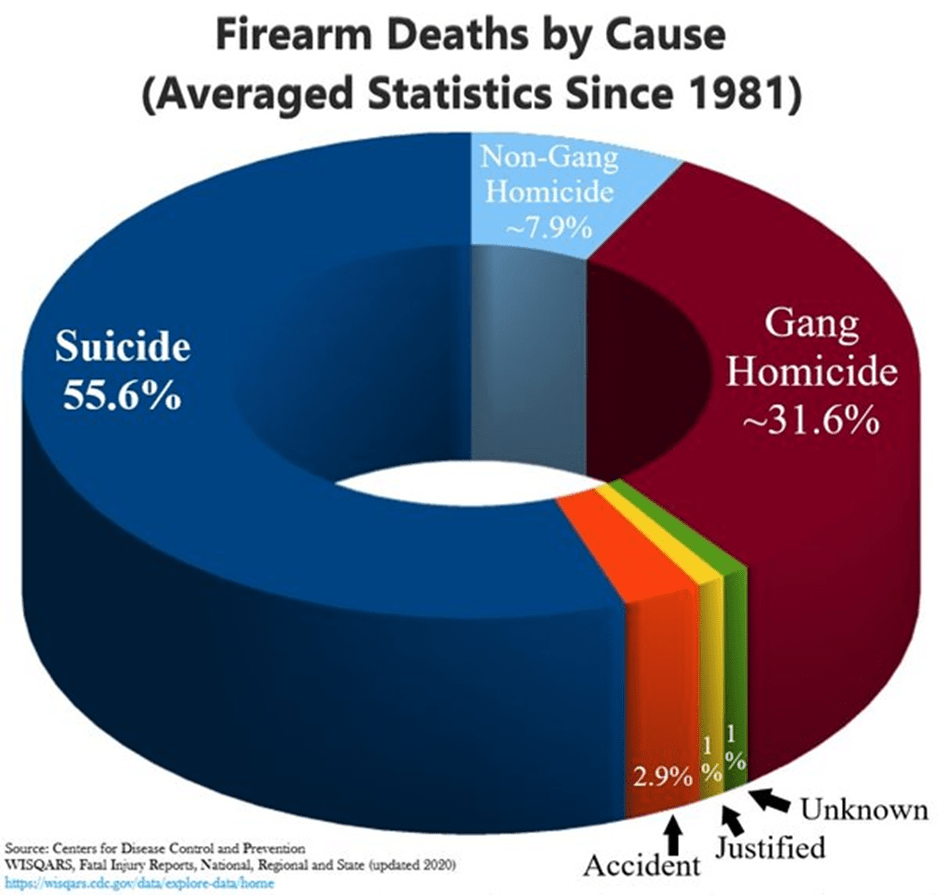
The chart, from CDC, provides a specific perspective – that, since 1981, 55.6% of gun deaths were suicides, and that 31.6% were gang homicides. It kind of makes the “gun control” legislation – like banning 30 round magazines and “assault type rifles” look a little bit ineffective. I don’t like suicide – permanent solutions to temporary problems aren’t something I approve of (kindly ignore the dangling preposition).
Finding out that about 80% of homicides are gang homicides . . . well, you don’t join a gang to get tips on obeying the laws, and gangs tend to be a more urban phenomena.
The next chart – with data from the labor department – gives a bit of a perspective on how we’re being affected by inflation. As I look at the gasoline costs, I really wonder if I shouldn’t be getting a second-hand Smart car to drive instead of the Talon . . . but as a child of the sixties, it’s nice to drive something that gets with the program when my right foot gets heavy.

And this map shows me that I surely don’t want to drive across Montana on Highway 2 in an electric car. I’m not certain, but it looks like the last charging station to the east is in Shelby or Cutbank . . . and the mile marker at the North Dakota line is 668 if I recall correctly.

-
One of the great things about the internet and youtube is the availability of songs once lost forever in the past. As a small boy, when Dad’s ship (The General J. C. Breckenridge – AP 176) would steam out, she would leave the dock to the song Shina No Yoru. The title translates to China nights, or the nights of China – the song was recorded in 1938 by Hamako Watanabe.

I think it was played when Japanese troop transports steamed out for China in those early years of World War II. The song was closely enough associated with the Japanese military that she did a year in a POW camp before being sent back to Yokohama. Her 1950 version is online at HAMAKO WATANABE – SHINA NO YORU -78RPM COLUMBIA JAPAN 1950 – it was picked up by American GI’s as they moved across the Sea of Japan for duty in Korea – and their lack of fluency in Japanese resulted in the mistranslation “She Ain’t Got No YoYo”. Somehow the Japanese song became the song played as the Breckenridge pulled away from the pier as she left the West Coast for Japan.

The picture was taken after 1955 – I know, because in 1955, the ship was taken in for work (she lost her armament) and Dad headed with family for shore duty in Tacoma . . . a base loaded with decommissioned ships, but nowhere playing Shina No Yoru. Before Dad was assigned to Breckenridge, she had brought my cousins to the East Coast as my uncle was assigned back stateside from occupation duty in Germany.
It’s nice to be able to listen to the song again. Click the link – you may enjoy it too.
-
Kevin O’Brian died a couple of years back – but in 2013, he wrote these rules for evaluating charities in his Weaponsman blog:
Some Rules of Thumb for Evaluating a Charity Pitch
The pitches will always be with us, and the same scamsters that pitch phony police and fire charities (a staple of the bogus-charity racket) began hitting troop and vet charities hard after 9/11. They also crop up after a Hurricane Katrina or Sandy, or a Boston Marathon bombing, with their hands out and their pitch polished. Here’s how to spot them:
- If they solicit by telephone, they’re a ripoff. Always. The “industry standard” is that 85% to 95% of the money raised by telemarketing consultants sticks to them, and as little as 5% creaks through to the charity. (AIP’s found cases where a half-million was raised and under $25k went to the charity — which then had over 50% overhead!) Phone solicitors are normally trained to pretend they work directly for the charity, while they invariably work for for-profit fundraising firms. Also, if you do give them a pledge, or your credit card number, your details go on a “sucker list” (that’s what they really call it) that’s sold and resold among telemarketing firms. Unfortunately, Congress carved out two exemptions when they criminalized rapacious telemarketing: non-profit fundraising (even by for-profit contractors) and, naturally, political fundraising and surveys. Finally, the people who man the phone banks are sketchy individuals, often rounded up from ex-con hangouts, rehab facilities, homeless shelters and other manifestations of what a 12-step program calls Rock Bottom. You wouldn’t give your credit card number to a bum in the street, don’t give it to a bum on the phone.
- If they solicit by direct mail, they’re a ripoff. Always. The economics of direct mail are identical to telemarketing (including the danger of being sucker-listed). They just don’t have to put some toothless meth addict on the phone with you. The current state of the art in mail pitches is to send a big fat envelope with a chaotic mess of different sizes of paper, some of which emulate typed or handwritten appeals. The theory is, if you take the time to read their pitch, you’ll give and they (the marketers) will cash in.
- If there are a lot of chachkas in the direct mail, they’re absolutely a ripoff. These include things like address labels, bookmarks, and the fad from a couple years ago, a coin or a dollar bill. Our advice: use the labels if they don’t advertise the dodgy charity; use the bookmarks if you must, but black out the “charity’s” website and phone number lest you forget where it came from and are moved to donate; and spend the dollar with aplomb. You’re not taking a dollar away from veterans (or starving Africans or orphaned kittens, for all these scams are run by the same for-profit ripoff artists); you’re taking a dollar away from a pustule on the ass of the advertising industry. Aplomb, hell; spend the dollar with glee.
- If they pay executives over $350k, there’s about a 90% chance they’re a ripoff. You can see some key salaries in the Form 990s, but sometimes they hide them with creative dodges like “renting” a building or an office from the CEO or his/her spouse at ten times market rate, or those famous consulting contracts. This is why you need to look at the charity evaluators before you sign that check.
- If they’re not up to date with their Form 990s with the IRS, they’re either incompetent or hiding something. Neither way do you want to finance that, right?
- If they don’t have all their Form 990s readily on their website, they’re hiding something. Legit charities are proud of the tale of good works the 990 tells.
- If the charity evaluators disagree, rely on the most pessimistic and lowest rating. Because they’re probably worse than the evaluators could find out.
One last warning: if a charity was created since 9/11, be extremely wary. As we mentioned, a lot of charity profiteers flocked to this sector in the last decade or so, because that’s where the generosity is. Or to boil it down: “That’s where the money is” — Willie Sutton. Mr Sutton, you may recall, was a bank robber, a trade that’s been in decline since his heyday. The Willie Suttons of the 21st Century run charities — with the blessing of the IRS and other government entities. There are some good post-911 charities, but there really weren’t any new problems to address, just new people wanting to be involved — many for good reasons, other for less so. (And this dynamic affected traditional charities, too. The American Red Cross, a perennial bad-financial-management tale, parlayed 9/11 into huge fundraising — and then hung on to the money, paying the fundraisers bonuses).
Kevin O’Brian
Want to tell us something or ask a question? Get in touch.

Recent Posts
- Recovery Time for a Retiree
- Venn Diagram and DSM
- When Castro Was Cool
- You Have To Beat Darwin Every Day
- Computer Repair by Mussolini
- Getting Alberta Oil to Market
- Parties On Economics
- Thus Spake Zarathustra – One More Time
- Suspenders
- You Haven’t Met All The People . . .
- Play Stupid Games, Win Stupid Prizes
- The Ballad of Lenin’s Tomb

Rough Cut Lumber
Harvested as part of thinning to reduce fire danger.
$0.75 per board foot.
Call Mike (406-882-4835) or Sam (406-882-4597)
Popular Posts
Ask The Entomologist Bears Books Canada Census Community Decay Covid Covid-19 Data Deer Demography Education Elections Eureka Montana family Firearms Game Cameras Geese Government Guns History Inflation life Lincoln County Board of Health Lincoln County MT Lincoln Electric Cooperative Montana nature News Patches' Pieces Pest Control Politics Pond Recipe School School Board Snow Taxes travel Trego Trego Montana Trego School Weather Wildlife writing
 Trego's Mountain Ear