-

The internet has information available on the Boito B-300 pistols – and much of it is wrong. The first site I hit shows part of the problem: “The chamber is long enough to fit a 3″ shell and there are no issues loading, ejecting, etc. However, the (rifled) barrel is stamped “44 cal. ball”. I’m a bit mystified as to what “44 ball” means, other than a muzzle-loading term (this gun is centerfire).”
The Boito B-300/1 was built to meet the criteria of the National Firearms Act (1934). The 44 ball cartridge listed on the barrel is one of the 44 cartridges used in the 1908 Marble Game Getter – a double-barrel, over and under pistol with a removable stock. Union Metallic Cartridge corp loaded the 44 round ball cartridge with 34 grains of black powder and a 115 grain lead round ball. A lead .433 caliber round ball weighs in at 122 grains, and the formula is diameter cubed x 1504.56 . . . so if I cube .425 and do the math I come up with the light side of 115.5 grains. My calipers measure the bore at the muzzle at 0.416 – so the bore is just tight enough that the rifling can engage that .425 round ball. It is rifled, and the barrel marking shows that it is intended for the UMC cartridge. The builders and importers carefully built the pistol to avoid being a short barreled shotgun. The critical measurements are the base diameter (.471”), and rim diameter (.520”). Those figures for the 410 cartridge are base diameter (.470”), and rim diameter (.525”). The barrel is marked for the UMC 44 ball cartridge – and the pistol chamber was cut to also (coincidentally?) fit the 3” 410.
I’m not particularly worried about the pressures of a 3 inch 410 cartridge – the Boito B-300/2 was built for a 44 magnum. SAAMI lists the 44 mag’s pressure at 36,000 psi (bullet diameter from 0.429 to 0.432) while chamber pressure of the 3 inch 410 is 13,500 psi. I’ve had no problems with the 3 inch 410 – but if you find one, remember it is marked for the 44 ball, not the magnum 410.
I suspect the idea to build a pistol that carefully missed classification as a sawed-off shotgun came after Thompson Center marketed the Contender in 45/410 – a barrel originally chambered in 45 Colt, chambered again in 410, with a special choke to neutralize the rifling. That was a more expensive way of getting a legal small shot pistol. Now with both Taurus and Smith and Wesson marketing 45/410 revolvers, it’s no big deal – but in the seventies Boito and Thompson Center were the alternatives.
Boito was equally creative in exporting guns to Canada. Canada’s legislation on short-barreled rifles and shotguns differs from the US – so the B-300 sold in Canada isn’t a pistol, and doesn’t need rifling:

It’s available in both 20 gauge and 410, and illegal as hell in the US – even if the name Boito Hiker is totally unthreatening.
The Boito B-300/1 is not a common gun – I ran across two others that listed serial numbers and each was within 20 of my own 3 digit number. As I reviewed the internet for more information, I learned that Rock Island Auctions has serial number 1554 coming up for auction on November 1.
The name Boito comes from Joao Boito – an Italian blacksmith who built shotguns in Brazil – he diversified around 1955, and Boito shotguns became a low price offering throughout the US and Canada by the mid-seventies.
-
We’ve touched on the Misery Index before– it’s economic shorthand for how unpleasant things feel at any given time. Inflation added to unemployment, the higher, the more unpleasant.
One of the wonders of the internet is that there so often is “a website for that”. In the case of the misery index, it’s miseryindex.us, which allows you to look at the misery index by year, month, and president. The last two decades are represented as follows.
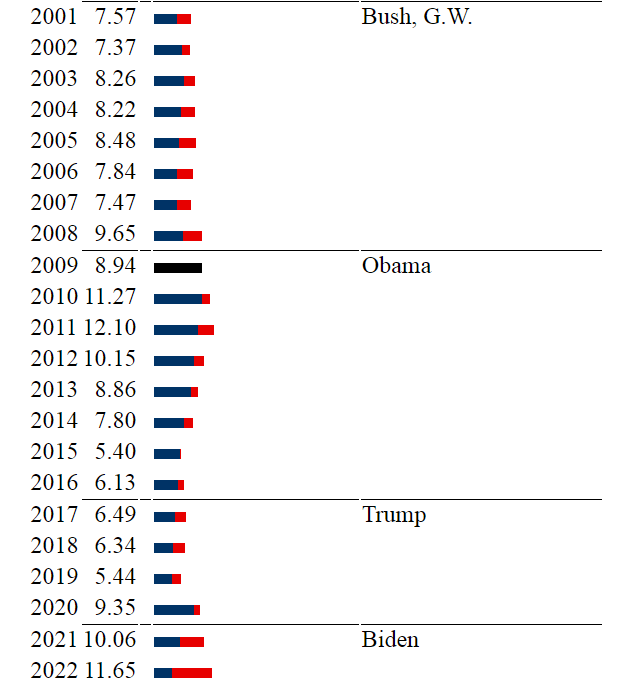
And- if you aren’t feeling the misery- here’s the link to the national debt clock (because there’s a website for that, too).
-
It’s the middle of October, when the days grow shorter and the trees are painted in the colors of fall. In previous years, we’ve written about Game Cameras, Chronic Wasting, Professional Licensure, Mushrooms, Harvestmen and more.
Game Camera Fails
At 6 am, Mike was out collecting firewood from the stack to start the days fire. Kiki, the older, chubby white Pomeranian was out with him. Kiki positioned herself off the back steps and started trying to raise the dead with her bark. With enough firewood in hand, Mike called Kiki to the house. Remarkably,…
Chronic Wasting Disease
As the start of the hunting season for deer and elk approaches (general, not archery), Chronic Wasting Disease becomes increasingly relevant again. Chronic Wasting Disease is a prion disease, fatal, with no known treatments. While there are no known transmissions to humans, the CDC recommends having elk, deer or moose tested if there’s known to…
I need a license for what?
One of the worst shocks of growing up was how much paperwork adulthood requires. Recently, I’ve been learning about licenses. Not fishing licenses, or hunting licenses, which I did know about, but professional and occupational licenses. Some professions are obvious. It’s clear that a doctor, an MD, will need a license to practice medicine. Clear,…
Harvestmen, or Daddy-Long-Legs
Earlier this week, I met a Harvestman while making supper. It had stowed away on some kale from the garden, and was still walking about on it… even after a week or so in the refrigerator. Harvestmen have a rather well-known urban legend. Perhaps you’ve heard people say that “they’re the most venomous spiders in…
Be Nice to the Candidates
I can claim that I am an elected school trustee. So can the school board members in Fortine and Eureka. Yet I (and probably most of them) was elected by acclamation. There may be a more politically correct way to describe it – but the reality is that I was elected without anyone voting for…
Thoughts on Mandatory Retirement Age
I recall a time when mandatory retirement age became illegal. The age discrimination law passed in 1967 – the year I graduated high school. It didn’t personally affect me – I was 17. Still, I can think of a few reasons we might want to revisit the idea. The Dakota – the Sioux – as…
A Billion to Increase Tree Equity
I notice that a small part of the huge “Infrastructure” bill is a billion dollars to plant trees to increase “tree equity.” I probably need a professional forester to explain the significance of “tree equity” to me – but looking at my small piece of the west, “tree equity” seems somewhere between impractical and impossible. …
BLS and My Neighbor’s Laws
Senator Daniel Patrick Moynihan told of overhearing his housekeeper on the phone, “Sure, he’s a doctor, but not the kind that does a body any good.” There are more doctors that can do “a body any good” than Ph.D. sociologists like Moynihan. There is a practicing physician (whether DO or MD) for somewhere on the…
Mushrooms abound!
It’s been a good couple weeks for mushrooms here – puffballs, many ready to be made into mushroom steaks, some already releasing spores, seeding future years’ mushrooms. And shaggy manes, good for eating fresh, or letting sit and turn into “mushroom ink”. The first time this happened to some shaggy manes we’d collected, I was…
Bear Attack Statistics
Flathead Bear Aware posted “In fact, more people are killed by black bears.” The statement brings the opportunity for statistics – and there are a couple of sources easily available for checking the statement. From a statistical perspective, fatalities are a more solid measure than attacks. Five years ago, I listened to a man telling…
I Think I Got the Bedbug Letter
I first heard of the bedbug letter about 50 years ago – from Bob Brown, when we were undergrads at MSU. In Bob’s story, the protagonist was P.J. Hill of the Great Northern . . . the Hill that Hill county is named after. The Hill who was known as the “Empire Builder.” Since the…
The Misery Index
Almost a half-century ago, an economist named Arthur Okun developed the Misery Index. It’s a simple calculation – just add the unemployment rate to the inflation rate, and you have the Misery Index. He also came up with Okun’s law – which is online, but I think it would be better termed Okun’s estimate. At…
-
This Sunday, folks were able to tour the cemetery and enjoy portrayals of some of the folks buried there. In between graves, tour guests learned facts about cemeteries in general (not the same as a graveyard, as it turns out) and about the Tobacco Valley Cemetery in particular. The tour ended with Sheriff Baney.

It was well organized, and wonderfully done.
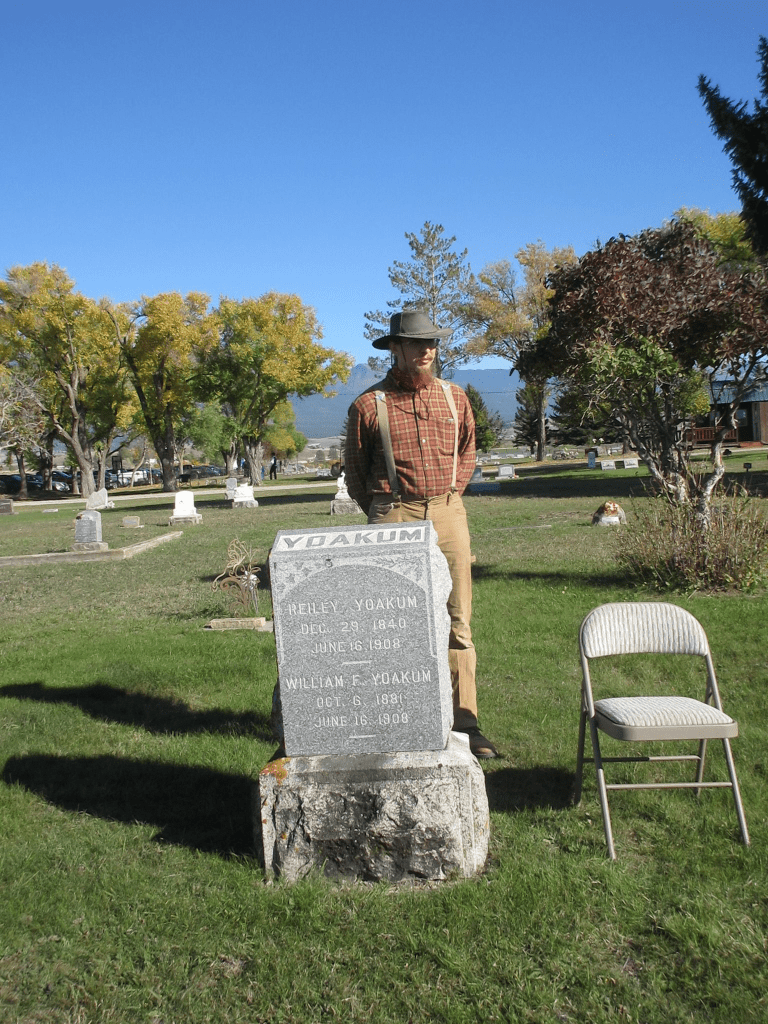
Jedidiah McCurry as William Yoakum -
Joe Biden said “Milton Friedman isn’t running the show anymore.” We’ve heard a lot of Biden comments over the past couple of years – and it isn’t a bad idea to look at some of the things Milton Friedman said:
I do not believe that the solution to our problem is simply to elect the right people. The important thing is to establish a political climate of opinion which will make it politically profitable for the wrong people to do the right thing. Unless it is politically profitable for the wrong people to do the right thing, the right people will not do the right thing either, or if they try, they will shortly be out of office.
A society that puts equality — in the sense of equality of outcome — ahead of freedom will end up with neither equality nor freedom. The use of force to achieve equality will destroy freedom, and the force, introduced for good purposes, will end up in the hands of people who use it to promote their own interests.
Anything that government can do, private enterprise can do for half the cost.
Indeed, a major source of objection to a free economy is precisely that it… gives people what they want instead of what a particular group thinks they ought to want. Underlying most arguments against the free market is a lack of belief in freedom itself.
There are severe limits to the good that the government can do for the economy, but there are almost no limits to the harm it can do.
I would say that in this world, the greatest source of inequality has been special privileges granted by government.
The problem in this world is to avoid concentration of power – we must have a dispersion of power.
Most economic fallacies derive from the tendency to assume that there is a fixed pie, that one party can gain only at the expense of another.
Because it is one thing to have free immigration to jobs. It is another thing to have free immigration to welfare. And you cannot have both. If you have a welfare state, if you have a state in which every resident is promises a certain minimal level of income, or a minimum level of subsistence, regardless of whether he works or not, produces it or not. Then it really is an impossible thing.
The excuse for the destruction of liberty is always the plea of necessary ‘ that there is no alternative
What works for Sweden wouldn’t work for France or Germany or Italy. In a small state, you can reach outside for many of your activities. In a homogeneous culture, they are willing to pay higher taxes in order to achieve commonly held goals. But “common goals” are much harder to come by in larger, more heterogeneous populations.
-
Somewhere, I read a definition of peace: “an unnatural state of human interaction that we assume exists because occasionally both sides are reloading simultaneously.” I don’t know who should get the credit for the definition.
My first studies of a war-torn locale were Sunday school. Times were rough on those Canaanite guys, and it didn’t change with the Philistines. You look at the photographs – it’s a country that blooms when irrigated – and I’ve spent enough time around agriculture to know how much access to water fits in with conflict. I expect conflict to be the natural state of affairs in a water deprived country that has had wars since the Exodus. Nothing personal, but I’m not buying real estate in a neighborhood where gangs dominate. Add in a little bit of religious differences and intolerance and it just isn’t a good place to be.
So I’m not particularly surprised that peace is not present in Israel. I’m not surprised that most of the folks invading are adherents of the religion of peace. Over a century ago, Kipling wrote “MacDonough’s Song.” It’s in the public domain now, so we can include the whole poem in the blog:
Whether the State can loose and bind
In Heaven as well as on Earth:
If it be wiser to kill mankind
Before or after the birth—
These are matters of high concern
Where State-kept schoolmen are;
But Holy State (we have lived to learn)
Endeth in Holy War.
Whether The People be led by The Lord,
Or lured by the loudest throat:
If it be quicker to die by the sword
Or cheaper to die by vote—
These are things we have dealt with once,
(And they will not rise from their grave)
For Holy People, however it runs,
Endeth in wholly Slave.
Whatsoever, for any cause,
Seeketh to take or give,
Power above or beyond the Laws,
Suffer it not to live!
Holy State or Holy King—
Or Holy People’s Will—
Have no truck with the senseless thing.
Order the guns and kill!
Saying—after—me:—
Once there was The People—Terror gave it birth;
Once there was The People and it made a Hell of Earth.
Earth arose and crushed it. Listen, O ye slain!
Once there was The People—it shall never be again! -
Sometime before 2000 – probably in 1997 or 98 – a small stuffed animal came into our lives and home. It resembled a chihuahua, and when you pressed on its chest a speaker vocalized the advertising message: “Yo quiero taco bell.” As Sam moved into elementary school, then middle and high school, the stuffed animals spent more time in drawers and closets. Eventually, this little stuffed dog was packed away for our trip returning to Montana.

As Sam’s little boy approached 6 months, a package labeled “stuffed animals” was opened – a large stuffed bear for the playpen, the old stuffed elephant . . . some of the plush menagerie are still missing, their packages unopened. But the Taco Bell advertising dog still talks – at least 25 years have passed since it was given out with a kids meal at Taco Bell, and was passed on to me for Sam, she can share it with her infant son – and after 25 years, it still comments “Yo Quiero Taco Bell.” That’s amazing longevity for a giveaway advertising gimmick.
I recall the advertising campaign – but I never realized how expensive it was to the restaurant chain.
From the Seattle Times, Jan 24, 2009:
“Dispute over the rights to market the sassy Chihuahua began in 1998, when Joseph Shields and Thomas Rinks of Grand Rapids, Mich., filed suit claiming breach of contract. The developers of a “psycho Chihuahua” cartoon had been in talks with Taco Bell advertising agents to adapt the character for TV spots when, the men claimed in their lawsuit, Taco Bell took the idea to another ad agency, TBWA Chiat/Day.
In June 2003, a federal jury in Michigan ordered Taco Bell to pay the creators $30 million, and a federal judge tacked on nearly $12 million more in interest three months later. The judgments prompted Taco Bell to sue TBWA, arguing that the ad agency was liable for the disputed content.”
I hope Remi enjoys his new old toy – even if the advertising campaign got a bit expensive. Heck, we might even have to find a copy of Legally Blonde so he can watch the post-advertising adventures of Gidget, the chihuahua in the advertisements.
-
I spent most of my public school years in South Dakota, and was a bit bewildered by Columbus day when I returned to Montana. South Dakota renamed Columbus Day back in 1990, after a proposal by Governor Mickleson.
It isn’t the only one, these days: Alabama, Alaska, Hawaii, Maine, Nebraska, New Mexico, Oklahoma, Oregon and Vermont also consider it some variation on Native American Day/Indigenous Peoples Day.
South Dakota’s renaming happened just shy of a century after the first Columbus Day, which was created by President Harrison in 1892. According to whitehouse.gov, this was to combat anti-Italian sentiments.
There’s a lot to be said about Columbus, and about the Columbian Exchange. There are also a number of other, lesser known explorers that have played roles (perhaps greater than those of Columbus): John Cabot, Vasco de Gama, and Leif Erikson among others.
-
The Longer Game – by Jeffrey Carter – Points And Figures simplifies our nation’s budgeting problem:
“70% of the budget that is now $33 trillion in deficit is pre-planned mandatory spending that no one in Washington has the standing to stop. Like a kudzu plant, it grows every year and you can’t kill it. It’s hard to even slow down or trim. . .
We can squabble all we want. We can make our talking points. We can go on TV and play “gotcha” with the other party every single day. You know what? Every single day the budget deficit gets bigger because no single Senator or Representative will do anything about the 70% of the budget that grows every year and is bankrupting us.
It’s not the defense budget. It’s entitlements. It’s transfer payments. It’s programs like Social Security, Medicare, Medicaid, EBT/SNAP, and programs like that. I always hear the refrain “We are the richest country in the world and in human history but we can’t seem to take care of our poor”. I have news for you, no government can.”
U.S. Debt: Visualizing the $31.4 Trillion Owed in 2023 provides a visualization of the total, but also shows the debt by year (click the link to see even more years):
Year Outstanding Debt Year-Over-Year Increase 2023* $31.4T 2% 2022 $30.9T 9% 2021 $28.4T 6% 2020 $26.9T 19% 2019 $22.7T 6% 2018 $21.5T 6% 2017 $20.2T 3% 2016 $19.6T 8% 2015 $18.2T 2% 2014 $17.8T 6% 2013 $16.7T 4% 2012 $16.1T 9% The article takes us back ten years at a time – it seems relevant to note that the last year the debt didn’t increase was 2000. The Trump years (2017 to 2021) showed an increase of 34%. The last 4 Obama years showed an increase of 20% – and it looks like Biden’s total will also be less than Trumps.
Growing interest in U.S. debt – POLITICO – Politico is regarded as left-slanting – but this article seems more like a fiscal conservative view:
“Now the Fed expects to keep its main policy rate above 5 percent through the end of next year. By the end of 2026, it could still be at roughly 3 percent. If that bears out, that’s a brave new world.
The piece of the budget eaten up by interest payments is already projected to be about 10 percent, or $663 billion, for fiscal 2023, according to the Center on Budget and Policy Priorities. And the Congressional Budget Office expects those costs to grow. That’s compared to an estimated $806 billion for national defense.
“If you look at the CBO outlook, we’re going to spend about $80 trillion over the next 10 years, and about $10 trillion of that is interest,” Douglas Holtz-Eakin, who headed the office under George W. Bush, told MM. That’s based on the 10-year Treasury note settling at 3.8 percent, compared to about 4.6 percent right now, leaving open the possibility that those costs could grow by, say, another trillion or so.
How much should we care? That’s tough to answer. There are, of course, modern monetary theorists who believe that government spending is too high only when it causes excessive inflation, and otherwise isn’t a problem.
But mainstream economists generally argue that there are costs to allowing government debt, and interest on it, to become too large in proportion to GDP, with implications for productivity and growth.
What’s less clear is whether voters care. Sure, they tend to say they do. But debt is an abstract idea that doesn’t seem to drive votes. Sarah Binder, a political science professor at George Washington University, said when it comes to principles, people tend to be conservative, criticizing the notion of “out-of-control spending.”
“But operationally people are kind of liberal,” balking at cuts to popular programs, she added. And they don’t want to pay more in taxes either.”
Somehow, it reminds me of my colleague’s Oldsmobile – new, shiny and just out of warranty. Even before the engine blew, he owed more on the car than it was worth. After the engine blew, the only folks that could work a trade in was the Oldsmobile dealership – he traded to a brand spanking new Olds, and owed more against it than the sticker price before he drove it off the lot. When ten percent of your budget is interest, it is somewhere between bloody difficult and impossible to reduce the principle.
Perhaps, instead of electing likable politicians, we should elect curmudgeons who can bite the bullet and cut down the national debt . . . and get the entitlements back into being less than half of the budget. Obviously, the popular politicians haven’t been able to do the job.
-
That is to say, that on the 20th of April, our Governor signed into law HB 536. This law amends the rules for write-in elections by removing section seven of the law regarding the declaration of intent for write-in candidates.
Section seven (of 13-10-211) is the last option to ensure a contested election, that is an election in which there is more than one candidate. An uncontested election is not an election in any way that matters– it is merely a rubber stamp.
Section seven is a written such that if there is no filed or declared candidate for a race in the primary, an undeclared write-in candidate is still eligible to be placed on the the official ballot in November. Had section seven been followed in our last election we would have had contested elections at the county level last November (the republican primary had a few races without candidates at the county level, and the democrat primary ballot was entirely blank at the county level).
Last year, after several email exchanges with the county election administrator (at the time, Paula Buff) we learned that she did not consider counting the write-in votes to be necessary.
Being rather appalled at the realization that anything written in on the appropriate blank was only an illusion of a vote, we contacted the secretary of state. The response was a form letter.
Now, we find that the state legislature has decided to codify Paula’s decision to ignore the law (something we suspect was happening throughout the state). Surely, removing a law designed to safeguard our elections and ensure that voters actually have a choice at the ballot box would be a highly contested issue? Something that passed by a narrow margin?
There were precisely four votes against it. In the House: Frank Smith, Katie Sullivan and Zoe Zephyr, all democrats. In the Senate: Brad Molnar, a republican. The vast majority of both the house and the senate thought removing this last chance at ensuring real elections was a good idea. We note that no one from Lincoln County is among those four votes. We remarked previously that Zephyr won a contested election to become a representative, though that was not the case for 31% of the House.
While it was the case that section seven was no longer functioning as a safeguard, since election administrators were allowed to ignore it, removing it rather than repairing it seems to be a rather bad decision.
It begs the question: What exactly are they going to replace our safeguard with? If the answer is nothing, then we have moved one step further away from representative democracy.


Want to tell us something or ask a question? Get in touch.

Recent Posts
- Recovery Time for a Retiree
- Venn Diagram and DSM
- When Castro Was Cool
- You Have To Beat Darwin Every Day
- Computer Repair by Mussolini
- Getting Alberta Oil to Market
- Parties On Economics
- Thus Spake Zarathustra – One More Time
- Suspenders
- You Haven’t Met All The People . . .
- Play Stupid Games, Win Stupid Prizes
- The Ballad of Lenin’s Tomb

Rough Cut Lumber
Harvested as part of thinning to reduce fire danger.
$0.75 per board foot.
Call Mike (406-882-4835) or Sam (406-882-4597)
Popular Posts
Ask The Entomologist Bears Books Canada Census Community Decay Covid Covid-19 Data Deer Demography Education Elections Eureka Montana family Firearms Game Cameras Geese Government Guns History Inflation life Lincoln County Board of Health Lincoln County MT Lincoln Electric Cooperative Montana nature News Patches' Pieces Pest Control Politics Pond Recipe School School Board Snow Taxes travel Trego Trego Montana Trego School Weather Wildlife writing
 Trego's Mountain Ear