-
A phobia is, by definition, intense, persistent and irrational. Glancing at the historical record, it’s difficult to claim that a fear of Islam is irrational. The Rise of Islamic Geography in the Middle Ages provides this description of Islamic expansion:
“The Islamic empire began to expand beyond the Arabian Peninsula after the death of the prophet and founder of Islam, Mohammed, in 632 CE. Islamic leaders conquered Iran in 641 and in 642, Egypt was under Islamic control. In the eighth century, all of northern Africa, the Iberian Peninsula (Spain and Portugal), India, and Indonesia became Islamic lands. The Muslims were stopped from further expansion into Europe by their defeat at the Battle of Tours in France in 732. Nonetheless, Islamic rule continued on the Iberian Peninsula for nearly nine centuries.”
When we talk about the west, or western civilization, we’re referring to what was the western quarter of Christendom – Europe. Prior to the Islamic expansion, Egypt was Christian. Syria was Christian. The Byzantines were Christian. A century after Mohammed’s death, three fourths of the Christian world was under Islamic rule – The First Crusade didn’t occur until 1096. Spain – then Andalusia – had been under Islamic rule for over 350 years when the first Crusade set out for Jerusalem.
Still, having a quarter of the territory left was pretty good compared to Zoroastrianism –
“Zoroastrianism is an ancient Persian religion that may have originated as early as 4,000 years ago. Arguably the world’s first monotheistic faith, it’s one of the oldest religions still in existence. Zoroastrianism was the state religion of three Persian dynasties, until the Muslim conquest of Persia in the seventh century A.D. Zoroastrian refugees, called Parsis, escaped Muslim persecution in Iran by emigrating to India. Zoroastrianism now has an estimated 100,000 to 200,000 worshipers worldwide, and is practiced today as a minority religion in parts of Iran and India.”
“The Muslim conquest of Persia between A.D. 633 and 651 led to the fall of the Sassanian Persian Empire and the decline of the Zoroastrian religion in Iran.
The Arab invaders charged Zoroastrians living in Persia taxes for retaining their religious practices and implemented laws to make life difficult for them. Over time, most Iranian Zoroastrians converted to Islam.”
9-11 was a date significant to Islam long before 2001. The Other September 11th | Gates of Vienna:
“Having failed to take Vienna in the siege of 1529, the Turks prepared a second attempt in 1683. Under the leadership of the Grand Vizier, Pasha Kara Mustafa, and with their Tatar and Malaysian allies, they made their preparations and fought their way towards the capital, overrunning Austrian villages and smaller cities in their path and taking many captives. As the Muslim hordes approached Vienna, King Leopold fled west with most of the citizens, leaving a garrison of about 11,000 soldiers and 5,000 citizen volunteers to hold the city against the Turks. The Viennese razed buildings in the area around the city walls in order to deny the enemy cover, and brought livestock and provender into the city to prepare for a siege.
On July 16th, 1683, the second siege of Vienna began. The tiny garrison in the city was no match for Kara Mustafa’s army of 140,000, but the Grand Vizier decided to starve the city into submission rather than attempt a frontal assault on its defenses.
All of these squabbling political entities were Catholic, and theoretically united under the leadership of Rome. Pope Innocent XI recognized the danger posed by the Ottomans, and, in the name of God and the Church, called on all the rulers of Central Europe to unite against the common foe and save Vienna.
Louis XIV declined to obey his pontiff, and continued his scheming.
Jan Sobieski, on the other hand, was ready to answer the Pope’s call. However, in order to go to war, Polish law required him to get the unanimous approval of the Polish Diet. The French king’s ambassador plied members of the Diet with massive bribes to induce them to vote against Sobieski’s venture. Through most of the summer it seemed that Sobieski would be unable to ride to Vienna.
Fortunately for the Austrians, and for Christendom, Pope Innocent authorized the papal nuncio in Kraków to use the full resources of the Vatican. The nuncio was able to outbid Louis in bribery, but only barely. In the end the Diet reached unanimity and authorized their King to ride to the relief of Vienna.
When the King of Poland set off for Vienna in early September, the Viennese garrison was in desperate straits. The people of the city were starving, and the city had suffered serious damage from the Turkish bombardment.
The Ottoman armies’ artillery pieces were of inferior design, and were unable to reduce the city walls, so the Turks had taken to tunneling. They had ample gunpowder, and their engineers dug mines under the walls and set off a number of charges that did serious damage and opened gaps in the walls. The Viennese rallied to build barriers in the gaps, and managed to keep the Turks out, but it was only a matter of time until Kara Mustafa succeeded. The Viennese garrison prepared for a last-ditch defense within the city walls.
It was then, at the last possible moment on the evening of September 11th, that Jan Sobieski arrived at a hill north of the city, leading a force of 40,000 Poles and their German and Austrian allies. The battle began soon afterwards, in the early morning hours of September 12th.
The Austrians and Germans attacked the Turks first at the center and on the left flank. The Turks counterattacked, but held back a significant portion of their forces in anticipation of entering the city through a breach in the wall. That very morning the Grand Vizier had prepared a second and more powerful charge to be set off under the Löbel bastion, one that would throw the city open to the Turkish forces once and for all.
Unfortunately for Kara Mustafa, the Austrians within the city had mounted a counter-tunneling operation. The Austrian “moles” detected the Turkish mine, found the charge, and defused it.
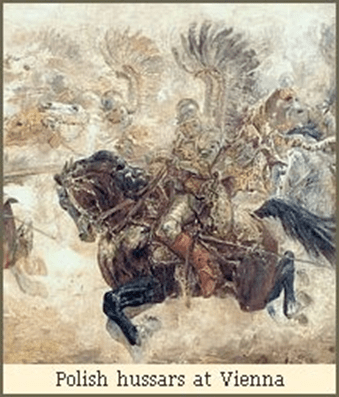
At about the same time the King of Poland, in the van with the fearsome Winged Hussars and with 20,000 men behind him, led a cavalry charge down the hill into the right flank of the Ottoman army. The Hussars were one of the most formidable fighting forces of the time, and the sound of the wind through the feathers of their artificial wings was said to unnerve the enemies’ horses and drive superstitious soldiers into a panic.
The battle was over in three hours. The King drove through the Turkish lines, and, seeing his success, the Vienna garrison sallied forth from the city and hit the Turks from the rear. Demoralized by these attacks and their failure to breach the wall, the Turks fled eastwards in haste, abandoning their tents, weapons, battle standards, provisions, and slaves.

The siege was broken and city was saved. Jan III Sobieski was received as the hero of Vienna. Though it was not evident at the time, the Ottoman tide had turned at the Gates of Vienna and was about to recede, beginning its long withdrawal through the Balkans and Greece into Asia Minor over the next two centuries.
Looking at history – even ancient history – suggests that Islamophobia may not qualify as irrational.
There is more of the story at each of the links.
-
NOAA has some long-range outlooks that let us look at the upcoming winter – and, as always, that’s a good news/bad news thing. Here are the maps:
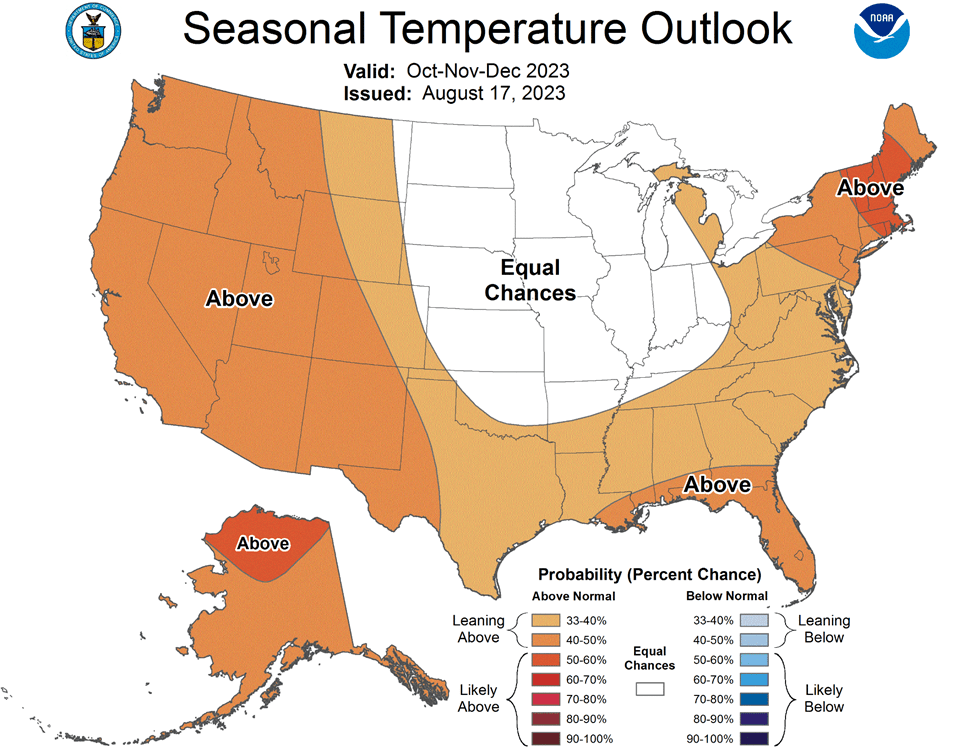

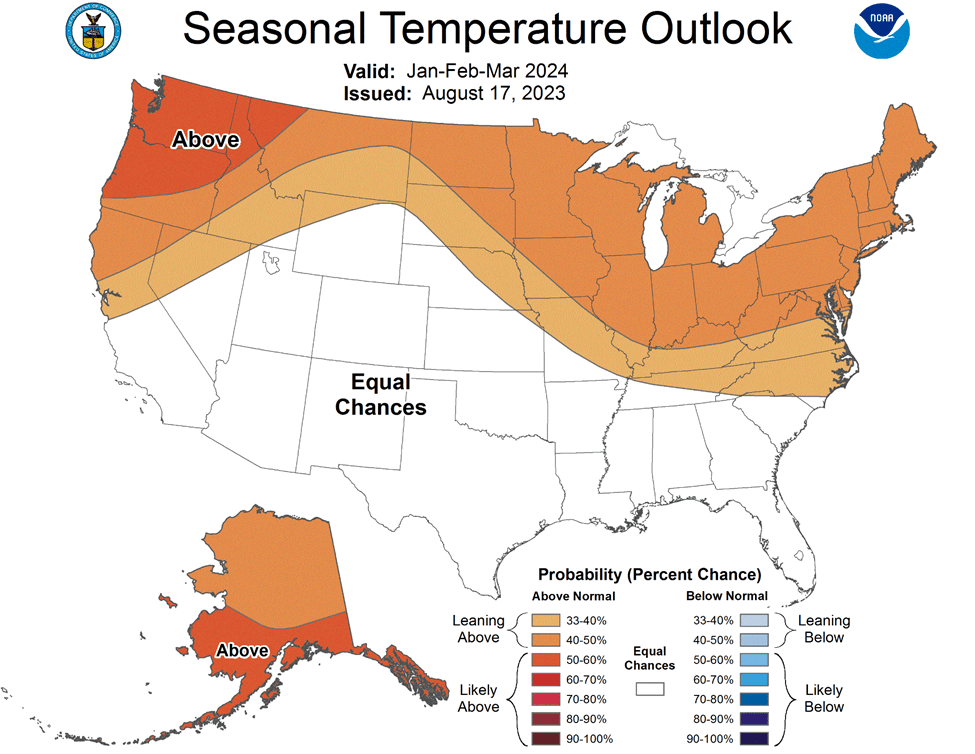

Winter may not be dryer and warmer than normal for us – but it looks like that’s the way to bet. I’ll hedge that bet by filling the woodshed – an easier task since bugkill has left me dry trees for firewood.
-

E. Digby Baltzell wrote decades ago, “History is a graveyard of classes which have preferred caste privileges to leadership.”
Rediscovering E. Digby Baltzell’s Sociology of Elites – American Affairs Journal offers a brief description of Baltzell’s work on elites. He coined the term WASP, and wrote of the nation’s elites and their training schools. His family origins could have been called ‘elites in decline’ – Harvard wasn’t in the cards for him, and it is likely that growing up adjacent to the elites, but with entry closed off, he was more observant of what he couldn’t achieve.
The end of the WASP elite domination of American leadership might be marked with the death of George Herbert Walker Bush, five years ago, and twenty years after Balzell’s death. It may have occurred in the 2008 elections. Baltzell saw the WASP elites as relatively brief:
The structure of the upper class began to shift in the 1870s, driven by several changes in society. The Civil War created a more cohesive American union. Large-scale industrialization, urbanization, and immigration began to remake the face of the country. As Irving Kristol noted, “In 1870, the United States was a land of small family-owned businesses. By 1905, the large, publicly-owned corporation dominated the economic scene.”7 These firms created vast new wealth, with Gilded Age fortunes dwarfing any that had come before. There were more millionaires in the Senate in 1910 than there had been in the whole country prior to the Civil War.
A more centralized economy and government led naturally to a more centralized upper class. In this new environment, new upper-class institutions came into being, many of them national in scope. These included the elite boarding school—the number of which grew significantly after the Civil War—the country club, the summer resort town, and genealogical societies. The 1880s were a seminal decade in institution building, witnessing the establishment of the first country club in Brookline, Massachusetts (1882), the Groton School (1884), and Tuxedo Park (1885). Of particular note was the publication of the first edition of the Social Register, a directory of upper-class families and their affiliations, for New York in 1887.
Some key upper-class institutions like Exeter Academy, Harvard, and certain clubs predated this period, but they took on increasing importance at this time. Baltzell documents how upper-class families in Philadelphia were more likely to have attended Harvard, Princeton, or Yale and less likely to have attended Penn as generations passed. Similarly, the founders of upper-class families had originally hailed from a variety of religious backgrounds but largely converged on Episcopalianism over time.
Acceptance and participation in these institutions came to eclipse family in importance for defining social status, though obviously being from the right family was also a principal factor in acceptance. “It was, then, one’s club and educational affiliations, rather than family positions and accomplishment alone,” Baltzell wrote, “which placed one in a secure establishment position in the corporate and urban world which America had become by the end of the nineteenth century.” This was particularly the case with schools and the city gentlemen’s clubs. As Baltzell noted, “The circulations of elites in America and the assimilation of new men of power and influence into the upper class takes place primarily through the medium of urban clubdom.” We see this multigenerational assimilation via clubdom in the case of the Rockefeller dynasty. John D. Rockefeller Sr. was a member of the Union League Club of New York, Rockefeller Jr. a member of the more prestigious University Club, and Rockefeller III a member of the most exclusive Knickerbocker Club.”
If we try to integrate Baltzell’s work on elites with our current Elite group, the easy explanation is that we no longer have the same training of responsibility:
“As Baltzell observed, “What an establishment means is that a society is led by a class of men who act according to an agreed-upon code of manners. Certain things are not done.” Without an establishment, anything can, and ultimately will, be done in a country where “money talks, echoing in a moral vacuum.” Without class codes of conduct, only public scandal constrains, and often now not even that. He would see the loss of the establishment along with its class codes of behavior and social enforcement—not such presently popular notions as the weakening of strong political parties or the end of smoke-filled rooms—as decisive in the erosion of political norms. There is little prospect of recapturing a sense of political norms in the absence of the establishment that defined and enforced them.
This erosion of norms and standards goes beyond the political arena as well. Baltzell argued that “One of the major functions of an upper class is that of creating and perpetuating a set of traditional standards which carry authority and to which the rest of society aspires.” In the absence of an upper-class establishment, those standards would inevitably decline. For instance, some conservatives bemoan the fact that men no longer behave as gentlemen. But our idea of a gentleman was defined by the Anglo-American upper class. When the values of this class were normative or aspirational in society, people sought to live up to them. With that class all but gone and now despised, their values are despised with them.”
The article linked above is worth reading.
-
In New Mexico, I see the governor issuing an executive order that bans carrying firearms in a single county. She issued that order because a couple of kids were shot – I’d tend to use the word murdered. She found a simple solution that doesn’t address the problem, but affects a lot of people and violates both her state constitution and the US constitution.
There are right turn lanes from highway 93 to each exit for Trego from the north – but no left turn lanes from the south. Right turn lanes were simple to add – the complexity of highway design made including left-turn lanes a project that required more thought and planning. I don’t like making the left into Trego when I have cars making 75 mph on my tail – and I remember a highway department employee telling me that “a couple of people are going to have to die before you get a left turn lane.”
Trego, Stryker, Fortine and Rexford have had part-time post offices for quite a while. Now, I read that UPS will be cutting down to 3 days a week of delivery. It’s a simple solution – but I’m not sure that it directly affects the problem – remoteness.

The simple solution to messy, misused garbage transfer sites – our green boxes – is to reduce the number of sites and reduce access. Another solution is “Narc on your Neighbor” – turn in the folks who violate policy. Clear, simple, and wrong.

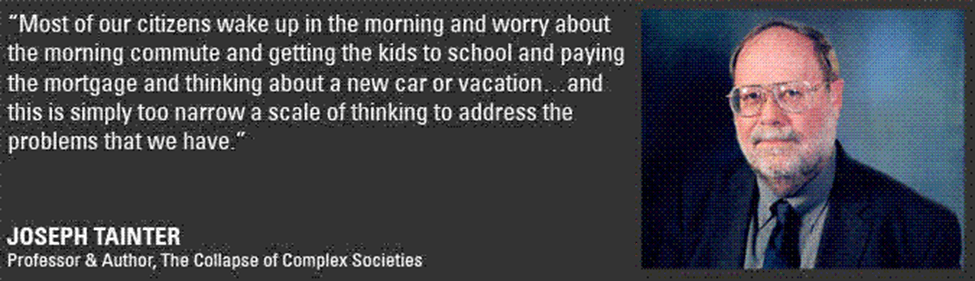
If we carry that Einstein quote out a little farther, perhaps another interpretation is that the problems we encounter in complex societies require more complex thinking rather than less. Every increase in complexity has been incorporated as a simple solution . . . and has generally led to another problem that was solved by increasing complexity.
Gibbons wrote of the rise and fall of the Roman Empire. Six volumes, and he gave Christianity credit for being the fall. He may have been right – but Rome was basically a pirate empire – supported by taking wealth from the neighboring folks they conquered. As they ran out of neighbors, the wealth stream grew smaller . . . in the year 383, Rome abandoned northern and western Britain. Around 409, Rome completed their Brexit. About 641, Rome was out of Egypt, as a new concept – the religious state, following the Koran, proved stronger than the pirate empire. When the old ways couldn’t continue successfully, nobody changed the paradigm.
As taxation, security, transportation and declining crop yields combined to make farming unprofitable at the edges of the empire, Rome’s solution was to declare that, if you were born a farmer, you couldn’t change professions . . . small wonder the barbarians on the edges of the Roman empire looked better to those agriculturists away from the capital. I suspect that those folks at the fringes of the empire were reduced to the equivalent of part-time post offices and three-day UPS deliveries long before the empire’s official fall in 476.
We live in a complex society – even an activity that is as mundane as garbage disposal is stressed. The same thinking that created a problem seems, and is, incapable of providing a solution. In 1910, faced with the problem of disposal of kitchen trash at the Tobacco Lumber dam in Trego, the cook hauled the empty cans to a stumphole on the adjacent place. Less than a century later, the solution was to haul those empty cans to the greenboxes.
Joseph Tainter’s book on The Collapse of Complex Societies is expensive – worth reading, but expensive. A PDF is available at Princeton that you can access online: The collapse of complex societies . It’s relevant to understanding our greenboxes and reduced deliveries.
“in the evolution of a society, continued investment in complexity as a problem-solving strategy yields a declining marginal return.”

-
Medscape ran an article titled “BMI Is a Flawed Measure of Obesity. What Are Alternatives?” The argument ran:
“BMI is also inherently limited by being “a proxy for adiposity” and not a direct measure, added Wee, who is also director of the Obesity Research Program of Beth Israel Deaconess Medical Center in Boston, Massachusetts.
As such, BMI can’t distinguish between fat and muscle because it relies on weight only to gauge adiposity, noted Tiffany Powell-Wiley, MD, an obesity researcher at the National Heart, Lung, and Blood Institute in Bethesda, Maryland. Another shortcoming of BMI is that it “is good for distinguishing population-level risk for cardiovascular disease and other chronic diseases, but it does not help as much for distinguishing risk at an individual level,” she said in an interview.”
That is probably as factual as a complaint can be – but the thing is, Quetelet didn’t develop the equation for the purposes of modern medicine. His goal was an equation that would allow measurements of height and weight to be normalized – a number that would show the normal proportions instead of being skewed by height. The medical folks just grabbed his equation because it was easy to use.

Let me take part of his story from the Britannica – “Belgian mathematician, astronomer, statistician, and sociologist known for his application of statistics and probability theory to social phenomena.”
Adolphe Quetelet is one of ours – an example of the many fields that converge to make an insightful demographer. He developed his equation – it was first known as “Quetelet’s Index” as part of his studies on the average man.
This article, Adolphe Quetelet and the Evolution of Body Mass Index (BMI) | Psychology Today describe his work – primarily in demography and statistics:
“He established the first international conference on statistics, and some consider him one of the founders of statistics as a scientific discipline. He was most fascinated with regularity in statistical patterns (Desrosières, The Politics of Large Numbers, 1998) and collected data on rates of crime, (with an interest in what he called “moral anatomy”), marriage, mental illness, and mortality, including suicides. (Porter, 1985) He believed that conclusions come from data of large numbers—populations—rather than from a study of individual peculiarities. For Quetelet, perfection in science was related to how much it could rely on calculation. Many of these original ideas are found in his classic A Treatise on Man and the Development of His Faculties . . .”
The BMI is criticized because it doesn’t work well at the extremes . . . calculations for short fat people can show respectable Body Mass Indices, while tall muscular folks can slide into the overweight and obese categories. That failure is a question of the time when he developed the equations – the BMI equation is:
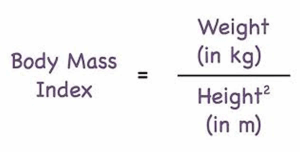
It has one exponent – your height is squared. Quetelet, though brilliant, was a generation earlier than the folks who worked with fractional powers. I’ve played with the equation – and changing it from simply squaring the height to raising the height to the 1.9 power greatly reduces the problem at both ends. Quetelet’s main work was in the 1840’s – the concept of fractional powers kicked in a generation later. As an aside, Quetelet would probably have lived his life an a respected Belgian astronomer if not for the revolution that kicked him out of his observatory. Not everyone grows up with plans of being an outstanding social scientist and inventing aspects of demography.
Quetelet’s index isn’t flawed – the problem is that it was repurposed 150 years after he developed it, and it wasn’t updated. The Atlantic has a good article on Quetelet at How the Idea of a ‘Normal’ Person Got Invented – The Atlantic. It’s worth reading. So far as your BMI score goes – it’s not bad when your height begins with 5 feet . . . the problems really show up below 5 feet and above 6 feet.
-
Hunter Biden has me wondering how many people are prosecuted for lying on Form 4473. The threat of 5 years in the big house and a $5,000 fine is more than enough to deter me, but Hunter does have a law degree, so he may have had a better idea about the actual risk.
Justice Department Charges More than 14,200 Defendants with Firearms-Related Crimes in FY20 Well, the headline misses that it was 2020 – but that’s close enough to give some idea of how many people are charged.
“Under federal law, it is illegal to possess a firearm if you fall into one of nine prohibited categories including being a felon, illegal alien, or unlawful user of a controlled substance. Further, it is unlawful to possess a firearm in furtherance of a drug trafficking offense or violent crime. It is also illegal to purchase – or even to attempt to illegally purchase – firearms if the buyer is a prohibited person or illegally purchasing a firearm on behalf of others. Lying on ATF Form 4473, which is used to lawfully purchase a firearm, is also a federal offense. The department is committed to prosecuting these firearms offenses as well as using all modern technologies available to law enforcement such as the National Integrated Ballistic Information Network, known as NIBIN, to promote gun crime intelligence.”
The next task is to take that number down to the prosecutions on form 4473 – so we need another data source: Few Prosecutions For Lying On ATF Gun-Purchase Form
“Lying on the form is a felony punishable by up to 10 years in prison. For being a user of unlawful drugs in possession of a firearm, the punishment is up to five years. The odds of being charged for lying on the form are virtually nonexistent. In the 2019 fiscal year, when Hunter Biden purchased his gun, federal prosecutors received 478 referrals for lying on Form 4473 — and filed just 298 cases. The numbers were roughly similar for fiscal 2020. At issue is when Biden answered “no” on the question that asks about unlawful drug use and addiction when purchasing a gun. Biden had been discharged five years earlier from the Navy Reserve for drug use and based on his 2021 memoir, he was actively using crack cocaine in the year he bought the gun. The data do not show how many people might have been prosecuted for falsely answering the question about active drug use. A 1990 Justice Department study noted how difficult it was to bring cases against people who falsely answer questions on the form, especially because there is no paper trail for drug abusers like there is for felons.”
Okay – Justice gets 478 referrals for lying on Form 4473, and filed 298 cases. That translates to 62% – five out of eight referrals for lying get prosecution. The computerized 4473 I filled out in Cabelas didn’t want my driver’s license – it had a post office box on it – but it did accept my passport (which didn’t even have that much information). I know something or someone is checking that form – and five years in the big house scares me, and I have no need to lie on the form.
Law Enforcement: Few Individuals Denied Firearms Purchases Are Prosecuted and ATF Should Assess Use of Warning Notices in Lieu of Prosecutions | U.S. GAO provides this table from 2017:
Table: Federal National Instant Criminal Background Check System (NICS) Firearms Denial Cases Investigated and Prosecuted, Fiscal Year 2017
Federal NICS Transactions Denials ATF Field Division Investigations United States Attorney’s Offices Prosecutions 8,606,286 112,090 12,710 12 Source: GAO Analysis of Bureau of Alcohol, Tobacco, Firearms and Explosives (ATF) and FBI data. | GAO-18-440 It shows that there were about 75 people who went through the process with no problem for every denial. Admittedly, 12 prosecutions seems a bit low when I think of how much time and money is committed to the process.
Looking at the data suggests that there’s a five out of eight chance of prosecution if you get reported for lying on the 4473. I don’t know how many of those are straw purchases and how many are drug users – but it looks to me that lying on the form 4473 is not a good idea.
-
Driving across Highway 2, there is a sign pointing out the Baker Massacre. It occurred in 1870, but has always been a bit hard to research.
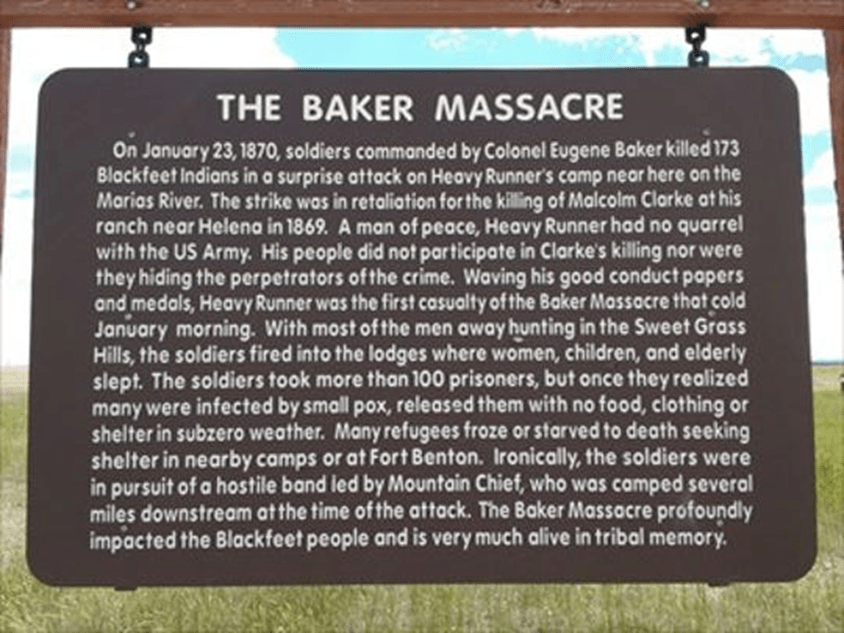
The sign perpetuates Major Baker’s reports – as I drove by, I believed the statement that the Cavalry hit the wrong group, but in 1982, Ben Bennett published Death, Too, for the Heavy Runner. There had been a Heavy Runner family in Rexford . . . and I started looking at the stories of the Baker Massacre a bit more critically. Later, a Blackfeet classmate in my master’s program brought a little more contact with the story, a little more interest. Having friends on reservations brings the history a bit closer – makes it a bit more relevant.
If you try a computer search for The Heavy Runner, you’ll probably wind up with a lot of hits on shoes. The Piikuni and the U.S. Army’s Piegan Expedition provides a pdf article that covers the story, and goes into the details that never made the sign by Shelby:
“Near the end of October, Sheridan proposed to Sherman, “Let me find out exactly where these Indians are going to spend the Winter; and about the time of a good heavy Snow I will send out a party and try and strike them” when “they will be very helpless.” Sheridan knew that only “women and children and the decrepit old men were with the villages.” “We must occasionally strike where it hurts,” he added. The purpose of the winter attack was “to strike the Indians a hard blow and force them onto the reservations; . . . to show to the Indian that . . . he, with his villages and stock, could be destroyed.” General Sherman sent word on November 4, 1869, that the “proposed action . . . for the punishment of these marauders has been approved.”18 On November 15, 1869, Sheridan recommended Major Eugene Baker of the U.S. Second Cavalry be assigned to lead the expedition. “Major Baker . . . is a most excellent man to be entrusted with any party you may see fit to send out,” Sheridan assured Major General Winfield Hancock, commander of the Department of Dakota, adding, “I spoke to him on the subject when he passed through Chicago.” En route, Baker conferred with de Trobriand at Fort Shaw on December 22 and continued to Bozeman to take charge of Fort Ellis. Inspector General of the Military Division of the Missouri James Hardie thought Baker “should be allowed to proceed generally according to the circumstances under which he finds himself in his operations,” an opinion to which Sheridan replied, “Tell Baker to strike them hard.” Hardie agreed, writing, “I think chastisement necessary. In this Colonel Baker concurs. He [knows] the General’s wishes . . . [and] may be relied on to do all . . . in the way of vigorous and sufficient action.” Thus, Sheridan expanded Sherman’s authorization to include attacking a camp sheltering any Piikunis and empowered Hancock to extend the order and authorization to de Trobriand and Baker. Sully and de Trobriand discussed attacking a friendly Piegan camp in order to quiet the others, after which de Trobriand lamented, “I cannot honestly say that I regret that no action has been taken on your proposition to pitch into those two friendly little bands.” In early January, de Trobriand ordered Baker “to chastise that portion of the Indian tribe of Piegans under Mountain Chief or his sons.” De Trobriand’s intent was to surprise Mountain Chief ’s camp first and then sweep into bands camped near Riplinger’s trading post and then others farther away. However, he specified that the camps of Heavy Runner and Big Lake—chiefs of the two “friendly” bands—“should be left unmolested.””
Fundamentally, Sheridan authorized attacks on the friendlies – The Heavy Runner’s camp, while Colonel de Trobiand said the Heavy Runner’s camp “should be left unmolested.”
The easiest way to cover the massacre is to quote Henderson: “The U.S. Second Cavalry under the command of Major Eugene Baker decimated Heavy Runner’s camp without warning on January 23, 1870, in what the military called the Piegan Expedition. Cavalrymen shot Heavy Runner and slaughtered 217 noncombatant elders, women, and children. They then destroyed the food supply, burned lodges, and captured four to five hundred of the camp’s horses. Few of Heavy Runner’s people survived. No depredations had been committed by the band, and Heavy Runner carried papers identifying him as being on peaceful terms with the United States. As trader Alexander Culbertson observed, 1870 would forever be engraved as “the year of Small pox and Soldiers.”
“Decimated” seems to be a misused word in this case – The Heavy Runner’s camp had a little over 300 people present. Killing 217 out of 300 people is closer to annihilation than decimation.
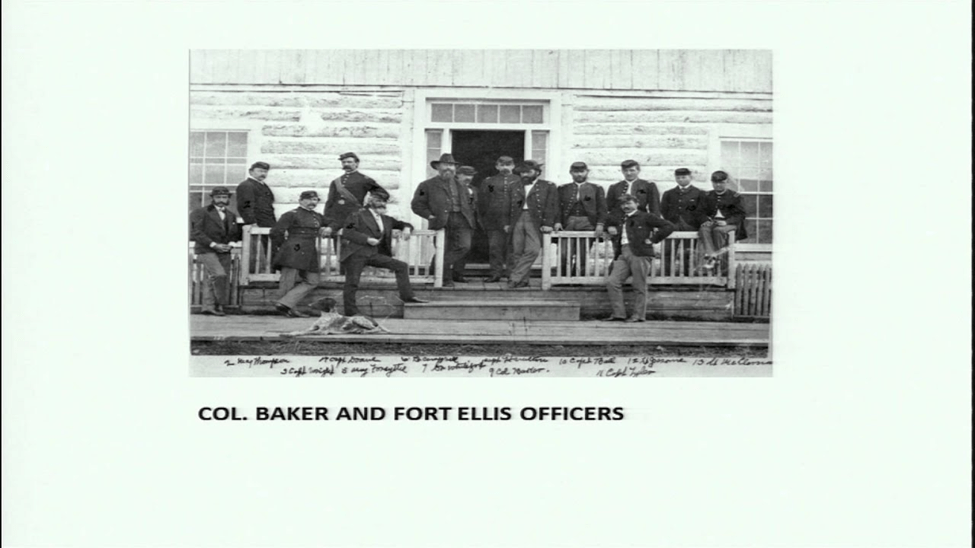
Find-a-grave includes a little biographical information on Major Baker: “Cadet, US Military Academy, 1854/07/01 to 1859/07/01; 1836th graduate of the United States Military Academy; Brevet 2d Lieutenant, 2d Dragoons, 1859/07/01; 2d Lieutenant, 1st Dragoons, 1860/02/28; 1st Lieutenant, 1861/05/07; Captain, 1862/01/16; Brevet Major, 1862/05/05, for gallant and meritorious service in the Battle of Williamsburg, Virginia; Brevet Lieutenant Colonel, 1864/09/19, for gallant and meritorious service in the Battle of Winchester, Virginia; Brevet Colonel, 1868/12/01, for zeal and energy while in command of troops operating against hostile Indians in 1866, 1867 and 1868 – Major, 2d Cavalry, 1869/04/08.”
It’s enough – Henderson’s article is worth reading.
-
This isn’t recent news on the UPS front, but it’s fairly recent locally. On May 1st, the UPS began its “rural deferred program”, which ostensibly saves costs by reducing deliveries to three days a week in rural zip codes (days vary by zip code). Why is this something we’re only noticing in September? The program has had a slow roll out, gradually increasing the zip codes impacted.
UPS hasn’t published much on the topic- but their employees have an online forum that’s worth a visit for more information (even if some of it is speculative). Effectively, this will reduce the number of routes going out each week, thus reducing the jobs available to drivers.
This is unrelated to the USPS accepting amazon deliveries directly in Eureka, but could certainly add to an already inconvenient situation.
Rural Montana just got a little more remote.
-
It was a busy weekend in Trego, starting with a cow parade on Friday evening to start off a weekend with games, vendors, educational opportunities and music, ending with a fireman’s breakfast at the TFS Hall on Sunday Morning.
Our thanks to everyone who worked to make this event happen- we look forward to next year!
-
It is not, technically,a pre-K program. Rather, it is described as “transitional kindergarten”. It consists of one afternoon a week, and accepts only four children.
Montana School boards have the option to admit four year-olds into kindergarten, which is the provision the program is based upon. Where things get a bit weird is that the board is required to have “exceptional circumstances” to justify this admission.
As a consequence, the application requires parents to determine which exceptional circumstance applies to their child.
How to Qualify:
Insert Picture Here
While I can appreciate the simplicity of taking the text directly from the policy, citing Montana code annotated without an explanation (and where a hyperlink is not available) doesn’t make understanding any easier.
So, the first two exceptional circumstances being rather self explanatory- what exactly is gifted and talented?
Montana Code Annotated 20-7-901 says that: “Gifted and talented children” means children of outstanding abilities who are capable of high performance and require differentiated educational programs beyond those normally offered in public schools in order to fully achieve their potential contribution to self and society. The children so identified include those with demonstrated achievement or potential ability in a variety of worthwhile human endeavors.
Since it allows for potential ability, and since Montana schools don’t normally offer any educational programs for four year-olds, this is probably broader than it looks.
The next likely candidate is homeless. Now, most of us with roofs over our heads don’t consider ourselves homeless. And, per the US Code cited, we really aren’t. But the board has some leeway there, and the board really should be using guidance from Montana’s office of public instruction… of course, by those standards anyone living off grid is homeless.
Homeless Students
Spending time on the school board provides a lot of information…Recently, I’ve learned that a student can have a home and still be homeless.
Keep readingIn short, parents that want their children to attend should probably check either the box for “homeless” or “gifted”. Of course, if the board wanted to simplify things, it could decide that “community based exceptional circumstances” are present. That would simplify the paperwork, and given the price of food/gas, the local housing shortage, and the percentage of our population living below the poverty line, probably be accurate.
Is a half day a week the best option?
It depends on what the board is trying to accomplish. If the goal is to let children know that school exists, and perhaps be less afraid of it the next year, probably. If it’s to educate- well, if they can admit the child for this half-day program, there is no reason they can’t admit them as a full or half time kindergarten student. If the child goes on to first grade, cool. If the child does a second year of kindergarten (or perhaps begins first grade material partially through that year- entirely feasible in a multi-grade classroom) also cool.
For a family struggling with childcare, gas prices, or hoping to benefit from Trego School’s free lunches for two meals five days a week, early kindergarten admission is a much better option. Similarly, for a child that is gifted/talented, early admission makes far more sense than a half-day program.
Could the school actually have a preschool program?
The school itself cannot legally do so, however, it absolutely could rent a classroom to a preschool, and share bus/cafeteria services. Since that isn’t happening at the moment, early admission into kindergarten is really as close as the school can come.
Want to tell us something or ask a question? Get in touch.

Recent Posts
- Recovery Time for a Retiree
- Venn Diagram and DSM
- When Castro Was Cool
- You Have To Beat Darwin Every Day
- Computer Repair by Mussolini
- Getting Alberta Oil to Market
- Parties On Economics
- Thus Spake Zarathustra – One More Time
- Suspenders
- You Haven’t Met All The People . . .
- Play Stupid Games, Win Stupid Prizes
- The Ballad of Lenin’s Tomb

Rough Cut Lumber
Harvested as part of thinning to reduce fire danger.
$0.75 per board foot.
Call Mike (406-882-4835) or Sam (406-882-4597)
Popular Posts
Ask The Entomologist Bears Books Canada Census Community Decay Covid Covid-19 Data Deer Demography Education Elections Eureka Montana family Firearms Game Cameras Geese Government Guns History Inflation life Lincoln County Board of Health Lincoln County MT Lincoln Electric Cooperative Montana nature News Patches' Pieces Pest Control Politics Pond Recipe School School Board Snow Taxes travel Trego Trego Montana Trego School Weather Wildlife writing
 Trego's Mountain Ear