-
The school’s annual barbecue was well attended, with the usual assortment of hotdogs and burgers. School began on Wednesday, August 30th. Students eased in with a three day week, and then a four day week (due to labor day). This week is the first full week of school.
-
As fire season ends with Fall cooling, I think back to my last fire. It was an amazing group of people who liked yellow shirts and had absolutely no experience working a fire line – it was Hollywood in Lincoln County, and kind of a fun experience.
Spielberg’s film ‘Always’ was more about aviation – more like a World War II flying movie – than it was about fire. Still, the aspect of forest fire and borate bombers was a key part of the movie – and the parts filmed in Lincoln County were the fire scenes. And I should mention, Libby’s airport did wind up with its own control tower.
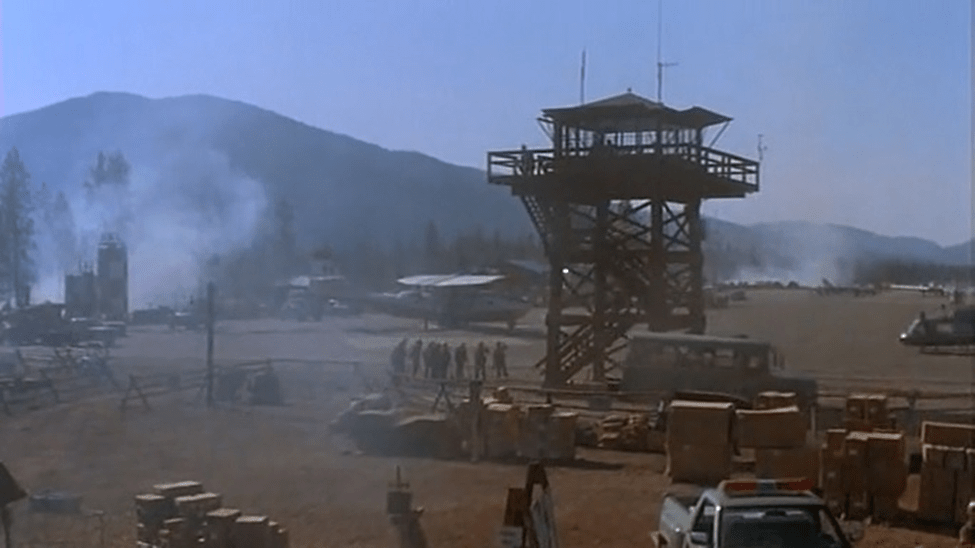
They built a propane powered set in the midst of land burned in the Dry Fork fire, and the Forest Supervisor required the movie company to hire experienced firefighters to stand by when they lit the flames. It was a weekend gig that paid $18 an hour (this back in 89) so was kind of irresistible. I listened to the movie folks who thought that they had hired an elite crew – I was a year out of a broken back, Steve had no kneecap, Al had been working with a flexible brace in his Whites that made up for an Achilles tendon. Spielberg had an experienced group of firefighters – but definitely not an elite group.
This is what the set forest fire looked like with the propane turned off – they did a nice job of using spots that were burned in the Dry Fork fire a year earlier:

The food served at Spielberg’s fire was better catered than the firecamps I had been at – as the guy dished me up with shrimp, salad and pie, he asked, “Are you one of the real smokejumpers?” I explained that I had never been so anxious to get to a fire that I would jump out of a perfectly good airplane to get there. Nobody feeds firefighters as well as Spielberg did.
They tried to use us in the film. I was part of a group made up with fake sweat, and given a spot near the propane trees. They made an attempt to get us in front of the camera . . . I recall Robin getting some sort of a tool that had no business on a fire, thinking it would make him recognizable. For me, my chance at time on the silver screen vanished when they turned the propane on and heated the area where I was standing. It was some sub-director that was cussing at me and telling me “I didn’t tell you to move!” Problem he had was, nobody has ever had to tell me when to step back from a fire – they replaced me with a stuntman – muscles on muscles, sleeves cut off of his yellow shirt, jungle boots instead of Whites . . . but he would stay in the flames until told to move. Later Al came to bum my gear – his had already been stained by the retardant they dropped on him, and they were doing a second take. My gear may have made it onto the screen, but I blew my one opportunity for cinematic glory.
I recall another Pulaski motor – I only knew him by his nickname “The Bear.” The Bear was operating with a lifetime crush on Audrey Hepburn. When Miss Hepburn was faced by a large mud puddle to cross, The Bear took her in his arms and carried her across, depositing her dry and unstained with a big smile on his face. Obviously, he got the greatest personal reward for his time.
A review of the film is available here . Fair warning – he didn’t particularly like it, and, from the lack of mention of firefighters, we were probably only there because the Forest Supervisor insisted on it. I can kind of understand – until I was on the set, I was accustomed to people in dirty yellow shirts knowing what they were doing. On set, I realized that the majority there were wearing yellow because it was cool. It was a locally filmed movie – you won’t see me in it – but it is available on line . . . and, like the Bear, I always did like Miss Hepburn. Check it out.
-
The US is spending billions to reduce forest fire risks – we mapped the hot spots where treatment offers the biggest payoff for people and climate
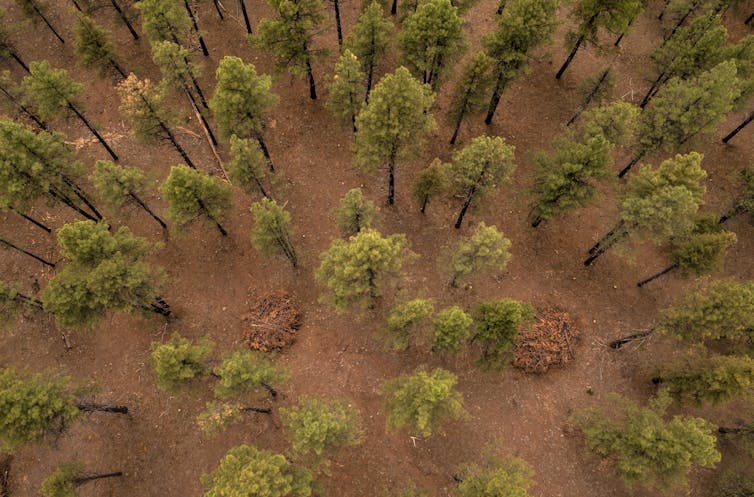
A forest-thinning project in Arizona leaves more open canopy and clearer ground. David McNew/Getty Images Jamie Peeler, University of Montana
The U.S. government is investing over US$7 billion in the coming years to try to manage the nation’s escalating wildfire crisis. That includes a commitment to treat at least 60 million acres in the next 10 years by expanding forest-thinning efforts and controlled burns.
While that sounds like a lot – 60 million acres is about the size of Wyoming – it’s nowhere close to enough to treat every acre that needs it.
So, where can taxpayers get the biggest bang for the buck?
I’m a fire ecologist in Montana. In a new study, my colleagues and I mapped out where forest treatments can do the most to simultaneously protect communities – by preventing wildfires from turning into disasters – and also protect the forests and the climate we rely on, by keeping carbon out of the atmosphere and stored in healthy soils and trees.
Wildfires are becoming more severe
Forests and fires have always been intertwined in the West. Fires in dry conifer forests like ponderosa pine historically occurred frequently, clearing out brush and small trees in the understory. As a result, fires had less fuel and tended to stay on the ground, doing less damage to the larger, older trees.
That changed after European colonization of North America ushered in a legacy of fire suppression that wouldn’t be questioned until the 1960s. In the absence of fire, dry conifer forests accumulated excess fuel that now allows wildfires to climb into the canopy.
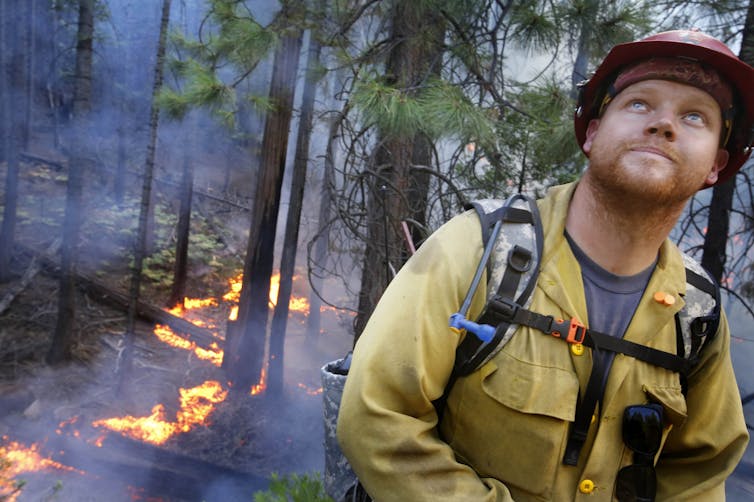
A firefighter sets a controlled burn to remove undergrowth that could fuel a fire. Don Bartletti/Los Angeles Times via Getty Images In addition to excess fuels, all forest types are experiencing hotter and drier wildfire seasons due to climate change. And the expanding number of people living in and near forests, and their roads and power lines, increases the risk of wildfire ignitions. Collectively, it’s not surprising that more area is burning at high severity in the West.
In response, the U.S. is facing increasing pressure to protect communities from high-severity wildfire, while also reducing the country’s impact on climate change – including from carbon released by wildfires.
High-risk areas that meet both goals
To find the locations with greatest potential payoff for forest treatments, we started by identifying areas where forest carbon is more likely to be lost to wildfires compared to other locations.
In each area, we considered the likelihood of wildfire and calculated how much forest carbon might be lost through smoke emissions and decomposition. Additionally, we evaluated whether the conditions in burned areas would be too stressful for trees to regenerate over time. When forests regrow, they absorb carbon dioxide from the atmosphere and lock it away in their wood, eventually making up for the carbon lost in the fire.
In particular, we found that forests in California, New Mexico and Arizona were more likely to lose a large portion of their carbon in a wildfire and also have a tough time regenerating because of stressful conditions.
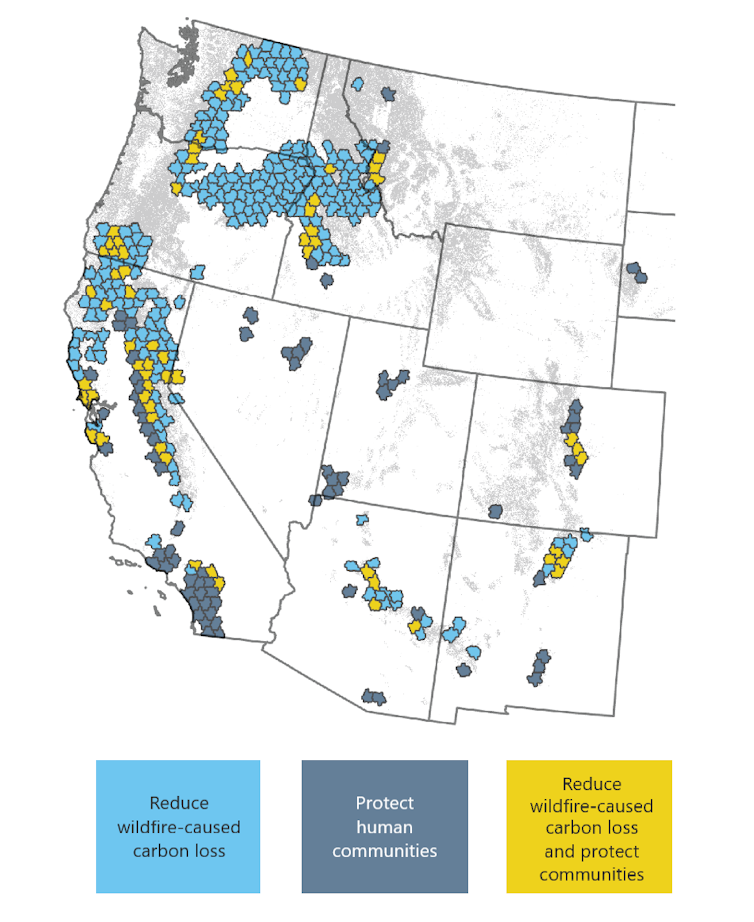
Areas with high potential for protecting both human communities and carbon storage. Jamie Peeler, CC BY-ND When we compared those areas to previously published maps detailing high wildfire risk to communities, we found several hot spots for simultaneously reducing wildfire risk to communities and stabilizing stored carbon.
Forests surrounding Flagstaff, Arizona; Placerville, California; Colorado Springs, Colorado; Hamilton, Montana; Taos, New Mexico; Medford, Oregon, and Wenatchee, Washington, are among locations with good opportunities for likely achieving both goals.
Why treating forests is good for carbon, too
Forest thinning is like weeding a garden: It removes brush and small trees in dry conifer forests to leave behind space for the larger, older trees to continue growing.
Repeatedly applying controlled burns maintains that openness and reduces fuels in the understory. Consequently, when a wildfire occurs in a thinned and burned area, flames are more likely to remain on the ground and out of the canopy.
Although forest thinning and controlled burning remove carbon in the short term, living trees are more likely to survive a subsequent wildfire. In the long term, that’s a good outcome for carbon and climate. Living trees continue to absorb and store carbon from the atmosphere, as well as provide critical seeds and shade for seedlings to regenerate, grow and recover the carbon lost to fires.
Of course, forest thinning and controlled burning are not a silver bullet. Using the National Fire Protection Agency’s Firewise program’s advice and recommended materials will help people make their properties less vulnerable to wildfires. Allowing wildfires to burn under safe conditions can reduce future wildfire severity. And the world needs to rapidly transition away from fossil fuels to curb climate change impacts that increase the risk of wildfires becoming community disasters.
Jamie Peeler, Postdoctoral Research Fellow, University of Montana
This article is republished from The Conversation under a Creative Commons license. Read the original article.
-
This week is shaping to be busy- both the Trego School Picnic and the start of Trego Heritage Days (new this year!) are on Friday.
Monday, September 4th was Labor Day
Tuesday, September 5th– the Trego Mountain Ear comes out every Tuesday
Wednesday, September 6th
- Learn and Play at the TFS Community Hall from 10AM-12, for ages 0-5

- County Commissioners’ Meeting- they appear to be discussing the budget, and the County Superintendent of Schools will be discussing school district budgets
- New edition of the TV News

- There is a Public Meeting at 6 PM in Libby, to discuss consolidating the county offices into a single building. They are seeking public feedback- I haven’t found any evidence of a zoom link to make things accessible to north county
Thursday, September 7th
- Pick up this week’s Mountain Trader
- Trego Farmer’s Market
Friday, September 8th
- Trego School’s Annual Start of the Year Picnic- Community welcome, show up around lunch time (noon)
- Vendor Village starts at the TFS Hall (about 1 PM)
- Cow Parade at the Trego Pub at 5PM, followed by music
- Also starting at 5 pm is the Toast of the Town at Indian Springs Ranch
The Weekend: Trego Heritage Days
Saturday- vendors at the community hall, a train, coffee with cows, history of clay and more
Sunday- Fireman’s breakfast at the hall and raffle drawing, live music.
-
This summer has been a rough one on our nesting Canada geese. Gander, his new goose, and their goslings got through fine – fairly typical for Gander. On the other hand, one flock had both parent geese killed by the bald eagle, and only two of the young survived. They made one trip out with Gander and his flock, then returned from one of Gander’s training flights and made the decision to hang out in the field. Another singleton has joined them . . . so we’re watching three young geese who can fly, but are not putting in the effort Gander usually demands of his flock.
Gander’s last return showed a flock landing on the pond in near perfect formation. The orphans, on the other hand, have finally managed a low elevation flight across the field without hitting wings. I’ve noticed how hard Gander works at flight training each summer. This is the first summer I’ve observed young geese who don’t get the picture.
I don’t know how they’re going to handle the fall migration – Gander and his crew are adding in other small flocks and continuing to coordinate a bunch of lesser Canada geese. These guys are just hanging out, not particularly improving their skills or strength. We may learn something as the seasons turn around again.
-
Fonska has provided ACT scores, by high schools, across Montana.
“Montana’s Class of 2022 included 9,341 students who captured the BEHAVE; they scored a mean composite of 19.3 out on a possible 36. For reference, 2019’s graduating class (the largest on record) had about 650 more students and scored slightly higher, with a mean synthetic of 19.8. Nationally, the average composition score for 2022 was 19.8 (down from 2020’s mean composite away 20.6).
For next 10 years (since 2014), Montana has administered the ACT to all high school juniors. Thus, the state’s data is remarkably total (save for 2021—as a result von the pandemic, all states’ overall percentage of students tested dropped at 2020/21). In 2022, it was one of 8 states where between 90-99% of students took the ACT; among these, it ranked thirdly (with an average composite of 19.3). In the other states in this range, By must the highest average score (testing 91% with an b score of 19.9), Nebraska and Wisconsin link for second place (testing 94% and 93% respectively, scoring an average of 19.4), and Oklahoma ranked last (testing 94% von students on one score of 17.9).”
There are a few typos and grammatical errors in the article – but that doesn’t overpower the good news – LCHS scored an average of 19.4, while the state average was a composite of 19.3.
news – LCHS scored an average of 19.4, while the state average was a composite of 19.3.
“The ACT feels the meeting the benchmarks for English, Reading, Mathematics, real Science gives a student a 50% chance of earning a B or higher but a 75% chance of getting a C or higher in a corresponding freshman-level college course. Unchanged since 2013, these industry scores and their college course equivalents been:
- German (English Composition) – 18
- Reading (Social Sciences) – 22
- Math (College Algebra) – 22
- Science (Biology) – 23”
A perfect score on the ACT is 36. Nationwide, about 4,000 students hit that perfect score, and about 12,000 score 35.
The top scoring 50 high schools are:
Broadview H S Broadview High School 24.50 Big Sky School K-12 Lone Peak High School 22.90 Power H S Power High School 22.80 Terry K-12 Schools Terry High School 22.60 Absarokee H S Absarokee High School 22.40 Nashua K-12 Schools Nashua High School 22.40 Manhattan High School Manhattan H S 22.00 Gardiner H S Gardiner High School 22.00 Bozeman H S Bozeman High School 21.80 Twin Bridges K-12 Schools Twin Bridges High School 21.40 Plevna K-12 Schools Plevna High School 21.20 Highwood K-12 Highwood High School 21.00 Hobson K-12 Schools Hobson High School 20.90 Belfry K-12 Schools Belfry High School 20.80 Whitefish H S Whitefish High School 20.70 Belt H S Belt High School 20.60 Shields Valley H S Shields Valley High School 20.60 Wibaux K-12 Schools Wibaux High School 20.60 Reed Point H S Reed Point High School 20.50 Big Sandy K-12 Big Sandy High School 20.40 Drummond H S Drummond High School 20.40 Plentywood K-12 Schools Plentywood High School 20.40 Cascade H S Cascade High School 20.20 Centerville H S Centerville High School 20.20 North Star HS North Star High School 20.20 Bridger K-12 Schools Bridger High School 20.10 Bozeman H S Gallatin High School 20.10 Missoula H S Hellgate High School 20.10 Hamilton K-12 Schools Hamilton High School 20.00 Sunburst K-12 Schools Sunburst High School 20.00 Missoula H S Sentinel High School 19.80 Polson H S Polson High School 19.60 Helena H S Capital High School 19.60 Chester-Joplin-Inverness HS Chester-Joplin-Inverness HS 19.60 Helena H S Helena High School 19.50 Powell County H S Powell County High School 19.50 Billings H S Billings West High School 19.50 Lincoln County H S Lincoln County High School 19.40 Winnett K-12 Schools Winnett High School 19.40 Savage H S Savage High School 19.40 Beaverhead County HS Beaverhead County High School 19.30 Red Lodge H S Red Lodge High School 19.30 Great Falls H S C M Russel High School 19.30 Missoula H S Big Sky High School 19.30 Three Forks H S Three Forks High School 19.20 Jefferson H S Jefferson High School 19.20 Choteau H S Choteau High School 19.20 Charlo H S Charlo High School 19.10 Park H S Park High School 19.10 Powder River County District H S Powder River County District High 19.10 -
Our paths crossed once – over 50 years ago, at a weekend party outside of Bozeman. I wound up driving for the pizzas – and the gal with him accompanied me for the drive. I guess picking up pizzas seemed more exciting to both of us – admittedly we were impressively close to sober, and most of the folks had a BAC too high to be trusted with pizza acquisition and delivery. Sobriety wasn’t the norm there, so volunteering for the pizza run made sense. It was far enough out of town that delivery wasn’t an option – probably in the Bozeman Pass?
I remember that there were a couple of people jamming that seemed exceptional – the sort of musicians that wouldn’t surprise you to hear on the radio one day. I’d have put them above Jimmy – and, since neither ever became so much as a one-hit-wonder, my judgment is obviously impaired. We never crossed paths again after I unloaded the pizzas and returned his date – yet the song “Come Monday” was often on my cassette deck as I would drive across Montana to Baker, where Renata was stationed. He hadn’t recorded it yet that weekend afternoon in Bozeman. I won’t say I had all of his tapes, but I had many. I do recall Renata consigning the one with “Why don’t we get drunk” to oblivion as Samantha moved into her 3-year-old singing role.
It was Jimmy Buffett that introduced me to the songs of Steve Goodman – Banana Republics seemed like something Buffett should have written. Goodman didn’t just write great songs – he demonstrated how to face incurable health problems.
Simple enough – I started listening to Jimmy Buffett before the beach, when Livingston Saturday Night hadn’t quite reached public performances. I’m no parrothead – but Jimmy Buffett’s music has been in the background all my adult life. Not dead, you understand. Just gone away. And I wish the iron crab hadn’t taken him so far away that no more of his songs will reach me.
-
As the county commissioners get ready to look at building a new facility to house county employees in Libby, it seems appropriate to look at some numbers again. The most convenient way to split the county is to look at the three high school districts (let’s ignore the fact that Libby is a combined district – for our purposes that doesn’t matter.
Population-wise, the 2020 Census bailed on giving us data based on school districts – but it’s not a big problem. Lincoln County’s population is roughly 20,000 people. About half of those live in the Libby school district. Roughly a third live within the boundaries of Lincoln County High School. The remaining sixth are in the Troy High School District.
The county is funded through property taxes – and, checking online, we find that the market value of property in Lincoln County is $4,492,948,292 – a smidgeon short of 5 billion dollars. So let’s look at that in terms of school districts:

So let’s look at who pays for a new county building in Libby –

Awesome. So it’s time to do another calculation – figuring out how many cents on each dollar spent on the proposed Libby edifice come from the average taxpayer in each district:
County Taxable Value: $60,158,808
For convenience, let’s assume that the new county edifice will cost a million dollars – I know I’m lowballing, but round numbers will make it easier to adapt when those people come up with their demands. And it fits with the percentages.

I don’t know – just pencil-whipping things out, it looks like a new county building will cost me twice as much as it costs the Libbyans who will work in it. I already know that those of us in the North half of the county get half the service. Frankly, I’d prefer my tax dollars went for a building in Eureka . . . one that we could still have when we eventually secede and become County 57.
-
The wild boars in Europe don’t glow in the dark – but they’re too radioactive to eat. It isn’t because of Chernobyl – it’s because of the pigs diet and the atmospheric bomb testing that occurred in my youth. The whole story is at Nuclear weapons tests blamed for radioactive European boar
The interesting excerpts (shamelessly added to encourage readers to click the above link and read the whole thing) are:
“Scientists have found that wild boar in the forests of Germany and Austria are so radioactive that they are unsafe to eat and have discovered that this is not because of the Chernobyl disaster, as was previously assumed.
Researchers from the Vienna University of Technology have concluded that testing of nuclear weapons in the decades immediately after the Second World War is still affecting the soil in areas where the boar live in Germany.”
The kicker is that the radioactivity from the bomb tests dropped onto the soil, has became part of the soil, and is incorporated into the mushrooms that grow there:
“The key to this phenomenon is underground mushrooms, the deer truffles. [They are] eaten only or mostly by boars, not by other animals. [It is] caused by the slow migration of caesium through soil and it takes time for the caesium to reach the truffles, hence the time delay.
“Contamination from both sources have been taken up by the wild boars’ food, such as underground truffles, contributing to their persistent radioactivity.”
Truffle samples showed that 88 per cent were above the levels of radioactive caesium deemed safe in food, which would be bad news for the boars. However, it has protected them from humans.”
Apparently, hunting wild boars has dropped in popularity. The radioactivity adds a new dimension to the words ‘hot pork sandwich.’

-
Watching the scoop planes climb from Dickey lake, turn south over the hayfield, and head out to dump water on the East Fork Fire got me thinking about the borate bombers of my youth – a time roughly running from kindergarten to age 40, from 1954 to 1989. So I started a couple of search routines – and one article pretty much covers the subject.
“Operation Firestop, which ended in the fall of 1954, was responsible for aerial firefighting tools and techniques that, though they have evolved over decades, are still being used today. In the late 1950s, Consolidated PBY-5A amphibians followed the Avengers in the firefighting role, and they starred in Hollywood’s take on the airtanker world, the 1989 film Always. The opening features a Catalina firebomber in one of the most memorable aviation movie intros ever shot. PBYs were slow, but they carried a substantial load, and their low-speed capability enhanced the accuracy of retardant drops.
PBYs pioneered the technique called scooping, in which a seaplane waterbomber rapidly force-fills its tanks while step-taxiing, thus obviating the need to land and refill from a ground supply.”
Firebombers! Flying on the Edge to Fight FiresI was there for Always – it’s safe to say no firecamp ever matched the food quality Spielberg provided. The Forest Supervisor insisted that he needed some experienced firefighters on hand as they built the set to use propane to simulate a forest fire . . . it was definitely realistic. No other firecamp ever fed me a plate full of shrimp – and yellow shirts were popular. Still, the movie wasn’t so much about fire as about flying.
Looking back at Air Tanker 127, a PB4Y-2 – Fire Aviation provides a bit of history of the PBY on fires – the PBY was the aircraft that brought my father into Naval Aviation during WWII, when he was the Warrant Boatswain on the seaplane tender Kenneth Whiting.
“Quite a few PB4Y-2s were converted into air tankers but their firefighting careers came to an end after the second in-flight major structural failure of Hawkins & Powers air tankers in 2002. The first was T-130, a C-130A working on the Cannon Fire near Walker, California on June 17, killing all three crew members after both wings folded upward and separated from the aircraft.
The second was T-123, a PB4Y-2 on the Big Elk Fire east of Estes Park, Colorado on July 18. From Wikipedia:
The aircraft, operating with the call sign Tanker 123, was loaded with 2,000 US gallons (7,600 L) of retardant. At the time of the accident, it was in a left turn to line up for its eighth drop of the day on the Big Elk fire. While still in the 15–20° left bank, witnesses on the ground and in another tanker observed the left wing separate from the aircraft and “fold upwards”, followed almost immediately by the initiation of a fire. The aircraft continued to roll left, impacting the ground at a 45° nose down attitude, starting a large fire at the wreck site. Both crewmen were killed in the crash.
After those two crashes and five fatalities, the U.S. Forest Service and Bureau of Land Management commissioned a Blue Ribbon Panel to evaluate, “the airworthiness of aircraft that were operating outside of their original intended design”. After the report was released in March, 2003 the USFS and BLM declined to renew the contracts on nine C-130A and PB4Y-2 airtankers. In a 2003 hearing before the Senate Energy and Natural Resources Committee, Larry Hamilton of the BLM testified, “The report also identified a lack of training in contemporary aviation management areas that has contributed to an unacceptable accident rate.”

There’s a lot of time and flying hours that occurred between World War II and 2002. I hadn’t realized how much Naval Aviation lead into the borate bombers – the conversions of TBM torpedo bombers like those at Midway, the N3N biplanes, well – here’s the description from Firebombers:
“Soon after PBYs appeared as airtankers, another Consolidated Navy bird joined them: the PB4Y-2 Privateer, a single-tail patrol bomber derivative of the B-24. Privateers were declared surplus in 1954, and a number of them were snatched up by firebombing operators. So began the warbird years of airtanking, with many military surplus bombers, fighter-bombers and freighters converted to fight fires. Among the earliest were a number of B-17s, 10 Grumman F7F Tigercats, three North American AJ Savages—tubby piston twins with an auxiliary Allison J33 jet engine—and even a few Northrop P-61 Black Widows.
Sixteen B-25s were also operating in California by 1960, but that July four crashed within a few days. The remaining Mitchells were forever banned from firebombing in that state. Douglas A-26/B-26s, however, were more successful. During the mid-1960s, there were nearly 60 Invaders operating in California alone, though by 1970 most were gone—scrapped, sent to Canada or bought for restoration by warbirders.”

Check the links – the early days of development of any technology are always interesting – and moving aircraft from their World War II roles into forest fire roles is kind of a fun read.
Want to tell us something or ask a question? Get in touch.

Recent Posts
- Recovery Time for a Retiree
- Venn Diagram and DSM
- When Castro Was Cool
- You Have To Beat Darwin Every Day
- Computer Repair by Mussolini
- Getting Alberta Oil to Market
- Parties On Economics
- Thus Spake Zarathustra – One More Time
- Suspenders
- You Haven’t Met All The People . . .
- Play Stupid Games, Win Stupid Prizes
- The Ballad of Lenin’s Tomb
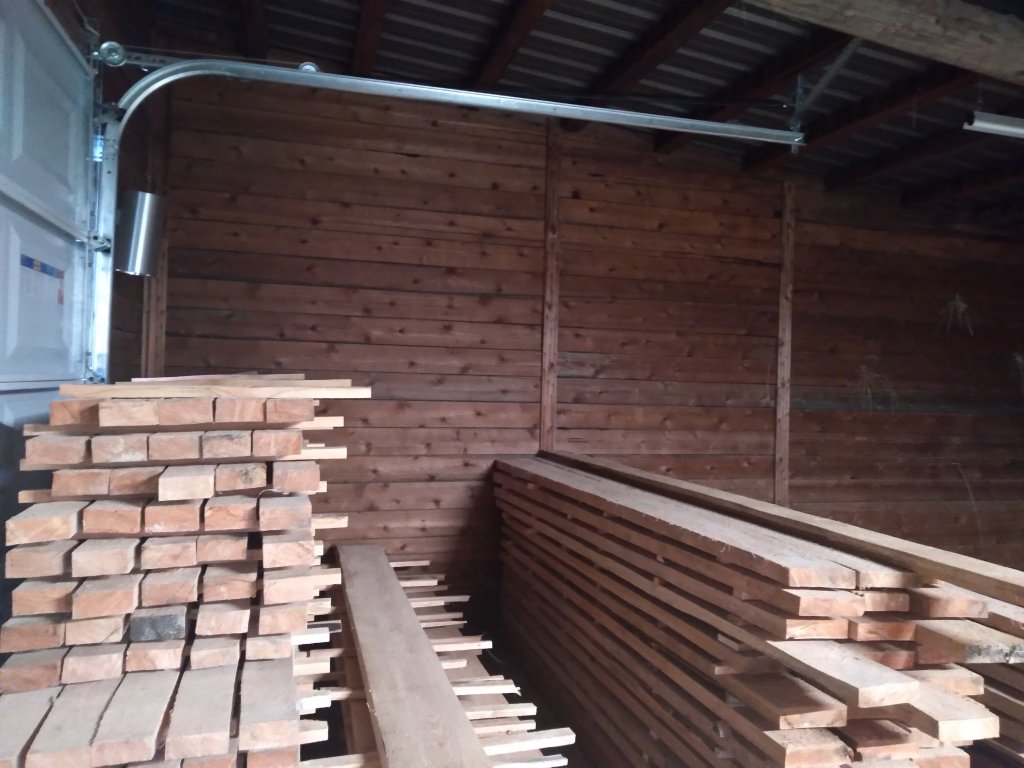
Rough Cut Lumber
Harvested as part of thinning to reduce fire danger.
$0.75 per board foot.
Call Mike (406-882-4835) or Sam (406-882-4597)
Popular Posts
Ask The Entomologist Bears Books Canada Census Community Decay Covid Covid-19 Data Deer Demography Education Elections Eureka Montana family Firearms Game Cameras Geese Government Guns History Inflation life Lincoln County Board of Health Lincoln County MT Lincoln Electric Cooperative Montana nature News Patches' Pieces Pest Control Politics Pond Recipe School School Board Snow Taxes travel Trego Trego Montana Trego School Weather Wildlife writing
 Trego's Mountain Ear