-
NASA’s Psyche mission to a metal world may reveal the mysteries of Earth’s interior
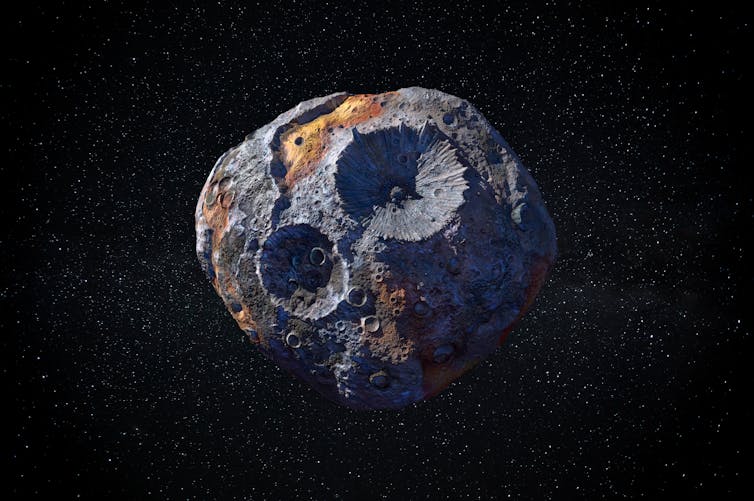
An illustration of the asteroid Psyche, orbiting between Mars and Jupiter. 24K-Production/iStock via Getty Images Plus Jim Bell, Arizona State University
French novelist Jules Verne delighted 19th-century readers with the tantalizing notion that a journey to the center of the Earth was actually plausible.
Since then, scientists have long acknowledged that Verne’s literary journey was only science fiction. The extreme temperatures of the Earth’s interior – around 10,000 degrees Fahrenheit (5,537 Celsius) at the core – and the accompanying crushing pressure, which is millions of times more than at the surface, prevent people from venturing down very far.
Still, there are a few things known about the Earth’s interior. For example, geophysicists discovered that the core consists of a solid sphere of iron and nickel that comprises 20% of the Earth’s radius, surrounded by a shell of molten iron and nickel that spans an additional 15% of Earth’s radius.
That, and the rest of our knowledge about our world’s interior, was learned indirectly – either by studying Earth’s magnetic field or the way earthquake waves bounce off different layers below the Earth’s surface.
But indirect discovery has its limitations. How can scientists find out more about our planet’s deep interior?
Planetary scientists like me think the best way to learn about inner Earth is in outer space. NASA’s robotic mission to a metal world is scheduled for liftoff on Oct. 5, 2023. That mission, the spacecraft traveling there, and the world it will explore all have the same name – Psyche. And for six years now, I’ve been part of NASA’s Psyche team. https://www.youtube.com/embed/y__vwRQ3PVg?wmode=transparent&start=0 It’s a mission of ‘firsts.’
About the asteroid Psyche
Asteroids are small worlds, with some the size of small cities and others as large as small countries. They are the leftover building blocks from our solar system’s early and violent period, a time of planetary formation.
Although most are rocky, icy or a combination of both, perhaps 20% of asteroids are worlds made of metal, and similar in composition to the Earth’s core. So it’s tempting to imagine that these metallic asteroids are pieces of the cores of once-existing planets, ripped apart by ancient cosmic collisions with each other. Maybe, by studying these pieces, scientists could find out directly what a planetary core is like.
Psyche is the largest-known of the metallic asteroids. Discovered in 1852, Psyche has the width of Massachusetts, a squashed spherical shape reminiscent of a pincushion, and an orbit between Mars and Jupiter in the main asteroid belt. An amateur astronomer can see Psyche with a backyard telescope, but it appears only as a pinpoint of light. https://www.youtube.com/embed/TgVorJfM8BM?wmode=transparent&start=0 An artist’s rendition of Psyche, a spectacular metallic world.
About the Psyche mission
In early 2017, NASA approved the US$1 billion mission to Psyche. To do its work, there’s no need for the uncrewed spacecraft to land – instead, it will orbit the asteroid repeatedly and methodically, starting from 435 miles (700 kilometers) out and then going down to 46 miles (75 km) from the surface, and perhaps even lower.
Once it arrives in August 2029, the probe will spend 26 months mapping the asteroid’s geology, topography and gravity; it will search for evidence of a magnetic field; and it will compare the asteroid’s composition with what scientists know, or think we know, about Earth’s core.
The central questions are these: Is Psyche really an exposed planetary core? Is the asteroid one big bedrock boulder, a rubble pile of smaller boulders, or something else entirely? Are there clues that the previous outer layers of this small world – the crust and mantle – were violently stripped away long ago? And maybe the most critical question: Can what we learn about Psyche be extrapolated to solve some of the mysteries about the Earth’s core?
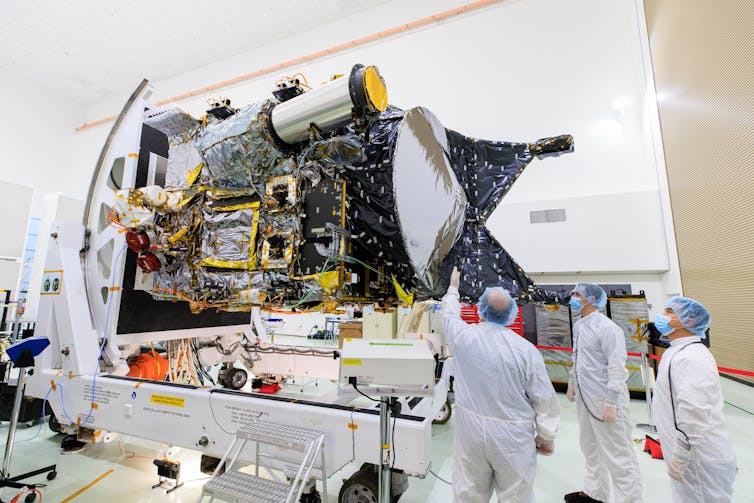
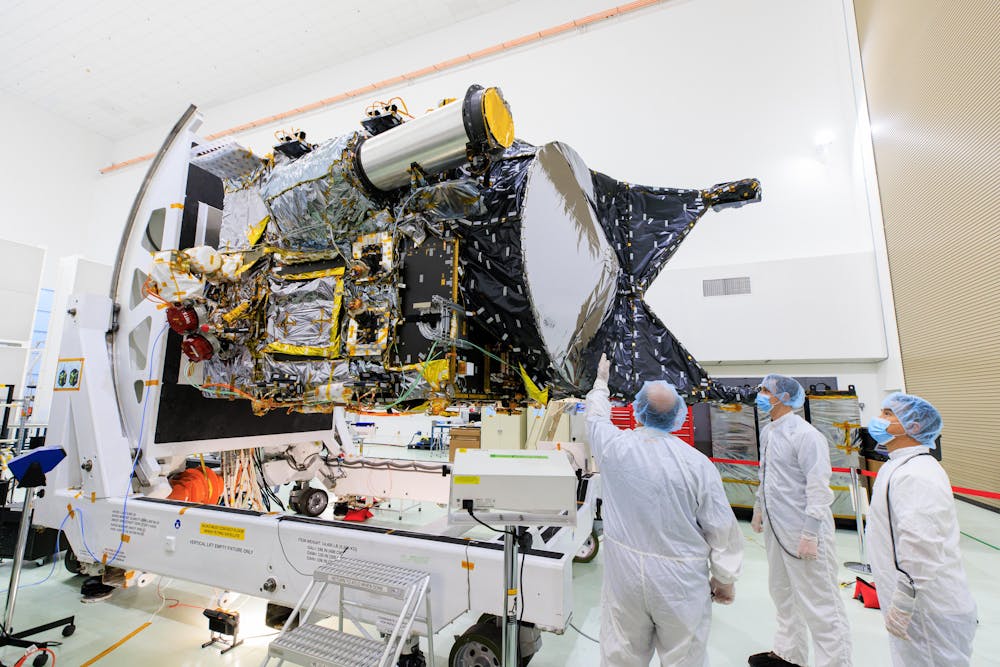
NASA’s Psyche spacecraft, undergoing final tests in a clean room at a facility near Florida’s Kennedy Space Center. NASA/Frank Michaux About the spacecraft Psyche
The probe’s body is about the same size and mass as a large SUV. Solar panels, stretching a bit wider than a tennis court, power the cameras, spectrometers and other systems.
A SpaceX Falcon Heavy rocket will take Psyche off the Earth. The rest of the way, Psyche will rely on ion propulsion – the gentle pressure of ionized xenon gas jetting out of a nozzle provides a continuous, reliable and low-cost way to propel spacecraft out into the solar system.
The journey, a slow spiral of 2.5 billion miles (4 billion km) that includes a gravity-assist flyby past Mars, will take nearly six years. Throughout the cruise, the Psyche team at NASA’s Jet Propulsion Laboratory in Pasadena, California, and here at Arizona State University in Tempe, will stay in regular contact with the spacecraft. Our team will send and receive data using NASA’s Deep Space Network of giant radio antennas.
Even if we learn that Psyche is not an ancient planetary core, we’re bound to significantly add to our body of knowledge about the solar system and the way planets form. After all, Psyche is still unlike any world humans have ever visited. Maybe we can’t yet journey to the center of the Earth, but robotic avatars to places like Psyche can help unlock the mysteries hidden deep inside the planets – including our own.
Jim Bell, Professor of Earth and Space Exploration, Arizona State University
This article is republished from The Conversation under a Creative Commons license. Read the original article.
-
The green box issue – cutting down access to garbage removal services – in Lincoln County has me thinking about garbage. Basically simple facts about garbage over a lifetime – there have been a lot of changes since 1960.
In 1960 there was a dump on Forest Service Land for Trego residents – less than a mile from where the green boxes are now. It had the collateral advantage of being the place to find bears. It was, fundamentally, trashy – but the old open dumps were cheap and accessible.
A half-century earlier, when Tobacco Lumber had managed the dam on Fortine Creek to run logs into Eureka, the garbage – mostly jars, bottles and cans, was just dropped on the ground at the edge of the neighbor’s place. (Those dump sites lasted a long while before the cans would rust away.) Some of the cans still had paint on them, proving that canned ham definitely preceded Spam.
Page 34, of Lincoln County Rural Living Handbook (March, 2011), page 34, describes “Waste Management”: “The rural areas in Lincoln County do not have roadside garbage pick-up, and you may have to haul your waste to the local transfer station or landfill site. The Lincoln County Landfill in Libby is the main site with an outlying transfer station in Eureka and Troy . . . For residents who live away from the 3 primary locations, 264 green boxes are available in 40 locations throughout Lincoln County for household waste.”
That’s interesting – a dozen years ago, across Lincoln County there were 40 locations where you could get rid of ‘household waste.’ That number was reduced to 11 this year. It was 13 at the start of 2023.
There’s a phrase that notes one of the differences between capitalism and socialism: “Under capitalism, the rich become powerful. Under socialism, the powerful become rich.” It’s hard to get into the garbage business these days. A license from the Public Service Commission is required- and competitors already licensed and in the business are allowed to protest the application. This isn’t just a simple protest, they can potentially generate lots of legal fees for businesses just starting out. Still, the garbage business has been a way to money and power – Judy Martz went from the garbage business in Butte to become Montana’s Lieutenant Governor and then Governor. I remember Scott Orr in Libby – S J Orr Services was waste management and recycling . . . and Scott was a state representative. I don’t know what the term is for an economic system where the garbageman (or, in our case, woman) becomes powerful.
When I went to SDSU, we met a different waste disposal system than in Lincoln County. I shared the story with Scott – instead of hauling our own garbage 20 miles to the landfill, I rented a Dempsey Dumpster for $20/ month. A private contractor’s truck came by every two weeks to empty it. Never did get a bill for the service – and after about 10 years we learned that a neighbor was paying $30, so we started mailing in a monthly check for $30. Two points to this story – first, private enterprise hauled our waste to the landfill, and second, after 15 years of use, the dumpster was still in good shape.
It’s a question of working the math – the truck emptied our dumpster 26 times per year. That’s 390 times over 15 years. The green boxes at Trego show a lot more wear and tear:

They look rough – but let’s do the math – if the truck picks up garbage three times per week, these boxes have 156 unloads per year – 2,340 over 15 years. They have a fair excuse for looking the way they do. Our private contractor owned the dumpster and the truck – while he may have been behind on billing, he took care of his equipment. Here the waste service is paid for by taxes and provided by contractors. Contrast the appearance of those green boxes with the one at Trego School:

I’ve used the dump site in Eureka – I’d hate to guess how many dead tires I hauled out of the trailer court – but 50 years left a lot of cleanup for me. Pacific brought me a big box, and I put in 12 tons of metal waste – all stuff that someone figured might be useful someday.
Perhaps – just perhaps – instead of blaming the folks who dispose of garbage improperly in the green box locations, we should look at the individual who our county government pays to be in charge of the green boxes. Someone has been neglecting these sites for years . . . and now wants increased taxes for less service. It may be fair to blame the folks who use the green boxes for all the problems – but it may be a lot fairer to look at the condition as created from the top down. My guess is that the responsibility is a Libbyan County employee who visited the Pinkham Creek site once in a blue moon . . . or less.
-
To steal today’s computerized cars, thieves go high-tech

A laptop is one of car thieves’ go-to tools. Lorado/iStock via Getty Images Doug Jacobson, Iowa State University
These days, cars are computer centers on wheels. Today’s vehicles can contain over 100 computers and millions of lines of software code. These computers are all networked together and can operate all aspects of your vehicle.
It’s not surprising, then, that car theft has also become high-tech.
The ones and zeros of getting from A to B
The computers in a vehicle can be divided into four categories. Many computers are dedicated to operating the vehicle’s drive train, including controlling the fuel, battery or both, monitoring emissions and operating cruise control.
The second category is dedicated to providing safety. These computers collect data from the vehicle and the outside environment and provide functions like lane correction, automatic braking and backup monitoring.
The third category is infotainment systems that provide music and video and can interface with your personal devices through Bluetooth wireless communications. Many vehicles can also connect to cellular services and provide Wi-Fi connectivity. The final category is the navigation system, including the car’s GPS system.
Computers in one category often need to communicate with computers in another category. For example, the safety system must be able to control the drive train and the infotainment systems.
One difference between the network in your car and a typical computer network is that all devices in the car trust each other. Therefore, if an attacker can access one computer, they can easily access other computers in the car.
As with any new technology, some aspects of today’s cars make it harder for thieves, and some make it easier. There are several methods of stealing a car that are enabled by today’s technology.
Hijacking wireless keys
One of the high-tech features is the use of keyless entry and remote start. Keyless entry has become common on many vehicles and is very convenient. The fob you have is paired to your car using a code that both your car and fob know, which prevents you from starting other cars. The difference between keyless entry and the remotes that unlock your car is that keyless entry fobs are always transmitting, so when you get near your car and touch the door, it will unlock. You had to press a button for old fobs to unlock the car door and then use your key to start the car.
The first keyless fobs transmitted a digital code to the car, and it would unlock. Thieves quickly realized they could eavesdrop on the radio signal and make a recording. They could then “replay” the recording and unlock the car. To help with security, the newest fobs use a one-time code to open the door. https://www.youtube.com/embed/rx5mjOEixMY?wmode=transparent&start=0 Thieves can hijack your car’s wireless key fob even when it’s in your home.
One method of stealing cars involves using two devices to build an electronic bridge between your fob and your car. One person goes near the car and uses a device to trick the car into sending a digital code used to verify the owner’s fob. The thief’s device sends that signal to an accomplice standing near the owner’s home, which transmits a copy of the car’s signal. When the owner’s fob replies, the device near the house sends the fob signal to the device near the car, and the car opens. The thieves can then drive off, but once they turn the car off they cannot restart it. Carmakers are looking to fix this by ensuring the fob is in the car for it to be driven.
Hacking the network
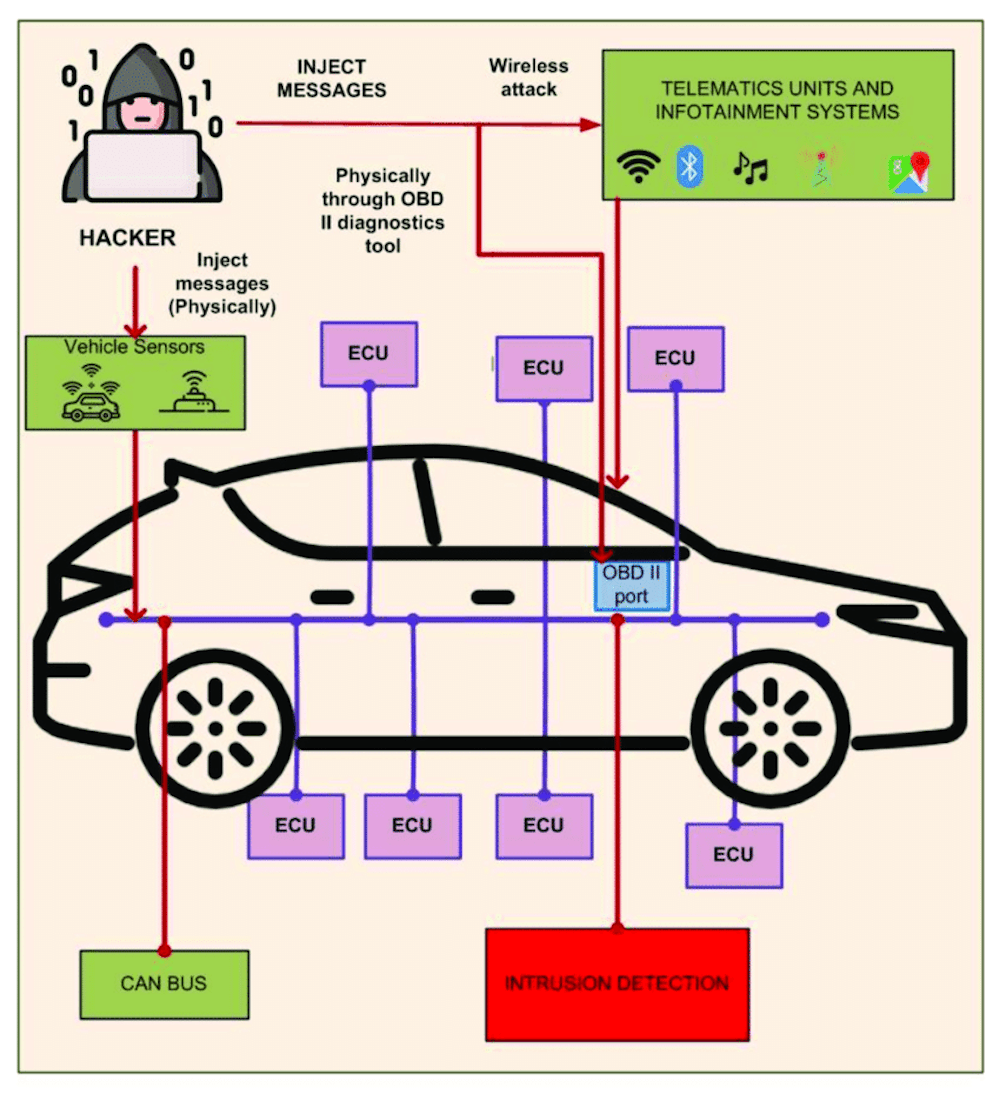
The network used by all computers in a car to communicate is called a controller area network bus. It’s designed to allow the computers in a car to send commands and information to each other. The CAN bus was not designed for security, because all of the devices are assumed to be self-contained. But that presumption leaves the CAN bus vulnerable to hackers.
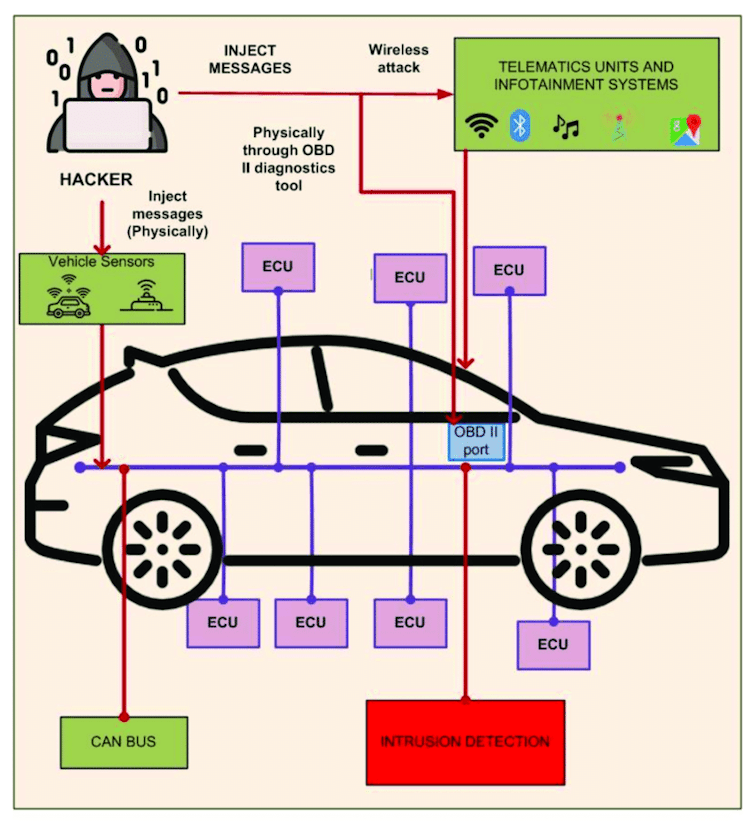
Your car has a computer network, and like most networks, it can be hacked. Electronic control units (ECUs) are sets of computer chips that control the various systems in your car. Khatri, Shrestha and Nam, CC BY Car thieves often try to hack into the CAN bus and from there the computers that control the car’s engine. The engine control unit stores a copy of the wireless key code, and thieves can clone this to a blank key fob to use to start the victim’s car. One method is accessing a car’s onboard diagnostics through a physical port or wireless connection meant for repair technicians. Thieves who access the onboard diagnostics gain access to the CAN bus.
Another network hacking method is breaking through a headlight to reach the CAN bus via a direct wiring connection.
Throwback attack
Modern thieves also try the USB hack, which exploits a design flaw in Hyundai and Kia vehicles. This is more of an old-style hot-wiring of a car than a high-tech computer issue. It is named the USB hack because when thieves break into a car, they look for a slot in the steering column. It turns out that a USB connector fits into the slot, and this allows you to turn on the ignition.
So all someone has to do is break the window, insert a USB connector and start the car. This technique has become infamous thanks to a loose affiliation of young car thieves in Milwaukee dubbed the Kia Boyz who have gained notoriety on TikTok.
Hyundai and Kia have issued an update that closes the vulnerability by requiring the fob to be in the car before you can start it.
Limiting your car’s vulnerability
Given there are so many different car models, and their complexity is increasing, there are likely to continue to be new and creative ways for thieves to steal cars.
So what can you do? Some things are the same as always: Keep your vehicle locked, and don’t leave your key fob in it. What is new is keeping your vehicle’s software up to date, just as you do with your phone and computer.
Doug Jacobson, Professor of Electrical and Computer Engineering, Iowa State University
This article is republished from The Conversation under a Creative Commons license. Read the original article.
-
There were no kittens in my early life . . . Navy housing, and the first opportunity was when the folks bought a home on 2 ½ acres in the Puget Sound area. Sweetwater Creek along the back of the little place, and a small barn – like our one Guernsey cow, our cats were barn cats, not house cats. Likewise, when we moved to Trego, we started with Tom – a black and white cat who lived in the barn and drank fresh milk morning and night. Thinking about it, I suspect having one tomcat was Dad’s way of avoiding kittens back in 1960. Still, kittens showed up – there has long been the concept of dumping excess cats near a farm . . . it puts the responsibility on someone else.
Renata had housecats – so from the time I got married, I learned that living with cats in the house was my new normal – and since one of her cats had died, I was granted the responsibility of getting another. Sunshine was a little starved down tabby whose idea of sport was hunting down box elder bugs. Those two were with us from Chinook, through Trinidad, back to Trego and then Libby. In Libby we replaced Midnight with Dusty – another young cat who had been dumped on Dad, and turned out to be faster than a mountain lion and the best hunter in South Dakota. We took in Smoke in Libby – but he wasn’t faster than the lion. Then Basil as a kitten. Dusty and Basil made the move to South Dakota – and taking care of Basil as his kidneys failed him was my task as I went through chemo.
That led to Spice – a fluffy orange kitten brought in by two heavily bandaged grad students. My grad students had made a tactical error – they thought that he was friendly because he stood still while the other kittens fled. Spice, however, had an attitude, and was committed to standing as rear guard. The shredding stopped briefly when the two got him into the car, but he added a few pains as they got out and emptied our first aid kit. The small demon cat got out, met Sam and the Pomeranian, hissed at Dusty, then decided that Shadow the Pom needed a protector. Congestive heart failure took Spice young, and Dusty’s kidneys didn’t last long enough for him to return to Montana.
So we’ve been 8 years without housecats . . . and for a change, we’re starting with two kittens. After the first week, I’m hypothesizing that 2 kittens can create four times as much chaos as one kitten can – I’ve never had two kittens indoors simultaneously. My experience is with a single kitten and a grumpy adult cat – it’s a new world for this old man. And I kind of like it.


-
Windbreaks have been around for well over 500 years, and they are a pretty simple technology. A wind break reduces the wind speed over a certain area, protecting crops/structures/livestock from wind. Windbreaks can be designed to shelter areas from winter or summer winds.
Design matters. A well designed wind break will reduce wind speeds around areas that need protection. A badly designed windbreak can do the opposite. Badly placed gaps in windbreaks (and arguably there is no good place to put a gap in a wind break) can actually increase the wind speeds in a given area.
Windbreaks are typically several rows of plants, each row varying somewhat in height. The simplest (though far from the most effective) windbreak is a single row of trees. More layers increases density and the longevity of the windbreak.
Height and density are the most important features of a windbreak. The taller the windbreak, the greater the area it can protect. The denser, the greater the protection. A windbreak cannot have 100% density, the way a solid fence can. Trees can only grow so close together before growth is impaired. Still, even a low density (~35%) can cut wind speeds by half.
How much area can a windbreak protect? 2 to 5 times the height on the leeward side (reducing wind by varying amounts- less reduction the further from the windbreak). Windbreaks can have one or two legs and should not have gaps. In order to avoid increasing the amount of wind at the ends, the length should be at least ten times the height.
Because windbreaks reduce soil erosion and provide wildlife habitat, they are viable conservation projects for ordering from the state conservation nursery, which is a very cost effective way of acquiring trees/shrubs.
For more information on how to design an effective windbreak, check out this pdf from Montana State University Extension service. Need more information in order to select plants? This pdf from the USDA discusses various trees for conservation purposes in montana, including information about drought tolerance, leaf scorch and frost cracking. Helpfully, it will also include 20 year height and full height, which is an essential aspect of windbreak design.
-
It’s not every day, or even every year, that you turn a hundred. Happy hundredth birthday to Mary Louise Peters!

Photo by George Dolgikh on Pexels.com -
I saw a headline that read “One in Three Britons Are Really Stupid.” My thoughts were, “OK, how is that surprising? IQ Percentile Calculator 📊 makes it real easy to quantify these numbers – and the cutoff for an IQ rarity of 33% is somewhere between 93 and 94. When 68% of the population is in the normal range, and half the population is above average, knowing the headline was wrong was easy: 50% plus 34% (half of 68) is 84%. Statistically and by definition, only 16% of the population is below normal – so the headline should have read “One in Six Britons Is Below Normal.” Come to think of it, the headline writer also screwed up the grammar – the subject was One, so the verb should have been singular – is, not are.
No matter what our IQ scores are, we all have the ability to make stupid decisions, to think stupid thoughts. Thoughts that can defy reality, and really cost us.
That thought, and a recent chat, brings back aspects of science, of research and analysis. Taxonomy is the science, the practice, of classification. I’m weak at taxonomy – I tend to see things in terms of similarities. In terms of soil taxonomy – one of my wife’s strengths – my tendency is to see how it fits in with what I need to build. She sees a much broader, more vivid group of traits – while my view is more limited, to the aspects I can quantify. I group insects by similarities – while Jed easily notices the small differences, the distinctions that are needed for precise identifications.
It’s not that the end results are particularly different – I’d hit the same range condition that Jack Cloninger arrived at . . . but his analysis would have an elaborate web of plants identified, while mine would have a large category of miscellaneous forbs. A forb is any non-woody flowering plant that isn’t a grass. A lot of the scientists I have worked around are awesome at taxonomy. Happy Jack was much more at home with plant identification than with the hydraulics and hydrology that were my focus at that time.
Evaluating grazing condition is a task that requires plant identification – taxonomy – and estimating population numbers or percentages. It took many years before I realized that my abilities to estimate populations made up for my weaknesses in plant identification. I basically understood that, like the Britons, I was in the bottom third. I’m not sure that it is easy for our teachers to recognize that we have differing strengths – I know that the taxonomists who taught me must have despaired. As an old man, it is easier to recognize that we have different strengths, different gifts, and that our teachers are more likely to teach their strengths than ours. My plant ID prof, in frustration, announced, “McCurry, you sort by similarities and you have to sort by differences.” Of course, I never did become a plant ID professor.
So I don’t believe that one Brit in three is really stupid. On one hand, that population is too large to be an accurate estimate. On the other hand, gifts differ. I suspect that at least half that population that the author categorized as ‘stupid’ actually have gifts, strengths, that the author didn’t recognize.
-
Check the state map or use this link for the inciweb page on the East Fork Fire and remember to scroll down. Be sure to keep updated on fire restrictions– we are currently at Stage 2 and consider signing up for code red.
From Previous Years:
Wildfire Resources- useful links
This time of the year, it’s hard to tell where the smoke is coming from – there is just so much of it. Given how dry things are, and how thin our resources are spread, it’s good to keep informed. So, where do we go? State Map- helpful to get a quick glance and see if there’s anything new in the area. InciWeb- Good for a broader map- the website also includes tables that list the reported incidents. Code Red- Receive notifications of emergencies in your area. TFS Volunteer Fire Department- they post information on Facebook, and they can always…
Keep readingBreathing Smoke
Smoke seemed to fill the air over the course of Saturday, with the mountains becoming increasingly difficult to see. According to the CDC, breathing in smoke may have several immediate effects: trouble breathing coughing wheezing headaches scratchy throat stinging eyes These, among other unpleasant side-effects are caused primarily by the very small particles in smoke. While wildfire smoke can contain carbon monoxide (which also causes headaches), carbon monoxide seldom travels far from the initial fire. Ozone is also a concern, because it can form as the smoke plume moves away from the fire. According to the EPA, the main components…
Keep readingHEPA Filters and Wildfire Smoke
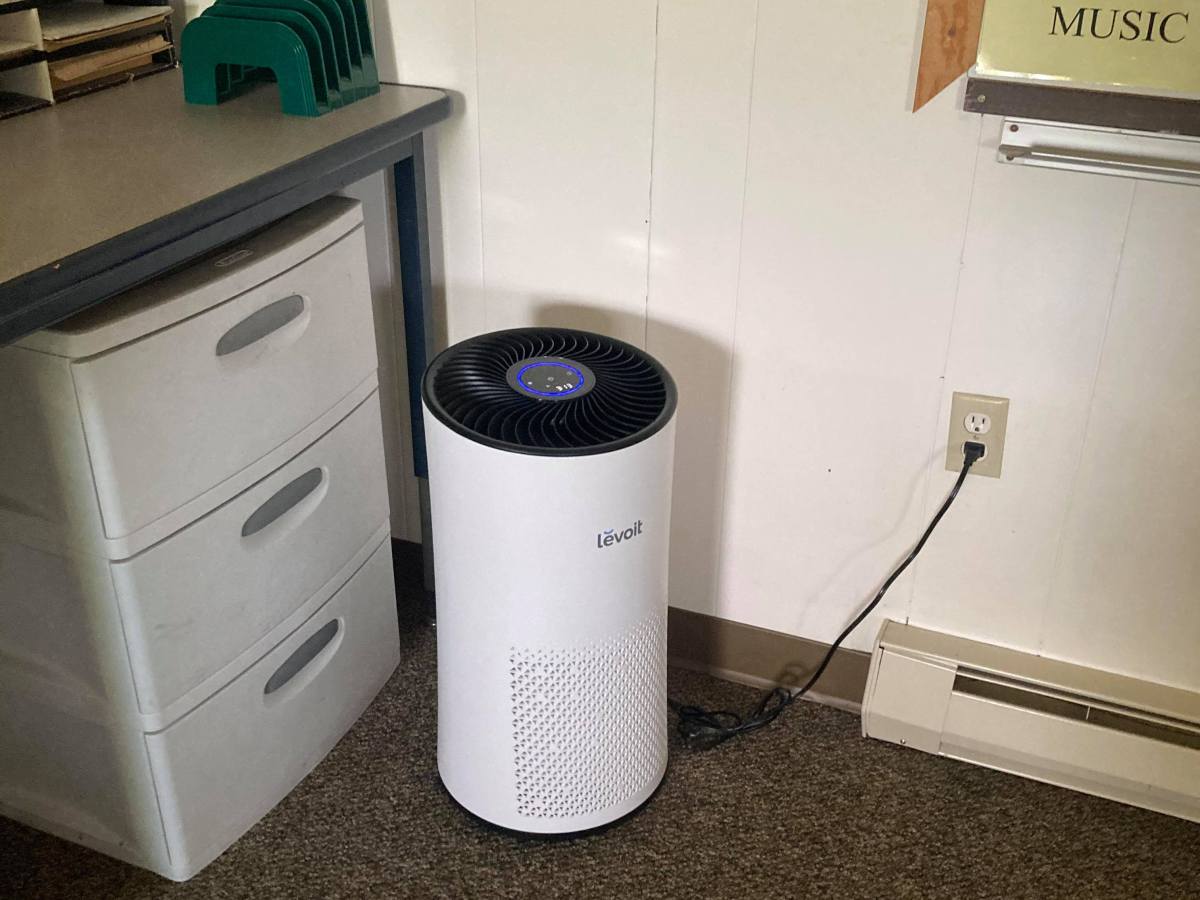
As I stepped into Trego School on a warm smoky afternoon, I developed a sudden admiration for HEPA filters. About a month ago, I wrote about the school’s new HEPA filters, purchased as part of their Health and Safety plan. As it turns out, HEPA filters are excellent for wildfire smoke. HEPA filters are good at filtering out the really small, which is what the most harmful particles in wildfire smoke are. Last week, as our air quality worsened, I wrote about the problems associated with breathing smoke, such as headaches and coughing. The tiniest particles of smoke (less than…
Keep readingWildfire Smoke- Christopher Migliaccio
How wildfire smoke can harm human health, even when the fire is hundreds of miles away – a toxicologist explains Christopher T. Migliaccio, University of Montana Smoke from more than 100 wildfires burning across Canada has been turning skies hazy in North American cities far from the flames. We asked Chris Migliaccio, a toxicologist at the University of Montana who studies the impact of wildfire smoke on human health, about the health risks people can face when smoke blows in from distant wildfires. What’s in wildfire smoke that’s a problem? When we talk about air quality, we often talk about…
Keep readingPine Bark Beetles and Fire Risk
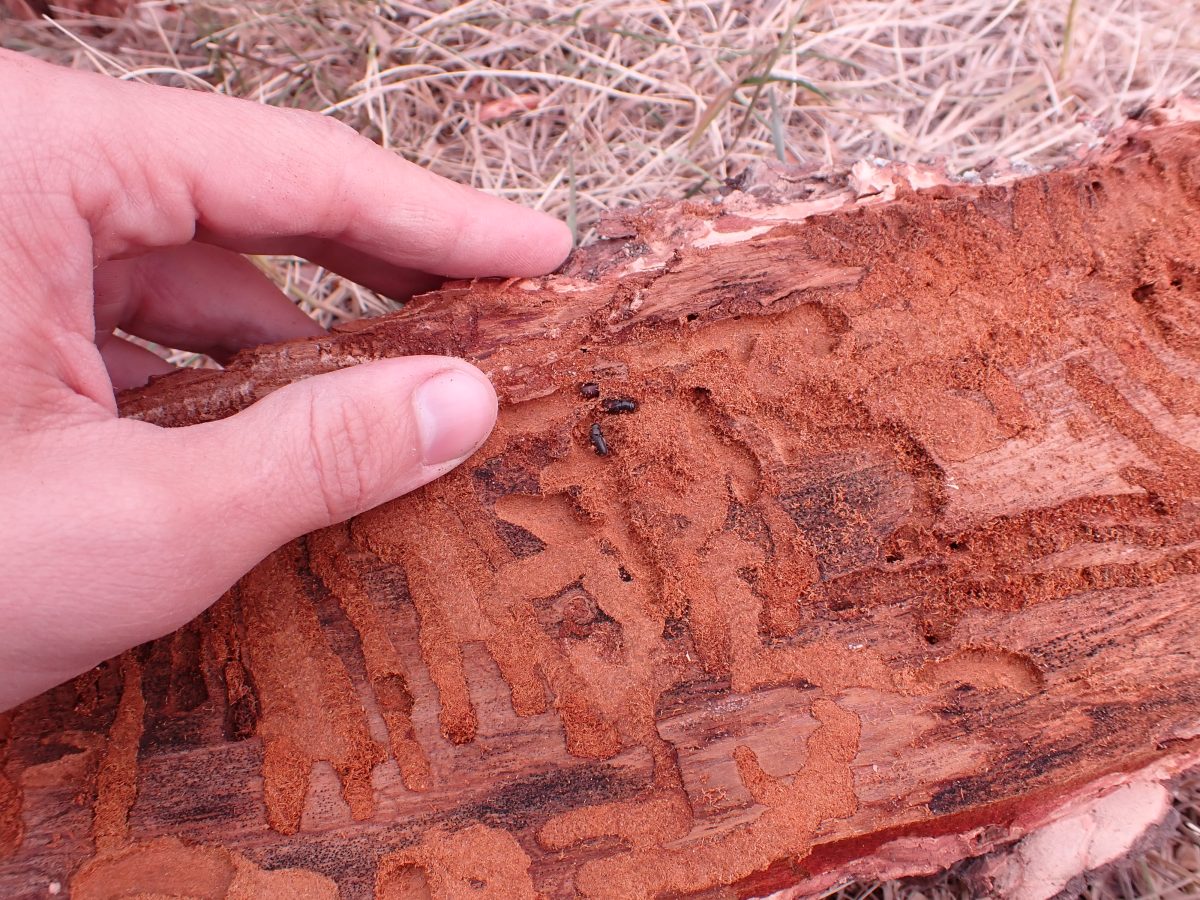
The dense smoke currently hanging over our part of the country has had me thinking about beetles. Why beetles, you say? Pine bark beetles and relatives (genus Dendroctonus) are notorious for killing large stands of coniferous trees (Fir, Larch, Pine, etc.) – even their scientific name translates to “tree killer”. As time goes by and environmental stressors increase, we’re seeing more and more tree die-offs related to these bark beetles. Death by bark beetle can triple the rate at which trees go up in flames. It’s not fair to put all the blame on the beetles, though – tree death…
Keep readingThinking of Fire
The ability to fight fire effectively is based on substitution of technology for human muscle power. A bucket brigade takes a lot more people and moves less water than a pumper. National Humanities Center describes how, in 1880, the Census included fires – now we’d call them incidents – and provides this map: Causes of fires (1880, U.S): The article begins with this paragraph: “For the 1880 census, Charles Sargent mapped forest fires. Fire was nearly everywhere, some places more vigorously than others. The amount of burning was, by today’s standards, staggering. A developing nation, still primarily agricultural, the United…
Keep readingFire Sky
The air is hazy, and the sun is red. And the sunsets? The sunsets are vibrant. Why? It is for the same reason a sunset is red. Particles in our atmosphere scatter light, and they scatter blue light more than red. At sunset, the sun reaches us through more of the atmosphere, and most of the blue has been filtered away from us, leaving us with the longer, redder wavelengths. When the sky is filled with smoke, there are far more particles in the air to scatter light and the colors are more vivid. Similarly the sun appears dimmer (more…
Keep readingThe International’s Last Run
Few of us recall Trego’s first fire truck. We have to go abeam nearly a half-century to get to those of us who drove it – and I guess I’m one of the youngest. Tommy White, Jack Dickinson, Ted Burke, LeeRoy Mee, Tom Johnson, Cecil Storm – all gone, and with them many of the memories and stories that involved the old International. It was red – faded, and pebble-textured in the way that only a lead-based paint endures the elements. It may have been from the late forties or the early fifties. I don’t know of any photos remaining. …
Keep readingFires by Year and Partial Duration Series
When I listened to the explanations that the California and Oregon fires were worse than ever, and resulted from anthropic climate change, I did what I usually do. I checked for data and found statistics at the National Interagency Fire Center. The table I found lists both number of fires, and acreage burned by year, starting in 1926. That’s almost a hundred years, and a lot of numbers. Since graphs tend to easier to read, line graphs follow. The drop in number of fires in 1984 is a dramatic shift, The drop in acreage burned that occurred in the fifties is…
Keep reading -
The article that governs impeachments never seemed particularly relevant to me – probably because impeachments seem more political than legal. Article II, section 4 specifically says: The President, Vice President and all civil Officers of the United States shall be removed from Office on Impeachment for, and Conviction of, Treason, Bribery, or other high Crimes and Misdemeanors.
Article III, section 3 goes on to define Treason: Treason against the United States, shall consist only in levying War against them, or in adhering to their Enemies, giving them Aid and Comfort. No Person shall be convicted of Treason unless on the Testimony of two Witnesses to the same overt Act, or on Confession in open Court.
Having watched a few impeachments – Clinton and Trump – I’ve learned that ‘High Crimes and Misdemeanors’ means precisely what the largest political party in the house of representatives wants it to mean. In Clinton’s case, his ‘High Crimes and Misdemeanors’ were lying under oath to a federal grand jury and obstructing justice.’ Back when Andrew Johnson was impeached, his ‘High Crimes and Misdemeanors’ were violating the tenure of office act (firing Edward Stanton), pardoning of traitors, and impeding ratification of the 14th amendment.
Trump’s ‘High Crimes and Misdemeanors’ included possible violations of the Foreign Emoluments Clause of the Constitution, collusion with Russia during the 2016 election, obstruction of justice (in the investigation of the collusion claim) and associating the presidency with White Nationalism, Neo-Nazism and Hatred. His second impeachment was grounded on inciting insurrection.
High Crimes and Misdemeanors is a mighty broad category.
As I read about the Chinese and Ukrainian payoffs, I’m beginning to appreciate Joe Biden – none of the creative ‘High Crimes and Misdemeanors’ malarkey for Joe. No constitutional demand for two witnesses. Just a simple case of bribery. It’s a refreshing change – if the House of Representatives decides to impeach this President they can use the simple listed offense of bribery.
Impeaching the President is no small thing. In 1998, 17 Democrat votes kept Al Gore from becoming President. Forget the hanging chads and the electoral college in the 2000 election – there were only 17 votes between Al Gore and the presidency in 1998 . . . and it’s essentially the same situation now – if Biden is impeached for bribery (or other High Crimes and Misdemeanors) another small number of Democrat senators will make the decision of whether Joe Biden continues as President, or if the job passes to VP Kamala Harris.
Still, a Trump-Biden rematch might convince more people that an election just isn’t right if it doesn’t have a box to mark for ‘None of the Above’. So impeach the bastards – all of them.
-
I learned of the Pig War as a little kid in Washington, studying Washington history. Much later, I learned the significance of a US Army captain named George Pickett and a second lieutenant named Henry Martyn Robert. Pickett is best remembered for “Pickett’s Charge” at the Gettysburg battle. Robert’s fame is for authoring Robert’s Rules of Order.”
In 1859 these two junior officers, at the extreme northwest corner of the United States, prepared for battle with the British Empire on San Juan Island. To maintain a neutral stance, let’s see what the Canadian Encyclopedia has to say: The Pig War | The Canadian Encyclopedia
“The Pig War is rooted in the Oregon boundary dispute. Throughout much of the early to mid-19th century, the United States and Great Britain disagreed over the exact location of the Oregon Territory’s northern boundary. The Anglo-American agreement of 1818 allowed citizens of both countries to share the disputed territory and provided both nations access to the region’s navigable waterways.
The Oregon Treaty of 1846 partly resolved the issue, but the wording was vague. The treaty stated that the border between the two countries would extend along the 49th parallel of latitude due west until the “middle of the channel that separates the continent from Vancouver Island” and then south along the channel to the Juan de Fuca Strait and then to sea. The problem was that there were two channels, Rosario Strait and Haro Strait, but the treaty did not specify which one; the San Juan Islands lay between the two channels. The British preferred to use Rosario Strait, which would leave the San Juan Islands in their territory. The Americans preferred Haro Strait, which left the islands in their territory.
British settlement of San Juan Island began in earnest when the Hudson’s Bay Company (HBC) set up a salmon-curing station in 1851; this was followed by a sheep farm in 1853, the same year the Americans made their claim to San Juan Island. By 1859, between 14 and 30 American settlers had also taken up residence there. British authorities considered the Americans illegal squatters.

Pig Shooting
On 15 June 1859, a pig wandered into the vegetable patch of an American farmer named Lyman Cutler (or Cutlar). This was not the first time the pig had been in Cutler’s patch, rooting for potatoes. Cutler decided he had had enough and shot the offending swine. The pig was owned by Charles Griffin, a British employee of the HBC, who confronted Cutler. Though Cutler offered $10 in compensation, Griffin demanded more money and ultimately reported Cutler to the British authorities, who threatened to arrest him.
Mounting Tension
In response, the local American military commander sent 64 troops to the island to defend the American settlers. This led James Douglas, governor of Vancouver Island, to send British frigate HMS Tribune to the island, with instructions to dislodge the American troops. It was soon joined by other warships. Tensions increased as the Americans requested additional reinforcements from the mainland. By mid-August, American forces comprised more than 400 soldiers and eight cannon; British forces in the area included five warships and more than 1,000 men. While the Americans constructed gun fortifications, the British conducted cannon drills. A major conflict seemed inevitable.”
Our Canadian source doesn’t get into the US officers present, explaining that war was averted because Rear Admiral Baynes explained that he wouldn’t bring “two great nations to war in a squabble about a pig.” Still, the 64 US officers and men sent to the island included Captain Pickett and Lieutenant Roberts – and the “squabble about a pig” left Roberts his own immortality with a National Park:
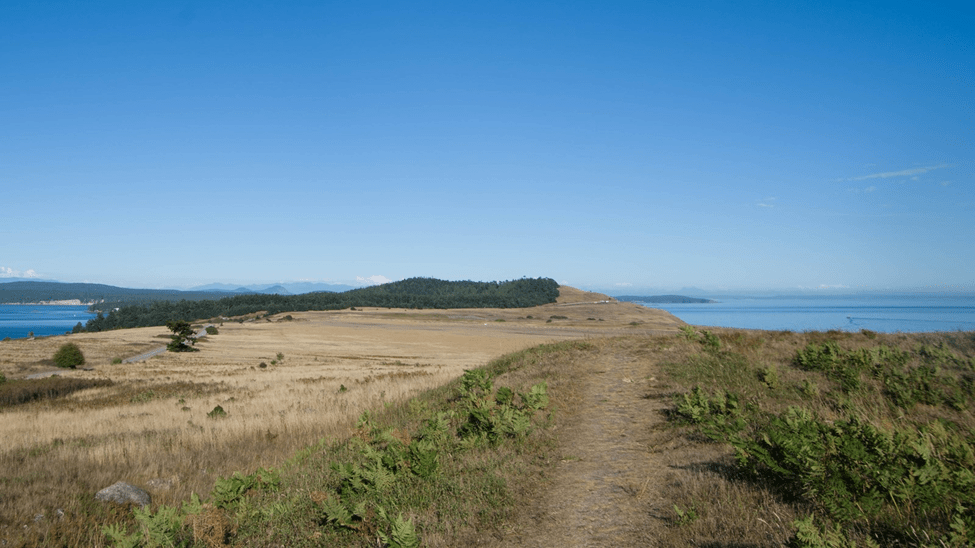
“East of the American Camp Visitor Center and the Parade Ground is Robert’s Redoubt. This man-made fortification was the American army’s commanding position during the height of the Pig War. This was early in Henry M. Robert’s military career. He later authored “Robert’s Rules of Order”.
Its construction showed the British that the Americans intended to remain on San Juan Island for as long as it took to claim the archipelago. Building the redoubt was no easy feat. At least 100 men used picks and shovels to alter the landscape, which included massive boulders. Though equipped to position guns, shots were never fired against the British while the redoubt was active.
Before military occupation, the area was heavily forested with Douglas Firs. The soldiers cleared out these trees to build the redoubt, and it’s still a prairie today. In the grass, you might see eagles or foxes.
From the redoubt you have views of the Haro Strait and Griffins Bay. On clear days you can see Mount Baker, the Olympic Mountain Range, and Mount Rainier looming in the distance. This placement was advantageous for the Americans: they would be able to see and prepare for attacks coming from the water.”
The Redoubt – San Juan Island National Historical Park (U.S. National Park Service)“The American army officer knew that the odds against him were overwhelming. The three warships set at anchor in the bay below his camp mounted a total of 61 guns and carried nearly a thousand men, including a contingent of Royal Marines. Manned by just 66 soldiers, his own recently occupied position was fortified by earthworks and protected only by a single six-pounder gun and two mountain howitzers. The orders that Captain George Edward Pickett of the U.S. Army had received from his commanding general had been clear, however, and he was determined to hold his position.
Pickett had served with valor in the Mexican War right after his graduation from the United States Military Academy at West Point, and he had subsequently seen duty at several frontier posts. Now, on August 3, 1859, the man whose name would be forever linked to the most famous of all Civil War charges was the American commander on the scene as the United States and Great Britain again stood on the brink of war. The issue dividing the two countries this time was the ownership of the often fog-shrouded San Juan Islands that dot the strait between what is today the state of Washington and British Columbia’s Vancouver Island. . . .
Based at Fort Vancouver, Washington Territory, General Harney sailed to San Juan Island in July 1859 aboard the USS Massachusetts. Upon his arrival, he met some of the American residents of the island and learned about Indian attacks on the settlement and the incident with the pig, as well as the American islanders’ fear and dislike of the British. Harney immediately pledged his support and suggested that they draft a petition–for which he provided the wording–requesting that he station a military force on the island.
Without consulting either civil territorial authorities or his superiors in the War Department, Harney then ordered Captain Pickett and Company D of the Ninth Infantry to proceed from Fort Bellingham on the mainland to San Juan Island and establish a post, ostensibly to protect the inhabitants from hostile Indians and “to resist all attempts at interference by the British authorities residing at Vancouver’s Island, by intimidation or force….” Although he issued the order on July 11, Harney did not send a report of his action to the War Department in Washington, D.C., until July 19; that report did not arrive there until September.
When James Douglas heard of Harney’s action, he issued orders to Captain Geoffrey Phipps Hornby of the British man-of-war Tribune, which had been dispatched from Hong Kong to the Pacific coast of North America, to land a force of Royal Marines on the island. Although the governor was fully within his rights to issue these orders, he was approached on July 29 by British naval officers who advised him against this course of action because it was contrary to Royal Navy policy in the Pacific. Douglas then dispatched a second set of orders to Hornby, countermanding his original instructions. Nonetheless, Hornby decided to invite Pickett to parlay with him aboard the Tribune on August 3. The American officer suggested that they meet in the American camp instead.
Hornby acquiesced and came ashore accompanied by Captains James Prevost and G. H. Richards, the two British boundary commissioners. The meeting, held in Pickett’s tent, was polite, but not cordial. Hornby opened by producing an extract of Secretary of State Marcy’s communication of four years earlier, and Pickett countered by citing the age of the letter.
When Hornby asked on what terms Pickett had occupied the island, the American captain declared that he had done so on orders from the general commanding the territory in order to protect the lives of American citizens. Pickett added that he believed General Harney was acting under orders of the government in Washington. But such was not the case; news of General Harney’s orders to Pickett would not even reach the capital for more than a month. . . . .
On April 10, 1860, General Harney–furious that he had not been advised about the joint-occupation agreement and that his man, Pickett, had been replaced as commander on the island–committed a final act of insubordination. In spite of the agreement reached by General Scott and the British, and in violation of Scott’s direct orders, Harney sent Company D under Captain Pickett back to San Juan Island to relieve Captain Hunt’s Fourth Infantry company.
When this news–and the flurry of protests from the British government that it caused–reached Washington, reaction was swift and coordinated. The departments of state and war being of one mind, Secretary of State Cass reported to the president that, on June 8, the adjutant general sent a dispatch to Harney, ordering him to turn over command to the officer next in rank and to “. . . repair without delay to Washington City, and report in person to the Secretaries of State and War.”
Harney avoided court-martial but received a reprimand from Secretary of War Floyd for his actions “. . . which might have been attended by disastrous consequences.” Given command of the Department of the West, he traveled to St. Louis, but after reporting difficulties with his officers, he was recalled from that post in May 1861. He held no further command and was retired in 1863.
General Harney’s departure from the Northwest mollified the British, who withdrew their objection to Captain Pickett commanding on San Juan Island. Pickett, a Virginian, left that post on June 25, 1861, and soon after, he resigned his commission and traveled to Richmond, where he was appointed a colonel in the army being formed by the Confederate States of America.
The San Juan Island’s “Pig War”: February ’01 American History FeatureGeneral Harney had the highest point east of the Rocky Mountains named after him – until 2016, when the name was changed to Black Elk Peak. On his trip back to the US, he became the first US general captured by southern troops – but was given back without comment. George Pickett went on to fame at Gettysburg, and General Roberts wrote the book that is essentially our bible of parliamentary procedure.
And Griffin’s pig is still dead.


Want to tell us something or ask a question? Get in touch.

Recent Posts
- Recovery Time for a Retiree
- Venn Diagram and DSM
- When Castro Was Cool
- You Have To Beat Darwin Every Day
- Computer Repair by Mussolini
- Getting Alberta Oil to Market
- Parties On Economics
- Thus Spake Zarathustra – One More Time
- Suspenders
- You Haven’t Met All The People . . .
- Play Stupid Games, Win Stupid Prizes
- The Ballad of Lenin’s Tomb

Rough Cut Lumber
Harvested as part of thinning to reduce fire danger.
$0.75 per board foot.
Call Mike (406-882-4835) or Sam (406-882-4597)
Popular Posts
Ask The Entomologist Bears Books Canada Census Community Decay Covid Covid-19 Data Deer Demography Education Elections Eureka Montana family Firearms Game Cameras Geese Government Guns History Inflation life Lincoln County Board of Health Lincoln County MT Lincoln Electric Cooperative Montana nature News Patches' Pieces Pest Control Politics Pond Recipe School School Board Snow Taxes travel Trego Trego Montana Trego School Weather Wildlife writing
 Trego's Mountain Ear