-
I recently saw a headline about how very bad the US is for infant mortality compared to other industrialized nations. Comparing the US to Canada, England, or Europe seems pretty fair; our technology is pretty equivalent, even if our health care systems are a bit different.
It’s common to see our health care system attributed as the cause, but is it? One major problem is that it isn’t a comparison of apples to apples. Technology has pushed the threshold for viability increasingly early- even as early as 22 weeks, there is a chance for survival!
The United States tends to count those early, early babies in the infant mortality rate. The odds of survival at that age are low, though, and not all countries count them.
Looking at the actual data is a much more complicated process- and thankfully in this case someone else has already done it. The short version is that the counting difference between countries accounts for about 40% of the difference.
Beyond that, the US seems to have a greater proportion of babies that are likely to have problems (more babies with lower birth rates and gestational age- this isn’t necessarily a bad thing, the study doesn’t examine the cause, and it could be something as benign as an increase in pregnancies with multiple babies as a result of increased IVF usage) and a slightly higher rate of death in the months after birth. That higher death rate is more significant within the first month, which might be explained by a greater number of premature infants (those being at a greater risk for SIDS).
At any rate, making the comparisons equivalent is a complicated process, and the explanation is unlikely to be something as simplistic as “Our Healthcare System is Worse”.
-
Bruce commented that my sawmill is a toy. Thinking about it, he’s right. Since I’m 73 and retired from the world of work, my mill doesn’t have to make me a living. I was cautioned that operating a mill is too much work for an old man – but I have no need to put in the long days – and I can clean up the woods and create boards. The first use of those boards is my own projects.
The mill looked like this in the advertisements:\

I quickly learned that my first products needed to be timbers that allowed me to support the track and keep it level. Most of the guys who use small sawmills can level them with string and a carpenter’s level – I’m accustomed to surveying instruments, and use them. It doesn’t mean I do any better than the guys with string and level – it just means I’m used to using fancier tools to do the same job. And I have a need for 6×6 timbers to make a strong footing for the mill.
I bought a lot of track – and it’s nice to have. The thing is, as an old man, sticking with 8 foot logs matches my strength and endurance better. So I cut nominal 8’ boards. The mill can handle 20 feet – but those long boards and slabs get heavy. And, since there’s some bend in the trees I harvest, and a bit of taper, I’m getting slabs that are going to be firewood.
So now I’m learning that making boards is fun. The problem is, I’ve reached the spot where I’m stacking boards – and filling space. The sawmill may be a toy – but it’s time to start selling boards. I have a couple thousand board feet stacked and stickered indoors – so it’s time to start selling boards instead of just having fun cutting them. I’m past being a hobbyist – it’s time to go into the business of selling lumber – it’s stacking up and needs to move out.
I guess even a toy can have commercial applications.
-
Measuring helium in distant galaxies may give physicists insight into why the universe exists

New measurements from Japan’s Subaru telescope have helped researchers study the matter-antimatter asymmetry problem. Javier Zayas Photography/Moment via Getty Anne-Katherine Burns, University of California, Irvine
When theoretical physicists like myself say that we’re studying why the universe exists, we sound like philosophers. But new data collected by researchers using Japan’s Subaru telescope has revealed insights into that very question.

Japan’s Subaru telescope, located on Mauna Kea in Hawaii. Panoramio/Wikimedia Commons, CC BY-ND The Big Bang kick-started the universe as we know it 13.8 billion years ago. Many theories in particle physics suggest that for all the matter created at the universe’s conception, an equal amount of antimatter should have been created alongside it. Antimatter, like matter, has mass and takes up space. However, antimatter particles exhibit the opposite properties of their corresponding matter particles.
When pieces of matter and antimatter collide, they annihilate each other in a powerful explosion, leaving behind only energy. The puzzling thing about theories that predict the creation of an equal balance of matter and antimatter is that if they were true, the two would have totally annihilated each other, leaving the universe empty. So there must have been more matter than antimatter at the birth of the universe, because the universe isn’t empty – it’s full of stuff that’s made of matter like galaxies, stars and planets. A little bit of antimatter exists around us, but it is very rare.
As a physicist working on Subaru data, I’m interested in this so-called matter-antimatter asymmetry problem. In our recent study, my collaborators and I found that the telescope’s new measurement of the amount and type of helium in faraway galaxies may offer a solution to this long-standing mystery.
After the Big Bang
In the first milliseconds after the Big Bang, the universe was hot, dense and full of elementary particles like protons, neutrons and electrons swimming around in a plasma. Also present in this pool of particles were neutrinos, which are very tiny, weakly interacting particles, and antineutrinos, their antimatter counterparts.

The Big Bang created fundamental particles that make up other particles like protons and neutrons. Neutrinos are another type of fundamental particle. Alfred Pasieka/Science Photo Library via Getty Images Physicists believe that just one second after the Big Bang, the nuclei of light elements like hydrogen and helium began to form. This process is known as Big Bang Nucleosynthesis. The nuclei formed were about 75% hydrogen nuclei and 24% helium nuclei, plus small amounts of heavier nuclei.
The physics community’s most widely accepted theory on the formation of these nuclei tells us that neutrinos and antineutrinos played a fundamental role in the creation of, in particular, helium nuclei.
Helium creation in the early universe happened in a two-step process. First, neutrons and protons converted from one to the other in a series of processes involving neutrinos and antineutrinos. As the universe cooled, these processes stopped and the ratio of protons to neutrons was set.
As theoretical physicists, we can create models to test how the ratio of protons to neutrons depends on the relative number of neutrinos and antineutrinos in the early universe. If more neutrinos were present, then our models show more protons and fewer neutrons would exist as a result.
As the universe cooled, hydrogen, helium and other elements formed from these protons and neutrons. Helium is made up of two protons and two neutrons, and hydrogen is just one proton and no neutrons. So the fewer the neutrons available in the early universe, the less helium would be produced.
Because the nuclei formed during Big Bang Nucleosynthesis can still be observed today, scientists can infer how many neutrinos and antineutrinos were present during the early universe. They do this by looking specifically at galaxies that are rich in light elements like hydrogen and helium.
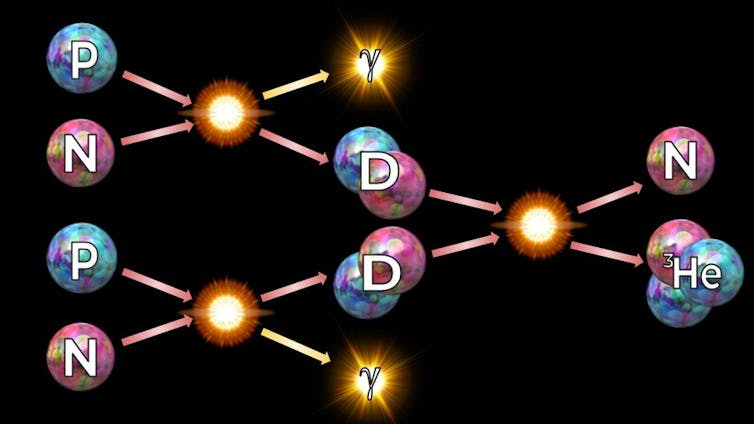
In a series of high-energy particle collisions, elements like helium are formed in the early universe. Here, D stands for deuterium, an isotope of hydrogen with one proton and one neutron, and γ stands for photons, or light particles. In the series of chain reactions shown, protons and neutrons fuse to form deuterium, then these deuterium nuclei fuse to form helium nuclei. Anne-Katherine Burns A clue in helium
Last year, the Subaru Collaboration – a group of Japanese scientists working on the Subaru telescope – released data on 10 galaxies far outside of our own that are almost exclusively made up of hydrogen and helium.
Using a technique that allows researchers to distinguish different elements from one another based on the wavelengths of light observed in the telescope, the Subaru scientists determined exactly how much helium exists in each of these 10 galaxies. Importantly, they found less helium than the previously accepted theory predicted.
With this new result, my collaborators and I worked backward to find the number of neutrinos and antineutrinos necessary to produce the helium abundance found in the data. Think back to your ninth grade math class when you were asked to solve for “X” in an equation. What my team did was essentially the more sophisticated version of that, where our “X” was the number of neutrinos or antineutrinos.
The previously accepted theory predicted that there should be the same number of neutrinos and antineutrinos in the early universe. However, when we tweaked this theory to give us a prediction that matched the new data set, we found that the number of neutrinos was greater than the number of antineutrinos.
What does it all mean?
This analysis of new helium-rich galaxy data has a far-reaching consequence – it can be used to explain the asymmetry between matter and antimatter. The Subaru data points us directly to a source for that imbalance: neutrinos. In this study, my collaborators and I proved that this new measurement of helium is consistent with there being more neutrinos then antineutrinos in the early universe. Through known and likely particle physics processes, the asymmetry in the neutrinos could propagate into an asymmetry in all matter.
The result of our study is a common type of result in the theoretical physics world. Basically, we discovered a viable way in which the matter-antimatter asymmetry could have been produced, but that doesn’t mean it definitely was produced in that way. The fact that the data fits with our theory is a hint that the theory we’ve proposed might be the correct one, but this fact alone doesn’t mean that it is.
So, are these tiny little neutrinos the key to answering the age old question, “Why does anything exist?” According to this new research, they just might be.
Anne-Katherine Burns, Ph.D. Candidate in Theoretical Particle Physics, University of California, Irvine
This article is republished from The Conversation under a Creative Commons license. Read the original article.
-
July and August are busy months for our area. The rainfalls become infrequent and grass is ready for haying. After we celebrated Canada Day (July 1st) and the 4th of July we had the accordion festival (Trego Pub), a bike rally, and a music festival (Sawmill), and rodeo. August is shaping up to be similarly eventful- we’re anticipating fiber fest, the quilt show, an art show, and a book sale this weekend. Later, we anticipate the fair and Shakespeare in the Park.
Year’s Past:
Backwoods Accordion Festival, Round 3
Trego’s third annual Backwoods Accordion Festival was the best-attended yet! We saw quite a few return visitors, as well as new faces, some of whom we fully expect to meet again next year. The Trego Pub outdid itself with covered seating (a pleasant reprieve from the hot sun), and was buzzing with activity, serving both…
Scraps and Threads Celebrates Another Successful Quilt Show
Held in conjunction with Rendezvous, Scraps and Threads Quilt Guild annual quilt show was well attended. This year the quilt show’s theme was Montana Silhouettes. The fair barn was decorated with silhouettes mostly representing Montana’s wildlife and included live wildlife (a fat mouse) scuttling in the facilities’ bathrooms. With over 100 quilted items on display,…
Eureka Montana Held 18th Fiber Fest
Fiberfest took place at the fairgrounds- it had numerous events and vendors, even a petting zoo. There were demonstrations on Portuguese knitting, Sketch Looms, Sheep Herding, and various forms of spinning. There was lots of noise and color, and many helpful people eager to get beginners into their craft. Everyone was very invested in passing…
-
Thirty years ago, I read of a homeless guy, who tied in the labels of ex-con, druggie and mental health problems. He was spending most of his time on buses – social workers in California would buy him a ticket to Miami, and when the Florida social workers realized he was in their state, they’d buy him a ticket to Los Angeles. I think it was called “Greyhound Therapy.” Here, back when Tom and Gene were our local deputies, the term was a “Tobacco Valley deportation.” No official court action – just a ride in the cruiser’s back seat down toward Olney, and encouragement to seek the benefits of Whitefish or Kalispell.
I read that the mayor of Anchorage intends to solve his homeless problem with airplane tickets – he explained that it takes over a hundred dollars a day to look out for a homeless guy, and that a plane ticket to Los Angeles costs only $276. There is an economic component to being your brother’s keeper – and shipping him out so some other brother can keep him is an alternative.
Greyhound Therapy – The American Prospect describes the situation within New Jersey:
“When Thomas Jones, a native of Asbury Park on the Jersey Shore, wanted to get clean and straighten out his life, service providers in his county gave him a one-way ticket to Trenton, 60 miles away. “In Asbury Park they didn’t have assistance-no shelter, no soup kitchen,” he said. “They just push you out to Trenton or Atlantic City.” Other homeless men recounted similar stories. When they got out of prison or lost their jobs and couldn’t keep up with the bills, they sought help. Instead, they were offered one-way bus rides to the Trenton or Atlantic City, home to the Trenton and Atlantic City Rescue Missions, the only two comprehensive shelters for adults without children in the southern half of the state.
The practice-shipping homeless people off to cities better-equipped to provide services-is common enough in southern New Jersey that it’s come to be known as “Greyhound Therapy.”
It’s difficult to quantify given that it’s not an official policy and there is no single offending agency, but homeless people and service providers alike report it is widespread. “Clients very often have recent medical exposure and the hospital doesn’t want to discharge them into homelessness so they tell them to go to Trenton,” says Mary Gay Abbott-Young, chief executive officer of the Trenton Rescue Mission. “The person shows up sometimes still wearing a hospital gown with a stack of prescriptions. We’ve had pre-paid taxis pull up.”
San Diego uses the term “Family Reunification.” https://www.latimes.com/local/lanow/la-me-homeless-bus-20180312-story.html
“From all appearances, Judy Bryant wanted out of San Diego.
For six years, the 48-year-old woman has been homeless there, and when she walked into an office at St. Vincent de Paul Village on a recent morning, she said she’d had enough of sleeping on concrete. She said she had spent the previous night on the back steps of a downtown apartment building.
Her daughter back home in North Carolina has a place for Bryant to stay if she can figure out how to get there, she said.
That’s where the Family Reunification Program comes in.
Run by the Downtown San Diego Partnership, it provides free bus tickets for homeless people to go live with relatives in other cities. If Bryant’s story checks out, she could be on board that night and back in North Carolina in three days.
“It’s a way for people to reconnect with their family support systems and start over,” said Alonso Vivas, executive director of the partnership’s Clean & Safe team, which runs the program.
Critics call relocation efforts such as this “Greyhound therapy” and say all they do is shuffle the homeless from one place to another. But the programs, cheaper than providing housing, are popular in cities all across America, and the one in San Diego is expanding.
After sending about 1,100 people to other places from early 2012 through mid- 2017, it’s bused out almost 600 in the last eight months.”
“The Sacramento Bee documented Brown’s story beginning in 2013. Subsequent investigations by the newspaper found that Rawson-Neal regularly discharged homeless patients using “Greyhound therapy,” sometimes to places where they had never been and had no ties.
During the long ride to Northern California, Brown had rationed the peanut butter crackers and Ensure nutritional supplements that a staff member at the mental hospital had given him, along with his discharge papers and a bus ticket to Sacramento. His food was gone, and he was nearly out of the medication to treat his array of mood disorders, including schizophrenia, depression and anxiety.
According to a state investigation, Brown spent 72 hours in the hospital’s observation unit before a doctor discharged him to a Greyhound bus to Sacramento. The discharge orders noted he should be given a three-day supply of Thorazine, Klonopin and Cymbalta to treat his schizophrenia, anxiety disorder and depression, plus “Ensure and snacks for a 15-hour bus ride.”
Brown wound up homeless in the capital city after arriving by bus. No prior arrangements had been made for his care or housing. He told police he was advised by the Nevada psychiatric hospital to “call 911” when he arrived in the capital city.
The Bee found that Brown’s experience was not an isolated one. The newspaper discovered that Rawson-Neal bused roughly 1,500 patients out of Nevada between 2008 and 2013, a third of them to California. Some of the patients, The Bee documented, became homeless and went missing after their bus trips. Some died tragically. Some committed serious crimes in their new cities.”
‘Greyhound Therapy’: Nevada Psychiatric Patients Bused to Different States Win LawsuitGreyhound Therapy – Diesel Therapy – Tobacco Valley Deportation. I guess it’s an economically viable way to do social work.
-
I wound up checking tax assessments – Dad died in 2012, and macular degeneration had taken his vision over 20 years earlier, and figuring out the buildings which were real on the assessment was an interesting challenge. My comments in the appeal to the County Tax Appeals Board show why everyone needs to go over their data. It also shows the casual errors that assessors make when they update the records. It also shows that an old blind man didn’t have a chance in hell of getting past errors made by government employees doing their jobs badly.
“AAP4 – Pole Frame Building, 1 side open, wood, built 1970 Value $1,780
This building exists, but was built after 1990
AAB2- Standard Barn, built 1960 Value $4,750
No barn exists on this tract – I believe that this is my brother’s barn, across the road from my tract, built before 1917. I don’t believe it is just to tax me for my brother’s barn.
AAP5 – Pole Frame Bldg, 4 sides open, metal, built 1980 Value $1,720
No such building exists on this tract. I can’t for the life of me figure out how this one was listed. If you folks can find it for me, I will stack hay in it and not complain – but I really don’t want to pay taxes on a non-existent building. I am sure you can understand.
AAP3 – Pole Frame Bldg, 1 side open, metal, built in 2018 Value $1,790”
I’m pretty sure this is my woodshed – though the only metal in it is the screws, nails and roofing. No problem but we should get a better description.
I think that AAP4 and AAP5 are the same building. Here’s how I reconstruct the chain of events:
Dad had a guy build it after 1990, the assessor noted it as AAP4 but dated the building as built in 1970.
Buddy was working at Plum Creek in Columbia Falls, where employees could buy cull fiberboard at extremely low prices. Dad took advantage of this, getting Bud to pick up loads of cull fiberboard – then Dad had his minions add 8 feet of fiberboard around the building.
I hypothesize that a new assessor came by, saw the half-walls on the shed, and came up with the description of AAP5 and never wondered why he couldn’t spot AAP4.
After Dad died, and the place was split, another government employee – one whose skills in property descriptions are beneath his/her/it’s salary level chose not to look at the air photo, and just set the old barn’s description on the east side of Fortine Creek Road. Had this nameless worthy looked a bit more closely and realized that the barn is on the west side of the road, and most of my place on the east side, this mistake could have been avoided.
I have no idea of how another assessor put my woodshed on the place a couple years before I built it – but I doubt if time travel was involved.
Over in the trailer court we found another assessor screwup:
Listed under “Other Buildings & Improvements” the first building listed is
“CSH2 – Shed, aluminum built 1980 Value $22,180”. Then comes:
CGFF – Garage, detached, frame finished Value $17,880 . . . there is no detached garage, but the next entry is
CSH1 – Shed, machinery built 1966 Value $5,160 . . . and I began to understand
CSH1 is the Butler Building that, with a frame addition Walsh-Groves built for a recreation building in 1966. The Butler building is iron framed with walls of insulated aluminum – an ambitious appraiser chose to pick a 1980 date for its construction, and started the county into taxing this building twice, too. It’s interesting that the building is worth $5,160 dollars in one incarnation and $22,180 in the other . . . as for the frame garage, it definitely is not detached – it’s bolted on through the Butler Building’s aluminum walls. It’s all one attached structure.
I don’t know when the county began taxing Dad’s buildings twice – my hunch is that it was after he lost his eyesight. My guess, with both the CSH2 and the AAP5 entries dated incorrectly as 1980 construction, and that AAP4 was dated incorrectly at 1970 that there were screwups by two (or more) separate appraisers.
Dad was blind. I understand why he didn’t catch these errors. Still, I wonder at the quality of a government whose employees do such things to a blind man who can’t read what they have done to him. I’m guessing that these assessor blunders wound up with Dad being double taxed for somewhere between 15 and 30 years.
Unfortunately a blind man was wrong in trusting his government to handle things competently. Check your property record cards – incompetence is a greater threat than evil intent.
-
Fiber is your body’s natural guide to weight management – rather than cutting carbs out of your diet, eat them in their original fiber packaging instead

Whole foods like unprocessed fruits, vegetables and grains are typically high in fiber. Tanja Ivanova/Moment via Getty Images Christopher Damman, University of Washington
Fiber might just be the key to healthy weight management – and nature packages it in perfectly balanced ratios with carbs when you eat them as whole foods. Think unprocessed fruits, vegetables, whole grains, beans, nuts and seeds. Research suggests that carbohydrates are meant to come packaged in nature-balanced ratios of total carbohydrates to fiber. In fact, certain types of fiber affect how completely your body absorbs carbohydrates and tells your cells how to process them once they are absorbed.
Fiber slows the absorption of sugar in your gut. It also orchestrates the fundamental biology that recent blockbuster weight loss drugs like Wegovy and Ozempic tap into, but in a natural way. Your microbiome transforms fiber into signals that stimulate the gut hormones that are the natural forms of these drugs. These in turn regulate how rapidly your stomach empties, how tightly your blood sugar levels are controlled and even how hungry you feel.
It’s as if unprocessed carbohydrates naturally come wrapped and packaged with their own instruction manual for your body on how to digest them.
I am a physician scientist and gastroenterologist who has spent over 20 years studying how food affects the gut microbiome and metabolism. The research is clear – fiber is important not just for happy bowel movements, but also for your blood sugar, weight and overall health. https://www.youtube.com/embed/wxzc_2c6GMg?wmode=transparent&start=0 Different types of carbs have different effects on the body.
Carbohydrates without their wrappers
Unfortunately, most Americans get the majority of their carbohydrates stripped of their natural fibers. Modern processed grains like white rice and white flour as well as many ultraprocessed foods like some sugary breakfast cereals, packaged snacks and juices have removed these fibers. They essentially come unwrapped and without instructions for the body on how much it should absorb and how it should process them. In fact, only 5% of Americans eat the recommended amount of carbohydrates with enough of their natural packaging intact. Guidelines recommend at least 25 to 30 grams of fiber a day from food.
It may not be surprising that lack of fiber contributes to diabetes and obesity. What is surprising is that the fiber gap also likely contributes to heart disease, certain types of cancer and maybe even Alzheimer’s disease.
One popular approach to mitigating some of the ill health effects of low fiber and high refined carbohydrates has been to limit carbohydrate intake. Such approaches include the low-carb, keto, paleo and Atkins diets. Each diet is a variation on a similar theme of limiting carbohydrates to varying amounts in different ways.
There is scientific backing to the benefits of some of these diets. Research shows that limiting carbohydrates induces ketosis, a biological process that frees energy from fat reserves during starvation and prolonged exercise. Low-carbohydrate diets can also help people lose weight and lead to improvements in blood pressure and inflammation.
That said, some keto diets may have negative effects on gut health. It is also unknown how they may affect heart health, some forms of cancer and other conditions in the long term.
Even more confusing, research shows that people with diets high in plant-sourced carbohydrates, like the Mediterranean diet, tend to lead the longest and healthiest lives. How can this be reconciled with studies that suggest that low-carbohydrate diets can benefit metabolic health?
Is a carb a carb?
The answer may have to do with the types of carbohydrates that studies are evaluating. Limiting simple sugars and refined carbohydrates may improve certain aspects of metabolic health, as these are some of the most easily digested and absorbed calories. But a more sustainable and comprehensive way of improving health may be increasing the percentage of unprocessed, more complex and slowly absorbed carbohydrates that come with their natural packages and instructions intact – those that have fiber.
These natural carbohydrates can be found in whole grains, beans, nuts, seeds, fruits and vegetables. They come in ratios of total carbohydrate to fiber that rarely exceed 10-to-1 and are often 5-to-1 or lower. Eating mostly whole foods is a simple way to ensure you’re consuming quality carbohydrates with the right ratios.

Fruits and vegetables typically come in ideal total carbohydrate-to-fiber ratios. Oscar Wong/Moment via Getty Images But who doesn’t like to have a big bowl of pasta or cake with ice cream on occasion? Focusing on packaged processed foods that maintain carb-to-fiber ratios of at least as low as 10-to-1 or ideally 5-to-1 can help you make the best choices when picking more processed foods at the store. Take a look at the nutrition facts label and simply divide total carbohydrates by dietary fiber.
On occasions when you’re eating out or celebrating someone’s birthday, consider taking a fiber supplement with your meal. One pilot study found that a supplement containing a blend of fibers decreased the blood sugar spike – an increase in glucose levels in the blood that if too high can damage the body over time – after a meal in healthy individuals by roughly 30%.
Listen to your body
While almost all fiber is generally good for health in most people, not all fiber affects the body in the same way. Consuming a range of different types of fiber generally helps ensure a diverse microbiome, which is linked to gut and overall health.
But certain medical conditions might preclude consuming certain types of fiber. For example, some people can be particularly sensitive to one class of fiber called FODMAPS – fermentable oligosaccharides, disaccharides, monosaccharides and polyols – that are more readily fermented in the upper part of the gut and can contribute to symptoms of irritable bowel syndrome like bloating and diarrhea. High-FODMAP foods include many processed foods that contain inulin, garlic powder and onion powder, as well as whole foods including those in the onion family, dairy products, some fruits and vegetables.
Listen to how your body responds to different high-fiber foods. Start low and go slow as you reintroduce foods like beans, seeds, nuts, fruits and vegetables to your diet. If you have trouble increasing your fiber intake, talk with your health care provider.
Tools like this online calculator I’ve created can also help you find the highest-quality foods with healthy fiber and other nutrient ratios. It can also show you what proportions of fiber to add back to sugary foods to help achieve healthy ratios.
I wouldn’t endorse eating sweets all the time, but as my three daughters like to remind me, it’s important to enjoy yourself every once in a while. And when you do, consider putting the carbs back in their fiber wrappers. It’s hard to improve upon nature’s design.
Christopher Damman, Associate Professor of Gastroenterology, School of Medicine, University of Washington
This article is republished from The Conversation under a Creative Commons license. Read the original article.
-
I noticed a post that shared a century’s worth of heat index data – then I checked the chart and it seems legitimate.
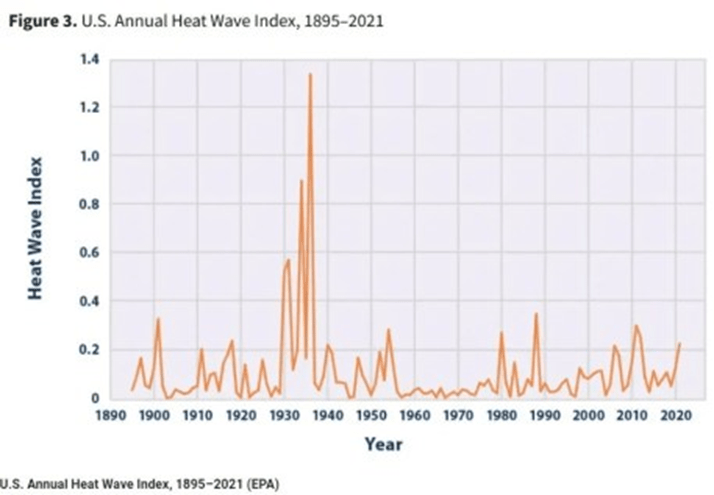
It’s no surprise to me – even as a sociologist, I was a rural sociologist, and part of the Ag department most of my career. As an aggie, and working on the plains, I know the legends from the Dust Bowl – and this chart definitely shows it. I guess it also shows that we had some cool summers in the sixties and seventies.
The chart comes from Fox News at It’s not climate change that’s causing heat waves this summer but no one wants to explain why | Fox News so I checked a couple other spots. Looks legitimate, and matches the stories that I heard of the Dust Bowl days.
The National Weather Service supports the chart in Heatwave of July 1936 , saying:
The “Dust Bowl” years of 1930-36 brought some of the hottest summers on record to the United States, especially across the Plains, Upper Midwest and Great Lake States. For the Upper Mississippi River Valley, the first few weeks of July 1936 provided the hottest temperatures of that period, including many all-time record highs (see tab below).
The string of hot, dry days was also deadly. Nationally, around 5000 deaths were associated with the heat wave.
In La Crosse, WI, there were 14 consecutive days (July 5th-18th) where the high temperature was 90 degrees or greater, and 9 days that were at or above 100°F. Six record July temperatures set during this time still stand, including the hottest day on record with 108°F on the 14th. The average high temperature for La Crosse during this stretch of extreme heat was 101°F, and the mean temperature for the month finished at 79.5°F – 2nd highest on record.
Several factors led to the deadly heat of July 1936:
- A series of droughts affected the U.S. during the early 1930s. The lack of rain parched the earth and killed vegetation, especially across the Plains states.
- Poor land management (farming techniques) across the Plains furthered the impact of the drought, with lush wheat fields becoming barren waste lands.
- Without the vegetation and soil moisture, the Plains acted as a furnace. The climate of that region took on desert qualities, accentuating its capacity to produce heat.
- A strong ridge of high pressure set up over the west coast and funneled the heat northward across the Upper Midwest and Great Lakes.

“Siegfried Schubert of NASA’s Goddard Space Flight Center, Greenbelt, Md., and colleagues used a computer model developed with modern-era satellite data to look at the climate over the past 100 years. The study found cooler than normal tropical Pacific Ocean surface temperatures combined with warmer tropical Atlantic Ocean temperatures to create conditions in the atmosphere that turned America’s breadbasket into a dust bowl from 1931 to 1939. The team’s data is in this week’s Science magazine.
These changes in sea surface temperatures created shifts in the large-scale weather patterns and low level winds that reduced the normal supply of moisture from the Gulf of Mexico and inhibited rainfall throughout the Great Plains.
“The 1930s drought was the major climatic event in the nation’s history,” Schubert said. “Just beginning to understand what occurred is really critical to understanding future droughts and the links to global climate change issues we’re experiencing today.”

By discovering the causes behind U.S. droughts, especially severe episodes like the Plains’ dry spell, scientists may recognize and possibly foresee future patterns that could create similar conditions. For example, La Niñas are marked by cooler than normal tropical Pacific Ocean surface water temperatures, which impact weather globally, and also create dry conditions over the Great Plains.
Top Story – SOURCE OF 1930s ‘DUST BOWL’ DROUGHT IN TROPICAL WATERS, NASA FINDS – March 18, 2004The old Chinese curse is supposed to be “May you live in interesting times.” From a weather and climate perspective, it seems we continue to live in interesting times.
-
It doesn’t take much to meet the legal definition of a farm – and the necessary equipment for me is small – everything is selected to work with a 28 hp Kubota. While there are about 160 acres, only about 15 acres produce hay – so a small baler does the job:

It bales at 1.24 to 3.00 mph – which translates to third or fourth gear. According to the manufacturer, it can make 80 to 120 bales per minute – but not on my fields. The timothy isn’t thick enough to make 80 bales per minute, and the Reed Canarygrass is too thick. The learning curve is difficult – a couple days of baling per year is all the experience I get, so it takes a while to learn the machine. For the mower, I went with a drum mower. It takes 25 hp to do the job, and mows 54 inches. Here’s what the drum looks like:

It’s different than the old sickle mowers, and the photo shows how the cutting unit can be changed out – like the baler, it’s slower – but after Larry helped me by repairing the broken spring, I have kind of learned how to use it. The problem is, when you only cut 15 acres once per year, you don’t amass experience quickly.
The rake is a Befco RS2 . . . which I will buy another piece for and get 4 wheels working. It operates at 8 to 14 mph, and I’m pretty sure it will be easier to use when it’s a little bigger:

I like it – but with a second set of wheels, and a little sawzall work, it will balance better and do a smooth job of giving me a windrow that will automatically match the pickup width of my little baler.
The first year was dry – I got about 200 bales. Last year I harvested over 500. It looks like I’ll have over 300 this year. They’re round bales – but just a smidgen under 20 inches in diameter and 27 inches long. And it’s fun to be farming again . . . and to be a farm, I only have to produce $1,000 worth of product each year.
-
Mother Goose flew south a couple years ago, looking weak. She didn’t make it back in the Spring – instead, Gander brought in a younger replacement. The past five years, having lesser Canada geese for neighbors has changed my understanding of them.
First came the conventional belief – “they mate for life.” That’s probably true – but I have a hunch that Gander was younger than Goose, and that he learned some of his responsibility from her. The island, for nesting, was her choice. That first year, she led the goslings through the grass, to an eagle that was dining on a road-killed cat. After that blunder, Gander led the flock, and Goose brought up the rear . . . always, the goslings between the adults.
Every Spring, Gander and Goose would show up before the ice went out, making sure that other geese couldn’t preempt their island nest. Most of the previous year’s hatch – now adults – accompanied them. When Goose didn’t return, Gander and Step-mother goose returned alone – I hadn’t realized the strength of the link with the young adults was hers.
This year, I’ve watched Step-mother goose work at blending 6 additional goslings into her flock – three blended smoothly, while the other 3 seem to have the ‘you’re not my mom’ attitude down pat. It’s a bad attitude to have with the bald eagle preying on geese. Since the adoptees are a little younger, Gander has delayed flight training. For the first time, his family group isn’t the first to fly. Step-mother goose is still training his three recalcitrant grand-goslings to follow him on land and water.
August is coming soon – the young geese will soon be airborne – this time (with luck and an absence of eagles) Gander will lead 15 young geese out on training flights, with Step-mother goose taking the rear position. I see more and more family responsibility in this goose family.
On the other hand, we have two geese this year who are amazingly poor parents. They nested late, so their two goslings still lack the adult coloration. These parental units might as well be dating – they swim or walk away as a couple, leaving their goslings to follow along as best they can . . it’s as if they got their parenting lessons from coots.
The worst predation has been on the orphaned mallards – the “injured mother” routine wasn’t a success for their parent, and the eagle just kept coming back for the ducklings. I didn’t see the eagle take either of the orphan geese parents – but I’m guessing they made a strategic miscalculation . . . twice.
The nighthawks are flying over the pond in the evenings . . . and the young crows have moved from the discovery of grasshoppers on newly mowed hay to a bountiful crop of serviceberries, at the tops of the bushes. The turkey hens, with their consolidated flocks, are doing well. The marsh hawk enjoys a much better view of voles in our harvested fields – technically, she’s a northern harrier and hunts by sound as well as sight. Cornell posts this picture:

And the bald eagle continues to come by and hunt. Spectacular, but may have made the island nesting strategy obsolete.





Want to tell us something or ask a question? Get in touch.

Recent Posts
- Recovery Time for a Retiree
- Venn Diagram and DSM
- When Castro Was Cool
- You Have To Beat Darwin Every Day
- Computer Repair by Mussolini
- Getting Alberta Oil to Market
- Parties On Economics
- Thus Spake Zarathustra – One More Time
- Suspenders
- You Haven’t Met All The People . . .
- Play Stupid Games, Win Stupid Prizes
- The Ballad of Lenin’s Tomb

Rough Cut Lumber
Harvested as part of thinning to reduce fire danger.
$0.75 per board foot.
Call Mike (406-882-4835) or Sam (406-882-4597)
Popular Posts
Ask The Entomologist Bears Books Canada Census Community Decay Covid Covid-19 Data Deer Demography Education Elections Eureka Montana family Firearms Game Cameras Geese Government Guns History Inflation life Lincoln County Board of Health Lincoln County MT Lincoln Electric Cooperative Montana nature News Patches' Pieces Pest Control Politics Pond Recipe School School Board Snow Taxes travel Trego Trego Montana Trego School Weather Wildlife writing
 Trego's Mountain Ear