-
John Lott has written a post relevant to Montana’s legislation that permits, for the first time, charter schools. The entire article is at the link above – and here’s an excerpt that may get you to click the link:
“Montana is one of the last states without charter schools, but that may be about to change. Gov. Greg Gianforte signed a pair of bills into law that establish separate and distinct charter school systems in the state — one widely embraced by Republican legislators and advocates of past charter school efforts, and the other supported by the bulk of Montana’s public education organizations as well as a bipartisan coalition of lawmakers.”
Lott cites The National Charter School Study III 2023 (accessible at: https://ncss3.stanford.edu/wp-content/uploads/2023/06/Credo-NCSS3-Report.pdf
The report is some 82 pages, and the summary of findings begins with
“Looking at year-to-year academic progress from 2015 to 2019, the typical charter school student in our national sample had reading and math gains that outpaced their peers in the traditional public schools (TPS) they otherwise would have attended. We report these differences as marginal days of additional (or fewer) days of learning on a learning benchmark of 180 days of learning each school year for matched TPS students. In math, charter school students, on average, advanced their learning by an additional six days in a year’s time, and in reading added 16 days of learning. Figure 1: Annual Academic Growth of Charter School Students, Reading and Math ** Significant at p ≤ 0.01 Figure above originally appears as Figure 1.7 in CSP31. These average effects are across all students, all schools, for all time periods. There is considerable variation around these averages and this variation forms the foundation for additional analyses and findings in our two papers.”
The report suggests that some charter schools do a better job than others:
“School Management – students who attend a charter school that is part of a charter management organization (CMO) experience significantly accelerated growth compared to students enrolled in standalone charter schools (SCS). Even so, CMO schools and SCS provide stronger learning than TPS in reading, and CMOs do so in math. CMO-affREADING Worse Same Betteriliated students advanced by 27 additional days in reading and 23 more days in math over TPS, both of which are statistically significant. Stand-alone charter schools still grew significantly more than TPS in reading by 10 additional days of learning, but were no different in math. Given that SCS serve two-thirds of all students enrolled in charter schools, soft math performance in these schools taints the otherwise decisive results in other parts of the study.”
Since Charter Schools will be coming to Montana, taking the time to read the report just might be worthwhile.
-
There was a lot of Wobblie influence on the words people used in Trego when we moved from the coast in 1960 – and the IWW Dictionary, at https://archive.iww.org/history/dictionary/ lets me realize how common phrases from the “One Big Union” were.
Some of the terms I learned are listed in the IWW dictionary:
Scissorbill – A worker who is not class conscious; a homeguard who is filled with bourgeois ethics and ideals. I heard the term – and I knew it wasn’t good to be a scissorbill – but it took the dictionary to show me why.
Short Stake – Worker apt to quit when they have earned a small sum.
Side Car Pullman – A hobo term for a Box Car.
Stake – A sum of money intended to last until the next job.
Stump Rancher – Someone who settles on logged off land and who usually continues to work, at least part time, for wages. Now this was still a common term along Fortine Creek in the early 1960’s – I’m thinking of how difficult it was to take out those old stumps.
Timber Beast – Lumberjack. Sometimes also called a Timber Wolf.
Bindle Stiff – An itinerant worker, (the term “bindle” refers to blankets carried by the worker).
Boomer – A temporary worker, a wanderer, one who follows “booms” (good times).
Bummery – A pejorative term used by Daniel DeLeon that referred to the Direct Action faction of the IWW that led to the 1908 split; also used to refer to IWW members with itinerant employment, such as lumber workers and agricultural workers. Also called “110 Cats”.
Cat – A worker well fitted in with some occupational subculture, such as “hep cat”; a worker who folows a specific occupation, such as “straw cat” for harvest hand. Also refers to the sab cat. I ran across the phrase ‘hep cat’ probably 2 years before we moved to Trego – maybe at age 8. In a world without internet, and lacking library skills and access, I never did get an adequate definition. As I think back on the axe heads and peavy parts we found in Fortine Creek, they must have been the results of sab cats (sabotage) throwing the tools into the pond behind the dam just up the creek. With the net, I did find this explanation of hep cat (and was amazed at how it fits in with more phrases at later times in my life:
An important term in the history of African American slang, a “hep cat” was a jazz aficionado in the marijuana-using urban subculture of the 1940s and 1950s. A hep cat’s essential qualities included a free-spirited rejection of societal convention, intense creativity, and an unflagging rejection of all things “square.” First entering the language in the late 1930s, the term was an amalgam of “hep,” an older term meaning “smart” or “aware,” and “cat,” slang for “man.” Its roots stretch back to the Wolof language of Africa where “hepi” meant “to see,” and “hipi” meant “to open one’s eyes,” while “hipicat” translated as “wise” or “informed.” As hep cat was appropriated by white beatniks in the 1950s, African Americans turned to using fresher terminology like “hip” and “hipster.” Continuing to evolve with stylistic changes in American musical and drug-related subcultures, its roots survive in terms like hippie and hip-hop.
—Steve Burnett
Encyclopedia.comIt’s kind of fun to have the research capacity of a major university’s library available when I’m awake at 4:00 am in Trego – so different from the early sixties.
-
I saw this dialogue quote, attributed to Jim Butcher’s series “The Dresden Files”: ““He’s Black Council,”, I said. “Or maybe stupid,” Ebenezar countered. I thought about it. “Not sure which is scarier.”
Ebenezar blinked at me, then snorted. “Stupid, Hoss. Every time. Only so many blackhearted villains in the world, and they only get uppity on occasion. Stupid’s everywhere, every day.” Ebenezar McCoy”
That brought me thoughts of the folks involved in the Enron financial shenanigans – where a movie was made about the scandal (ripoff?) referring to them as “The Smartest Guys in the Room.” There are a couple of problems that we should think about if we’re the smartest guys in the room. First, smart people can do stupid things. Matter of fact, there are some stupid things that only smart people can envision – sometimes slow and steady just can’t make the logic jumps it takes to do something astonishingly stupid.
The second situation is when you’re the smartest guy in a very small room. Statistically, being the smartest guy in a room filled with a dozen people doesn’t put you in Einstein’s class. Enron used creative accounting tricks that could be called downright fraudulent – and the lack of ethics doesn’t give bonus points on intelligence tests. I guess it isn’t a question of picking out the smartest guy – the challenge may just be recognizing the room you’re in.
If I pick my room, I can be the smartest guy in the room. I may be alone, but I can be the smartest guy in the room. It’s important to pick the right room – and equally important to accurately judge the people who share that room. At SDSU, if I saw Nels Granholm, I knew that the best I would manage would be second. When I started teaching at Trinidad State, one of my students was a Christian fundamentalist with a serious alcohol and drug problem – and he may have been the brightest student I have ever encountered. His classmates nicknamed him ‘God’s Own Drunk’. I have no doubt that he was the smartest guy in the room . . . and probably the least successful.
At MSU, I knew Frank Dudas – while his first college teaching post was at Dickinson State in North Dakota, he retired from MIT – another colleague who qualified as the smartest guy in the room. I’ve been blessed in working with people who were brighter than I. I’m a cow college guynd, and MIT isn’t my room. Frank could start his academic career at a land grant and finish at MIT.
Like so many things in the world, finding out that you’re not the smartest guy in the room is basically statistics and self-awareness. If we base the decision on the smartest guy in the room on IQ score it’s easy to figure out how many people are in the room. Average is supposed to be 100, so the room has to be small – like an old telephone booth – for the folks who score in the seventies and eighties to be the smartest guy in the room. At 100, it’s a 50-50 chance. But let’s look at how IQ numbers and room size work out on the right hand side of the IQ Bell Curve:
IQ Score Rarity
110 1 in 4
120 1 in 11
130 1 in 44
140 1 in 261
150 1 in 2,330
160 1 in 31,560
170 1 in 652,598
180 1 in 20,696,863
190 1 in 1,009,976,678
200 1 in 76 billion
Rarity is the room size. The calculator I used for this table is at gigacalculator.com
IQ test scores probably don’t measure intelligence perfectly. The explanation is that they measure the ‘G factor” – which basically stands in for intelligence. It is the most commonly used measurement, so I’m using it. My calculations also called for a standard deviation of 15 – which can be explained that there are 2 standard deviations between 100 and 130 – but also 2 standard deviations between 160 and 190.
I’ve read that Ted Kaczinski tested at 165 or 167. 165 has a rarity of 136,074 – so Ted, was probably one of the half-dozen brightest Montanans before his relocation to SuperMax prison. Being the smartest guy in the room doesn’t necessarily translate to the most successful. (Ted tested at 136 on the Wechsler after his arrest – I suspect he wasn’t in his best form)
The reverse – for those under 100 – takes little to chart, because the rarity is identical – just on the other side of the line, and someone with an IQ score of 60 is just as rare as someone who scores 140.
IQ Score Rarity
90 1 in 4
80 1 in 11
70 1 in 44
60 1 in 261
So the quote was “Stupid’s everywhere, every day.” As Kaczinski demonstrated, you can be really smart and still do stupid things. Bonhoeffer’s Theory of Stupidity Explains The World Perfectly | by Peter Burns | Lessons from History | Medium
“Against stupidity we have no defense. Neither protests nor force can touch it. Reasoning is of no use. Facts that contradict personal prejudices can simply be disbelieved — indeed, the fool can counter by criticizing them, and if they are undeniable, they can just be pushed aside as trivial exceptions. So the fool, as distinct from the scoundrel, is completely self-satisfied. In fact, they can easily become dangerous, as it does not take much to make them aggressive. For that reason, greater caution is called for than with a malicious one. Never again will we try to persuade the stupid person with reasons, for it is senseless and dangerous.” — Dietrich Bonhoeffer
Bonhoeffer looked at stupidity as a sociological function – believing that your need a group to be really stupid:
“The power of the one needs the stupidity of the other. The process at work here is not that particular human capacities, for instance, the intellect, suddenly atrophy or fail. Instead, it seems that under the overwhelming impact of rising power, humans are deprived of their inner independence, and, more or less consciously, give up establishing an autonomous position toward the emerging circumstances. The fact that the stupid person is often stubborn must not blind us to the fact that he is not independent. — Dietrich Bonhoeffer
The challenge isn’t in being the smartest guy in the room. The challenge is not doing something stupid. To Bonhoeffer, the best way to avoid stupidity was to avoid groupthink. Carlo Cipolla had a different tack – he wrote The Basic Laws of Human Stupidity. They’re online at principia-scientific.com
The 5 Basic Laws Of Human Stupidity
1. Always and inevitably, each of us underestimates the number of stupid individuals in the world
2. The probability that a certain person is stupid is independent of any other characteristic of the same person
3. A stupid person is one who causes harm to another person or group without at the same time obtaining a benefit for himself or even damaging himself
4. Non-stupid people always underestimate the harmful potential of stupid people
5. The stupid person is the most dangerous person that exists
-
The short definition would be a chemical other than glucose (sugar) that our taste buds interpret as “sweet”. These are the substances typically behind”diet” and “zero calorie” foods.
What are they? In the US, we’re likely to find those approved by the FDA:
- Aspartame
- Acesulfame potassium (Ace-K)
- Sucralose
- Neotame
- Advantame
- Saccharin
How do they work? (Or, to phrase it differently, how do they fool our tongues?)
To understand how artificial sweeteners work, we have to first consider how sugar (glucose) works. We have five basic tastes or, perhaps more accurately, five types of signals our tongue sends to our brain about the food we’re eating. Sugar is sweet because of how it bonds to our taste receptors.
Glucose is a popular molecule. The formula might be familiar from studies of photosynthesis or cellular respiration. It has 6 Carbons, 12 Hydrogen, and 6 Oxygen. It chemistry, arrangement is as important as formula. Flip a bond and glucose changes from a form we can digest into one we cannot.

It makes a degree of sense, then, that artificial sweeteners share some structural similarities with glucose. They are not equivalent to glucose in sweetness, however. Relative sweetness appears to be related to the ability to hydrogen bond with the taste receptors. Aspartame is probably at least a hundred times sweeter than glucose, and Saccharine is sweeter still.
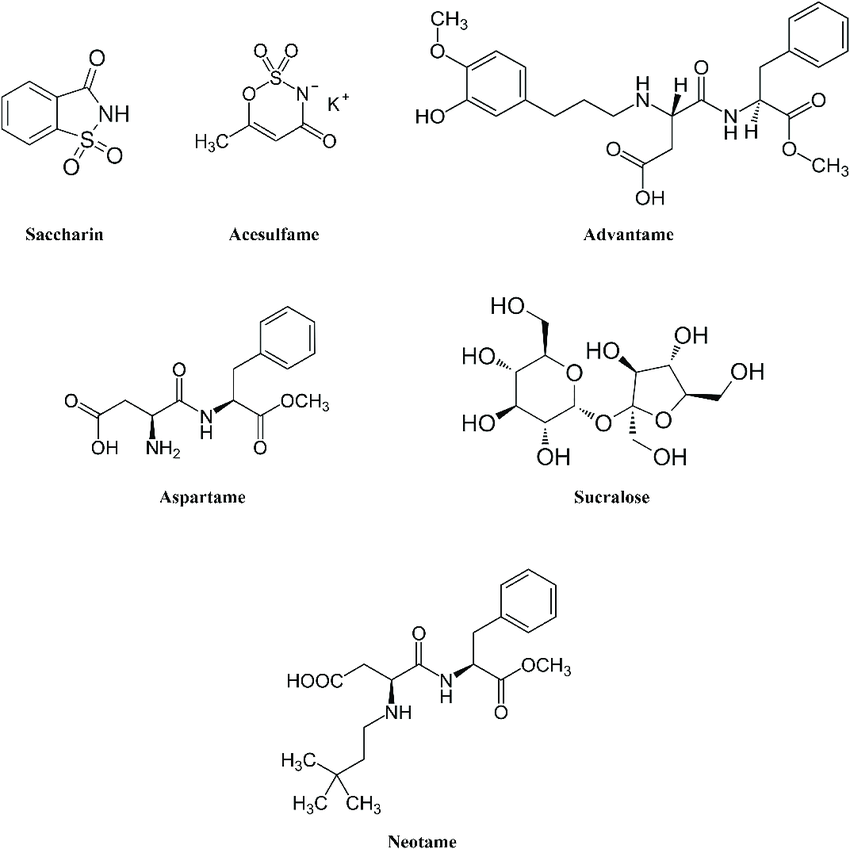
Alsunni, Ahmed. (2020). Effects of Artificial Sweetener Consumption on Glucose Homeostasis and Its Association with Type 2 Diabetes and Obesity. International Journal of General Medicine. Volume 13. 775-785. 10.2147/IJGM.S274760. It’s of note that while this type of chemical drawing is generally easier to read, it often neglects to include some of the hydrogen in the structure (those familiar with the format are expected to know, from the structure, where they go). To someone familiar with the illustration style, it’s clear that these molecules all have areas with plenty of hydrogen.
For the most part, these are substances that our bodies are not able to break down for energy; Aspartame is an exception, and is not “zero calorie” but is generally used in smaller quantities.
One of the many interesting characteristics about artificial sweeteners, is that while they fool our taste buds, they do not fool our gut. Some studies with rats showed that even without taste buds, they were able to distinguish between sugar and saccharine (and preferred the real thing). Taste is not merely an artifact of the taste buds- but more on that system another time.
-
Here are a few George Carlin quotations that seem as relevant today as when George said them:
“Keep in mind, the news media are not independent; they are a sort of bulletin board and public relations firm for the ruling class-the people who run things. Those who decide what news you will or will not hear are paid by, and tolerated purely at the whim of, those who hold economic power. If the parent corporation doesn’t want you to know something, it won’t be on the news. Period. Or, at the very least, it will be slanted to suit them, and then rarely followed up.”
“Governments don’t want a population capable of critical thinking, they want obedient workers, people just smart enough to run the machines and just dumb enough to passively accept their situation.You have no choice. You have owners. They own you. They own everything. They own all the important land. They own, and control the corporations. They’ve long since bought, and paid for the Senate, the Congress, the state houses, the city halls, they got the judges in their back pockets and they own all the big media companies, so they control just about all of the news and information you get to hear.”
“Government want to tell you things you can’t say because they’re against the law, or you can’t say this because it’s against a regulation, or here’s something you can’t say because its a… secret; “You can’t tell him that because he’s not cleared to know that.” Government wants to control information and control language because that’s the way you control thought, and basically that’s the game they’re in.”
“If honesty were suddenly introduced into American life, the whole system would collapse.”
“the important thing is to, first of all, question everything you read or hear or see or are told. Question it, and try to see the world for what it actually is, as opposed to what someone or some company or some organization or some government is trying to represent it as, or present it as, however they’ve mislabeled it or dressed it up or told you.”
“There’s a reason education sucks, and it’s the same reason it will never ever ever be fixed. It’s never going to get any better. Don’t look for it. Be happy with what you’ve got, because the owners of this country don’t want that. I’m talking about the real owners now… the real owners. The big wealthy business interests that control things and make all the important decisions. Forget the politicians. The politicians are put there to give you the idea that you have freedom of choice. You don’t. You have no choice. You have owners.”
They’ll get it all from you sooner or later ’cause they own this f**kin’ place. It’s a big club and you ain’t in it. You and I are not in the big club. By the way, it’s the same big club they use to beat you over the head with all day long when they tell you what to believe. All day long beating you over the head with their media telling you what to believe, what to think and what to buy. The table is tilted, folks. The game is rigged and nobody seems to notice. Nobody seems to care. Good, honest, hard-working people: white collar, blue collar, it doesn’t matter what color shirt you have on.”
-
The question is not whether human activities have altered the planet’s climate. The map below, gives a pretty decent interpretation of how wintry the planet looked 20,000 years ago – and glancing at my own little part of Montana shows a spot much less suitable for agriculture or gardening.

In high school, I heard of the cyclic nature of ice ages – the explanations weren’t there, but evidence of the cycles was apparent. History.com provides this commentary:
“There have been at least five significant ice ages in Earth’s history, with approximately a dozen epochs of glacial expansion occurring in the past 1 million years. Humans developed significantly during the most recent glaciation period, emerging as the dominant land animal afterward as megafauna such as the wooly mammoth went extinct.”
Nothing personal – but I like living in a world that is 6 degrees Celsius warmer – as I write this, with the summer solstice due tomorrow, the temperature is 38 degrees Fahrenheit. Six degrees Celsius is 10.8 degrees Fahrenheit – you can push the numbers and figure out the growing season 20,000 years back. Climate change can be a good thing. On the other hand, if you had owned oceanfront property in Florida 20,000 years ago, it’s ocean today. Climate change is a matter of location and perspective. My perspective if I lived in Paramaribo would likely differ – 6 feet above sea level is very different from 3,000 feet above sea level. There is a difference between 49 degrees of latitude and 6 degrees.
“Over at least the past million years, glacial and interglacial cycles have been triggered by variations in how much sunlight reaches the Northern Hemisphere in the summer, which are driven by small variations in the geometry of Earth’s axis and its orbit around the Sun. But these fluctuations in sunlight aren’t enough on their own to bring about full-blown ice ages and interglacials. They trigger several feedback loops that amplify the original warming or cooling. During an interglacial,
- sea ice and snow retreat, reducing the amount of sunlight the Earth reflects;
- warming increases atmospheric water vapor, which is a powerful greenhouse gas;
- permafrost thaws and decomposes, releasing more methane and carbon dioxide; and
- the ocean warms and releases dissolved carbon dioxide, which traps even more heat.
These feedbacks amplify the initial warming until the Earth’s orbit goes through a phase during which the amount of Northern Hemisphere summer sunlight is minimized. Then these feedbacks operate in reverse, reinforcing the cooling trend.”
Climate.govHumans work best in the interglacial periods. Mammoths and mastodons are better adapted to interglacials. Here, where the continental glaciers hit, warming is not so much a threat as cooling. Climate change is something we need to understand – and the first thing to understand is what the alternatives are. Then, we can make decent decisions.
-
Watching the commentary on OceanGate’s submersible Titan brought back stories my father told. He had spent time as a diver during WWII and later – just how that fit in with his role as a Warrant Officer and Chief Boatswain never was quite clear to me, but damage control was his long suit.
One of his stories was the Squalus rescue – one of his shipmates from USS Hannibal had transferred to submarines, was on Squalus, and added a bit of personal interest to the story. It was 1939. Squalus was sunk in 240 feet of water. The story is here:
“On the morning of May 23, 1939, the submarine USS Squalus slipped beneath the storm-tossed surface of the Atlantic on a sea trial. Minutes into the maneuver, she began flooding uncontrollably. The Squalus sank to the ocean floor nine miles off the New Hampshire coast, trapping 59 men on board.
No submarine rescue had ever succeeded beyond 20 feet of water. The Squalus was down 240 feet. The Navy team had to use new methods that had existed only in theory before that day. They encountered problems that forced them to make decisions on the fly—each with life-or-death consequences. And they did it all with the world watching intently, captivated by the fate of the trapped men whose plight had been broadcast around the world at telegraph speed.”
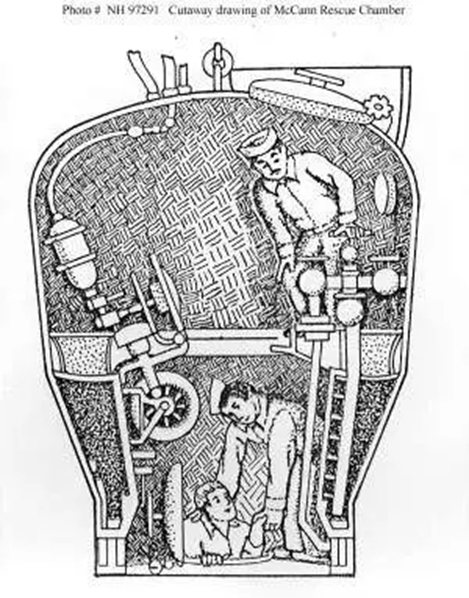
Squalus was 200 miles from the Momsen diving bell designed for submarine rescue. As you read the entire linked story, the luck factor keeps popping in – the sort of luck that happens to highly competent people. Still, losing even a few more hours would have changed the mission from rescue to recovery:
“It was only by luck that the rescuers knew where the Squalus went down.
Somehow, the exact coordinates of the dive had been garbled in transmission to the shipyard. So Sculpin went in the wrong direction to search for signs of Squalus.
One lookout, Lt. (jg) Ned Denby, happened to glance in the opposite direction and thought he saw a smudge of red smoke. He whipped out his binoculars and confirmed it was a distress signal just as the smoke disappeared. The Sculpin changed course and raced toward the spot.
At 12:55 p.m., Sculpin recovered the yellow telephone buoy and then dropped anchor. The trapped submariners’ spirits rose because they knew the propellers they heard came from their sister ship.
Sculpin’s commander, Lt. Warren Wilkin, got on the phone. “Hello, Squalus. This is Sculpin. What’s your trouble?”
Nichols, the lieutenant (jg.) who had sent up the marker buoy, responded: “High induction open, crew’s compartment, forward and after engine rooms flooded. Not sure about after torpedo room, but could not establish communication with that compartment. Hold the phone and I will put the captain on.”
Thirty seconds later, Naquin got on the line. “Hello, Wilkin,” said Naquin. Then the cable snapped.”
The Squalus was raised and recommissioned – this next excerpt comes from Naval History Magazine
“The Navy cleaned out the Squalus, repaired and recommissioned as the Sailfish in February 1940 She sank seven ships during World War II. Her conning tower now serves as a memorial to those who died at the Portsmouth Naval Shipyard.
Conning tower of SS-192 on display at Portsmouth Naval Shipyard, during a 2013 visit by Gen. Martin Dempsey, chairman of the Joint Chiefs of Staff.
Divers William Badders, James McDonald and John Mihalowski received the Medal of Honor.

Squalus was on the seabed at 240 feet. That’s a little over 100 psi of pressure. Read the linked articles – the story is worth your time.
-
There’s a solitary yearling hanging around the house – and given the season, I figure she hasn’t lost her mother to predator or automobile encounters. I figure this forlorn, solitary little deer is my first sign that fawns will be on the ground soon. In the next couple of weeks, the majority of the 2023 fawns will be here – for my viewing enjoyment.
The book tells me that fawns average 6 to 8 pounds at birth, can walk within a couple of hours of birth, and spend most of their early lives bedded down. It creates a challenge for me with the haying season – I’ve only hit one fawn with a mower, and hopefully it never happens again.
The little things almost self-domesticate. At the same time, I’m watching what happens with the goslings when one parent goose is taken by a predator. I’m learning that what I was taught about Canadian geese wasn’t the whole story – and I’m revising my understanding of the goose ethos.
About eight years ago, I watched goose and gander set up their nest on the island – and I believed they were both young geese. I’m not so certain anymore – the old goose flew south looking decrepit a couple of years ago, and gander returned with a new mate. He had to work to convince his younger mate that the island was the right spot for their nest. Now, I wonder if his original mate wasn’t older than he.
On their third nesting season, the previous year’s goslings also returned to the pond. It was too many geese – but it was impressive to watch the older siblings set up a combat air patrol to protect the goslings from the bald eagle. When the original goose was replaced by sweet young thing, fewer of the last year’s hatch accompanied them onto the pond – this year the nesting pairs on the pond were gander and sweet young thing, plus two of his older offspring and their mates.
I didn’t see what took the one younger gander out. Predation occurs quickly, and the tall grass conceals the story. I did see an adult goose, alone, moving her hatchlings close to gander’s, and then becoming a group of three adults, with gander’s goslings and grand-goslings swimming between three adults. A couple years back we watched the effort gander and goose put in as they tried to get the gosling with angel wing capable of flying out in the fall.
The turkeys have the problem of raven success – successful raven reproduction translates to increased predation on turkey nests – eggs and hatchlings. Instead of single mother turkeys with large flocks, we’re watching three or four mothers mob up to protect the two or three hatchlings that each has left after the raven predation.
-
Can we train our taste buds for health? A neuroscientist explains how genes and diet shape taste

Researchers are increasingly learning that early diet can shape taste preferences but that our taste buds can also be trained to prefer healthier foods. RichVintage/E+ via Getty Images Monica Dus, University of Michigan
Have you ever wondered why only hummingbirds sip nectar from feeders?
Unlike sparrows, finches and most other birds, hummingbirds can taste sweetness because they carry the genetic instructions necessary to detect sugar molecules.
Like hummingbirds, we humans can sense sugar because our DNA contains gene sequences coding for the molecular detectors that allow us to detect sweetness.
But it is more complex than that. Our ability to sense sweetness, as well as other tastes, involves a delicate dance between our genetic makeup and the foods we encounter from the womb to the dinner table.
Neuroscientists like me are working to decipher how this intricate interplay between genes and diet shapes taste.
In my laboratory at the University of Michigan, we are diving deeply into one specific aspect, which is how consuming too much sugar dulls the sense of sweetness. Taste is so central to our eating habits that understanding how genes and the environment shape it has crucial implications for nutrition, food science and disease prevention.
The role of genes in sensing taste
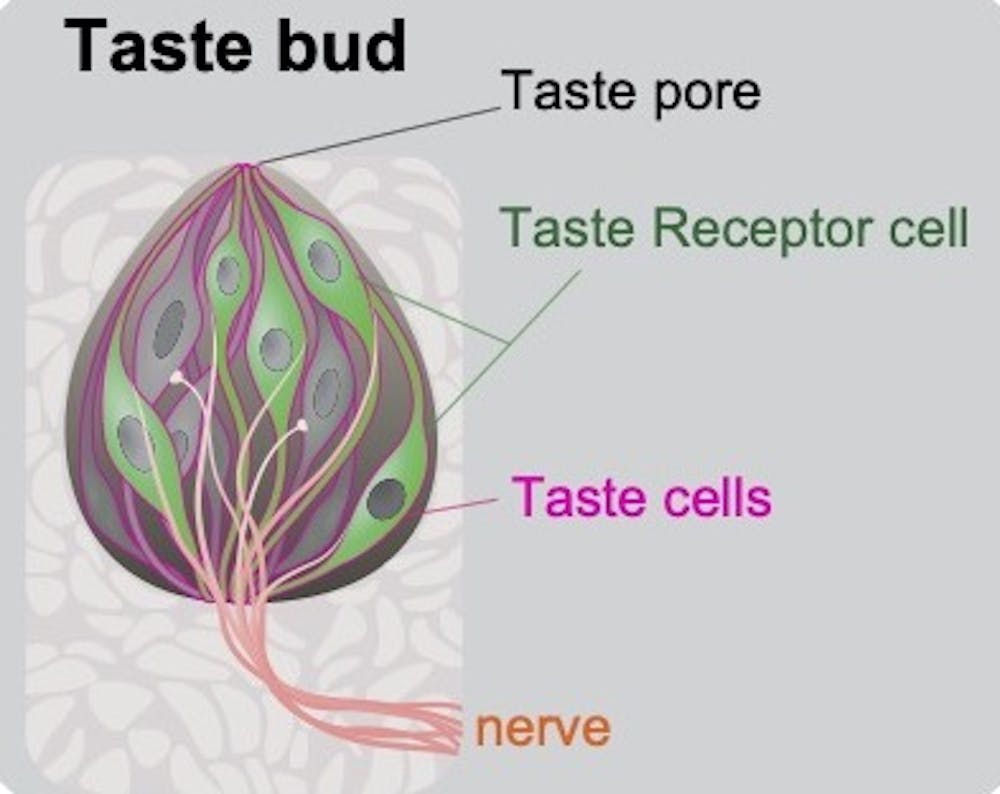
As with hummingbirds, the human ability to discern what food tastes like depends on the presence of taste receptors. These molecular detectors are found on the sensory cells, which are housed inside the taste buds, the sensory organs on the surface of the tongue.
The interactions between taste receptors and food molecules give rise to the five basic taste qualities: sweetness, savoriness, bitterness, saltiness and sourness, which are transmitted from the mouth to the brain via specific nerves.
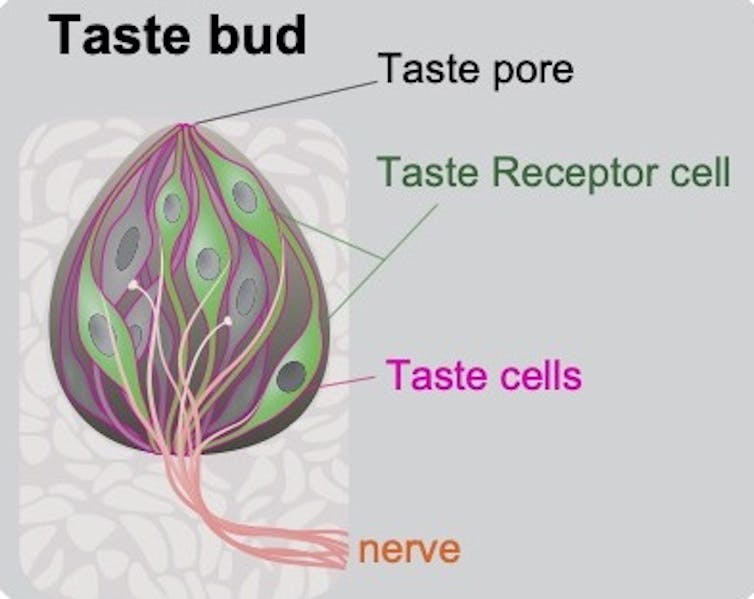
A diagram of a taste bud, indicating different types of cells and the sensory nerve. Julia Kuhl and Monica Dus, CC BY-NC-ND For instance, when sugar binds to the sweet receptor, it signals sweetness. Our innate preference for the taste of some foods over others is rooted in how the tongue and the brain became wired during our evolutionary history. Taste qualities signaling the presence of essential nutrients and energy, like salt and sugar, send information to brain areas linked to pleasure. Conversely, tastes that alert us to potentially harmful substances, such as the bitterness of certain toxins, are connected to those that make us feel discomfort or pain.
While the presence of genes encoding for functional taste receptors in our DNA allows us to detect food molecules, how we respond to these also depends on the unique combination of taste genes we carry. Like ice cream, genes, including those for taste receptors, come in different flavors.
Take, for instance, a taste receptor for bitterness called TAS2R38. Scientists found small changes in the genetic code for the TAS2R38 gene among different people. These genetic variants affect how people perceive the bitterness of vegetables, berries and wine. https://www.youtube.com/embed/C4rdqXXzPGU?wmode=transparent&start=45 Aside from allowing us to taste the wide variety of flavors in foods, taste also helps us distinguish between foods that are healthy or potentially harmful, such as spoiled milk.
Follow-up studies have suggested a link between those same variants and food choice, particularly with respect to vegetable and alcohol consumption.
Many more variants exist in our gene repertoire, including those for the sweet taste receptor. However, whether and how these genetic differences affect our taste and eating habits is still being worked out. What is certain is that while genetics lays the groundwork for taste sensations and preferences, experiences with food can profoundly reshape them.
How diet influences taste
Many of our innate sensations and preferences are molded by our early experiences with food, sometimes before we’re even born. Some molecules from the mother’s diet, like garlic or carrots, reach the fetus’s developing taste buds via the amniotic fluid and can affect the appreciation of these foods after birth.
Infant formula can also influence food preferences later on. For example, research shows that infants fed with formulas that are not based on cow’s milk – which are more bitter and sour because of their amino acid content – are more accepting of bitter, sour and savory foods such as vegetables after weaning than those who consume cow milk-based formula. And toddlers who drink sweetened water strongly prefer sweet beverages as early as age 2.
The effect of food on our taste predispositions doesn’t stop in early life: What we eat as adults, especially our sugar and salt intake, can also shape how we perceive and potentially choose food. Cutting down on sodium in our diet decreases our preferred level of saltiness, whereas consuming more makes us like saltier foods.
Something similar occurs with sugar: Reduce sugar in your diet and you may find food sweeter. Conversely, as research in rats and flies suggests, high sugar levels may dull your sensation of sweetness.
Although we researchers are still working out the exact how and why, studies show that high sugar and fat intake in animal models dampens the responsiveness of taste cells and nerves to sugars, modifies the number of taste cells available and even flips genetic switches in the taste cells’ DNA.
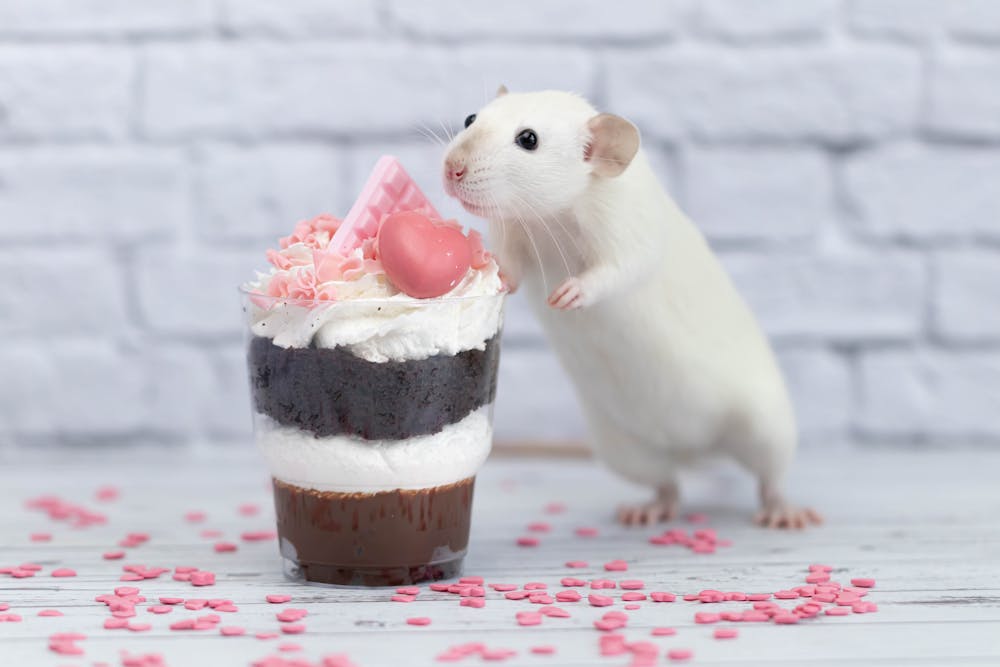
In my lab, we’ve shown that these taste alterations in rats return to normal within weeks when the extra sugar is removed from the diet.
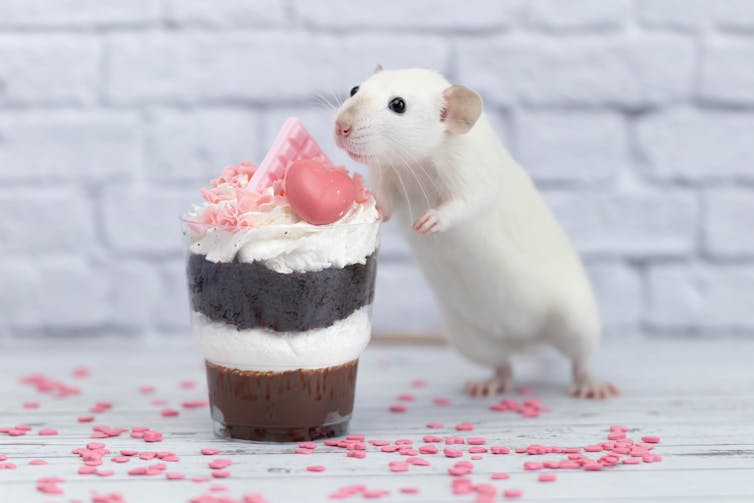
Animal studies have helped inform how high sugar intake affects taste and eating. Irina Ilina, CC BY-NC-ND Illness can also influence taste
Genetics and food aren’t the only factors that affect taste.
As many of us discovered during the height of the COVID-19 pandemic, disease can also play a role. After testing positive for COVID-19, I couldn’t tell the difference between sweet, bitter and sour foods for months.
Researchers have found that about 40% of people infected with SARS-CoV-2 experience impairment in taste and smell. In about 5% of those people, these taste deficits persist for months and years.
Although researchers don’t understand what causes these sensory alterations, the leading hypothesis is that the virus infects the cells that support the taste and smell receptors.
Training taste buds for healthier eating
By shaping our eating habits, the intricate dance between genes, diet, disease and taste can affect the risk for chronic diseases.
Beyond distinguishing food from toxins, the brain uses taste signals as a proxy to estimate the filling power of foods. In nature, the stronger a food tastes – in terms of sweetness or saltiness – is directly connected to its nutrient levels and calorie content. For example, a mango contains five times the amount of sugar than a cup of strawberries, and this is why it tastes sweeter and is more filling. Thus, taste is important not just for food enjoyment and choice, but also for regulating food intake.
When taste is altered by diet or disease, sensory and nutrient information could become “decoupled” and no longer provide accurate information to our brains about portion size. Research shows this may also occur with consumption of artificial sweeteners.
And indeed, in recent studies in invertebrate animal models, our lab discovered that the changes in taste caused by high dietary sugar intake drove higher eating by impairing these food predictions. Notably, many of the eating patterns and brain changes we observed in flies have also been discovered in people who ate foods high in sugar or fat or who had high body-mass index. This raises the question of whether these effects also arise from taste and sensory alterations in our brains.
But there is a silver lining to the adaptable nature of taste. Since diet shapes our senses, we can actually train our taste buds – and our brains – to respond and prefer foods with lower quantities of sugar and salt.
Interestingly, many people already say that they find foods overly sweet, which may not be surprising since between 60% to 70% of grocery store foods contain added sugar. Reformulating foods tailored to our genes and the plasticity of our taste buds could be a practical and powerful tool to enhance nutrition, promote health and decrease the burden of chronic disease.
Monica Dus, Associate Professor of Molecular, Cellular, and Developmental Biology, University of Michigan
This article is republished from The Conversation under a Creative Commons license. Read the original article.
-
On May 24, 1863, the citizenry of Bannack elected Henry Plummer as their sheriff. Henry was personable, had an excellent presentation of self, and was experienced in law enforcement. He had been elected sheriff in Nevada City, California, in 1856. The next year he was convicted of second degree murder, for killing an unarmed man – shades of Derek Chauvin and George Floyd. Henry did six months at San Quentin before California’s governor pardoned him.
“When Plummer arrived in Bannack, Montana, in October 1862, the people of the booming little mining town knew nothing of his record. With the Idaho gold fields beginning to give out, many of Plummer’s old partners in crime followed him to Montana. Plummer quickly reorganized his gang and called the motley band “The Innocents.” Skillfully maintaining his public role as an honest citizen, Plummer then managed to convince 307 inhabitants of Bannack to elect him sheriff in May of 1863.
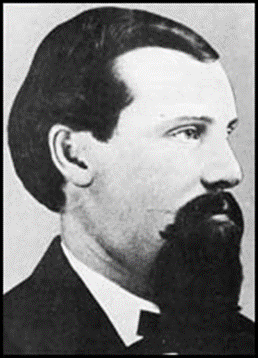
Henry Plummer Plummer’s office of sheriff was the perfect cover for operating an effective and deadly criminal ring. Plummer provided his henchmen with information on the movements of gold shipments and ensured that they avoided capture. During the next six months, road agents ruthlessly terrorized the people of Bannack and the nearby town of Virginia City. To the dismay of the townspeople, Sheriff Plummer seemed unable to stop them. After more than 100 people were robbed or murdered, the settlers organized a vigilance committee of nearly 2,000 members in December 1863.
The Montana vigilantes destroyed Plummer and his gang in a surprisingly short time. Among their first victims was Erastus “Red” Yeager, who revealed Plummer’s complicity and the names of the other gang leaders before he was hanged. Early on a bitterly cold Sunday morning, January 10, 1864, the vigilantes arrested Plummer and two of his lieutenants. While his cronies swore and resisted, Plummer reportedly wept and begged to be spared, but to no avail. All three men were hanged at once on a Bannack gallows Sheriff Plummer had prepared for another. The vigilantes rode away, “leaving the corpses,” as one contemporary wrote, “stiffening in the icy blast.” By spring, all of Plummer’s Innocents were either dead or departed.”

Helena Vigilantes 1870 1863 was a time of strife and division – yet these early days of Montana were populated by people who preferred to travel the Bozeman trail to fight the war between the states. Draft dodgers maybe – but definitely not cowards or pacifists. Probably their nation’s divisions left a bit of skepticism about government’s ability to protect citizens from harm – there are still names like “Confederate Gulch” that reflect the divided loyalties. Even the name “Virginia City” has roots in the conflict – some wanted it named “Varina City” after the wife of Jefferson Davis. Wilbur Fisk Sanders, who prosecuted for the Vigilantes was a hard-core Unionist – but his co-prosecutor was pro-confederacy. Neither was so strong in their convictions as to stay in the conflicted areas and fight the war – though Sanders served the Union as a first lieutenant before resigning his commission in August, 1862 and departing for the peaceful Montana.
The Vigilante law was simple, as laid out in the bylaws of Virginia City: “It shall be the duty of members to attach themselves to some company and whenever any criminal act shall come to their knowledge to inform his Captain or Lieutenant of the same, when the officers so informed shall call together the members of his Company, (unless the Company has chosen a committee for such purpose) when they shall proceed to investigate the case, and elicit the facts and should the said company conclude that the person charged with any offense should be punished by the committee, the Captain or Lieutenant will first take steps to arrest the Criminal and then report same with proof to the Chief who will thereupon call a meeting of the Executive Committee and the judgement of such Executive Committee shall be final. The only punishment that shall be inflicted by this Committee is death.”
History.comAs I write, Attorney General Merrick Garland is cited
“Some have chosen to attack the integrity of the Justice Department,” Garland said Friday after a reporter asked whether Americans have “cause to be concerned” about the DOJ’s integrity. Garland said such criticism “constitutes an attack on an institution that is essential to American democracy.”
Washington Free BeaconI couldn’t find a similar comment attributed to Henry Plummer. As a Montanan, my limited study of our state’s history shows me that when the legal system breaks down, it takes a long time (like a generation) to get it back.
Want to tell us something or ask a question? Get in touch.

Recent Posts
- Robert Treat Payne Had Traveled To Greenland
- 75 Years Ago in New York
- Recovery Time for a Retiree
- Venn Diagram and DSM
- When Castro Was Cool
- You Have To Beat Darwin Every Day
- Computer Repair by Mussolini
- Getting Alberta Oil to Market
- Parties On Economics
- Thus Spake Zarathustra – One More Time
- Suspenders
- You Haven’t Met All The People . . .

Rough Cut Lumber
Harvested as part of thinning to reduce fire danger.
$0.75 per board foot.
Call Mike (406-882-4835) or Sam (406-882-4597)
Popular Posts
Ask The Entomologist Bears Books Canada Census Community Decay Covid Covid-19 Data Deer Demography Education Elections Eureka Montana family Firearms Game Cameras Geese Government Guns History Inflation life Lincoln County Board of Health Lincoln County MT Lincoln Electric Cooperative Montana nature News Patches' Pieces Pest Control Politics Pond Recipe School School Board Snow Taxes travel Trego Trego Montana Trego School Weather Wildlife writing
 Trego's Mountain Ear