-
Suddenly, you have pop-ups in the corner. The sort of spam advertisements that you know never to click on, interspersed with suggestions that your anti-virus is out of date.
And you didn’t download anything. What happened?
One possibility is that among those many “allow notification” requests that you turned down, something malicious got through.
Strictly speaking, there is no reason that request had to include the “no” option, or that the “no” button you clicked was actually that.
If it’s in the notifications, go through the settings on your internet browser and see which websites are allowed to send you notifications. Remove permissions for anything you don’t recognize.
-
Since it’s that time of the year again- it also seems time to revisit what we’ve said about the origins of the word.
Origins of the Word Rendezvous
One of the reasons that English is described as difficult to learn is the number of words- over 170,000! Of those, the majority are loan-words, words taken from other languages.
The word Rendezvous is one such word. It was appropriated from the French, around 1600 (during a brief period in which Britain and France were not at war- as a result of competition with Spain). The original usage appears to be a verb: rendez vous meaning present yourselves. This then becomes the noun describing the place of meeting we are accustomed to.
English has borrowed from different languages at different times. At the time Rendezvous joined the English vocabulary, a significant number of the new words were coming from French.
About two centuries after Rendezvous was appropriated from the French, William Ashley held the first trappers’ Rendezvous. These lasted for only fifteen years. Some of them were so large as to create temporary towns. Other gatherings in the same time period are occasionally given the same name. Our local Rendezvous has outlasted the original.
-
This chart, from YouGov provides examples of things where the general perception differs greatly from reality. Still, there are some subjects where I suspect the polls are flawed – several times I have denied gun ownership to telephone pollsters. Still, the small proportion of labor union membership surprises me – but I grew into adulthood in Lincoln County during the late sixties – a time when the county was largely union and democrat . . . and it shocked me to see a single-party ballot in 2022.
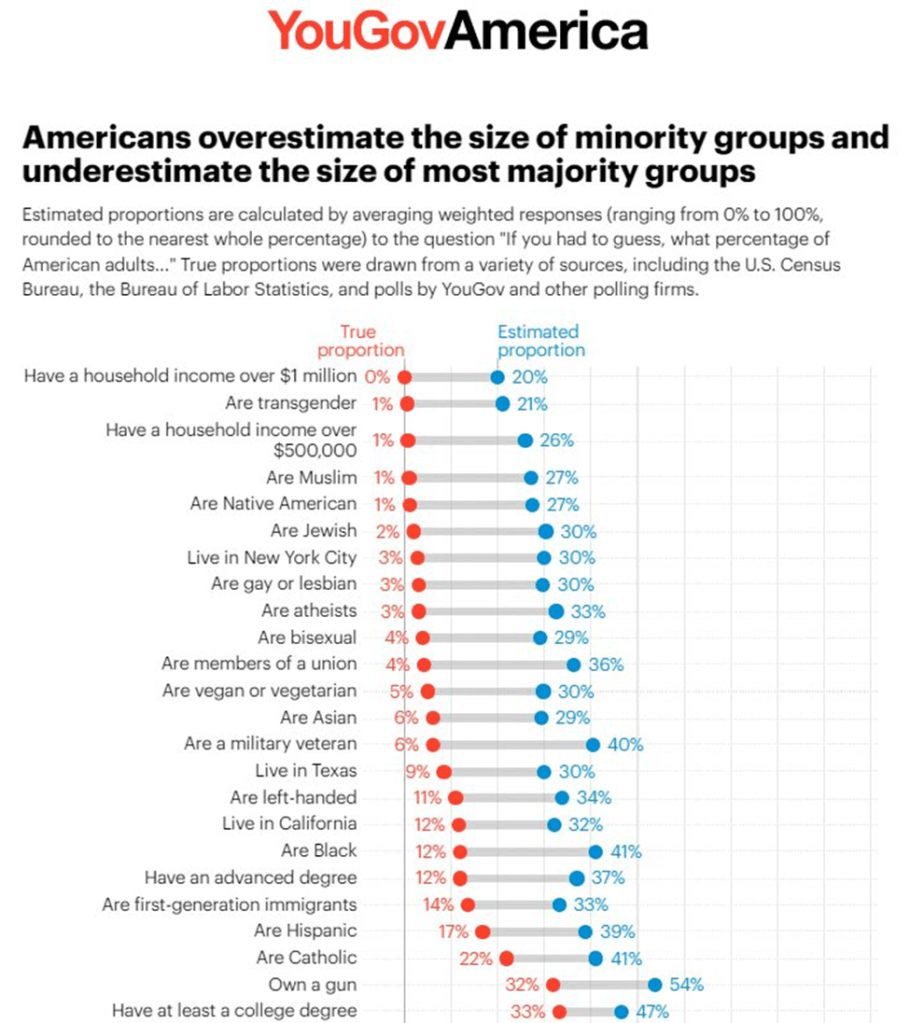
Ronald Reagan said “The trouble with our Liberal friends is not that they’re ignorant; it’s just that they know so much that isn’t so.” He was right – but our Conservative friends also know a lot that isn’t so. It’s the problem of making decisions based on ideology . . . confirmation bias steps in.
The numbers above are, in general, at the national level – I suspect the number of lefties is about the same at the county level as at the national level, while there is a great difference in the percentage of first-generation immigrants between California (the highest percentage) and Montana (one of the lowest percentages).
NBC offers some numbers that show how details can change the perspective:

The chart is developed from PEW data, and as I look through the rest, it illustrates that sometimes we need more data to better understand what is happening, and to whom.
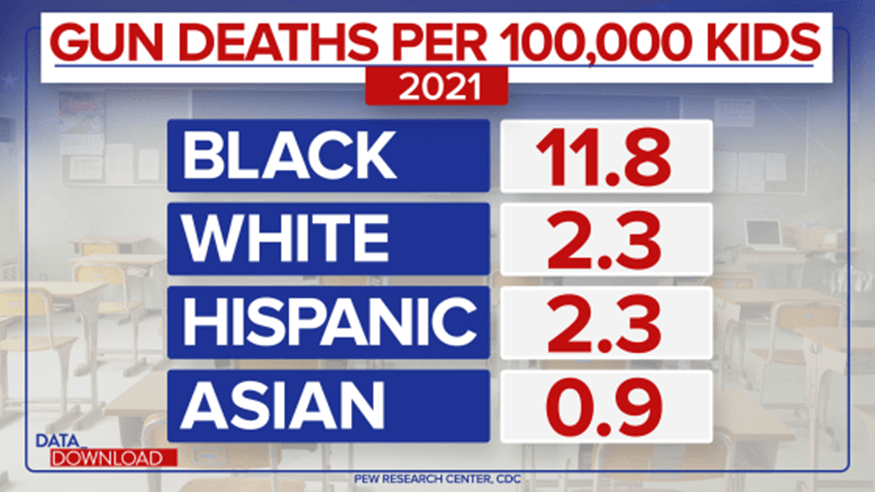
This one is even more skewed than it looks – remember from the first chart, about 12% of Americans are black. The next chart shows homicides versus suicides. The numbers fit in with Durkheim’s century-old theory explaining suicide – and show that, excepting black Americans, the shooter and the victim are frequently the same individual.
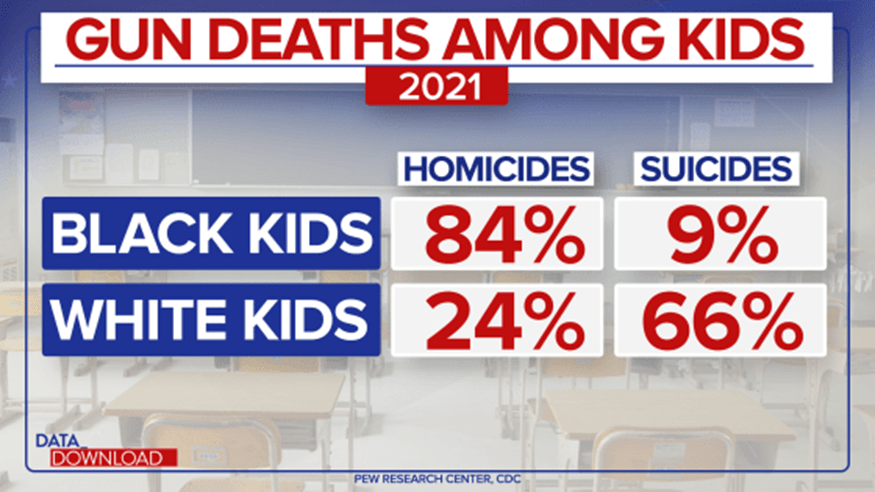
Looking at school shootings, PEW data gives yet a different perspective:

Click on the link, read the NBC article. Sometimes, even if we know what the correct numbers are, we draw erroneous conclusions.
-
I was glancing through the second and third annual Shotgun News Treasury Issues – at that time I was in the habit of buying and saving them for their gunsmithing articles. Those old articles are still good to review, even if the neuropathy has taken a lot of skill from my fingers – but I happened to look at the advertising pages, and thought to compare some of the prices with the advertisements in this month’s issue of Firearms News (the successor to Shotgun News).

The Third Treasury Issue advertised a Rock Island model 1911 for $349 (page 146). The same company advertises that pistol at $499 today – and then knocks off $49. The Turkish-made Tisas variant has a suggested retail price of $449.99 today, so the comparison seems fair. An off-brand AR-15 M-4 carbine for $914.45 (page 131). April’s second issue of 2023 advertises a Smith & Wesson version of the AR-15 at $625 (page 67).

In 2023, the advertisement on page 9 offers a Model 1911 “Builder’s kit” – all the parts for the 1911 except the frame – for $279. The same group of parts in 2003 was $272.95 on page 203.
Frames in 2003 went for $89.95 – this year the stripped frame goes for $179.95.

So if I start comparing things, even disregarding inflation, an AR-15 costs less – about 30% less – today than it did 20 years ago. That Model 1911 .45 is about 30% more. I’m no economist. I can’t begin to explain why the base AR-15 costs less today than it did 20 years ago. But with everything else going up, and the prices of AR-15 rifles going down, I can understand why so many people have bought them.
-
The easy place to learn about the Laffer curve is laffercenter.org– the website dedicated to the accomplishments of Dr. Arthur Laffer. Laffer is best known for development of the Laffer Curve – which ostensibly describes how taxation rates can be set to raise the money for the government.
It’s economics – in geometry I learned that two established points can be connected with a straight line. Dr. Laffer used two established points (0 and 100) to develop a curve. Might explain why I’m not an economist – I’d really like a little more data.
The theory has face validity. If your tax rate is zero, the revenue you raise will be zero. On the other hand, if you tax income at 100% you really do take away most of the motivation to work. I really think that we have enough tax records since Abraham Lincoln started the income tax that we should be able to fill in some numbers on the right hand side of Laffer’s curve.
Right now, our tax brackets top out at 37% – and, if you’re single, that kicks in when you’re a little past a half-million in earned income. Back in 1963, the top income tax bracket was 91%, and it kicked in at $200,000. Of course the bottom bracket in 1963 was 20% and that went from 0 to $2,000 for filing single. (It went up to 22% when you climbed to $2,000). Today the bottom bracket is 10%, and it doesn’t go up until $9,950.
Back when Lincoln started the income tax, it was 3% from $600 to $10,000, then going up to 5% on all income over $10,000.
Since there should be 160 years of data, ranging from 3% up to 91% taxation rates, it shouldn’t be all that hard to put real numbers on the Laffer Curve. Laffer actually did research the data to develop his theory, and more recent data can be accessed at SOI Tax Stats – Individual Statistical Tables by Size of Adjusted Gross Income | Internal Revenue Service
A few quotes from Dr. Laffer (easier than reading the whole book – but one of his books is available at https://laffercenter.org/taxes-have-consequences/
“Government spending is taxation. When you look at this, I’ve never heard of a poor person spending himself into prosperity; let alone I’ve never heard of a poor person taxing himself into prosperity.”
“The tax rate increases reduce economic growth; they shrink the pie; they cause more poverty, more despair, more unemployment, which are all things government is trying to alleviate with spending.”
“And you can’t have a prosperous economy when the government is way overspending, raising tax rates, printing too much money, over regulating and restricting free trade. It just can’t be done.”
-
It’s easy to assume that warming plays a role in the movement of feral pig population. After all, feral pigs have been quite successful in the southern United States and gradually spreading north. And northern winters are a deterrent for many invasive species.
In fact, the invasion is unlikely to come from the south. According to the Smithsonian, Canadian farmers, raising pigs brought over from europe were initially unconcerned about escapes, as the Canadian winter seemed likely to prevent the pigs spreading and becoming a problem.

It turns out, pigs are rather clever animals, and quite adept at tunneling below the snow. The Canadian feral pig population has vastly increased, covering more territory each year. The pigs include a cross between domestic and feral species, which increases the size and resilience of the domestic pig.
North Dakota and Montana are already concerned about feral pigs crossing the border. Lincoln county is one of the counties that had feral swine reported in 2022. The state reporting program is “Squeal on Pigs“, and while we don’t seem to have a problem yet, the pig are expected to become one in the northern US states sooner rather than later.
-
Is social media making people depressed?

Click here for unhappiness. www.shutterstock.com Mark Widdowson, University of Salford
Anyone who regularly uses social media will have had the experience of feeling envious of the fun their friends all seem to be having. This might especially be the case if you’re are sitting at home on a cold wet evening, feeling bored while everyone else is partying or having a glamorous holidays in the sun.
But is it possible that these feelings could be the start of something worse? Could using social media actually make you depressed? A recent US-based study, sponsored by the National Institute for Mental Health, identified a “strong and significant association between social media use and depression in a … sample of US young adults”. The study found that levels of depression increased with total amount of time spent using social media and number of visits to social media sites per week.
Previous studies have painted a more mixed picture. It would seem that the relationship between social media and depression and well-being is complex and likely to be influenced by a number of factors.
At its best, social media allows us to connect and keep up with friends and people we don’t see very often. It allows us to have short interactions with them that keep the relationships going when we don’t have much free time. At its worst, social media can, it seems, feed into feelings of inadequacy.
There are likely to be many complex reasons why social media use might be associated with depression. For instance, it is possible that people who are already depressed might be more inclined to rely on social media instead of face-to-face interactions, so greater social media use may be a symptom rather than a cause of depression.
An unsatisfactory fix
We all have a basic need to be liked and accepted by others and social media can play into this vulnerability. “Likes” are the currency of social media, and people who have low self-esteem may place great value on seeking validation from their social media use by trying to attract likes to their comments as a way of increasing their self-esteem. In this way, social media can be a bit of a popularity contest. Of course, “winning” the popularity contest by garnering the most likes is only a short-term boost to morale. It’s a precarious way to boost self-esteem.

How everyone looks on social media. www.shutterstock.com It is human nature to compare ourselves to others. Sometimes comparison can be a way to inspire ourselves to improve in some way, but, more often than not – especially when someone is feeling down or is prone to depression – the comparisons become negative, and erode self-esteem. One problem with social media is that the image people portray of themselves tends to be positive, interesting and exciting. Let’s face it, most of us would rather post a photograph of ourselves looking great on a night out than one where we are in our pyjamas, washing the dishes. If someone is feeling down or dissatisfied with their life then, instead of being a bit of a distraction, social media use can give the impression that everyone else is having way more fun than we are.
Not all bad
Many parents have misgivings about their children’s use of social media and more than one parent has had to console a tearful teenager, distraught over an online argument. Whether we like it or not, social media is here to stay and, for many young people, opting out of social media would mean losing access to their network of friends. For them, it is not a viable option.
At the moment, we don’t know enough about how the way that social media is used and its impact on mood and longer-term mental health. Until we do, perhaps the best option is to recognise that social media can be a valuable tool to keep in touch with friends and that our interactions on social media should not overly influence our self-esteem. It might also be worth remembering that, although everyone else might seem to be having a great time, newsfeeds are more biased towards showing all the fun, interesting things that people are doing. So they are just curating the best bits of their life – not necessarily having a better time than you are.
Mark Widdowson, Lecturer in Counselling and Psychotherapy, University of Salford
This article is republished from The Conversation under a Creative Commons license. Read the original article.
-
For years, Petroleum County has been Montana’s smallest county. World Population Review explains it part of it:
Petroleum County, which has a population of 513 people. Since the last census in 2010, Petroleum County’s population has seen an increase of 4.91%. Following up after Petroleum County, other small counties in Montana include Treasure County (679), Golden Valley County (826), Wibaux County (1,034), and Prairie County (1,087). Of these counties, Petroleum County experienced the most significant growth while Prairie County had the most dramatic decline with a growth rate of -8.11%.”
worldpopulationreview.comIt is harder to find the data on school district populations – the 2010 Census was the last to give an actual count, and the results are now reported on the American Community Survey. The ACS samples too small a number to give reliable information – but as we’re having a school district election, and we have 498 registered voters in school district 53, it looks like Trego has a larger population than Petroleum County. The 2010 Census showed Trego’s population at 588. Unitedstateszipcodes.org provides this data for Trego and Stryker (both parts of school district 53):
“Stats and Demographics for the 59934 ZIP Code
ZIP code 59934 is located in northwest Montana and covers a slightly higher than average land area compared to other ZIP codes in the United States. It also has a slightly less than average population density.
The people living in ZIP code 59934 are primarily white. The number of middle aged adults is extremely large while the number of seniors is extremely large. There are also a small number of single parents and a large number of families. The percentage of children under 18 living in the 59934 ZIP code is small compared to other areas of the country.” This site showed 59934 (Trego) population at 528 and 59933 (Stryker) at 43, for a total population of 571.”
Somehow it seems unusual to have a community where 87% of the population is registered to vote. It’s going to be interesting to see when we surpass Treasure County. Unfortunately, the last enumerated count of the school district was in 2010, and we can expect to only have ACS estimates in the future – and precinct counts won’t be contiguous with school district boundaries anymore.
-
I’ve been looking for macroeconomic data, and found this chart. Remember, sociologists have been split off from economists for over a century – so I am definitely not an expert on the topic – but it feels like this chart has some face validity.

The chart comes from an article at treeofwoe.substack.com . Another graph shows the declining GDP of Canada, France, Germany, Italy, Japan, the UK and the US.

I’m definitely not an economist – but I’ve recently been watching one of the Great Courses on western history. It reminded me how Roman inflation can be assessed by watching the content of silver in the Denarius coins.

(Chart from armchairprehistory.com) Somehow, it seems that our 20th and 21st Century leaders may not have known anymore than the old Roman emperors 2000 years earlier.
-
There are some tools for doing good research (as opposed to arguments or lobbying). One of the tools of research is the philosophical razor – probably going back to Occam’s Razor. The article at lifelessons.co lists and describes 9 philosophical razors that make research easier. It begins with:
In this article nine philosophical razors you need to know:
- Occam’s razor: Entities should not be multiplied without necessity
- Sagan standard: Extraordinary claims require extraordinary evidence
- Hitchens razor: What can be asserted without evidence can be dismissed without evidence
- Hume’s razor: Causes must be sufficiently able to produce the effect assigned to them
- Duck test: If it looks like a duck, swims like a duck, and quacks like a duck, then it probably is a duck
- Popper’s falsifiability principle: For a theory to be considered scientific, it must be possible to disprove or refute it
- Newton’s flaming laser sword: If something cannot be settled by experiment, it is not worth debating
- Grice’s razor: Address what the speaker actually meant, instead of addressing the literal meaning of what they actually said
- Hanlon’s razor: Never attribute to malice that which can be adequately explained by incompetence or stupidity
Popper’s falsifiability principle is a solid basis – if there is no way to refute a theory, you have a problem with your theory: “It is easy to obtain confirmations or verifications for nearly every theory – if we look for confirmations. Every genuine test of a theory is an attempt to falsify it, or refute it.” – Karl Popper
Hitchens’ Razor is a time saver – there are tons of people who are willing to make an unsupported argument, and pass the task of refuting it on to the poor guy they’re trying to convince. “What can be asserted without evidence can also be dismissed without evidence.” – Christopher Hitchens
The burden of proof doesn’t belong to the listener – it belongs to the person making the assertion. If you don’t present evidence that supports the assertion, your audience has the right – even the responsibility – to dismiss your assertion without evidence.
Want to tell us something or ask a question? Get in touch.

Recent Posts
- Watching Iran
- The Quality of Numbers
- Robert Treat Payne Had Traveled To Greenland
- 75 Years Ago in New York
- Recovery Time for a Retiree
- Venn Diagram and DSM
- When Castro Was Cool
- You Have To Beat Darwin Every Day
- Computer Repair by Mussolini
- Getting Alberta Oil to Market
- Parties On Economics
- Thus Spake Zarathustra – One More Time

Rough Cut Lumber
Harvested as part of thinning to reduce fire danger.
$0.75 per board foot.
Call Mike (406-882-4835) or Sam (406-882-4597)
Popular Posts
Ask The Entomologist Bears Books Canada Census Community Decay Covid Covid-19 Data Deer Demography Education Elections family Firearms Game Cameras Geese Government Guns History Inflation life Lincoln County Board of Health Lincoln County MT Lincoln Electric Cooperative Montana nature News Patches' Pieces Pest Control Politics Pond Recipe School School Board Snow Taxes Teaching travel Trego Trego Montana Trego School Weather Wildlife writing
 Trego's Mountain Ear