-
I suspect that I’m not in favor of war anywhere. Ukraine probably isn’t a bad spot for a war – it is a long way from my home. Still, I keep remembering a comment that “Peace is an unusual state of affairs that we assume exists because there are times when the fighting is somewhere else.” Don’t know who said it.
In a weird sort of way, I think I understand what motivates Putin. He’s not quite three years younger than I, and he hails from a time when the planet had two first-rate powers – the United States and the Union of Soviet Socialist Republics. At the end of 1991, the USSR had fallen apart. Eight years later, Putin was in charge of Russia . . . but Russia wasn’t even a second or third rate power. Putin leads Russia with a memory of when Russia led the USSR and was a first rate power. Now Russia is pretty much a fourth rate operation . . . but bringing the best parts of the Ukraine into Russia would, at the least, move his nation into a little more power – legitimately claiming at least a third-rate status. Add in the leftover nukes and he’d be solidly up to second rate.
Iran is another fourth-rate power with memories of being first-rate long ago. I suspect if the ayatollahs watched the 300, they’d be rooting for the Persians.
And yet, I recall reading of the major presentation of the thirties – Smedley Butler, and his book/lecture War is a Racket. There’s a Youtube video on Butler and his message, and I’m not sure that all of us shouldn’t listen to it once a year. You can download his book at archive.org, you can hear the book read on youtube, and there is a youtube video.
Smedley Butler – Major General United States Marine Corps – two Medals of Honor – looked back at his career
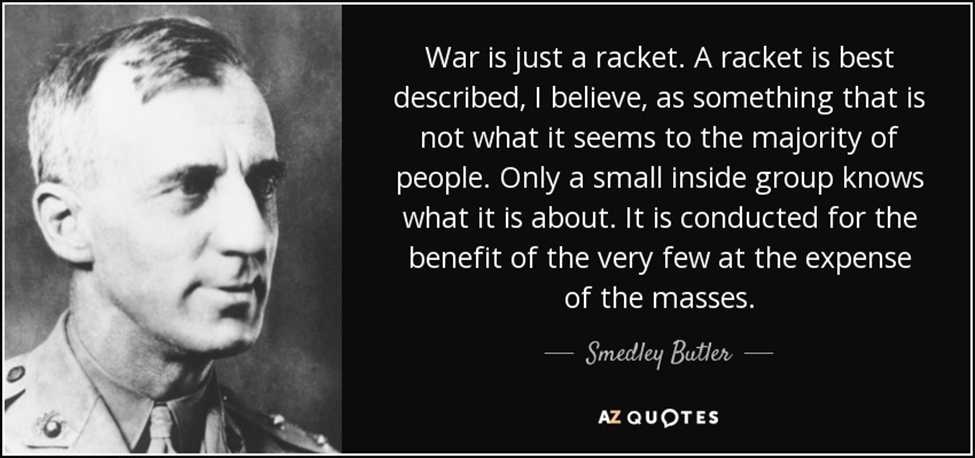
“War, like any other racket, pays high dividends to the very few. The cost of operations is always transferred to the people who do not profit.”
“I helped make Mexico, especially Tampico, safe for American oil interests in 1914. I helped make Haiti and Cuba a decent place for the National City Bank boys to collect revenues in.”
“A few profit – and the many pay. But there is a way to stop it. You can’t end it by disarmament conferences. You can’t eliminate it by peace parleys at Geneva. Well-meaning but impractical groups can’t wipe it out by resolutions. It can be smashed effectively only by taking the profit out of war.”
Smedley ButlerSomeone – someone in our country – or maybe a group of someones – is making a lot of money supplying munitions and arms to Ukraine.
-
We learned of Paula Buff’s resignation with her email response line as we looked at planning the Trego school election:
From: Paula Buff <pbuff@libby.org>
Date: Mon, Mar 27, 2023 at 3:43 PM
Subject: Automatic reply: Express vote machine
To: Trego School <clerk@tregoschool.org>I am no longer with Lincoln County. If you need assistance, please contact the County Commissioners.
Thanks.
Sometimes the news is incomplete – but more information is available at the Western News
There’s a lot that isn’t said in the article – but Paula, her minion Amanda, and the County Clerk Robin Benson all pulled the pin at the same time. That’s a somewhat unlikely cluster of events, so it’s probably a safe bet that there is a common motivation for Paula, her minion, and her boss all bailing at the same time – and that not because of commendations.
In a quote taken from the Tobacco Valley News, Robin Benson claimed, “Paula and Amanda have worked tirelessly and diligently for the county and all electors in Lincoln County and have run safe and secure elections. . . The hostility shown to Paula and Amanda, of course, is all under the guise of ‘election integrity.’”
This description, from the Western News, may give us a spot for further research:
“Josh Letcher, first elected in 2018 and the current county Commissioner Chairperson, did not return phone calls by press time.
Tensions have been on the rise between Letcher, Benson and Buff over the last several months.”
“Additionally, Letcher also referenced a meeting about the post-election audit and asked Benson if she was able to properly supervise her employees while stating that Buff had falsified election documents and he felt he was ridiculed questioning this at a prior meeting.”
Western NewsWe started reporting on Paula’s choice not to follow Montana laws in running elections during the 2022 primary – specifically,
13-10-211. Declaration of intent for write-in candidates. (1) Except as provided in subsection (7), a person seeking to become a write-in candidate for an office in any election shall file a declaration of intent. Except for a candidate under 13-38-201(4) or a candidate covered under 7-1-205, a candidate may not file for more than one public office. The declaration of intent must be filed with the secretary of state or election administrator, depending on where a declaration of nomination for the desired office is required to be filed under 13-10-201, or with the school district clerk for a school district office. When a county election administrator is conducting the election for a school district, the school district clerk or school district office that receives the declaration of intent shall notify the county election administrator of the filing. Except as provided in 13-1-403, 13-1-503, 20-3-305(3)(b), and subsection (2) of this section, the declaration must be filed no later than 5 p.m. on the 10th day before the earliest date established under 13-13-205 on which a ballot must be available and must contain:
Subsection (7) reads:
(7) Except as provided in 13-38-201(4)(b), the requirements in subsection (1) do not apply if:
(a) an election is held;
(b) a person’s name is written in on the ballot;
(c) the person is qualified for and seeks election to the office for which the person’s name was written in; and
(d) no other candidate has filed a declaration or petition for nomination or a declaration of intent.MCA 44.3.2403, ends with:
“3) Consistent with 13-10-211, MCA, votes for undeclared write-in candidates may be counted if:
(a) an election is held;
(b) a person’s name is written in on the ballot;
(c) the person is qualified for and seeks election to the office for which the person’s name was written in; and
(d) no other candidate has filed a declaration or petition for nomination or a declaration of intent.”The critical word is “may”. Paula chose to interpret that as not requiring her to count write-in votes that are specifically exempted from filing under subsection 7. By doing so, Paula made Lincoln County a one party county, and in her appointed position, made herself the single person determining how two elected positions would be filled.
So now, with Paula gone (along with her minion and her enabler), I have requested that the County Commissioners pass this following resolution:
“In Lincoln County, the word “may” in MCA 44.3.2403 shall be interpreted in the way that provides the maximum citizen involvement in the electoral process. This will normally mean ‘shall’.” This small word change provides for the most citizen involvement from now on without the personal interests of an election official overriding that constitutionally paramount interest.” Personally I’d like to think of it as the memorial stone for Paula Buff’s record of public service.
If the commissioners agree, our next step will be getting our state representative and our state senator to introduce legislation that replaces the word ‘may’ in MCA 44.3.2403 3 with ‘shall’. That single word empowered Paula to determine, single-handedly, who filled two elected positions. We won’t get it changed in Helena this year – but it seems little to ask of our representative and our senator in the next legislative session.
-
So I’m looking at a Newsweek article on feral hogs. One of the neat things it included was this chart:

I’m not really sure about invasive wild pigs, but I notice a 0.6 to 0.8 probability of them coming into Lincoln County. I don’t know if that’s per year, or what – but the maps motivate speculation. Obviously, the left coast and the south are more in keeping with a wild pig invasion – but if we are getting some warming in the climate, we may get some wild pigs.

It’s kind of like ‘bucket biology’ – the term I’ve heard as an explanation for how perch, sunfish, and pike made it into our local lakes (I’ve seen small perch in the pond, and I’m not sure that the sticky eggs aren’t transported on bird legs – but that explanation only explains the last leg of the trip). But the story behind the feral pig population explosion is similar:
“In the pre-cable years, there was occasionally a hunting show on TV. In the multi-channel era, those morphed into entire hunting channels that needed enough content to fill 24 hours every day. “And they started to show pig hunting,” Ditchkoff says. “And people said, ‘Boy, I’d like to try that.’ And pretty quickly they realized they didn’t have to go where the pigs were—they could track them, transport them, and release them close to where they lived. And that’s what led to this massive range expansion.”
The idea that people were trundling pigs all over the country might sound far-fetched, and it would have been illegal. But several lines of evidence make it plausible. Genetic studies by multiple research teams show that characteristics possessed by wild pigs in one place abruptly appear in pigs hundreds or thousands of miles away; in one 2015 study, a group of feral hogs in California possessed mitochondrial DNA sequences that otherwise had been found only in Kentucky. Then there’s the reality of how rapidly pigs appeared in new places. USDA research estimates that, on their own, hog populations will expand their range by about 4 to 8 miles per year. But Mayer jokes darkly that they have relocated at “about 70 miles per hour—which is the speed of the pickups taking them down the highway.”
https://www.wired.com/story/feral-hogs-worst-invasive-species/I’m not anticipating an invasion of feral hogs here in Trego – but, if we are living through global warming, we may have a more inviting climate for them. I’m remembering the stories I heard from Walt Ritter when I was young – since Walt stuttered, his stepfather thought school was wasted on him. He spent his time with a shovel, digging drainage ditches. Later, with a bit of frost, he was hired out as a cook’s helper for a logging camp. His story was that one of the loggers had died, and the body was covered and left outside in the cold until a wagon would come and take the departed to town. Part of Walt’s job had been to feed the cookshack slops to the pig – but he found that the pig had eaten most of the logger. Walt claimed the experience took him off bacon for quite a while – and he insisted that digging ditches and working in the logging camp didn’t help his stuttering a bit.
Editors note: this is, you may note, entirely ignoring the potential influx of feral hogs from Canada which is a potentially far nearer source population. More on that later.
-
I had been thinking of Mike Brandon off and on for the past week or two when I heard he had gone away. Not dead, you understand. Just gone away – for he lives in memories of those who knew him. We were teenagers when we met – probably on the school bus in the mid-sixties, for we never were in the same classes. He was one of the kids who moved to Trego – they were kind of like military brats whose fathers worked on the tunnel. Thinking about it, Mike Brandon was one of the finest examples of Montana Improved Californians.
I was college track as LCHS assumed a place in the rear view mirror – Mike went to the Marine Corps and Viet Nam. He was shot in the stomach, recovered and came home. The war story I heard was of being in tall grass, knowing something was hidden by the grass and coming at them, and finding out that they had killed an elephant. I’m not sure if the beast had been mortared or machine gunned – I heard it once, over a half-century ago – but I remember the ending comment “I only wanted to get back home to Peggy and never leave Trego.”
Mike liked the 1911 – I recall him describing getting one from an aging neighbor. Not a 1911A1 mind you – a 1911. He was pleased to have the straight hammer spring housing. That was back when I was still a revolver guy – his time in the Marine Corps had left him a bit more evolved than I was.
People will remember Mike as a logger – specifically a sawyer. I remember Mike as the guy who taught me to file a chainsaw. My first teacher (notably unsuccessful) was Pete Klinke. I still recall Pete’s words: “File it so it looks like a fishhook.” That made sense to Pete, but not to me. Mike Brandon explained, “It doesn’t cut – the top of the tooth planes away a strip of wood. When it’s sharp, it leaves a long strip. That’s the important edge.” Then he went out to his pickup and brought back a chain that couldn’t have had more than three or four logs left in it – and demonstrated that the angle with the bar wasn’t nearly so important as getting the tooth filed so it could plane off long strips of wood. He promised to teach me how to deal with the rakers once I had managed the cutting edges. I had learned – later that week he taught me how to trim down the rakers. He definitely could teach and share what he knew.
As he declined physically, he went from a sawyer’s tape and chainsaw to driving a log truck – something that had never appealed, since he could make as much money with a chainsaw, and it was a lot smaller investment than a logging truck. His health further declined, with neuropathy taking away the ability to walk. He described how he could still drive to the post office with a UTV – but neither of us made it to the post office all that often, and I think that was our last visit . . . though I waved at every little 4-wheeler that drove by, thinking Mike might be in it.
Just gone away. And the world is a little darker for it.
-
Secession is here: States, cities and the wealthy are already withdrawing from America
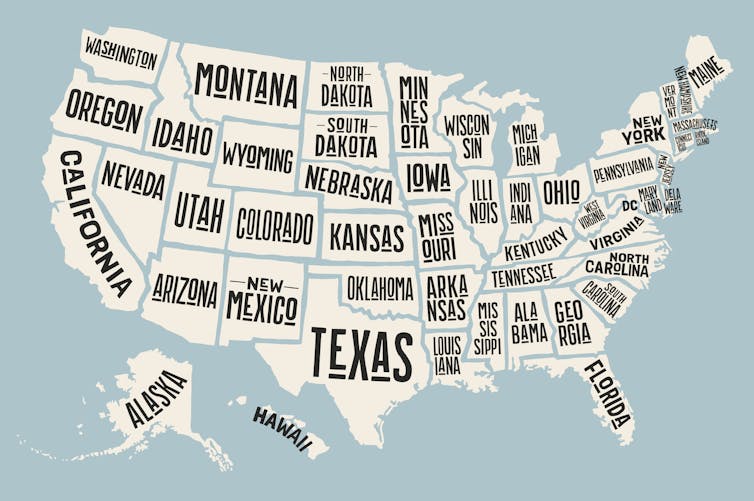
Acts of secession are happening across the U.S. Vector Illustration/Getty Images Michael J. Lee, College of Charleston
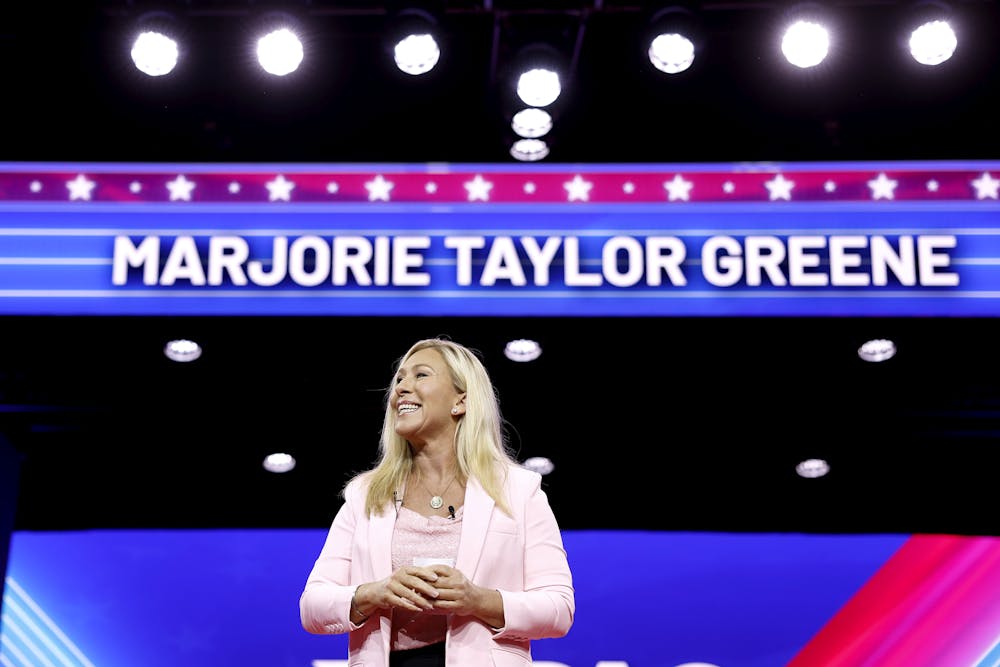
Rep. Marjorie Taylor Greene, a Republican from Georgia, wants a “national divorce.” In her view, another Civil War is inevitable unless red and blue states form separate countries.
She has plenty of company on the right, where a host of others – 52% of Trump voters, Donald Trump himself and prominent Texas Republicans – have endorsed various forms of secession in recent years. Roughly 40% of Biden voters have fantasized about a national divorce as well. Some on the left urge a domestic breakup so that a new egalitarian nation might be, as Lincoln said at Gettysburg, “brought forth on this continent.”
The American Civil War was a national trauma precipitated by the secession of 11 Southern states over slavery. It is, therefore, understandable that many pundits and commentators would weigh in about the legality, feasibility and wisdom of secession when others clamor for divorce.
But all this secession talk misses a key point that every troubled couple knows. Just as there are ways to withdraw from a marriage before any formal divorce, there are also ways to exit a nation before officially seceding.
I have studied secession for 20 years, and I think that it is not just a “what if?” scenario anymore. In “We Are Not One People: Secession and Separatism in American Politics Since 1776,” my co-author and I go beyond narrow discussions of secession and the Civil War to frame secession as an extreme end point on a scale that includes various acts of exit that have already taken place across the U.S.
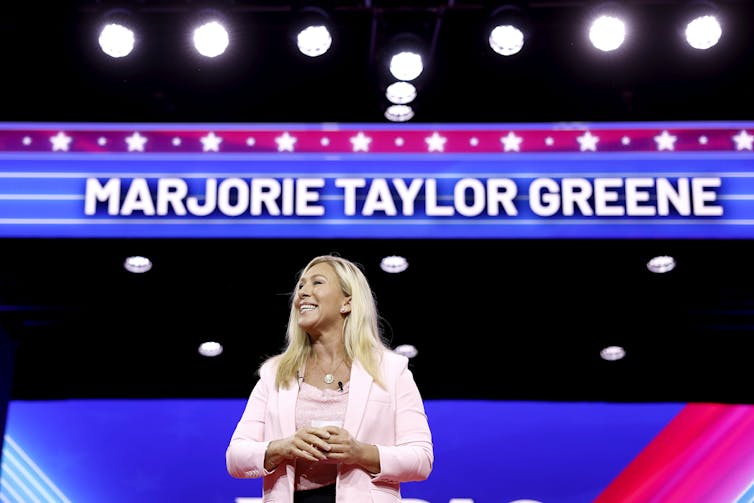
GOP Rep. Marjorie Taylor Greene wants red and blue states to separate. Anna Moneymaker/Getty Images Scaled secession
This scale begins with smaller, targeted exits, like a person getting out of jury duty, and progresses to include the larger ways that communities refuse to comply with state and federal authorities.
Such refusals could involve legal maneuvers like interposition, in which a community delays or constrains the enforcement of a law it opposes, or nullification, in which a community explicitly declares a law to be null and void within its borders. At the end of the scale, there’s secession.
From this wider perspective, it is clear that many acts of departure – call them secession lite, de facto secession or soft separatism – are occurring right now. Americans have responded to increasing polarization by exploring the gradations between soft separatism and hard secession.
These escalating exits make sense in a polarized nation whose citizens are sorting themselves into like-minded neighbhorhoods. When compromise is elusive and coexistence is unpleasant, citizens have three options to get their way: Defeat the other side, eliminate the other side or get away from the other side.
Imagine a national law; it could be a mandate that citizens brush their teeth twice a day or a statute criminalizing texting while driving. Then imagine that a special group of people did not have to obey that law.
This quasi-secession can be achieved in several ways. Maybe this special group moves “off the grid” into the boondocks where they could text and drive without fear of oversight. Maybe this special group wields political power and can buy, bribe or lawyer their way out of any legal jam. Maybe this special group has persuaded a powerful authority, say Congress or the Supreme Court, to grant them unique legal exemptions.
These are hypothetical scenarios, but not imaginary ones. When groups exit public life and its civic duties and burdens, when they live under their own sets of rules, when they do not have to live with fellow citizens they have not chosen or listen to authorities they do not like, they have already seceded.
Schools to taxes
Present-day America offers numerous hard examples of soft separatism.
Over the past two decades, scores of wealthy white communities have separated from more diverse school districts. Advocates cite local control to justify these acts of school secession. But the result is the creation of parallel school districts, both relatively homogeneous but vastly different in racial makeup and economic background.
Several prominent district exits have occurred in the South – places like St. George, Louisiana – but instances from northern Maine to Southern California show that school splintering is happening nationwide.
As one reporter wrote, “If you didn’t want to attend school with certain people in your district, you just needed to find a way to put a district line between you and them.”
Many other examples of legalized separatism revolve around taxes. Disney World, for example, was classified as a “special tax district” in Florida in 1967. These special districts are functionally separate local governments and can provide public services and build and maintain their own infrastructure.
The company has saved millions by avoiding typical zoning, permitting and inspection processes for decades, although Florida Gov. Ron DeSantis has recently challenged Disney’s special designation. Disney was only one of 1,800 special tax districts in Florida; there are over 35,000 in the nation.
Jeff Bezos paid no federal income taxes in 2011. Elon Musk paid almost none in 2018. Tales of wealthy individuals avoiding taxes are as common as stories of rich Americans buying their way out of jail. “Wealthier Americans,” Robert Reich lamented as far back as the early 1990s, “have been withdrawing into their own neighborhoods and clubs for generations.” Reich worried that a “new secession” allowed the rich to “inhabit a different economy from other Americans.”
Some of the nation’s wealthiest citizens pay an effective tax rate close to zero. As one investigative reporter put it, the ultrawealthy “sidestep the system in an entirely legal way.”
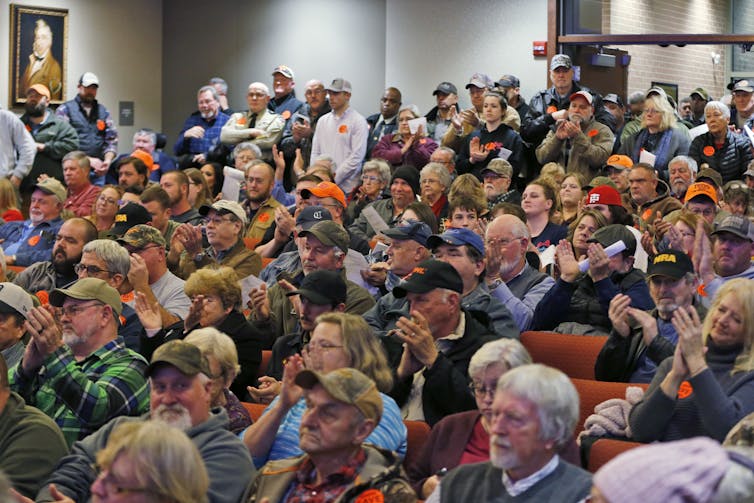
Spectators applaud after the Buckingham County Board of Supervisors unanimously votes to pass a Second Amendment sanctuary resolution at a meeting in Buckingham, Va., Dec. 9, 2019. AP Photo/Steve Helber One nation, divisible
Schools and taxes are just a start.
Eleven states dub themselves “Second Amendment sanctuaries” and refuse to enforce federal gun restrictions. Movements aiming to carve off rural, more politically conservative portions of blue states are growing; 11 counties in Eastern Oregon support seceding and reclassifying themselves as “Greater Idaho,” a move that Idaho’s state government supports.
Hoping to become a separate state independent of Chicago’s political influence, over two dozen rural Illinois counties have passed pro-secession referendums. Some Texas Republicans back “Texit,” where the state becomes an independent nation.
Separatist ideas come from the Left, too.
“Cal-exit,” a plan for California to leave the union after 2016, was the most acute recent attempt at secession.
And separatist acts have reshaped life and law in many states. Since 2012, 21 states have legalized marijuana, which is federally illegal. Sanctuary cities and states have emerged since 2016 to combat aggressive federal immigration laws and policies. Some prosecutors and judges refuse to prosecute women and medical providers for newly illegal abortions in some states.
Estimates vary, but some Americans are increasingly opting out of hypermodern, hyperpolarized life entirely. “Intentional communities,” rural, sustainable, cooperative communes like East Wind in the Ozarks, are, as The New York Times reported in 2020, proliferating “across the country.”
In many ways, America is already broken apart. When secession is portrayed in its strictest sense, as a group of people declaring independence and taking a portion of a nation as they depart, the discussion is myopic, and current acts of exit hide in plain sight. When it comes to secession, the question is not just “What if?” but “What now?”
Michael J. Lee, Professor of Communication, College of Charleston
This article is republished from The Conversation under a Creative Commons license. Read the original article.
-
The Mountain Ear will be taking a temporary pause until the baby is able to come home.
We’ll look forward to continuing the Mountain Ear as usual when our family is home. Check for us next Tuesday.
-
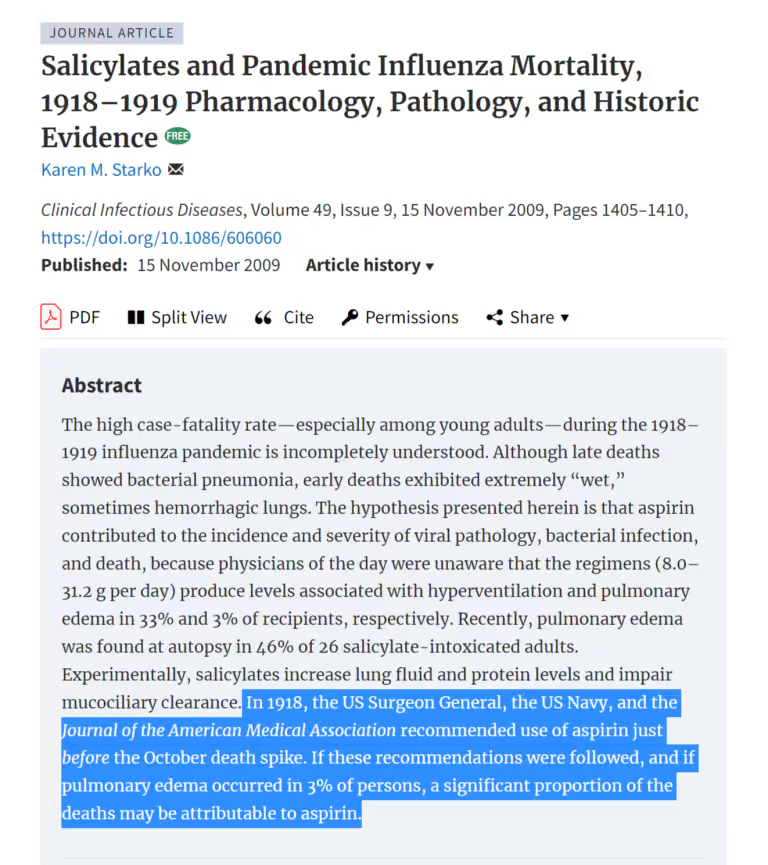
I ran across an article at brownstone.org The title intrigued me – I do wonder what makes one lie greater than another – so I clicked the link. I found out what they considered the greatest lie of covid – but I am more interested in their linking aspirin with the death rate of Spanish Flu a little over a hundred years back. The article included this abstract:
It intrigued me – as a demographer, I looked at a lot of data on the Spanish Flu epidemic – probably the location that was most memorable was Milk’s Camp – a church remained, but the town, village, however you term it was still empty nearly a century after being hit hard by Spanish Flu.
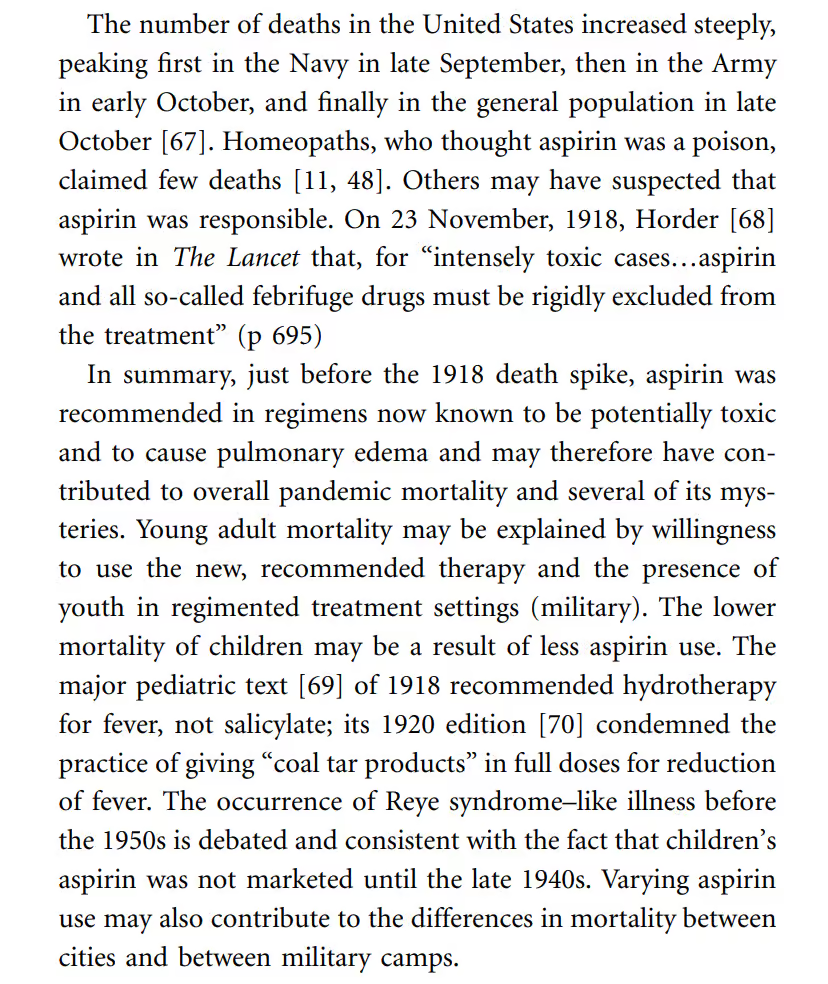
“The unprecedented overall mortality and the mortality rate among young adults during the 1918–1919 influenza pandemic are incompletely understood. Deaths in the United States peaked with a sudden spike in October 1918. Later, Wade Hampton Frost [2] studied surveys of 8 US cities and found that, for every 1000 persons aged 25–29 years, ∼30% were infected with influenza virus, and 1% died of pneumonia or influenza. This 3% case-fatality rate has been called, “perhaps the most important unsolved mystery of the pandemic” [3, p 1022]”
“Official recommendations for aspirin were issued on 13 September 1918 by the US Surgeon General [64], who stated aspirin had been used in foreign countries “apparently with much success in the relief of symptoms” (p 13), on 26 September 1918 by the US Navy [29], and on 5 October 1918 by The Journal of the American Medical Association [31]. Recommendations often suggested dose regimens that predispose to toxicity as noted above. At the US Army camp with the highest mortality rate, doctors followed Osler’s treatment recommendations, which included aspirin [48], ordering 100,000 tablets [65]. Aspirin sales more than doubled between 1918 and 1920 [66].Again, anyone starting to pick up a bit of a rhyme in the history here?”
The next chunk of data was the following statement:
The Smithsonian points out the aspirin dosage in 1918 was higher than we regard as safe today: https://www.smithsonianmag.com/history/ten-myths-about-1918-flu-pandemic-180967810/
“One hypothesis suggests that many flu deaths could actually be attributed to aspirin poisoning. Medical authorities at the time recommended large doses of aspirin of up to 30 grams per day. Today, about four grams would be considered the maximum safe daily dose. Large doses of aspirin can lead to many of the pandemic’s symptoms, including bleeding.”
As I looked into the possibility that aspirin increased the lethality of the 1918 flu epidemic, I realized that I missed many of the articles on the topic that were written during the H1N1 epidemic of 2009 – I think at the time I was focused on colon cancer. While I can’t write conclusively about the effects of Aspirin, the articles have a level of face validity.
This 17th century poem, by Matthew Prior seems to cover the idea:
I sent for Ratcliffe, was so ill,
That other doctors gave me over
He felt my pulse, prescribed his pill
And I was likely to recover.
But when the wit began to wheeze,
And wine had warmed the politician,
Cured yesterday of my disease,
I died last night of my physician. -
The other day, I dragged the body of last Summer’s smallest fawn away. She may have weighed 40 pounds. As winter came in she had been in company with her mother – a young doe in great shape – and her grandmother. Grandma was an old doe who didn’t look like she had a chance of making the winter . . . but the fawn’s mother was hit on the road and died around Christmas time.
Grandma didn’t look good – but she stayed with the fawn, cuddled together through the cold times of winter. Then, in the middle of February, the old doe died. Alone as a cold March came in, the little fawn died alone, lying down in the same place where she had slept with her grandmother. A spot where she could watch my front door.
Most Springs would have had warmer weather, and the snow would have been gone. This is one of the late Springs – and Spring and early Summer are dying times for the weakened wildlife. In a couple of months, there will be new fawns in the field.
It brings back thoughts to archaeologists doing a rush job along the Kootenai River just before the rising waters of Koocanusa made it forever impossible to do the field work. I was young and curious, and asking what they had found. The answer described our climate – “We found spots where people lived for a couple hundred years . . . then they would be gone for a long time before their replacements would come in and live for another couple hundred years.” Here in Trego, the winters were probably just too rough for year-round human occupation in pre-history. The difference between the top of the hill and Ant Flat is noticeable. Snow melting a week or so earlier is the difference between surviving the winter and not.
When I worked in Trinidad, Colorado, I worked with the same annual precipitation as we get in Trego – about 18 inches. The difference was the length of growing season, the frost-free period. In Trinidad, the 50% frost dates are May 8 and October 3. In Trego, the safe last date for frost is listed as June 21. Even Eureka is May 21 and September 21. And people wonder why global warming seems like a good thing to me.
My old copy of Climate and Man immortalizes Winton Weydemeyer’s work, listing Fortine with 32 years of records (I don’t know who started the volunteer work that Winton took over). The average killing frost dates were May 29 and September 8, for 102 days of growing season. There were no climate records listed for Eureka – just Fortine, Libby and upper Yaak. Eureka didn’t have Winton keeping records for the good of his fellow residents. Upper Yaak shows no growing season – a place where frost can come any month of the year.
Merle Haggard sang “If we make it through December, everything’s gonna be alright.” Merle came from Bakersfield, California. He had a longer growing season.
-
Some prayer lists have better records than others. Back when I went through cancer treatment, I had been making presentations across the state, and kept finding out that churches I never attended – may have never driven past – were adding me to their prayer lists.
Remember – my specialty was demography. I quizzed everyone who told about adding me to their local prayer list about how effective it was. The damned cancer made life-expectancy calculations a whole lot more personal – and the local Methodist church I was attending didn’t have a very good record. I mean they’d put people on the prayer list, and in three or four months, they’d be burying them.
My surgeon for the arthroscopic work on my knees was an obnoxious bastard – he must have skipped every med school class on bedside manner. But I had checked out his record, and there were no cases of postoperative infections. I want surgeons who do the job right. It’s the same thing with preachers – if they’re going to lead a group petitioning the old boy up above for someone’s good health, I want a preacher and congregation that has a good success record. My regular preacher didn’t have that – and it took a bit of dodging to stay off the Brookings United Methodist Prayer list. Just barely dodged it as one educator added me to it, and I explained I was healed up and they needed to apply the efforts to someone who really needed it.
So I was on prayer lists on every continent except Antarctica – rural churches across South Dakota, and avoided the usually fatal prayer list of the church I attended. Since then, I’ve wondered – does anyone, anywhere, keep good records on the success/failure rates of their prayer lists? Francis Galton started a study in England, 150 years ago – but the best descriptor I could find today was “The third party studies reported either null results, correlated results, or contradictory results in which beneficiaries of prayer had worsened health outcomes. For instance, a meta-analysis of several studies related to distant intercessory healing published in the Annals of Internal Medicine in 2000 looked at 2774 patients in 23 studies, and found that 13 studies showed statistically significant positive results, 9 studies showed no effect, and 1 study showed a negative result.” That statement comes from Wikipedia, so take it for whatever you think it’s worth.” Francis Galton’s study on the efficacy of prayer is a rather long read, and can be accessed at galton.org.
Toward the end, he wrote, “If prayerful habits had influence on temporal success, it is very probable, as we must again repeat, that insurance offices, of at least some descriptions, would long ago have discovered and made allowance for it. It would be most unwise, from a business point of view, to allow the devout, supposing their greater longevity even probable, to obtain annuities at the same low rates as the profane. Before insurance offices accept a life, they make confidential inquiries into the antecedents of the applicant. But such a question has never been heard of as, ‘Does he habitually use family prayers and private devotions?’ Insurance offices, so wakeful to sanatory influences, absolutely ignore prayer as one of them. The same is true for insurances of all descriptions, as those connected with fire, ships, lightning, hail, accidental death and cattle sickness. How is it possible to explain why Quakers, who are most devout and most shrewd men of business, have ignored these considerations, except on the ground that they do not really believe in what they and others freely assert about the efficacy of prayer? It was at one time considered an act of mistrust in an over-ruling Providence to put lightning conductors on churches; for it was said that God would surely take care of his own. But Arago’s collection of the accidents from lightning showed they were sorely needed; and now lightning conductors are universal. Other kinds of accidents befall churches, equally with other buildings of the same class; such as architectural flaws, resulting in great expenses for repair, fires, earthquakes, and avalanches.”
As I continue aging, I really would like to have a conclusive study that shows which prayer lists are more likely to have positive outcomes – at least to a 95% confidence level.
-
A while back, I wrote about the hypothesis that car seat laws actually reduce the number of children, such that there may have been considerably more children not born due to car seat laws than have been saved by them.
Are bicycle safety laws similar? Quite possibly. In what appears to potentially be another case of unanticipated consequences, mandating helmets reduces the number of people riding bicycles.
This reduces exercise (it doesn’t seem that people simply replace cycling with jogging), which is generally accepted to be a bad thing from the health perspective. Additionally, fewer cyclists seems to make being a cyclist just generally a bit more dangerous, presumably because folks driving cars are less accustomed to watching out for them.
So, the argument is thus: By reducing the amount of people bicycling, helmet laws decrease the overall amount of exercise in the population, causing increased health problems (and presumably more premature deaths).
Note that the argument is not that bicycle helmets are not useful. Rather, it’s an argument that the net result of mandating their use may do more harm than good.
Just a weird idea on the internet? Well- maybe- but it’s one with some scientific papers behind it, not just blog articles.

Want to tell us something or ask a question? Get in touch.

Recent Posts
- Watching Iran
- The Quality of Numbers
- Robert Treat Payne Had Traveled To Greenland
- 75 Years Ago in New York
- Recovery Time for a Retiree
- Venn Diagram and DSM
- When Castro Was Cool
- You Have To Beat Darwin Every Day
- Computer Repair by Mussolini
- Getting Alberta Oil to Market
- Parties On Economics
- Thus Spake Zarathustra – One More Time

Rough Cut Lumber
Harvested as part of thinning to reduce fire danger.
$0.75 per board foot.
Call Mike (406-882-4835) or Sam (406-882-4597)
Popular Posts
Ask The Entomologist Bears Books Canada Census Community Decay Covid Covid-19 Data Deer Demography Education Elections family Firearms Game Cameras Geese Government Guns History Inflation life Lincoln County Board of Health Lincoln County MT Lincoln Electric Cooperative Montana nature News Patches' Pieces Pest Control Politics Pond Recipe School School Board Snow Taxes Teaching travel Trego Trego Montana Trego School Weather Wildlife writing
 Trego's Mountain Ear