-
It’s the gun I have most frequently traded off or sold – only to buy or assemble another one later on. Now, my carbine is a post-war manufacture, an Iver Johnson built in Arkansas, back in 1984. As you will note from the photo below, others have shared my appreciation for the carbine.

If you look at things from Robert Ruark’s perspective – Use Enough Gun – the carbine is kind of inadequate – which is probably why, over a lifetime, it has been my most traded off gun. There was always another one coming down the line – after all, over 6 million were manufactured during World War II. On the other hand, estimates of 20 million AR-15s privately owned in the US gives another way to look at the carbine – they aren’t making anymore, and I suspect the ones re-imported from Ethiopia will be the last returning.
Mine is a bit easier to sight since I replaced the traditional wood handguard with a metal stamping – probably because the stock is a bit short for me. Likewise, I’ve learned that a little acraglas bedding helps it group a little better. I had thoughts of entering one in a CMP 100 yard match – but I suppose that it just never made much sense. I’m not sure, but I suspect a lot of the carbine’s reputation for inaccuracy could be better attributed to poor marksmanship.
It’s light, easy to handle, and the cartridge is marginal for everything – which probably explains why it has been my most frequently traded gun. As I’ve gotten older, I’ve learned that shot for shot the little carbine about matches the energy of the rifles that the Lewis and Clark expedition carried across the continent – and that isn’t a bad thing.
-
Before going to bed, and upon rising in the morning, the task is taking the dogs out. That gives a bit of time to admire the view of the night sky, and over the years and miles I have learned to spot the differences that identify planets, and I can pick out Polaris on a clear night. Nights with clouds deprive me of the stars in those pre-dawn moments – but there is always a chance that the next rotation will return the stars for my viewing.
I don’t know when I ran across the phrase, “I have loved the stars too fondly to be fearful of the night.” Grade school possibly – definitely by early high school. With the internet the phrase, and its author are more available.

The excerpt from Sarah Williams’ poem is
“Though my soul may set in darkness, it will rise in perfect light;
I have loved the stars too truly to be fearful of the night.”The poem is “The Old Astronomer to his Pupil”:
The Old Astronomer to his Pupil
Reach me down my Tycho Brahe, I would know him when we meet,
When I share my later science, sitting humbly at his feet;
He may know the law of all things, yet be ignorant of how
We are working to completion, working on from then to now.Pray remember that I leave you all my theory complete,
Lacking only certain data for your adding, as is meet,
And remember men will scorn it, ’tis original and true,
And the obliquy of newness may fall bitterly on you.But, my pupil, as my pupil you have learned the worth of scorn,
You have laughed with me at pity, we have joyed to be forlorn,
What for us are all distractions of men’s fellowship and wiles;
What for us the Goddess Pleasure with her meretricious smiles.You may tell that German College that their honor comes too late,
But they must not waste repentance on the grizzly savant’s fate.
Though my soul may set in darkness, it will rise in perfect light;
I have loved the stars too fondly to be fearful of the night.What, my boy, you are not weeping? You should save your eyes for sight;
You will need them, mine observer, yet for many another night.
I leave none but you, my pupil, unto whom my plans are known.
You “have none but me,” you murmur, and I “leave you quite alone”?Well then, kiss me, — since my mother left her blessing on my brow,
There has been a something wanting in my nature until now;
I can dimly comprehend it, — that I might have been more kind,
Might have cherished you more wisely, as the one I leave behind.I “have never failed in kindness”? No, we lived too high for strife,
Calmest coldness was the error which has crept into our life;
But your spirit is untainted, I can dedicate you still
To the service of our science: you will further it? you will!There are certain calculations I should like to make with you,
To be sure that your deductions will be logical and true;
And remember, “Patience, Patience,” is the watchword of a sage,
Not to-day nor yet to-morrow can complete a perfect age.I have sown, like Tycho Brahe, that a greater man may reap;
But if none should do my reaping, ’twill disturb me in my sleep
So be careful and be faithful, though, like me, you leave no name;
See, my boy, that nothing turn you to the mere pursuit of fame.I must say Good-bye, my pupil, for I cannot longer speak;
Sarah Williams
Draw the curtain back for Venus, ere my vision grows too weak:
It is strange the pearly planet should look red as fiery Mars,
God will mercifully guide me on my way amongst the stars.Williams died at 31, during a surgery for the cancer that was destroying her in 1868.
-
Up in Trego, our neighboring railroads have been far better mannered than the stretch of Norfolk Southern adjacent to the folks of East Palestine, Ohio.
This past Tuesday (2023-03-07), Mission Mountain Railroad locomotive WAMX 3946 had a slight derailment. The leading truck of the southbound locomotive jumped the track halfway through the icy crossing where its line meets Fortine Creek Road, and proceeded to run some 130 yards before coming to rest, nearly clearing the intersection.

The point at which the locomotive’s leading truck leapt the track, nearly halfway through its crossing with Fortine Creek Road. 
The partially derailed locomotive at rest. Note that only the leading truck has left the rails. 
The locomotive’s leading truck swiftly drifted to the west upon leading the rails, its eastern wheels catching on the inside of the western rail, not 10 yards from the point it jumped the tracks. Both witnesses and TFS VFD responders suspect that ice buildup between the tracks was what led to the partial derailment. A BNSF worker passing through the intersection postulated that, while ice buildup alone might be responsible, damage to the flange of a leading wheel could have contributed.
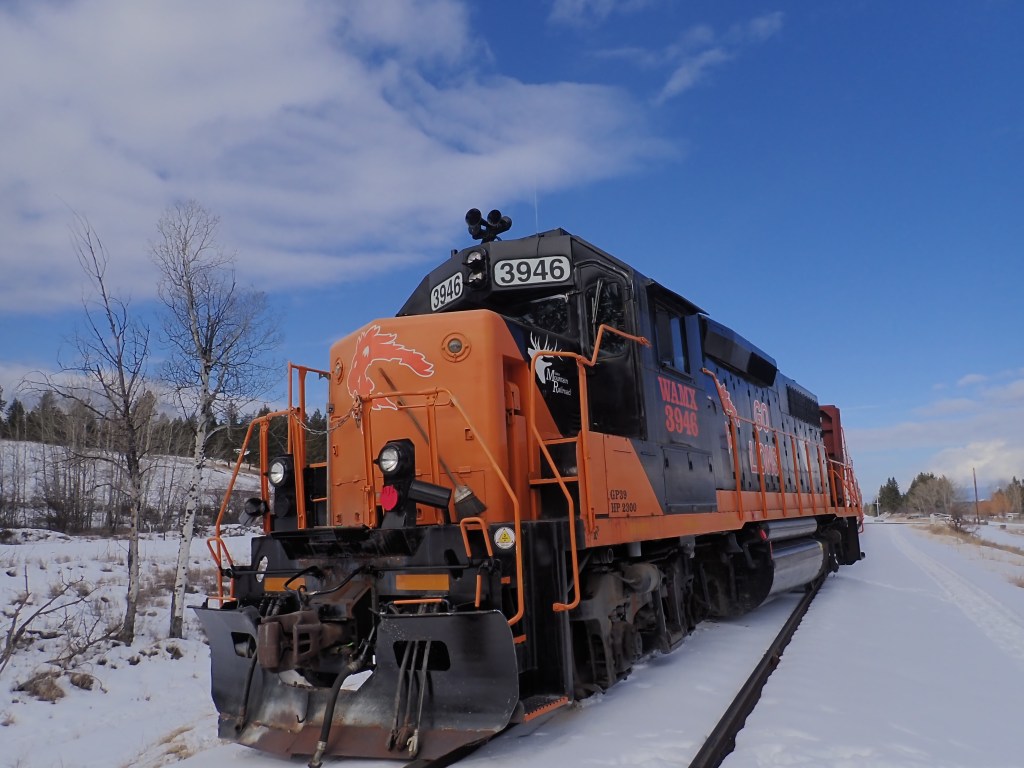
Note that BNSF is an unrelated railroad – Mission Mountain Railroad is separately administered, though it has leased line from BNSF in past. The TFS Volunteer Fire Department responded swiftly, putting up signage within 2 hrs of the incident, warning drivers of the narrowed crossing both above and below the tracks, as well as placing traffic cones at the crossing itself.

As can be seen, Trego drivers took this in stride, and made use of the 3/4ths of a lane available to them, and (cautiously) used the crossing, despite the flashing red lights of the level crossing signal. The train was hauling 5 cars of Canadian lumber southwards, and was cleared from the line by the following day. One Trego local at the scene commented that, in all his years here, that train has passed by each day without issue.
Not a bad track record – and it’d be hard to find a derailment any politer than this.

I think we’d all rather take this situation over that of East Palestine, Ohio. -
Or rather, how they should work. I should begin with the reminder that while the election should happen every year, it does not always (one might go so far as to say that having one is a rarity). Why not? Because an election is not required if there are not more candidates than vacancies. If the candidates and vacancies are equal, those running are simply elected by acclamation.
Are we going to have an election? Truly, we don’t know until the deadline for candidates to file is past, and even then, we’ll probably only have an accurate answer after the deadline to drop out of the race is past.
When will the election be? Two ways to find out:
- First: check out Montana Code Annotated and find the section determining the date
- Second: Get the Election Calendar from Montana’s Office of Public Instruction
Using the Election Calendar- because it will have the dates for this year- it appears that election day will be Tuesday, May 2nd.
Who’s responsible for arranging the election? There’s a lot of pretty specific who does what, when, information in both the law, and in OPI’s handbook. It appears the primary party is the “election administrator” which would refer to the school clerk unless the district requests otherwise (in which case, it would be the Lincoln County Election Administrator).
Who can run? Anyone registered to vote in the district (though there are some constraints on who can be a trustee- not anyone employed by the district, for example)
When can a candidate file? To be on the ballot this year, a candidate must file between December 8, 2022 and March 23, 2023.
Who can vote? To be qualified to vote the person must be
- Registered to vote as required by law
- 18 years of age or older
- A resident of the state of Montana and the county in which the district is located for at least 30 days
- A United States Citizen
- Not a felon currently in a penal institution or someone adjudicated to be of unsound mind.
Is voting in person? The laws read like it’s expected to be, but the board or election administrator can request it be done by mail, though since the deadline for that appears to be March 3rd, this year’s should be in-person.
When do we find out who won? By May 26th- which is also the date by which the trustees must hold the organizational meeting, deciding on board chair and appointing the district clerk. (Or sooner, I suppose, if there aren’t enough candidates.)
A related note: There are a lot of elections we should be having every year. You may have received your notice of the Annual Meeting for Lincoln Electric (April 1st) this year- in the past, that’s been the time when trustee elections were held. Since members voted to allow mail-in ballots, your notice included a mail-in ballot (complete by the 27th- though really, as there aren’t more candidates than vacancies, there probably isn’t much reason to do so other than the promised prize drawing).
It’s a pity so many of our elections are by acclamation- it turns elections into a rarity instead of an expectation and makes it far easier for us to forget that we are supposed to have elections. -
note that Robin Benson has asked for an additional county employee because of increasing demands on the elections department. The story (TV News, March 8, 2023) reminded me of this email I received almost a year ago (it was forwarded to me):
From: Paula Buff <pbuff@libby.org>
Sent: Thursday, April 7, 2022 4:14 PM
To: Taralee McFadden <tmcfadden@libby.org>
Cc: Robin Benson <lcclerk@libby.org>
Subject: RE: election district linesHi Tara.
I talked to Pam today and gave her a link to my elections web map.
It is a great tool and pretty intuitive. Here is the link: https://lcplanning.maps.arcgis.com/apps/webappviewer/index.html?id=08040ea8fe28444f9d6cf1cd9ee2a768
The layer list in the right hand corner will provide them with the ability to see where their school district boundaries lie and if they want to look up a specific address they just do a search in the left hand corner.
I would send them (or anyone who inquires for that matter) a link to this map.
Let me know if you need anything else.
Thanks.
Paula Buff
Lincoln County Election Administrator
512 California Ave.
Libby, MT 59923
P: 406-283-2302Shortly after sending this, Tara resigned as School Superintendent – but note that Paula stated “I would send them (or anyone who inquires for that matter) a link to this map.” With that quote, and the fact that she is a public employee, I don’t see her as having any legitimate gripe about this published in the Ear.
Click the link, and see the massive amount of data she has shared with the world – then find the red dot that shows your address. It’s a great place if you want to find the land I own, my home phone number, etc. and then move directly to collect data on my neighbor.
I clicked one open spot to find the owner’s name, address, phone number, that she lived in a brick house with an electric fence. Now Paula didn’t include that her husband is well armed and a good shot – but the Elections Board page has more potential for misuse than I have realized yet.
A friend called the elections folks, and heard that they are legally required to post all of this. Couldn’t cite the codes – and I’m pretty sure there are federal laws protecting privacy that the map violates. I do know that Paula sees no problem in ignoring subsection 7 – and I’ve got the feel that she is ignoring several state and federal laws as she shares private information about voters on the internet.
If you have been treated the same as I, registering to vote will have your name, address, phone number, etc. published for the world to see, for the telemarketer to copy, for the Chinese to download.
If you have, it’s probably time to call the county commissioners and ask that the elections department staffing level be reduced – then they won’t have time to put your personal data on a public website. The county website is https://lincolncountymt.us/ but I can’t find the commissioners numbers listed on it. Perhaps the directory would be a better place to start.
Calling Robin Benson, the County Clerk, would likely be less than helpful . . . back when they left a box of ballots at the annex in Eureka, Ms. Benson described the handling of the election as “impeccable.” In the TV News she is quoted “I have complete and total trust in every single one of my staff, 100% without hesitation.” Her recorded statements make that level of confidence seem ungrounded.
Maybe it is time to start working for county 57. The rot in County 56 goes deep.
-
I was recently reading The Coddling of the American Mind by Greg Lukianoff and Jonathan Haidt. One of the things the book describes is the increasing popularity of three “Great Untruths”. The first of those can be paraphrased “what does not kill me makes me weaker”
I first thought about the phrase “what does not kill me makes me stronger” in middle school, as my martial arts teacher was quite fond of it.
He was testing for another degree on his black belt. Part of the test went as follows: someone lay out a tarp. They put down a bunch of broken glass on the tarp. My teacher took of his shirt. He lay down so his back was over the glass and someone placed several large cement blocks on his chest. Then, a very tiny lady with a very large hammer took her best shot at breaking them. Took her a few tries. Finally, my teacher got up, and was scored by the number of pieces of glass in his back. I presumed less was better.
It was around that time that I decided that “what doesn’t kill me” could probably result in permanent injuries, and that my martial arts teacher might not be the best person to take life advice from (He also believed in “fair fights”, something my father wasn’t especially pleased by).
The actual quote is from Nietzche’s Twilight of the Idols, which is something I didn’t learn until I was older. It isn’t taken out of context per say, because there really isn’t much context. It’s the 8th entry of the section Maxims and Missiles, sandwiched between Seven: “Which is it? Is man only a blunder of God? Or is God only a blunder of man” and Nine:”Help thyself, then everyone will help thee. A principle of neighbour-love.”
As a literal truth, it’s a bit lacking, because arguably there are plenty of things that can leave a person weaker without killing him. As a metaphorical truth, however, the idea goes a bit deeper.
The challenges we overcome, physical, emotional, or intellectual do frequently leave us stronger in some sense. A debate, for example, should leave our thoughts better honed, our opinions better reasoned.
The book, The Coddling of the American Mind addresses the idea in the metaphorical. Haidt and Lukianoff state that “teaching kids that failures, insults, and painful experiences will do lasting damage is harmful in and of itself. Human beings need physical and mental challenges and stressors or we deteriorate.”
The authors believe that this has become increasingly prevalent, and it matches what I observed in college and the news as well as professionally. They are correct about humans requiring stressors; it’s the explanation behind the muscle atrophy of bedrest and the bone density loss of astronauts in space.
Avoiding physical stress results in physical weakness. Is the same true for emotional and intellectual stress? And, if it is, what the heck are we doing
-
Silicon Valley Bank biggest US lender to fail since 2008 financial crisis – a finance expert explains the impact

SVB encountered a perfect storm of high interest rates and fearful clients. AP Photo/Jeff Chiu William Chittenden, Texas State University
Silicon Valley Bank, which catered to the tech industry for three decades, collapsed on March 10, 2023, after the Santa Clara, California-based lender suffered from an old-fashioned bank run. State regulators seized the bank and made the Federal Deposit Insurance Corporation its receiver.
SVB, as it’s known, was the biggest U.S. lender to fail since the 2008 global financial crisis – and the second-biggest ever.
We asked William Chittenden, associate professor of finance at Texas State University, to explain what happened and whether Americans should be worried about the safety of their financial system.
Why did Silicon Valley Bank collapse so suddenly?
The short answer is that SVB did not have enough cash to pay depositors so the regulators closed the bank.
The longer answer begins during in the pandemic, when SVB and many other banks were raking in more deposits than they could lend out to borrowers. In 2021, deposits at SVB doubled.
But they had to do something with all that money. So, what they could not lend out, they invested in ultra-safe U.S. Treasury securities. The problem is the rapid increase in interest rates in 2022 and 2023 caused the value of these securities to plunge. A characteristic of bonds and similar securities is that when yields or interest rates go up, prices go down, and vice versa.
The bank recently said it took a US$1.8 billion hit on the sale of some of those securities and they were unable to raise capital to offset the loss as their stock began dropping. That prompted prominent venture capital firms to advise the companies they invest in to pull their business from Silicon Valley Bank. This had a snowball effect that led a growing number of SVB depositors to withdraw their money too.
The investment losses, coupled with the withdrawals, were so large that regulators had no choice but to step in to shut the bank down to protect depositors.
Are the deposits now safe?
From a practical perspective, the FDIC is now running the bank.
It is typical for the FDIC to shut a bank down on a Friday and have the bank reopen the following Monday. In this case, the FDIC has already announced that the bank will reopen on March 13 as the Deposit Insurance National Bank of Santa Clara.
At the end of 2022, SVB had $175.4 billion in deposits. It’s not clear how much of those deposits remain with the bank and how much of those are insured and 100% safe.
For depositors with $250,000 or less in cash at SVB, the FDIC said that customers will have access to all of their money when the bank reopens.
For those with uninsured deposits at SVB – basically anything above the FDIC limit of $250,000 – they may or may not receive back the rest of their money. These depositors will be given a “Receiver’s Certificate” by the FDIC for the uninsured amount of their deposits. The FDIC has already said it will pay some of the uninsured deposits by next week, with additional payments possible as the regulator liquidates SVB’s assets. But if SVB’s investments have to be sold at a significant loss, uninsured depositors may not get any additional payment.

Santa Clara Police officers exit Silicon Valley Bank. AP Photo/Jeff Chiu What was the last US bank to fail?
Prior to the failure of SVB, the most recent bank failures occurred in October 2020, when both Almena State Bank in Kansas and First City Bank of Florida were taken over by the FDIC.
Both of these banks were relatively small – with about $200 million in deposits combined.
SVB was the biggest bank to fail since September 2008, when Washington Mutual failed with $307 billion in assets. WaMu fell in the wake of investment bank Lehman Brothers’ collapse, which nearly took down the global financial system.
On the whole, U.S. bank failures aren’t all that common. For example, there were none in 2021 and 2022.
Is there any risk that more banks might fail?
At the end of 2022, SVB was the 16th-largest bank in the United States with $209 billion in assets.
That sounds like a lot – and it is – but that’s just 0.91% of all banking assets in the U.S. There is little risk that SVB’s failure will spill over to other banks.
Having said that, SVB’s collapse does highlight the risk that many banks have in their investment portfolios. If interest rates continue to rise, and the Federal Reserve has indicated that they will, the value of the investment portfolios of banks across the U.S. will continue to go down.
While these losses are just on paper – meaning they’re not realized until the assets are sold – they still can increase a bank’s overall risk. How much the risk will go up will vary from bank to bank.
The good news is that most banks currently have enough capital to absorb these losses – however large – in part because of efforts taken by the Fed after the 2008 financial crisis to ensure financial firms can weather any storm.
So rest easy for now, the banking system is sound.
William Chittenden, Associate Professor of Finance, Texas State University
This article is republished from The Conversation under a Creative Commons license. Read the original article.
-
The value of currency hasn’t been stable recently – or possibly ever.

It isn’t a lot different from Roman times
“Roman emperor Nero began debasing Roman currency around 60 AD by reducing its silver content from 100% to 90%. Over the next 150 years, the silver content was reduced to 50%. By 265 AD, the silver content was down to 5%.
When a currency is debased, and therefore loses value, sooner or later the citizenry catches on and begins demanding higher prices for the goods they sell or more wages for their work, resulting in inflation. In the case of the Roman Empire, the debasement produced annual inflation of around 1,000%.”
https://www.investopedia.com/terms/d/debasement.aspCointalk provides this chart, that shows how in times of old, you could create inflation just by adding lead to the silver when you were making coins:
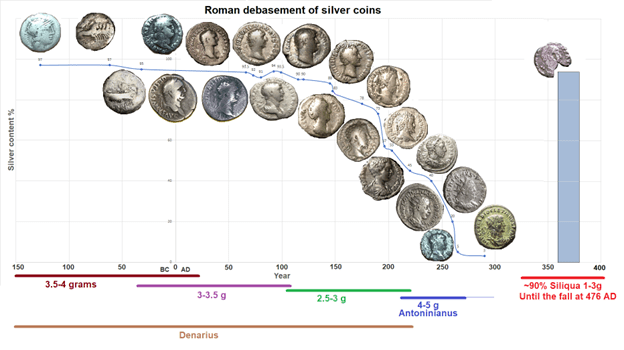
“During what is called the ‘Crisis of the Third Century’ some 200 years later, Rome experienced a period of hyperinflation, as the silver content in their currency was lowered even further. This was a time where Roman faced great economic problems, invasions and civil unrest. As a result, trade broke down and landowners could no longer export their crops or import manufactured goods. They became largely self sufficient, and food was grown for subsistence and bartering.
Government revenue was extremely low, but government spending was not. During this time, governments had additional incentive to wall-in cities, and increase the size and power of their armies to combat the invasions and civil unrest. As a result, the silver content of coins had to be reduced further to accommodate the additional spending, fueling inflation.
The situation was not helped by the fact that in just a period of 50 years, there were at least twenty-six Soldier-Emperors, who would ruthlessly assassinate the previous emperors in order to seize power, and would then need the budget to meet the demands of buying off loyalty from their soldiers. Before 300 CE, the purity had already dropped to as low as 2% silver.”
https://warwickeconomics.wordpress.com/2015/03/05/the-debasement-of-the-roman-currency/The table below came from the article linked and cited above, and was written in 2015. You can look at the prices you see today – like coffee and gasoline – and extrapolate the recent years for yourself.
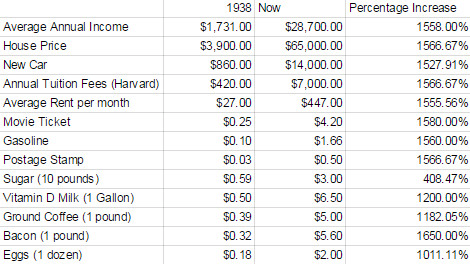
I’m a demographer, not an economist or a politician. Still, it seems like printing more money and reducing its buying power doesn’t create a lot of benefit to folks who don’t belong to the kleptocracy.
-
I don’t know how long it’s been since we actually had an election for the school board trustees. The ballots stashed in Trego School’s records date back to the 1900s. It may be that children have been born, graduated from college, certified to teach, and been granted tenure in the time since Trego’s last election. If the district doesn’t get two candidates to run, a single candidate will win “by acclamation.” Eureka already has 4 candidates running for two positions – and the LCHS board has Raymond Flanagan running for the Fortine position unopposed. Since five of the high school board positions are filled by Eureka Elementary trustees, this election cover three of the seven high school trustees. Fortine has three 3-year terms up this year, and no filings yet.
Nothing personal – but we need to get back in the habit of having elections . . . and the school district is the place to start. To run for school board, you need to be a registered voter in the school district and get your form filled out and notarized by March 23. On the other hand, if you miss getting the form in by the 23rd, you can still file as a write-in candidate until March 30 – and, in districts where we’re not accustomed to an actual election, a write-in candidate probably has as good a chance as a candidate whose name is on the ballot.
My term runs out in a little more than two years. I’d like to be the last school board member elected by “acclamation.” The lack of elections does not improve the quality of our schools.
Here are some of the laws governing school elections, the whole list is available at leg.mt.gov
Regular School Election Day And Special School Elections — Limitation — Exception
20-20-105. Regular school election day and special school elections — limitation — exception. (1) Except as provided in subsection (5), the first Tuesday after the first Monday in May of each year is the regular school election day.
(2) Except as provided in subsections (4) and (5), a proposition requesting additional funding under 20-9-353 may be submitted to the electors only once each calendar year on the regular school election day.
(3) Subject to the provisions of subsection (2), other school elections may be conducted at times determined by the trustees.
(4) In the event of an unforeseen emergency occurring on the date scheduled for the funding election pursuant to subsection (2), the district will be allowed to reschedule the election for a different day of the calendar year. As used in this section, “unforeseen emergency” has the meaning provided in 20-3-322(5).
(5) In years when the legislature meets in regular session or in a special session that affects school funding, the trustees may order an election on a date other than the regular school election day in order for the electors to consider a proposition requesting additional funding under 20-9-353.
Poll Hours
20-20-106. Poll hours. (1) The polls for any school election in any district shall open not later than noon. The trustees may order the polls to open earlier, but no earlier than 7 a.m.
(2) If the school election is held on the same day as an election held by a political subdivision and at the same polling place pursuant to 13-1-305, the polls must be opened and closed at the times required for the school election.
(3) If the school election is held on the same day as a general or primary election, the polls must be opened and closed at the times required for the general or primary election under 13-1-106.
(4) Once opened, the polls must be kept open continuously until 8 p.m., except that whenever all the registered electors at any poll have voted, the poll must be closed immediately.
Election Judges — Qualifications — Training
20-20-109. Election judges — qualifications — training. (1) Election judges must be qualified registered electors of the school district in which they serve.
(2) An election judge may not be:
(a) the candidate;
(b) an ascendant, descendant, brother, or sister of a candidate; or
(c) the spouse of the candidate or of any of the individuals listed in subsection (2)(b).
(3) School election judges must meet the training and certification requirements of 13-4-203.
There are some other laws available, but these are the significant ones.
-
Sam’s kind of slowed down during pregnancy, and asked me to attend the meeting from the Montana Election Integrity folks. I picked up some material, and had a brief, pleasant conversation with Jane Rectenwald – frankly, I liked the lady, but remember, I find most politicians easy to like.
I hadn’t been in the Timbers Lodge since the seventies, so it was pleasant going back in the building and seeing the logs supporting the roof, and that the remodeling fits well with my memories. Attendance was on the light side of fifty, and I suspect that at 73 I was probably close to the median age.
As a general rule, I’m in favor of election integrity. I also have the idea that you shouldn’t start by looking at a conspiracy where stupidity, carelessness and laziness combine to provide an adequate explanation. Yes, we’ve had some bizarre election irregularities in Lincoln County – but I’m not sure that the default position of looking at whichever election administrator is responsible as either stupid, careless, or lazy doesn’t provide an adequate explanation – though I might embrace the power of the word “and”.
Rectenwald pointed out several times that Christi Jacobsen pulled more votes than Donald Trump – and that she had never before been elected to state office. Well, the problem isn’t that an attractive, relatively unknown woman who ran a good campaign could pull more votes than Donald Trump. See, I think I voted for both of them – but the choice between Biden and Trump was what the headshrinkers call avoidance-avoidance. My distaste for Joe Biden pushed me into being a Trump voter . . . but I well understand the folks who went the other way. The ones I don’t understand are the never-trumpers and the only-trumpers.
“More Democrat votes were certified in 2020 for the Supt. of Public Instruction than for Biden for President.” I’m not a bit surprised – I’m used to having Democrats as the State Soup, and face it- Biden just doesn’t pull well in Montana.
I found the numbers interesting on Zuckerman contributions to Montana for elections – Rectenwald pointed out spots where that violates state law. According to the list of “Zuckerbucks Per Capita Used in US 2020 Election, Montana receive $2.26 per head for the counties that received Zuckerbucks. The best one was the $256,433 total received by Blaine County – which has about the same population as the Lincoln County High School district. (Yellowstone County (Billings) received $320,593). If I was trying to buy an election, I sure wouldn’t be donating a quarter of a million to Chinook – and to be fair, I did work there in the early 80’s when I was with SCS, and for some reason I had access to the indoor pistol range in the basement – a nice perk in the winter.
Now they have data from a guy named Seth Kershel who estimates excess votes for counties – and the map shows them up colored in green (which means historic voting data is consistent with 2020 results) yellow (suspect/likely fraud) and red (rampant, obvious, ugly). Lincoln County is colored yellow – but my roots go deep here – through the seventies, Lincoln County was a Union Democrat county – Republicans couldn’t win a county-wide election. Over the years, our county has moved to the Republican column – so far that on the last ballot, the general election was over at the Primary – we had no Democrat candidates. Zero. None. Nada.
As population changes, it is fairly easy to point out how elections can be expected to change. I haven’t done any detailed analysis, but a lot of our California immigrants came from Bakersfield, not San Francisco. Bakersfield leans Republican. Retirees are going to be more so. I can set up a testable hypothesis that our California immigrants have a tendency to be more to the right side of the political map. My data handling experience was predominately based around the Census – but data is data.
Montana Election Integrity has been around for about 20 years. In that length of time, we’re bound to have had some level of election chicanery. The problem is, there is nothing that is statistically impossible – merely statistically unlikely. I played pinochle in a game where I finally learned the deck was marked – one of the horses backing the jack of diamonds and one backing the queen of spades had a white blaze. The game got a lot fairer after I added about a dozen more blazes. I’ve drawn two cards and wound up with four of a kind – it’s statistically unlikely, when I was holding 3 jacks, the odds of getting the fourth was 1 out of 47. Fraud is hard to prove – and if you do have a fraudster, he can be expected to deny it. I suspect the folks at Montana Election Integrity could stand to have some better stats guy on hand.
And I still believe sub-section 7 does mandate write-in votes for positions where no one has filed are to be counted. The fact that our Election Administrator doesn’t do show doesn’t show that Paula has a conspiracy going – after all, never look for a conspiracy where stupidity, carelessness and laziness provide an adequate explanation.
Want to tell us something or ask a question? Get in touch.

Recent Posts
- Watching Iran
- The Quality of Numbers
- Robert Treat Payne Had Traveled To Greenland
- 75 Years Ago in New York
- Recovery Time for a Retiree
- Venn Diagram and DSM
- When Castro Was Cool
- You Have To Beat Darwin Every Day
- Computer Repair by Mussolini
- Getting Alberta Oil to Market
- Parties On Economics
- Thus Spake Zarathustra – One More Time

Rough Cut Lumber
Harvested as part of thinning to reduce fire danger.
$0.75 per board foot.
Call Mike (406-882-4835) or Sam (406-882-4597)
Popular Posts
Ask The Entomologist Bears Books Canada Census Community Decay Covid Covid-19 Data Deer Demography Education Elections family Firearms Game Cameras Geese Government Guns History Inflation life Lincoln County Board of Health Lincoln County MT Lincoln Electric Cooperative Montana nature News Patches' Pieces Pest Control Politics Pond Recipe School School Board Snow Taxes Teaching travel Trego Trego Montana Trego School Weather Wildlife writing
 Trego's Mountain Ear