-
When the announcement came out that the Republicans had reached the 218 number that determines control of the house of representatives, one of the first comments I saw was “They did it by Gerrymandering the districts!” accompanied by a rant on the states the evil Republicans had Gerrymandered. Now here in Montana, the eastern district is solidly Republican . . . and the numbers are more interesting:
Rosendale (Republican) 56.6%
Buchanan (Independent) 21.9%
Penny Ronning (Democrat) 20.2%
Sam Rankin (Libertarian) 1.4%
I think Democrats are as endangered on the East side as they are in Lincoln County. When an Indy and a Libertarian pull more votes than the Democrat candidate, it’s a reasonably safe bet that they pulled more votes from Rosendale than Ronning.
Our western district, on the other hand, doesn’t look particularly Gerrymandered – Zinke scored 49.6%, Tranel 46.5%, and Lamb came in with 3.9%. With the failed Libertarian candidate making up more than the difference, it doesn’t look Gerrymandered. On the other hand, if I were Zinke’s 2024 campaign manager, I’d start working on that election very soon.
Nationally, as I download the data on RealClearPolitics, it shows 53,619,512 Republican votes for Representatives have 218 Representatives and 49,947,328 Dem votes have 213. Four remain undecided – but the data is close enough to put into equations. 50.9 percent Republican, 47.5% Democrat. 218 Representatives is 50.115% of the House, 213 Representatives is 48.966%. If anything, the Dems are punching a little above their weight.
If all of the 4 remaining undecideds go to the Republicans (unlikely, my guess is no more than 3), just 51% of the Representatives will be Republicans – with 50.9% of the vote. My maximum projection is 3, for 221 . . . 50.8% of the Representatives for 50.9% of the vote. If Gerrymandering is a factor, it hit both sides equally this election.
-
The final two weeks of the Lincoln Electric members’ uprising. On one hand, the conflict was all but finished when 35 petitions with 608 signatures had been turned over on November 7. On the other hand, with the call for a special meeting, and the meeting scheduled for December 10, the conflict had a measurable timeline, and one group was going to win.
My own private calculations were that if the special meeting had only 300 members attending – still a large turnout – management would win. 400 members turning out would be close, but the win would go to CREAM. From our perspective, everything came down to turnout . . . an early December storm could keep turnout down, and attending a meeting takes more effort than signing a petition. Nobody knew what was going to happen – and it was a big issue in the Tobacco Valley, but less so among the Flathead County LEC members.
On November 28, a CREAM ad read:
“Did you know that
Lincoln Electric has over 2100 members – yet at the last annual meeting, March 12, 1988, these were the election winners totals:
James Hutchens – 73 votes
Billie Gossett – 78 votes
Dave Curtiss – 76 votes
Dale Hudson – 76 votes
Duke Baney – 77 votes
Less than 4% of the co-op’s membership is represented! Wonder why we’ve called for a special members meeting?
Concerned REA Members”
Saturday, December 10, was set for the special meeting – starting at 1:00 pm. In the Mountain Ear, I described an anonymous phone call – the article isn’t important, but the incident showed that emotions were running strong. Remember, while all this was going on, I was in a metal frame to deal with the broken back.
Eureka’s Town cop – Jerry Schmuck – greeted me in town: “What are you doing in town unarmed?” I assured him that I could put a 1911 on my belt, and went on my way.
CREAM posted
The Miller Memorandum
The subject of Monk Miller’s retirement/consultant deal has been represented as the answer to an orderly transition of power, or a sweetheart contract and ‘golden parachute.’
CREAM would like to clear up the air on this by printing Lincoln Electric’s unreleased August 17, 1988 MEMORANDUM IN REGARD TO THE STATUS OF MELVIN MILLER
After June 11, 1989 when Mr. Miller plans to retire as Manager but remain for two years there after as a consultant.
IT IS UNDERSTOOD AND AGREED:
- That Mr. Miller will remain in the Eureka area for a period of two years from and after July 11, 1989.
- During that period of two years, Mr. Miller will be available for consultation, information and advise in regard to the cooperative at all reasonable times, but will have no managerial responsibilities or duties to the cooperative.
- Mr. Miller’s appointments for consultation and advise will be arranged by the manager either for the managers own benefit or for the information of the Board; provided that, in the event the consultation is in regard to job performance and services of the manager such consultation may be set up by the president of the board.
- During the two year period, Mr. Miller will receive his regular salary as fixed on June 11, 1989 with Lincoln Electric Cooperative, Inc. and InterBel Telephone Cooperative, Inc. each being responsible for one year’s salary.
- That it is specifically understood and agreed that Mr. Miller will not in any way assume or be responsible for any managerial responsibilities or duties and will not in any way, except for advise, interfere with the management of the cooperative.
As you know, the Manager’s wages are $50,000 plus benefits. The Concerned REA Members feel that, with this copy of the memorandum to go by, you can decide for yourself whether this agreement was in the best interests of the cooperative or in the best interests of Mr. Miller.
The December 12 issue of the Mountain Ear summed up the December 10 Special meeting:
Electric Trustees Ousted
The Lincoln Electric special members meeting is now history. With about 550 members voting, the old board of trustees was voted out by a landslide 2:1 margin.
Let that say it all. The time for rhetoric is gone, and now comes the time of reality – when the new board of trustees must tackle the problem of restoring the cooperative to what the members want.
On the first ballot CREAM endorsed candidates Bill Donsbach Jr., Billie Gossett, Phyllis Hansberry, Jan Comstock, and Duke Baney easily won the ‘long’ positions (expiring in March of 1990). On the second ballot, Bill Raver, Hazel Stoken, John Hossack and Joe Jankovsky were swept into the ‘short’ positions. In a final runoff, Gib Burke was returned to his ‘short’ position.
In an organizational meeting after the election, Duke Baney was elected president of the board, with John Hossack serving as vice-president and Bill Raver being selected to serve as the board’s secretary. The new board chose to call their first meeting Tuesday, December 13, at the REA building.
Craig Eaton, chairman of the Concerned REA members acknowledged that his organization’s success was tempered with the unpleasantness of watching his father lose in his bid for re-election. After the election, he commented, “Now we’re all on the same side again.” Two days earlier, the co-op manager Melvin Miller had said about the same thing, “When this is over, we’ll all be members of the co-op.”
The Lincoln Electric members’ revolt was over.
Afterword:
The members’ revolt was a divisive time. The Monday after the special meeting, I had 31 people ask “When are we going after the telephone co-op?” It wasn’t time to continue the strife, it was time to get folks back onto the same side.
The same thing that made the cooperatives easy for management to run made the members’ revolt possible – that first generation of REA members worked to get electricity. After 40 years, it was hard to get member involvement – and the trustees trusted management. The problem with the cooperative, the problem with our schools, is that, so long as things are done kind of right, the constituents don’t get angry and throw the boards out. On the other hand, when too many things go too far wrong, the voters can, and will show up. With 550 voting, the results were never in question.
Management had divided the LEC employees – the linemen had unionized because of mistreatment. The December 26 Mountain Ear headlined “Board Hears of Unequal Treatment.” It was about an attempt to get equal treatment for other retired and retiring employees.
Could it happen again? Hegel said that history repeats itself, first as a tragedy, the second time as farce (I know, Karl Marx said it too, but Karl said it second). Times have changed – the cooperative management and trustees no longer view themselves as powerful enough to eliminate Kootenai Falls. The folks there accept that smaller role. The cooperative has grown into a mature bureaucracy – run primarily for the benefit of its employees, and the secondary purpose is providing electricity to the members.
Jerry Pournelle wrote: “Pournelle’s Iron Law of Bureaucracy states that in any bureaucratic organization there will be two kinds of people”:
First, there will be those who are devoted to the goals of the organization. Examples are dedicated classroom teachers in an educational bureaucracy, many of the engineers and launch technicians and scientists at NASA, even some agricultural scientists and advisors in the former Soviet Union collective farming administration.
Secondly, there will be those dedicated to the organization itself. Examples are many of the administrators in the education system, many professors of education, many teachers union officials, much of the NASA headquarters staff, etc.
The Iron Law states that in every case the second group will gain and keep control of the organization. It will write the rules, and control promotions within the organization.”
-
Angelo Codevilla died in a car accident about a year ago. I casually followed his writings over his last ten or 12 years – say from the time he hit retirement age until he died at 78. As an academic, his specialty was the history of spycraft. Moving into the general area of observing American government, he was observant and without equal. Here’s an excerpt of how he saw things:
“The polls quantify what any observant person can see: the division between the Ruling Class and the Country Class has overwhelmed that between Republicans and Democrats. When pollsters ask the American people whether they are likely to vote Republican or Democrat in the next presidential election, Republicans win growing pluralities. But whenever pollsters add the preferences “undecided,” “none of the above,” or “Tea Party,” these win handily, the Democrats come in second, and the Republicans trail far behind. That’s because while most of the voters who call themselves Democrats say that Democratic officials represent them well, only a fourth of the voters who identify themselves as Republicans say the same about the Republican officeholders. Hence our rulers, both Democrats and Republicans, gladden the hearts of some one-third of the electorate—most Democratic voters, plus a few Republicans. This means that Democratic politicians are the Ruling Class’ prime legitimate representatives, and that because Republican politicians are supported by only a fourth of their voters while the rest vote for them reluctantly, most are aspirants for a junior role in the Ruling Class. In short, the Ruling Class has a party: the Democrats. But some two-thirds of Americans—a few Democratic voters, most Republican voters, and all Independents—lack a vehicle in electoral politics.
Sooner or later, well or badly, that majority’s demand for representation will be filled.”
As I think back on Karl Marx, Codevilla also looks at class conflict – but a class conflict that isn’t associated with the means of production. In Karl’s day, most of the working class (the proletariat) weren’t represented. Codevilla’s comment that “two-thirds of Americans lack a vehicle in electoral politics” shows why we have folks who coalesce around a Trump or a Perot. If you would like to look at some of Codevilla’s articles, you might click on muckrack.com
-
It’s been several weeks since I first heard that Joe Cheevers died in a house fire. I waited for confirmation in an obit or a death announcement, and saw none. It’s not the norm to have a long-term Trego resident die without comment – so I’m going to share a little about the Josef Cheevers I knew.
I’ve been acquainted with Joe for over 60 years – the off and on conversations of two men whose work took them out of the Trego area for long periods of time, and returned for brief stays and eventually retirement. I recall stories of Joe working in Africa and Antarctica – places that needed his skills, but places that had some drawbacks to living there. Joe was six or eight years older than I, and I recall Dad working to get him into the Navy, and set him up to know all the knots presented in boot camp. I’ve never been certain that nudging Joe into enlistment was such a mitzvah as Dad thought it was – but I suspect it was the basis of his career operating equipment.
Visiting with Joe at the post office a couple years back, he smiled that I had remembered his horse – Joker – and remembered his name from before he entered the Navy. The obits for his sister, Susan, and brother Rocky, who attended Trego school at the same time I did are online. I can’t find any mention of Joe – and he deserves a remembrance, even if this story turns out to be it.
-
The Kingston Trio’s song, Bad Man’s Blunder, dates back to my pre-teen years: “The judge was an old man – 93 (too old, entirely too old) and I didn’t like the way the jury looked at me.” I’m well past the age of drinking whisky that’s older than I am . . . my whisky should be decades younger. And I think the politicians who get my vote should be younger, too.
Donald Trump announced a 2024 Presidential run – DOB 6/14/1946 – he’ll be 78. Joe Biden – DOB 11/20/1942 – he turned 80 last Sunday. Mitch McConnell – DOB 2/20/1942 . . . heavens, he’s even older than Slow Joe. Nancy Pelosi – DOB 3/26/1940 . . . the list can continue.
It may be spending time around the Dakota and Lakota – culturally their leadership roles are for the younger folks, while the older people become, well, elders. They have influence because of their successful experience . . . perhaps wisdom might be a better descriptor. You can grow old in that culture without becoming an elder.
In the House of Representatives, the ancient Nancy Pelosi is no anomaly. The average age is 58, and the only leadership role occupied by someone under 80 is Kevin McCarthy, the minority leader – DOB 1/26/1965. Steny Hoyer, the majority leader – DOB 6-14-1939. I don’t believe that he ever held a job outside of politics. Maxine Waters – DOB 8-15-38. The list goes on – and they can be accurately described as “Too old. Entirely too old.”
I remember when Reagan promised to take senility tests. He may have forgotten to, but he did promise. Trump actually took them. I haven’t seen where Biden has gone in for testing – but he may have forgotten. The scuttlebutt on Diane Feinstein – DOB – 6/22/1933 . . . the media is kind, using the words “cognitive decline” instead of bloody senile. Too old. Entirely too old. Still, she went into the Senate as a sharp cookie – just picture what Fetterman – DOB 8/15/69 will test at in another 20 years.
On the other hand, Alexandria Occasio-Cortes – DOB 10-13-1989 – is the youngest woman ever elected to the House. Ilhan Omar – DOB 10-04-1982 is the seventh youngest. Maybe age isn’t so much a problem. Or maybe the only way to get rid of them is term limits.
-
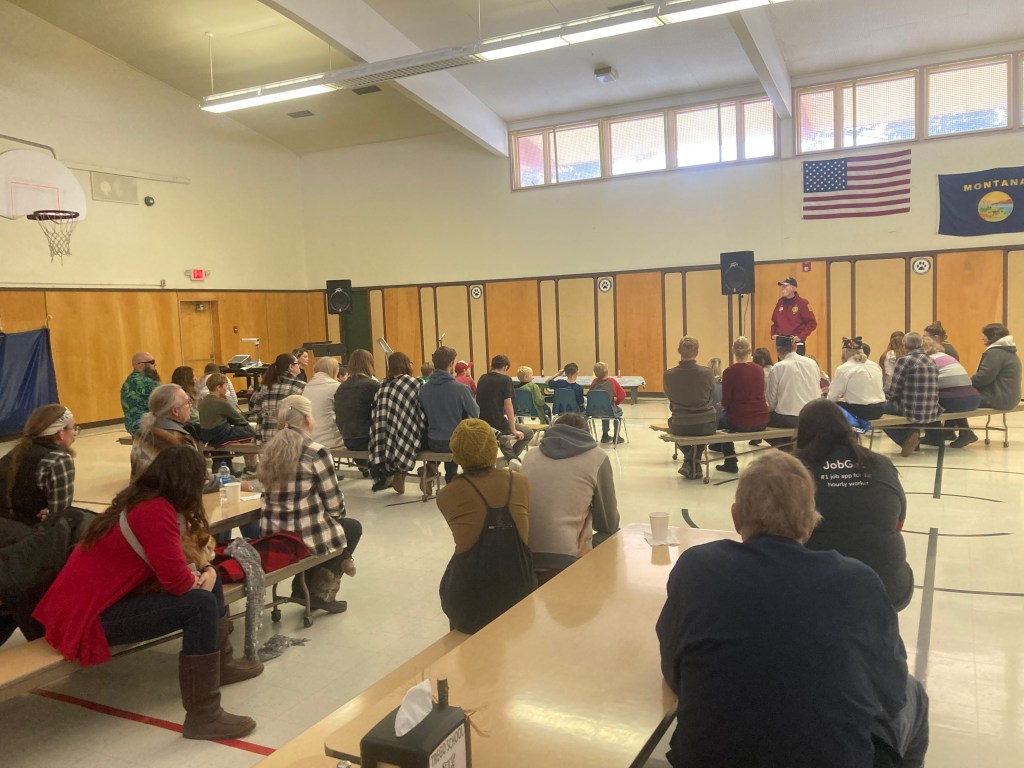
Trego School hosted our local veterans with a thanksgiving dinner with all the fixins and pumpkin pie for dessert. Following lunch, the pledge and all-school singing of the Star Spangled Banner, Trego School K-4 students honored the vets with singing My Country ‘Tis of Thee and This Land is Your Land. The 5th-6th grade students played patriotic music on the hand bells and Silas Poe, Liam Morris, and Cora Morris had solo performances on the harmonica.
Several students had prepared speeches about “What Veterans Day Means to Me” and read those. The program had two guest speakers, Colonel James Carlton and Lieutenant Colonel Dave Scott. Both speakers gave inspiring speeches about the importance of doing well in School and their experiences during their years of service.
The 5th-8th grade students prepared cards for each Vet and at the end of the program all the vets in attendance stood and the students passed out the cards. One of the attendees, Dave Scott, commented about the program: “What an amazing day! The children’s performances and speeches were spectacular!” Truth be told, the hand-made cards stole my heart.
-
I didn’t pay much attention to the idea of narcissism as a personality disorder until a whole bunch of psychs were diagnosing Trump as having a “narcissistic personality disorder.” So I checked, and the guy who edited the “Journal of Personality Disorders,” Allen Frances, said:
“We must not confuse Trump’s constant bad behavior with mental illness. That he is a world class narcissist does not prove he meets DSM criteria for “Narcissistic Personality Disorder” which require the accompanying presence of significant distress or impairment. Trump mostly causes distress in others rather than experiencing it himself and, rather than being impairing, his extravagant narcissism has gained him the presidency.”
That got me looking at narcissism. My first thought was that it would take no small amount of narcissism to even try for the office of President – whether your name was Bush, Obama, Trump or Biden. I’m no headshrinker, but some of the descriptors in DSM apply to most of our recent presidents – and definitely apply as well to Biden as Trump.
So I kept looking. They have a test for narcissism at openpsychometrics.org and it is a series of paired statements. This pair struck me as a hard choice:
The thought of ruling the world frightens the hell out of me.|
If I ruled the world it would be a better place.I would run away if a cabal of busybodies showed up for coffee and said, “Mike, we want you to run the world.” On the other hand, when I look at the guys who run a big share of the world – let’s just look at Biden and Putin – it wouldn’t be particularly difficult to match or surpass Biden’s recent economic accomplishments or Putin’s leadership in Ukraine. This isn’t an either/or choice – it’s a yes, given the quality of leaders and the multiple problems.
Mayo Clinic gives these observations about narcissists:
Symptoms
Signs and symptoms of narcissistic personality disorder and the severity of symptoms vary. People with the disorder can:
- Have an exaggerated sense of self-importance
- Have a sense of entitlement and require constant, excessive admiration
- Expect to be recognized as superior even without achievements that warrant it
- Exaggerate achievements and talents
- Be preoccupied with fantasies about success, power, brilliance, beauty or the perfect mate
- Believe they are superior and can only associate with equally special people
- Monopolize conversations and belittle or look down on people they perceive as inferior
- Expect special favors and unquestioning compliance with their expectations
- Take advantage of others to get what they want
- Have an inability or unwillingness to recognize the needs and feelings of others
- Be envious of others and believe others envy them
- Behave in an arrogant or haughty manner, coming across as conceited, boastful and pretentious
- Insist on having the best of everything — for instance, the best car or office
At the same time, people with narcissistic personality disorder have trouble handling anything they perceive as criticism, and they can:
- Become impatient or angry when they don’t receive special treatment
- Have significant interpersonal problems and easily feel slighted
- React with rage or contempt and try to belittle the other person to make themselves appear superior
- Have difficulty regulating emotions and behavior
- Experience major problems dealing with stress and adapting to change
- Feel depressed and moody because they fall short of perfection
- Have secret feelings of insecurity, shame, vulnerability and humiliation
Allen Francis reminded us that Trump had a lot of Narcissistic behaviors, but they didn’t qualify as a personality disorder. I have a hunch that it would be hard to be President without a pretty large dose of Narcissism.
-
The November 14 issue of the Mountain Ear headlined “Eaton gives Burk the Petitions”:
“Lincoln Electric’s Board of trustees met Monday night, November 7, to accept the petitions that the concerned REA members (CREAM) had circulated calling for the ouster of the trustees. The trustees, their attorney, some Co-op employees, and approximately 50 LEC members attended the brief meeting.
CREAM chairman Craig Eaton presented the 35 petitions to Board secretary Gib Burk who quipped “Ever hear of the paperwork reduction act?”
The signatures were to be reviewed the following day, and, according to our information, both sides agreed that there are sufficient valid signatures to call for the special meeting.
The meeting date will be scheduled at the next regular board meeting, on November 21. Craig has explained since that, tentatively, CREAM is anticipating the meeting will be scheduled for December 10, due to time restraints and availability of the LCHS gym.
As the meeting wound down, Duke Baney mentioned that he’d heard rumors that “(Lincoln Electric) management has threatened employees and members, and if that be the case, it should be stopped.” Co-op manager Monk Miller rose to deny that rumor, stating, among other things, “We deal with employees like we always have.” Apparently satisfied, Duke agreed, commenting, “That’s probably true.”
An advertisement from CREAM, on page 2, “Did you know that”:
“At the start of 1988, six out of ten trustees for the Lincoln Electric Cooperative had been trustees when the previous manager left in 1978? It’s not hard to see why we support an 8 year maximum term, is it.
CREAM
From “Hitting the High Points”:
“I’ve been asked, “Why have you tackled the Lincoln Electric Co-op’s management and board of trustees?”
For 25 years, off and on, I’ve watched a Lincoln Electric that was totally and irrefutably ran by the manager. The management controlled votes at the annual meeting amount to less than 10% of the membership. But that small minority shows up for every annual meeting, votes as a block, and controls the co-op.
Each annual meeting ends with the manager’s rubber stamp collection intact. Every attempt to tackle this system over the last 25 years has failed – because the manager has his own solid voting block. Most of those votes have been bought with co-op funds, one way or another.
Now, we have a chance to have the members take back our cooperative. In the past, with a large Co-op advertising budget and excruciatingly boring meetings, the LEC kept the press from reporting what they’d done. No longer is the press on the sidelines. For the first time in years, the members have two board members who know they’ve been lied to, and are angry about it. No longer do the Lincoln Electric employees stand 100% behind the manager – his capricious policies have forced the linemen to unionize for protection and even his other subordinates aren’t too solid.
The mathematics of the special meeting are simple. If less than 300 members show up, management wins. If 700 or more members show up, the members win.”
The math that I worked out was closer than that – my calculations were that, with a turnout below 300, management would win, and that if the turnout was over 400, CREAM won. Still, the calculations were based on assumptions and theory – and there is something to be said for safe predictions.
A CREAM ad pointed out the problem, with the headline “The hard part is just beginning . . . “
“Last Monday evening, the petitions calling for a special members meeting for Lincoln Electric were turned over to the trustees.
Next week, the time and place will be set for that special meeting. That meeting is just the starting place for restoring the word ‘cooperative’ in Lincoln Electric Cooperative, Inc.
Membership control means attending more annual meetings. It means being willing to serve as a trustee when your friends and neighbors ask you to help. Our proposed bylaw changes, to permit trustees to serve for 8 years will eliminate the position of ‘trustee for life’, but will require more participation from each member. We think it’s worth it.
CREAM
296-2152”
The November 21 Mountain Ear had another CREAM ad – taken from the February 15 board minutes, showing that the trustees had spent $777,747.56 of the cooperative’s funds on a project which, had it been successful, would have essentially eliminated Kootenai Falls:
“From: Lincoln Electric Minutes, February 15, 1968
Mr. Miller and Mr. Hanson then discussed a proposal for the allocation of the recovery of costs incurred on the Kootenai project. Mr. Hanson has prepared a proposal for prorating those costs over several years and the proposal has been accepted by REA.
BE IT Resolved By the Board of Trustees of Lincoln Electric . . .
THAT WHEREAS, Lincoln Electric Cooperative, Inc. was jointly involved in a feasibility study and application for a Hydro-Electric Project at Kootenai Falls, on the Kootenai River in North Western Montana, and incurred costs amounting to $777,747.56, and . . .
NOW, THEREFORE BE IT RESOLVED that the Board of Trustees doe hereby allocate $.00335 per kilowatt hour of the present rate to be set aside to amortize the costs of the Kootenai Falls Project, beginning with the year ending December 31, 1987 and continuing until such costs are fully recovered.
At CREAM, we don’t consider ¾ of a million ‘nitpicking’. It comes to $370 per member, or
8 ⅜% of of our basic rate.”
This information – that management and trustees were attempting to use coop funds to destroy Kootenai Falls – came to light after CREAM had quit collecting signatures calling for the special meeting. Today, it is even more shocking than it was 44 years ago to realize that the LEC board and management was willing to spend so much to eliminate such a resource. I’ve looked at the submerged stretch of the Missouri River that named Great Falls, and wondered what my grandfather saw there – and am pleased that we can still see Kootenai Falls.
Next Issue: Force 12: Hurricane – Only strongest structures can withstand The members meeting, and the 2:1 vote.
-
There was a time when this sort of weaponry was common – kind of like land mines, you could set the gun and wait for someone or something to come by and set it off . . . kind of like an assault burglar alarm.

Taken from Kevin O’Brien’s Weaponsman posts:
“Trap guns (which are also called “spring guns,” and other names) were common means of poacher and burglar control from the fifteenth through the 19th centuries. Basically, it’s a firearm arranged to be set up unattended and fired by a tripwire. Such a booby trap could easily be rigged with any firearm and a basic understanding of pulleys, of course, but purpose-made trap guns were cheap and low-maintenance.
Trap guns gradually fell out of favor, especially after World War II as courts came around to the idea that criminals’ rights were more important than victims’. In the USA, the key rulings were Katko v. Briney (1971) and McComb v. Connaghan (1990) in which career criminals (Katko and McComb) were held to be unlawfully killed. At least one other booby-trap dead burglar case was resolved with the acquittal of the booby-trapper, but he used electricity, not a trap gun.
Despite these rulings, trap guns and booby-traps are not banned, per se, in many jurisdictions. But it’s hard to imagine a situation in which an attorney would advise a property owner to deploy such devices. They’re a use of deadly force that is not being used to protect life and limb; they seem to fail several prongs of the use of deadly force test.”
Still, there are a lot of things that qualify as antiques and collectibles – even if they are no longer of practical use.
-
P.J. O’Rourke wrote “Don’t Vote. It only encourages the bastards.” Here, in Lincoln County, the voting process has been so finely tuned that election day is only a formality that “encourages the bastards.” It occurs not only at Libby, but even in our local elections.
Three times I’ve been “elected” to the Trego school board – once by the members of the school board, and twice “by acclamation” since nobody ran against me. In the county offices, our political placeholders run unopposed. O’Rourke was probably right – the purpose of our elections can be nothing more than encouraging the bastards.
I saw a meme this morning:

I think of the election of 2016 – when voters had to choose between Hillary Clinton and Donald Trump. I voted for (what I saw) as the lesser evil. Folks who voted the other way did the same. In 2020, I had another opportunity to vote for the lesser evil . . . as did folks who voted the other way. I don’t write off friends because we disagree on which is the lesser evil.
I noticed the Nevada results, when the Dims tied up the majority in the Senate. Ignore the winner – the truly great listing is this:
None Of These Candidates OTH 12,070 1.21% Here, our election officials have mastered the art of the choiceless election – in Nevada, a little over one percent of the population voted for “None of These Candidates.” It’s not worth moving to Nevada to get that privilege.
From school board to the state House and Senate, Lincoln County has grown into the choiceless election. On the other hand, the folks in Pennsylvania had a Fetterman-Oz choice – much the same as we had in 2016 and 2020 for President. I have friends who voted for Trump. I have friends who voted for Hillary, and for Biden. It shouldn’t be necessary to hold your nose when you mark a ballot.

Want to tell us something or ask a question? Get in touch.

Recent Posts
- The Density of Water Explains When Dickey Lake Freezes
- Watching Iran
- The Quality of Numbers
- Robert Treat Payne Had Traveled To Greenland
- 75 Years Ago in New York
- Recovery Time for a Retiree
- Venn Diagram and DSM
- When Castro Was Cool
- You Have To Beat Darwin Every Day
- Computer Repair by Mussolini
- Getting Alberta Oil to Market
- Parties On Economics

Rough Cut Lumber
Harvested as part of thinning to reduce fire danger.
$0.75 per board foot.
Call Mike (406-882-4835) or Sam (406-882-4597)
Popular Posts
Ask The Entomologist Bears Books Canada Census Community Decay Covid Covid-19 Data Deer Demography Education Elections family Firearms Game Cameras Geese Government Guns History Inflation life Lincoln County Board of Health Lincoln County MT Lincoln Electric Cooperative Montana nature News Patches' Pieces Pest Control Politics Pond Recipe School School Board Snow Taxes Teaching travel Trego Trego Montana Trego School Weather Wildlife writing
 Trego's Mountain Ear