-
Time on the school board has brought building maintenance and neglect thereof to my mind. Unfortunately, the only school that has done a respectable job is Fortine. Here at Trego, we received a new school at Federal expense in the mid-sixties so that the community would be capable of serving the many kids who came in with parents working on the tunnel and railroad relocation. Fifty years went by without establishing a building reserve fund or a maintenance schedule. A new building doesn’t need much maintenance – but planning for maintenance, scheduling maintenance, and having a building reserve to pay for maintenance keeps from having to call for a special levy and passing a bond. We have started the building reserve fund – but it should have been started at least 25 years earlier.
It’s easy to defer maintenance. There is always someone who needs money for a different purpose – and the building stands quietly when it is short-changed. I have a lot of respect for the school boards that stay conscious of the fact that it’s cheaper (in the long run) to maintain the school than go to the voters to authorize a bond to build a new one.
So I’m reading the Tobacco Valley News, and I notice that we’re not alone – Rebecca Nelson’s article (p5, V62, I42) tells of Eureka’s woes:
“Mepham said he believed the bond wouldn’t have passed, but that the district absolutely needs new buildings. “To put all our money into one K-4 building with the idea that someday we’re gonna get some more money and put it into the junior high, that’s good in theory, but the bottom line is, that means the junior high would have to make 20 more years in the condition it’s in.” he said.
Mepham reminded the board of a 2007 facilities report which he said essentially put the junior high as the worst facility in Montana, with the elementary close behind. Now the most urgent needs are for a boiler at the junior high and a roof for the high school, each with a price tag of at least a quarter of a million dollars. “We’re going to nickel and dime this district to death.” he said.”
Tobacco Valley News, article by Rebecca NelsonThat’s an interesting choice of words – the purpose of a building reserve fund is to accumulate nickels and dimes so that the school can have the funds to pay for maintenance projects as they are needed – without passing special levies.
Mepham acknowledged the restrictions of the elementary district’s bonding capacity and rising construction costs, and suggested it might be good to think outside the box and make use of the higher bonding capacity of the high school district, to build a new high school and junior high and remodel the current high school as an elementary.”
Tobacco Valley News, article by Rebecca NelsonI’m not sure that turning Lincoln County High School into an elementary is out of the box thinking. There was a boiler in the building when I attended LCHS, and I have a strong suspicion that folks thought outside the box and made use of the higher bonding capacity of the high school district then remodeled my old school into Eureka Middle School. If I’m reading the tea leaves correctly, Superintendent Mepham wants to get the taxpayers of Trego and Fortine to help pay for a new high school so that the old one can go to replace the unmaintained buildings in Eureka. Sweet Jesus, Mepham, can’t you even bring a box of chocolates first?
Darris Flanagan’s book: Eureka Montana Standing the Tests of Time, on p.20 tells of the origins of this “outside the box” scheme: “In 1955 a new grade school was built. A major administration change occurred in when a joint board with LCHS and Roosevelt Grade School operating together just as they still do today. Voting is complicated with Trego and Fortine board members voting only when an item concerns the high school.”
I think that translates something like “The LCHS board members from Eureka can outvote the two from Trego and Fortine.” It’s good to get a little bit of a heads-up before they come to us with a tax levy for a bigger bond.
Flanagan also pointed out “In 1955 a new grade school was built.” That’s less than a dozen years older than Trego. I’m not sure that we shouldn’t be looking at building a high school in Fortine – they have a record of maintaining their buildings.
-
I saw a vague statistic the other day – an estimate that between 46 million and 93 million Americans are descended from homesteaders. The number seems low – but my work experience is in the West . . . I have received a few paychecks from Minnesota, but most of my working life has been in Montana, Colorado, and South Dakota. I suspect that, at least in Montana and South Dakota, the majority of my coworkers had homesteader grandparents and great-grandparents.
My maternal great-grandparents had a story about Sitting Bull and his two wives stopping by their homestead right after my grandmother was born. The dates of her birth and his death make the story possible, but don’t verify. At the least, she was born in the same area and time where Sitting Bull was for the last year of his life. My maternal great-grandparents were homesteaders, My grandfather homesteaded in North Dakota, then finished proving up on two homesteads (which he bought) in Trego. There is a special place for the legislation that authorized both homesteading and the land grant colleges – they were passed at a time when most of the Democrat legislators were in Richmond, not Washington.
The Homestead Act granted free land – but the homesteader had to live on that tract, raise a crop and build a house. I’ve seen the log cabins and soddies that were their initial homes, and realize how limited the toolbox on the homestead was. Yet the risks and hardships associated with the homesteading movement are the basis real estate investment for about a tenth of the land in the United States. Not a tenth of the private land – a tenth of the total land mass.

Checking the records in South Dakota, I learned that the majority of female homesteaders near my home were Indian women – not all tribes received reservations, and these Indian women didn’t wait until 1924 for the rights of US citizenship – they were recognized as citizens upon proving up their homesteads. Single women, white or Indian, former slaves, immigrants, all could qualify for homesteads.
Not all succeeded. Along the Milk River, that reliable water source also brought disease – typhus if memory serves correctly. Homesteads were being claimed when Custer was still on active duty. Risks from all sources were high. Yet the Homestead Act gave Americans of all backgrounds the opportunity to risk it all for the chance to become landowners.
Some died. Some gave up, sold the homestead and found a job in town. Some became landowners – property owners. The Homestead Act provided a framework for upward mobility in rural America. That opportunity to choose risk and hard work as a way to property doesn’t exist in today’s risk averse society.
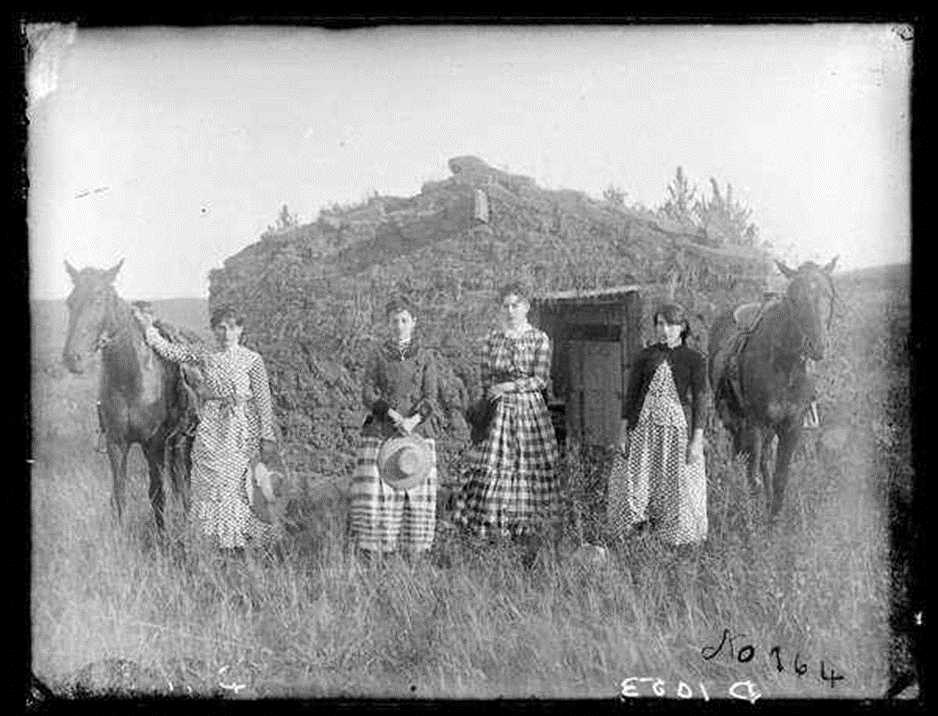
I think we’ve lost that link with the homesteaders – when my grandparents moved to Trego, their neighbors were people like them, homesteading to become property owners and eking out a living until the land became their own. My last link with that generation went with the passing of Loretta Todd – I doubt if she ever realized that her comments on “Fahlgren’s Pond” were my last touch with a grandfather who died before my fifth birthday.
-
Part of Trego School’s playground was leased to the school in 1960 in return for water. It makes a lot more sense if we go back in time and figure out what was going on in the fifties.
Electricity was new, and the closest telephone was at Osler Brothers sawmill, just north of Mud Creek. The general land price at the time was $30 per acre . . . less if you weren’t looking at the more desirable downtown Trego locations.
From the documents, it looks like the school got electricity, drilled a well, added wiring and plumbing to the school, and then thought “a bigger playground would be nice.” The neighbors to the north, Bill and Madeline Opelt thought “Water would be nice.” So a trade was made – in return for a 99 year lease for an acre of playground – relatively flat – the school would provide water for 99 years to the Opelt family, their heirs and assigns.

Trego School is on a 4.64 acre (rectangular) parcel. The area the school leases (highlighted yellow) is about .9 acres. The playground is located behind the school and includes swings, a slide, monkey-bars and several large tires, painted and partially buried Originally, the water went to the horse trough, not the house. Bill had three elderly work horses that he called appaloosas – while they had the spots, they were definitely draft horses, and I didn’t realize the history that they represented for years – until I took a job at Chinook, near the Bear’s Paw Battlefield, and learned of the glorious military efforts of the Montana State militia at that location. As near as I recall the story, the militia was tasked with running off the Nez Perce horse herd . . . and once they got them moving, drove them southeast to Billings or some such location, and sent them through the auction. The Nez Perce mares were crossed with draft stallions, and provided work horses across Montana. Bill may not have known the whole story, but he was right – his horses were descendents of the Nez Perce Appaloosas.
I could end the story there – Bill wasn’t interested in putting the water indoors. He explained how he had a deep hole under his outhouse, with even deeper poles under each corner, and nobody could tip it over. It wasn’t an argument that I would have used – but I was raised around flush toilets and kind of bigoted. Bill later lost his vision – as I recall he took a fall after cataract surgery. He was one of our last veterans of World War I.
It looks to me that on January 22, 2059, much of the school’s playground will go back to the assigns of the Opelts.
-
Depression occurs after brain injuries so frequently that screening for it should be common practice. It’s logical, to an extent. Who wouldn’t be sad, after a brain injury?
Sounds simple-it is- and it’s also inaccurate. To assume that the depression (which has a symptom list far longer than simple sadness) is caused simply by the psychological effects of the injury is a dangerous misconception. Could it be? Perhaps- having a brain injury is living with a list of things you can no longer do. But humans are resilient.
Life is difficult, and often tragic. To some extent, the wonder isn’t at the high rates of depression, it’s how low they are when we consider the state of human existence (which, arguably, is better than it has been for much of human history, at least within industrial nations).
The numbers: Mayo Clinic says that people who have had traumatic brain injuries (TBIs) are between 2 and 5 times more likely to suffer from major depression. Another source, says that half the people with TBIs will develop depression within the year of the injury, and 2/3rds of them will have it within seven years.
Why the wait? Compare the symptoms. While every brain injury is unique, there are common symptoms between the two. When the symptoms don’t improve, the diagnosis of depression should follow. I suspect that the numbers are on the low side- after all, not everyone gets the diagnosis, even if they qualify.
We don’t know all that much about how the brain works, not well enough to treat it when things go wrong. In a brain injury, they can go wrong at a neurochemical level. Some neurotransmitters rise (is it protective? In some cases, high amounts cause damage…) and other neurotransmitters fall. We don’t necessarily know why, or what the effects are. And, each brain injury is different. Each brain is different, to some degree.
What we do know is that a brain injury can damage neurotransmitter systems. Looking at just one- dopamine- studies show that the dopaminergic system is affected in a significant number of patients. What is the difference between a dopamine deficiency and clinical depression? Low levels of dopamine are associated with an incredibly long list of symptoms, varying on the cause of the deficiency; It shares symptoms with both Parkinson’s Disease, and Depression.
There’s a very real possibility that the link between depression and brain injuries is caused by the damage to the neurotransmitter systems within the brain.
-
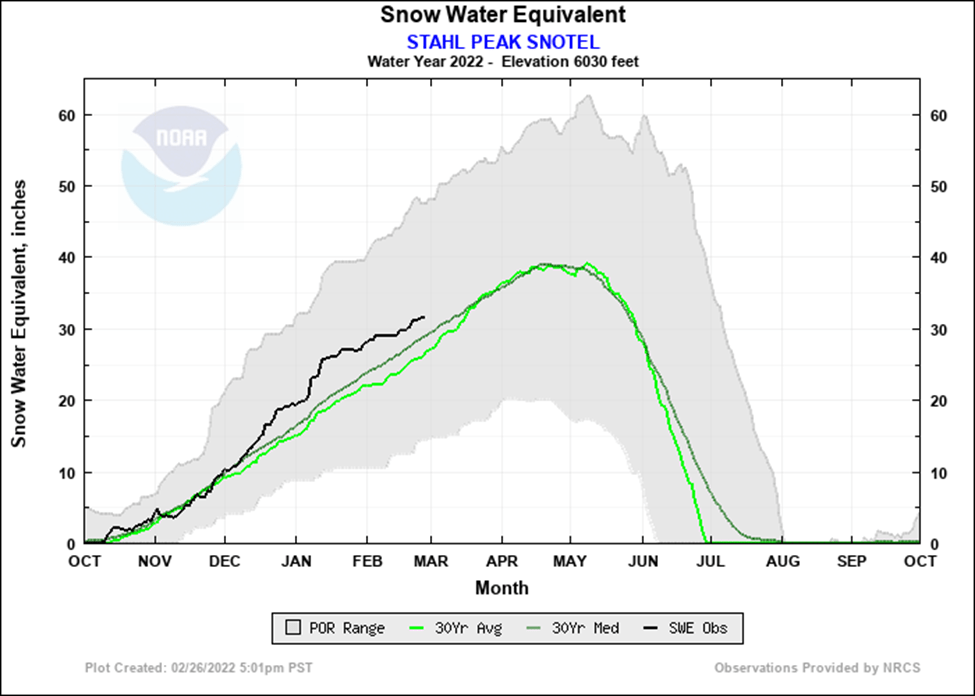
Stahl Peak’s snow pillow continues to report that the snowpack is above the long-term average:

The three month outlook (March/April/May) has temperatures leaning below normal and precipitation leaning above. Looking at further predictions, the forecast for the longer term has temperatures above average and precipitation below. In other words, starting out wetter and colder than usual, and being hotter and dryer by the June/July/August forecast.
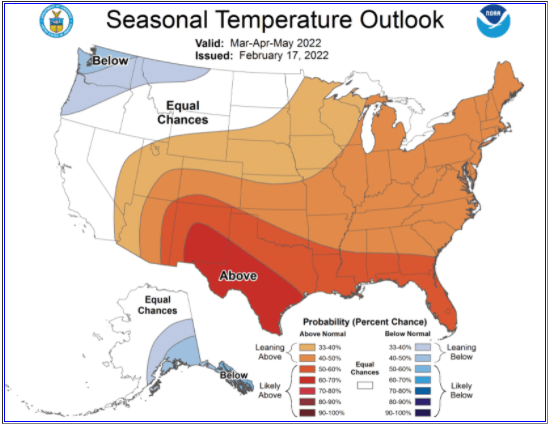
Temperature is leaning below normal 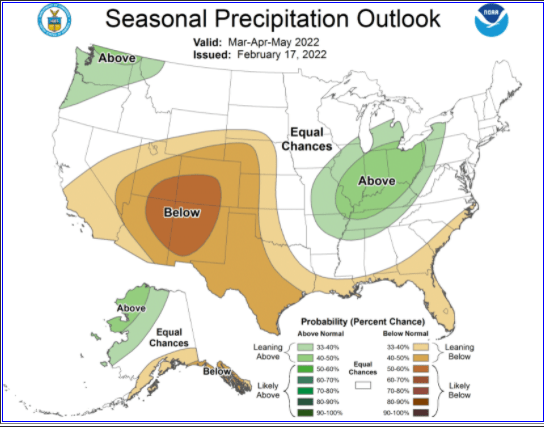
Precipitation is leaning above normal -
On Presidents Day (that was Washington’s Birthday in my youth) I read and realized that day, in Manitoba, memorializes Louis Riel. Living adjacent to Canada, we need to take the time to learn a bit of our northern neighbor’s history – and Louis Riel looms large in Canadian history, and even had a small role in Montana history.
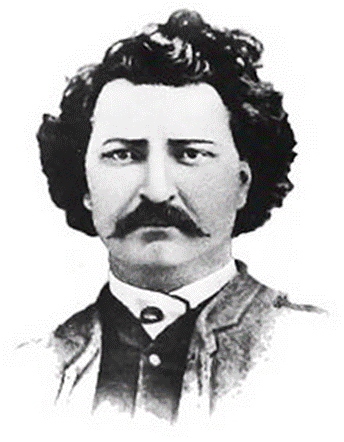
Wikipedia opens its description of Riel with “Louis Riel; 22 October 1844 – 16 November 1885) was a Canadian politician, a founder of the province of Manitoba, and a political leader of the Métis people. He led two resistance movements against the Government of Canada and its first prime minister, John A. Macdonald. Riel sought to defend Métis rights and identity as the Northwest Territories came progressively under the Canadian sphere of influence.”
True, so far as it goes – but Riel’s story not only could fill books – it does fill books. Strange Empire: Louis Riel and the Metis People, by Joseph Kinsey Howard remains available and in print – durable for a book that I first read almost 60 years ago.
There is a tendency to view the Metis as the children of French trappers and Indian women who lived among the tribes – but that simplified view ignores the Scots and English who moved the fur trade west with the Northwest Company – men who imported teachers from Scotland to run finishing schools for their daughters. Education was expected for their sons – and, while some of the Metis lived among the tribes, many were educated men who lived in two cultures as “civilization” moved west. Louis Riel was one – he was from the Red River community, attended school there, and at 14 was sent to the seminary in Montreal. He left the seminary (broke) at his father’s death, found a job as a law clerk, decided he didn’t like the idea of law as a profession, and returned to the Red River community, just as surveyors arrived to put it on the rectangular coordinate system (yeah, US surveyors using the system they were accustomed to using). The metis (including Riel) stopped the survey, and, by the time it was over, formed their own government – Assiniboia – which operated for about 3 months with Louis Riel as president. Delegates went to Ottawa, met with the Prime Minister, and hashed out an agreement for the province of Manitoba.
Unfortunately, in his brief term as president, Riel had authorized a firing squad for a Canadian named Thomas Scott – and his delegates hadn’t managed to get an amnesty included in the act creating Manitoba. Riel found it safer to go south and avoid the Canadian militia.
There has to be an Irish influence in most Metis stories – in this case, it was the threat of Fenians invading from North Dakota that got the authorities to rescind the hit, and brought Louis Riel back to raise a couple companies of Metis to hold off a Fenian invasion. A grateful Canada kept the warrant open and sent him back stateside with $1,000. He didn’t stay south of 49, returned to Red River, and was elected to parliament. Since the premier of Ontario funded a $5,000 reward for his arrest, Louis Riel chose not to sit in Parliament. In 1875, he was offered a pardon for Scott’s killing if he would stay out of Canada – which is where his Montana connection comes in – he taught school in northeast Montana, married, became a Republican, sued the democrats for election fraud, and became a US citizen. These accomplishments are not necessarily in order because it’s over half a century since I read the book.
By 1884, the buffalo were gone, the Metis were hungry and in rebellion, and they sent for Louis Riel to return north. In 1885, they declared the Provisional Government of Saskatchewan, with Louis Riel as civilian leader and Gabriel Dumont as military head.
I’ll end with a quote from wiki – my memory of the section on his trial isn’t that solid:
“Several individuals closely tied to the government requested that the trial be held in Winnipeg in July 1885. Some historians contend that the trial was moved to Regina because of concerns with the possibility of an ethnically mixed and sympathetic jury. Prime Minister Macdonald ordered the trial to be convened in Regina, where Riel was tried before a jury of six Anglophone Protestants. The trial began on 20 July 1885.
Riel delivered two long speeches during his trial, defending his own actions and affirming the rights of the Métis people. He rejected his lawyers’ attempt to argue that he was not guilty by reason of insanity. The jury found him guilty but recommended mercy; nonetheless, Judge Hugh Richardson sentenced him to death on 1 August 1885, with the date of his execution initially set for 18 September 1885. “We tried Riel for treason,” one juror later said, “And he was hanged for the murder of Scott.” Lewis Thomas notes that “the government’s conduct of the case was to be a travesty of justice”.”
wikipedia.orgIt’s probably enough to say that they didn’t give him a good drop.
-
How different is the United States from Canada? With the recent declaration of National Emergency by Prime Minister Trudeau, I’ve been curious about how National Emergencies work within the United States. Comparing the requirements of Canada’s Emergency Act with that of the United States shows that Canada has much more precise definitions, requirements for oversight and time constraints.
United States Canada The United States has no definition for an emergency in the Emergency Act (We do not have a definition written into our laws) A national emergency is temporary, urgent and critical. It either seriously endangers Canadians and is more than what a province can handle or it “seriously threatens the ability of the government to preserve the sovereignty, security and territorial integrity of Canada” Declared by the President, or by Congress Declared by the Governor in Council (which, translates to the Prime Minister and his Cabinet) Not divided by type, since it isn’t defined. But there are some sort-of type specific laws, such as the Public health Service Act and the Disaster Relief Act and the International Emergency Economic Powers Act Divided into Four Types of Emergencies
-A Public Welfare Emergency
-A Public Order Emergency
-An International Emergency
-A War EmergencyThe President isn’t required by law to consult anyone. The state Governors can request a declaration of National Emergency. Provincial Governments must be consulted before the emergency is declared The President must publish the proclamation of National Emergency immediately in the Federal Register A motion for the confirmation of emergency (with an explanation and a report on the consultation with the provincial governments) must be provided to Parliament within seven sitting days No more than six months after declaration, congress must vote to determine whether or not to terminate the emergency Parliament must vote to confirm (or not confirm) the Declaration of National Emergency The President can declare the National Emergency over The Governor in Council may declare the National Emergency over Congress must consider terminating the emergency every six months the emergency continues.
It may also vote to end the National Emergency at any time (Provided it makes it through committee)Parliament must vote on continuing the declaration of emergency each time it is requested (every 30-120 days, depending on the type of emergency.
It may also vote to end the National Emergency at any time (provided sufficient people sign the motion)The President can declare the National Emergency will continue in the ninety days before it automatically expires At any time before the automatic expiration, the government may continue the declaration (and parliament must vote on it) The National Emergency expires automatically after a year Automatic Expiration date dependent on type: Public Welfare Emergency expires in 90 days (unless renewed), a Public Order Emergency expires in 30 days, an International Emergency expires in 60 days, and a War Emergency expires in 120 days President must maintain a file of all significant orders issued during the emergency and provide copies to congress promptly Any government actions to respond to the emergency must be tabled in Parliament two days after they are issued. Parliament must establish a committee to review them. *Not a legal scholar of any kind- so there’s always the possibility of mistakes. There is the additional difficulty that being unfamiliar with Canadian Government presents. In Canada, a national emergency is clearly defined, while in the United States the definition a national emergency is far more nebulous. The President of the United States is subject to fewer time constraints and overall less explicit oversight.
That doesn’t mean the President has more powers. Upon examination of those, it’s evident that the Canadian Prime Minister has far broader powers in the event of an emergency.
-
There are few meals more easily assembled than a can of soup. Anymore you don’t even need a can opener – a lot of them come with a pull ring. Unfortunately, if that’s as far as you go, it isn’t that great a meal.
I shared Mom’s quick technique for improving chicken and noodles with Sam – and she asked if I could go through all I could remember. Mom’s mastery of basing the soup off a can meant that getting a couple unanticipated dinner guests was never a problem. A hearty soup would go along with slightly smaller portions and everyone would be happy and well fed.
That can of chicken noodle soup is a pretty thin meal – but half a handful of dried onions, a carved up carrot and a small can of chicken turns it into something resembling a meal. A can of tomato soup, accompanied by a can of milk and a can of diced tomatoes (preferably with a bit of peppers) turns it into a near-great tomato soup. We’re 500 miles from the sea, so there’s nothing wrong with beginning your clam chowder with a can, adding another can of clams, and making a decent clam chowder – decent only, because fresh clams are definitely better, but not available in the rural Rock Mountains.
She knew how to use cans to improve the quality of soup – that and a few other tricks. I’ve picked up a few of them.
-
The recent headlines in Canada have had me wondering about National Emergencies on this side of the line. I was very shocked to discover, in my initial search a Wikipedia page seventy plus entries long of national emergencies. When did these happen? Why didn’t I know about them?
Did you know it was a National Emergency that recently resulted in the transfer of all US-held assets of Da Afghanistan Bank to the Federal Reserve Bank of New York? Apparently it’s authorized by the International Emergency Economic Powers Act, and the National Emergencies Act, as well as some of the United States Code. This is only the most recent “National Emergency” that Wikipedia lists, there are plenty of others, going back as far as 1917. It’s not entirely clear how many are active- Wikipedia says 40, ABC News listed 31 back in 2017, either way, the answer is a lot. Canada only has one at the moment.
I’ve griped before, about the difficulty in keeping track of the sheer volume of laws and regulations in the United States- so in some sense, it isn’t a surprise that we have a number of laws concerning emergencies of which I was unaware.
After President trump declared a National Emergency in 2019 in order to build a wall along the southern border, the Brennan Center published some tables outlining the powers that a President has in the event of a national emergency and the laws that grant them.
Their list of Emergency Framework Statues includes:
- National Emergencies Act (1976)
- Public Health Service Act (1944)
- Robert T. Stafford Disaster Relief and Emergency Assistance Act (1988)
The Brennan Center identified 123 statutory powers that become available to the president when he declares a national emergency; Wikipedia suggests that 500 federal laws take effect when a National Emergency is declared.
Interesting, but where is a national emergency defined? What is it? In the United States, there is no legal definition for National Emergency. It isn’t defined explicitly by law, which means it falls into the confusing category of something defined by argument, precedent, court rulings, and such. The President can declare one, as can congress, and governors can petition the president to declare one.
So, with no clear definition to determine when a National Emergency Starts- perhaps we can at least find out when one ends?
In the National Emergencies Act the emergency ends when a law is passed by congress saying it ends, or when the president declares that it is ended. Also, Congress must, within six months, vote to determine whether the emergency will end. If no one ends it- it will end a year from when it began, unless the president says that it will continue.
How do we have so many? Because sitting presidents keep renewing them. We don’t place a lot of constraints on the declaration of National Emergency, but arguably we also don’t grant the sort of sweeping powers that the Canadian Emergency Act does.
-
How different is the United States from Canada? With the recent declaration of National Emergency by Prime Minister Trudeau, there’s a fair bit of discussion concerning the exact powers he is granted in the event of a National Emergency.
Since the Canadian Government’s Powers depend on the type of emergency, I’ll compare with a Public Order Emergency, as that is the type in the news currently. Because the National Emergencies Act provides the US President with 126 powers that don’t require a vote from congress (and an additional thirteen that do), I’ll only list the ones comparable to those of Canada.
United States: National Emergency Canada: Public Order Emergency – Didn’t find anything close to that The Government may regulate or prohibit “any public assembly that may reasonably be expected to lead to a breach of the peace” -There are some provisions about not going in certain areas, but otherwise not much along these lines The Government may regulate or prohibit “travel to, from or within any specified area” Under the International Emergency Economic Powers Act, the president can block and freeze assets
During war, transfer of boats to non-citizens can require consent from the secretary of transportation. They also can’t be built for non-citizens.
Atomic Energy Commission may suspect atomic energy licenses if necessary to the common defense and security
Secretary of Transportation may requisition a vessel owned by US citizensThe Government may regulate or prohibit “the use of specified property” Criminal provisions of the Espionage Act extend to prohibited places (with some caveats) The Government may make orders or regulations with respect to “the designation and securing of protected places” President may allocate coal and require the transportation thereof for the use of any electric powerplant or fuel burning installation… The Government may make orders or regulations with respect to “the assumption of the control, and the restoration and maintenance, of public utilities and services” In national defense, members of the military can be kept working after their service expires. Reserves can be called to active duty.
President may suspend provisions related to labor management relations with respect to any post. bureau. office or activity of the Department of State
President may implement alternate pay adjustments for members of the uniformed servicesThe Government may make orders or regulations with respect to “the authorization of or direction to any person, or any person of a class of persons, to render essential services of a type that that person, or a person of that class, is competent to provide and the provision of reasonable compensation in respect of services so rendered” President may impose fees and limitations on the importation of certain agricultural products The Government may make orders or regulations with respect to the imposition “on summary conviction, of a fine not exceeding five hundred dollars or imprisonment not exceeding six months or both that fine and imprisonment” for not following any order/regulation from the declaration of National Emergency Maybe the provision about applying the espionage act? There really wasn’t anything else that was similar. The Government may make orders or regulations with respect to the imposition ” on indictment, of a fine not exceeding five thousand dollars or imprisonment not exceeding five years or both that fine and imprisonment” for not following any order/regulation from the declaration of National Emergency In short, while the US President is granted many more specific powers, they are just that, specific. The majority apply only to emergencies that are war or national security- though those do suggest that anyone who has ever served in the military, retired or otherwise, could be called to serve. Other than that, most of them are simply “you have permission to skip this batch of bureaucratic paperwork and just do things” in nature.
The only really broad powers the President has come from the International Emergency Economic Powers Act, which does allow for asset seizure, bank account freezing and the like. It can only be enacted in the event of an international emergency, but is still well worth watching.
Very few of the powers allotted the US President, in event of a national emergency, are anywhere near as sweeping as those the Canadian Government possesses. While the Canadian government is more limited in the length of an emergency, and by the definition of an emergency, its powers are far greater and broader than those of the United States.
The United States allows the President broad freedom to declare an emergency, but precisely limits his power. Canada limits the declaration of an emergency, but provides sweeping powers. It’s worth remembering that Canada is a Constitutional Monarchy
Want to tell us something or ask a question? Get in touch.

Recent Posts
- Voting Yourself In
- A Few Charts and Trends
- The Density of Water Explains When Dickey Lake Freezes
- Watching Iran
- The Quality of Numbers
- Robert Treat Payne Had Traveled To Greenland
- 75 Years Ago in New York
- Recovery Time for a Retiree
- Venn Diagram and DSM
- When Castro Was Cool
- You Have To Beat Darwin Every Day
- Computer Repair by Mussolini
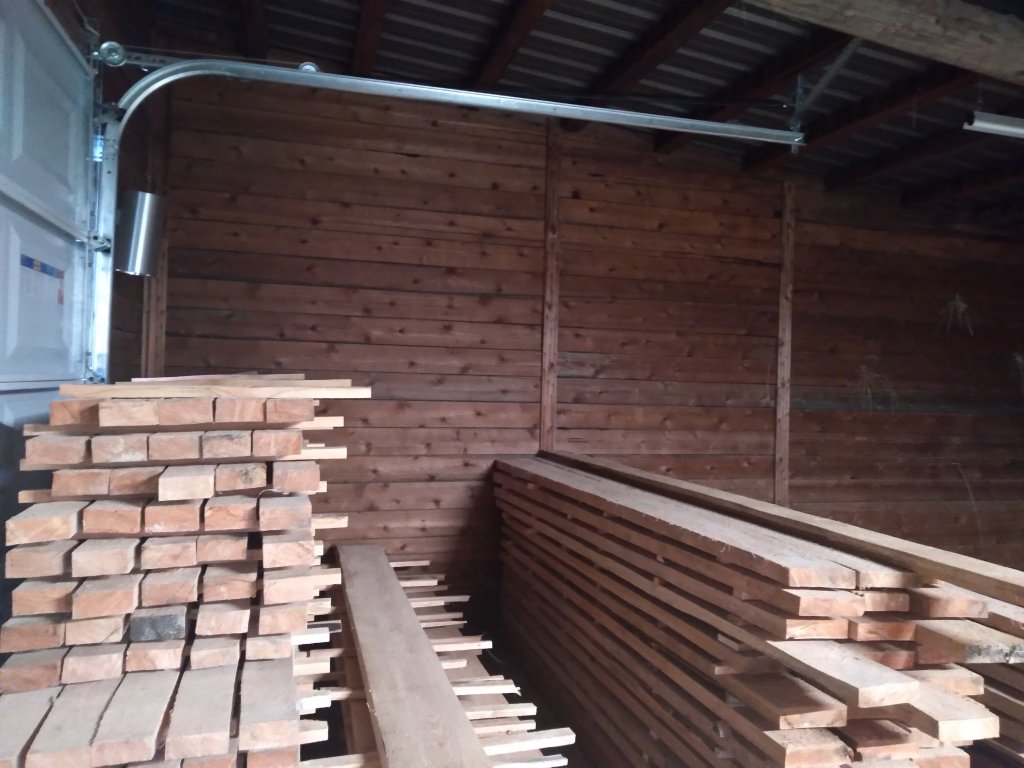
Rough Cut Lumber
Harvested as part of thinning to reduce fire danger.
$0.75 per board foot.
Call Mike (406-882-4835) or Sam (406-882-4597)
Popular Posts
Ask The Entomologist Bears Books Canada Census Community Decay Covid Covid-19 Data Deer Demography Education Elections family Firearms Game Cameras Geese Government Guns History Inflation life Lincoln County Board of Health Lincoln County MT Lincoln Electric Cooperative Montana nature News Patches' Pieces Pest Control Politics Pond Recipe School School Board Snow Taxes Teaching travel Trego Trego Montana Trego School Weather Wildlife writing
 Trego's Mountain Ear