-
I never paid a lot of attention to the fifth amendment – but I listened to a podcast by a guy named William Kirk, about a potential Supreme Court case on the bump stock ban – and it isn’t a second amendment case, it’s a fifth amendment case.
Here’s the whole fifth amendment: “No person shall be held to answer for a capital, or otherwise infamous crime, unless on a presentment or indictment of a grand jury, except in cases arising in the land or naval forces, or in the militia, when in actual service in time of war or public danger; nor shall any person be subject for the same offense to be twice put in jeopardy of life or limb; nor shall be compelled in any criminal case to be a witness against himself, nor be deprived of life, liberty, or property, without due process of law; nor shall private property be taken for public use, without just compensation.”
The case is McCutchen v. United States – and, as it was explained, the issue is not that bump stocks should be permitted, but that if BATF takes them, the owner should be paid for them – “nor shall private property be taken for public use without just compensation.” I didn’t really ever pay much attention to that part of the amendment.
Now I don’t know how much the “public use” fits in. Personally, I’m an accra glass or bisonite guy – I want the rifle action tied down tight . . . but that’s just me. I can’t see a “public use” for a bump stock by any government agency that can legally possess a real machine gun – but there were a lot of bump stocks out there, and folks had put a bunch of money into them. Anything resembling “just compensation” may include a bunch of dollars – I’ve read an estimate of a half-million people owning bump stocks. If we figure a bump stock cost a hundred dollars, there’s a lot of money sitting on the table waiting for a Supreme Court decision. Five hundred thousand bump stocks at a hundred dollars each and you’re talking many millions – enough that a payout would influence the inflation rate.
I don’t have a dog in the fight – I’ve always had the habit of shooting one round at a time – but it is interesting to watch another way to take the fifth.
-
The map of time zones is more social than mathematical. As I look at this map, I realize that I gained Mike Jandreau, Tribal Chairman of the Lower Brule, as a friend. I showed up an hour early (to be fair, it was my third day at South Dakota State University) because I was on Central Time. I guess I should also credit Joel Clairmont with that new friend – Mike’s first question was “What do you know about tribal sovereignty?” and I replied with the information Joel had shared over our many trips carpooling to Montana State University. At any rate, Mike liked having someone who had a bit more up-to-date view of tribal sovereignty than Phil Sheridan’s.
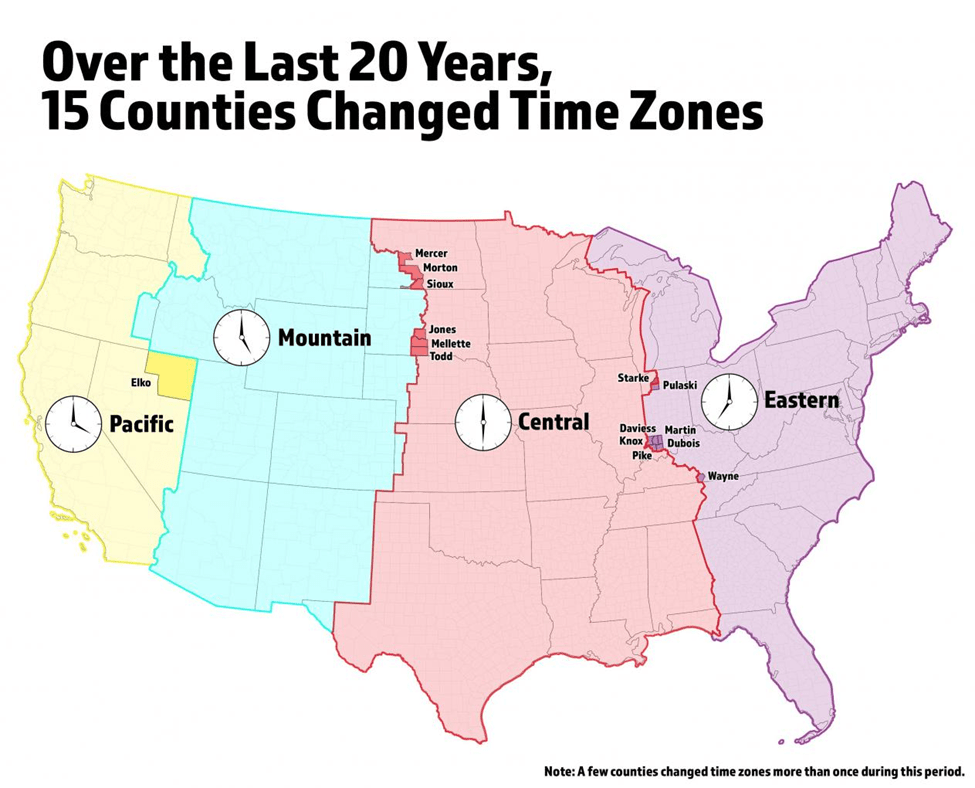
Since there are 360 degrees in a circle, and 24 hours in a day, it makes sense that each time zone should measure 15 degrees of longitude. A glance at the map shows that Central time is 6 hours behind Greenwich, so it should start somewhere around 90 degrees west – Chicago is about 88 degrees, so close enough. Sidney (MT) is between 104 and 105 – so Montana’s eastern border is just about where mathematics would suggest it should be – but the eastern state line is not along a standard degree of longitude, but rather follows the 27th meridian west from Washington, DC.
“I am unsure just why the 27th meridian was chosen as the boundary between the two Dakotas and Montana and Wyoming. It may have been a number chosen “out of the blue” at the time Idaho Territory was established. The line does not coincide with any particular section or half-section line, or anything else of local or regional significance.
As I noted, the boundary line was not intended to follow the 104th degree of west longitude, but rather it was placed on the 27th meridian west of Washington. The boundary between North Dakota and Montana is supposed to be at 104°03’02.3″ (27° + 77°03’02.3″), and it is supposed to be a straight north-south line. However, a study of 7.5 minute topographic maps shows that the North Dakota – Montana boundary is at 104°02’46” at the South Dakota state line and at 104°02’54” at the International Boundary. That is, on the north end the boundary is approximately 533 feet farther west than it is on the south end.”
https://www.dmr.nd.gov/ndgs/ndnotes/Boundaries/Boundaries.aspMathematics doesn’t do much to determine the spot where Pacific time begins. I’ve heard stories that Montana’s western border was because of a surveyor error – that it was supposed to be along the continental divide. The actual story is equally interesting.
“Montana owes its contours to Sidney Edgerton, the state’s first territorial governor. Montana was split from the massive Idaho Territory that included what is now Idaho, Montana, and part of Wyoming. Lincoln chose Edgerton as chief justice of the Idaho Territory Supreme Court, and Edgerton was picked to make Montana’s case to become its own territory. Edgerton proposed making Montana’s western boundary along the Bitterroot Mountains, and as a result Montana gained the riches of the Bitterroot Valley as well as the eventual wealth of Butte.”
https://www.usatoday.com/story/money/2021/04/10/this-is-how-each-state-got-its-shape/43513185/As for longitude 120 – where mathematics suggests we might locate the eastern line of the Pacific time zone? It’s closest to the western edge of Malheur County in Oregon – the one county in Oregon that is on Mountain time. Time zones have a fairly loose relationship with longitude.
-
We unpacked a small package of coins that were in my mother-in-law’s home when she died. Obviously there was some value – but we hadn’t gone through them. The 50 “junk silver” mercury dimes showed she had decided to invest in some silver coins – and got us looking at everything. The pre-war Soviet coins – nine of them, not quite adding up to two rubles. The cash she had carried with her when she was taken from Kiev to spend the second World War as a “guest worker” in Hitler’s Germany.
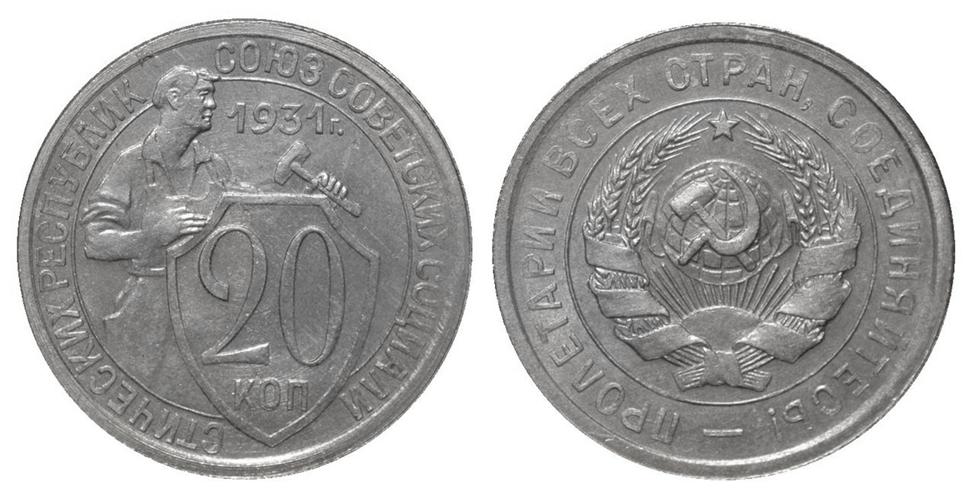
A single Reichsmark and a five pfennig coin that she had brought from Germany to the US when she left after the war.

And a Libby Diamond Anniversary dollar that must have been purchased with a plan to share it with her daughter or granddaughter – a plan that was forgotten, yet obvious as we looked for information on the coin that might be online.


There was one for sale on ebay. I’m guessing that she bought it in an Illinois coin shop while we lived in Libby – whether for my wife or daughter, I don’t know. Still, the message that she was thinking of them arrived.
-
By October 24, 1988, the game was playing us. On page 3, the Mountain Ear published this letter to the editor:
Dear Mike;
We want the members of Lincoln Electric Cooperative, Inc. to know that the information they received from the cooperative was not unanimously approved by the trustees. On Wednesday evening, Oct. 19, 1988, the board met, was handed this information by the manager, and reviewed it. No vote was taken on mailing this out.
Trustee E. Duke Baney
Trustee Billie Gossett
On page 4, under the headline “REA Packs House” the report ran”
“The Lincoln Electric meeting room held 135 people last Monday evening as Manager Monk Miller tried to wriggle off the hook of the 100 G’s retirement/consultant deal he’d pushed through the board.
It wasn’t to be. Monk started off smearing at the Mountain Ear’s inaccuracies, explaining that he’d never meant to retire, but when Gib Burk read the minutes, the phrase “Early retirement” was heard by all attending. Burk interrupted his reading to comment that he hadn’t seen this before, then he recognized his own signature on the document he was reading. According to our sources, the same deal was made for the Flathead Co-op’s recently retired manager.
Here’s the proposal Monk gave to the board 10-14-88:
Trustees: The following is a proposal . . . . concerning my continued employment as manager of Lincoln Electric and InterBel Telephone Cooperatives. Due to the very obvious takeover attempt by a group of very uninformed people under the guidance of a few self-interest people, I’m proposing the agreement presently in force be canceled, providing a contract for my continued service as manager for the two cooperatives until July 1, 1991 . . .
The summary is simple: if the trustees will guarantee Monk’s wages ‘ti; July of 91, he’ll cancel the sweetheart deal that guarantees full wages ‘til July of 91 and early retirement.
Duke Baney’s speech killed the motion to guarantee Monk employment until June of 91. Baney went on to move that the board conduct all business by Roberts Rules, and adopt the state’s open meeting code. In a room full of LEC members the motion passed.
Lindsey reported on the pole relocation job near Dickey Lake caused by the planned highway work on 93. He stated that the job isn’t large enough to make soliciting bids worthwhile. Harp was contacted and will do the job for slightly over $11,000. Additional study on this by the Mountain Ear gave us the information that Mr. Harp is a Montana State Senator, and has chaired the Highway Committee. Costs of this job will be totally reimbursed to the Co-op by the state. Please note that the Mountain Ear does not imply that this hiring was unethical. We wish to show that the method of awarding this bid allows questions to be raised that wouldn’t have to be had been bid announcements mailed out.
Most of the attendees left before McCurry’s request, on behalf of CREAM, for a list of LEC members and mailing addresses was denied by the board of trustees. After the denial, trustee Dale Hudson informed Mike that he doesn’t represent the people who are trying to get rid of him.
On October 24, Hitting the High Points:
“You’ll have a hard time believing this one. Just two days after passing a motion to conduct business openly, the trustees of Lincoln Electric Co-op held a secret, illegal meeting.
Incredible as this seems, trustees were notified of the pending meeting Wednesday morning, and the meeting was held Wednesday night. Less than half a day’s notice was given, nd, incredibly enough, the public wasn’t present.
The meeting was totally in violation of the Co-op’s bylaws – Article V, section 3, states “Written notice of the time, place, and purpose of any special meeting of the board of trustees shall be delivered not less than five days previous theretofore . . .” It’s all on page 26 of the phone book.
The business was simple: Manager Monk Miller wanted the board to rubber stamp 6 pages of Miller’s responses to CREAM. According to my information, 7 trustees rubber stamped his 6 page semi-factual soporific. It was mailed to all members. Please note that the Mountain Ear at no time requested a list of members – Monk’s statement is in error and none of his rubber stamps corrected the lie.
The board has gone beyond the Pale. By conducting business in violation of the bylaws, the trustees can no longer claim to be acting legitimately. They have graduated to outlaw boar status.
Last Monday, trustee Dale Hudson told me that he didn’t represent me. That was no great surprise. Wednesday, Monk and his rubber stamp collection threw the bylaws to the wind. Now the Lincoln Electric trustees have only 8 constituents – 7 guilty trustees and Monk. Sorry guys, but this time you should pay for mailing Monk’s propaganda out of your own pockets, not the cooperative’s. Isn’t it safe and secure following Monk?”
At this point, the conflict had less than 50 days to continue.
-
As the election approaches, I notice reminders that the polls aren’t all that accurate. The problem is that the samples selected for the polls somehow don’t perfectly represent the voting public. Part of the misrepresentation is just demographics – if we look at California, 46.8% identify as Democrats and 23.9% as Republicans. In San Francisco, 85.3% voted Dem in the last presidential election. In Kern County (Bakersfield) 53.9% voted Republican. The populations are set up in a way that can lead to biased samples. That’s not a big deal – the problem is figuring out what the results actually mean.
In this chart, the folks at RealClearPolitics have tried to develop correction factors to deal with polling inaccuracies – showing where past voting records and polls have disagreed, and developing adjustments to better project the results. The trick is to control for the discrepancies – the task isn’t a whole lot different than population projections.
State RCP Average 2020 2018 2016 Adjusted 10/21 Poll Average RCP Projection November 8 Polls Under-Estimated Penn. Fetterman +2.4 D +5.6 D +16.0 D +6.2 GOP 4.8 Oz +2.4 GOP Hold N.H. Hassan +5.4 D +11.0 – D +8.0 GOP 5.8 Bolduc +0.4 Dem Hold Nevada Laxalt +1.2 D +5.2 R +1.7 D +4.2 Dem 0.8 Laxalt +0.4 GOP Pick Up Arizona Kelly +2.5 D +4.0 R +0.3 D +1.3 GOP 2.0 Kelly +0.5 GOP Pick Up Georgia Warnock +2.4 D +2.0 – R +4.0 GOP 1.4 Warnock +1.0 12/6 Runoff N.C. Budd +2.8 D +2.7 – D +2.5 GOP 5.1 Budd +7.9 GOP Hold Florida Rubio +4.7 D +1.4 Tie D +4.0 GOP 3.4 Rubio +8.1 GOP Hold Wisconsin Johnson +2.8 D +6.3 D +10.6 D +7.0 GOP 4.4 Johnson +7.2 GOP Hold Ohio Vance +2.5 R +0.5 D +16.0 R +0.6 GOP 8.3 Vance +10.8 GOP Hold As we look at Pennsylvania, we see Fetterman polling 2.4% above Oz – but the next 3 columns show that historically Dems have polled high, averaging 4.8% more on the polls than in the votes. That correction factor leads them to project Oz the winner by 2.4%.
In New Hampster Maggie Hassan leads by 5.4% – but the 2020 and 2016 voting results suggest that Dem polls show up 5.8% high. The next column shows a correction where Republican Bolduc is up by 0.4% – yet RCP projects a Hassan victory. I suspect the model includes an adjustment for the incumbency advantage.
Georgia’s requirement for a runoff election if neither candidate gets 50% plus one of the total vote shows up in the projection of a runoff on December 6.
Here in Lincoln County, where we don’t have two candidates to pick between, we don’t have to develop a model to project which candidate will win the election. Personally, I’d rather have a poor choice than no choice – particularly when following the law (subsection 7) would provide us a choice.
-
I first heard of the bedbug letter about 50 years ago – from Bob Brown, when we were undergrads at MSU. In Bob’s story, the protagonist was P.J. Hill of the Great Northern . . . the Hill that Hill county is named after. The Hill who was known as the “Empire Builder.” Since the legend of the bedbug letter has made it into Snopes, here’s their version of the story Bob told:
Did a real event spark off this legend? Possibly. Folklore Jan Harold Brunvand reported on a 1992 letter from the corresponding secretary of the George Mortimer Pullman Encomium Society in which it was claimed the bed bugging took place on 4 March 1889 to a Mr. Phineas P. Jenkins, a salesman of pig-iron products. After spending a night in the company of far too many bedbugs (which in my book would number “one”), Jenkins penned a note of complaint to George M. Pullman, President of the Pullman Palace Car Company. In return, Jenkins supposedly received a wonderfully detailed and heartfelt apology from Pullman. Its effect was undermined, however, by the enclosure of his original letter, across which Pullman had handwritten “Sarah — Send this S! O! B! the ‘bedbug letter.’”

Thirty years later, Bob was Montana’s Secretary of State – and, when I read the following letter from Christi Jacobsen, I couldn’t help wondering if Bob had left a version of the bedbug letter in that office:

Perhaps Christi really did notice my sterling qualities in the certified letter I sent. On the other hand, I wonder . . . did Bob leave his own version of the bedbug letter in Helena when he left the Secretary of State position . . . and did I just get my own personalized copy?
-
Years ago, I read that the constitution of the Texas Republic banned preachers and lawyers from their legislature. I think that the thought on banning lawyers was that the profession had a vested interest in passing unclear laws . . . but as I look at our non-attorney legislators, I’m not sure that a law degree makes for a poorer legislator.
Then I look at Georgia, where we have a preacher and a football player neck and neck for the job as US Senator. I listened to part of their debate – the preacher is definitely more articulate. On the other hand, I’m pretty sure Herschel Walker could beat him hands down on a football field. Still, I’m not overly convinced that either has the precise ability we need – there’s no spot in the Senate chambers where running or throwing a football is particularly appropriate, and experience preaching doesn’t necessarily translate into good governmental decisions.
As I looked at the First Amendment Encyclopedia, I learned that it wasn’t just Texas. Thirteen states (including New York) had constitutional provisions that prohibited the clergy from holding elected or appointed public office. While most removed these from their constitutions before 1880, Tennessee’s prohibition was removed by the Supreme Court in 1978 (McDaniel v. Paty).
Maryland voters amended their constitution to get rid of it in 1978. Apparently it is wrong to discriminate against preachers.
So the folks in Georgia get to choose between representation by a preacher or a football player. It may not be a perfect choice – but it is a lot more choice than the single-candidate ballot offers us in Lincoln County.
-
I spotted this chart at The U.S. Misery Index: It Ain’t as Sweet as Your Ice Cream, Jack – PJ Media the other day. One of the advantages of being an old guy is that I remember when the Misery Index was new – back when Jimmy Carter was a president.

The Misery Index doesn’t have a lot of scientific basis – it’s just the inflation rate and the unemployment rate added together, though it was first developed by an economist. It does make for an interesting chart. The interesting thing about today’s Misery Index is that it is developed with relatively low unemployment – something like 3 ½ percent. I’ve heard some fairly solid economists explain that when unemployment stands at 5 percent, it translates to full employment, and that 3 ½ percent is actually too low for a healthy economy. I recall a time of even lower unemployment – with clerks who couldn’t make change. This time, the Misery Index is dominated by inflation – and things may not be the same as we saw when Reagan was a president.
This chart, from https://www.advisorperspectives.com/dshort/charts/inflation/inflation-1872-present.png shows inflation from 1872. It’s no new problem. It is a whole lot easier to get inflation when you can increase the money supply by printing press instead of mining.

-
In Octobers past we’ve considered all of the many things that require a license beyond hunting and fishing, learned about Chronic Wasting Disease, remarked upon a historical sighting of Caribou in Lincoln County and considered the increasingly relevant question of mandatory retirement ages.
I need a license for what?
One of the worst shocks of growing up was how much paperwork adulthood requires. Recently, I’ve been learning about licenses. Not fishing licenses, or hunting licenses, which I did know about, but professional and occupational licenses. Some professions are obvious. It’s clear that a doctor, an MD, will need a license to practice medicine. Clear, too, the reasons. It’s an obvious issue of public health and safety that people doing surgery ought to have some education on the topic! Which professions require a license is a matter determined by each state. Montana’s Department of Labor regulates 40 boards/programs for…
Chronic Wasting Disease
As the start of the hunting season for deer and elk approaches (general, not archery), Chronic Wasting Disease becomes increasingly relevant again. Chronic Wasting Disease is a prion disease, fatal, with no known treatments. While there are no known transmissions to humans, the CDC recommends having elk, deer or moose tested if there’s known to be Chronic Wasting Disease in the area. If the animal tests positive, they recommend against consumption. For a deer, sampling requires removing the lymph nodes, packaging them, and mailing them to the wildlife health lab in Bozeman. More detailed information about having an animal…
This Week in Trego’s History
This week, in 1987: Caribou sighted in the Northwest Corner of Lincoln County and Construction of the Trego Firehall began.
Game Camera Fails
At 6 am, Mike was out collecting firewood from the stack to start the days fire. Kiki, the older, chubby white Pomeranian was out with him. Kiki positioned herself off the back steps and started trying to raise the dead with her bark. With enough firewood in hand, Mike called Kiki to the house. Remarkably, she came when called. Mike noted that some critter was out there but thought a follow up investigation was better left until daylight. Later that day, we received a call. “Looks like a grizzly walked down your driveway” the caller reported. We had received…
Thoughts on Mandatory Retirement Age
I recall a time when mandatory retirement age became illegal. The age discrimination law passed in 1967 – the year I graduated high school. It didn’t personally affect me – I was 17. Still, I can think of a few reasons we might want to revisit the idea. The Dakota – the Sioux – as well as the Metis and many other tribes – use the term “elder.” Just being old isn’t enough to be an elder. I think it’s because growing older is mandatory, growing wiser is optional. At any rate, vigorous people are supposed to lead, elders…
-
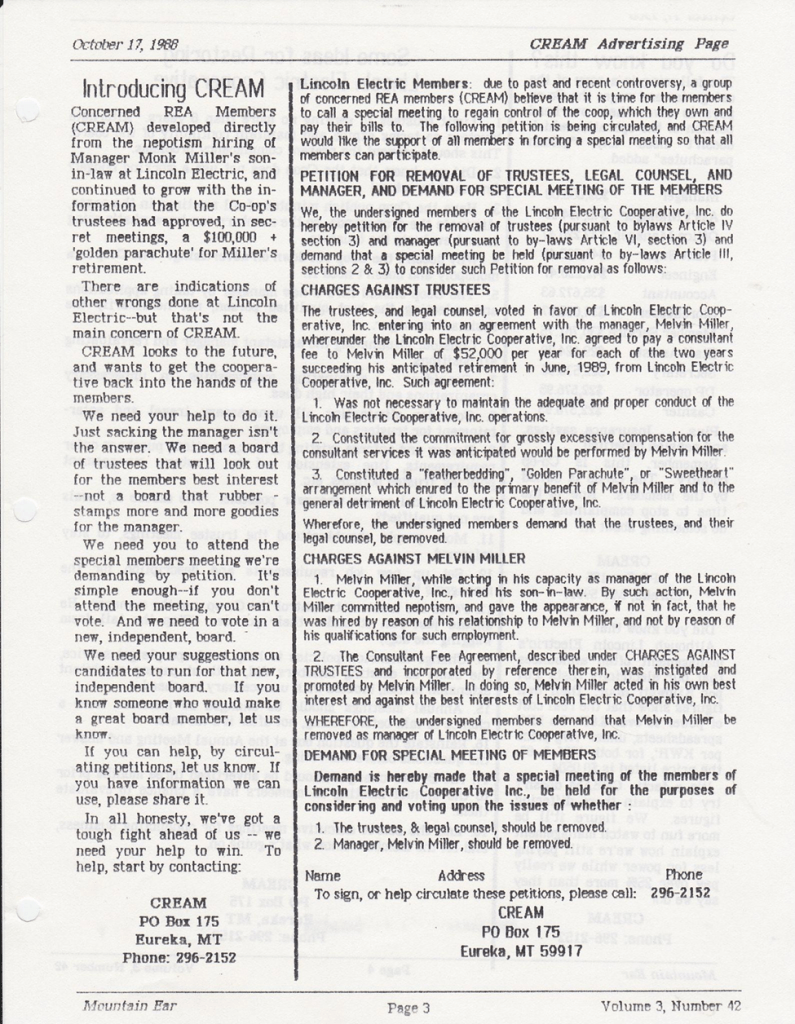
This installment includes the organization of CREAM – concerned REA members. The October 17 issue of the Mountain Ear includes the first announcement:
Petition Notice
The petitions now being circulated by CREAM will not, by and of themselves, remove either the trustees, the attorney, or the manager.
The petitions only call for a special meeting of Lincoln Electric Cooperative members to consider and vote on these issues.
Your attendance at the special meeting is needed if any changes are to be made.
CREAM
From the October 17, 1988 Mountain Ear column “Hitting the High Points”:
“Does anybody want to know what happened in Lincoln Electric/InterBel’s last secret meeting? Hang in folks, here comes Mike’s unofficial, unauthorized version of the last secret meeting.
Board Chairman Charlie Cope has assured us that the last secret meeting was strictly for the board members – that not even Monk Miller would be there.
That’s a half truth according to my information. True, Monk wasn’t at the meeting. But, from what I hear, the board’s own attorney represented Monk’s interests, made the propositions, and the board members accepted them.
I guess that answers my question of “What do these guys have to hide?” The board of trustees apparently held a secret meeting, without Monk, and waited for the lawyer to tell them how Monk preferred to solve the problem. I guess for a rubber stamp board, that’s taking the bull by both horns. Board members left, sworn to secrecy, and commenting only that their decision “is a positive one, that will really solve the problems now and in the future.”
Let’s look at what’s happening. According to the reports I’ve got on the meeting, the proposal was that Monk should lower his sights a little. Monk wouldn’t have to stick around two years as a consultant to get the 100 Gs. Instead, he’d retire in June and would collect between $45,000 and $50,000 for his unused sick leave. Another report has it that the board will negotiate the leave payment.
Now I understand why Charlie felt they could talk more freely in a secret meeting.
Apparently CREAM’s been effective. Monk’s latest proposal offers to drop the 100 G consultant business, in return for a contract as manager running through 1991. He doesn’t expect a fast answer.
Pages 3 and 4 are identified as “CREAM advertising Page” and copied in their entirety:

Page 6 includes the article “I Sought the List”:
“Last Tuesday, representing a group of Concerned REA Members (CREAM), I requested a list showing names and addresses of all Lincoln Electric members. My reasons were simple: since the manager can use our funds to propagandize his side of the issue to every member, we need to mail the truth to every member.
I walked out without the list. Don Sanders was courteous, but explained that my request had to be presented to the board of trustees. Sanders helped write up the request and promised to present it to the board at it’s next meeting.
That next meeting is tonight. So far, CREAM has been refused the right to communicate their views with fellow Lincoln Electric members. At the very least, CREAM has been delayed for a week with administrative delaying tactics. Don Sanders has been as helpful as he could be, and, I am sure, a lot more cordial than was required.
But I’d like to have a little help tonight. The board meets at 7:30 pm, October 17th at the REA building north of town. If a few members would show up, it might help me get the list.”
Next Installment: Force 9: Strong Gale – Slight structural damage occurs; chimney pots and slates removed

Want to tell us something or ask a question? Get in touch.

Recent Posts
- The Density of Water Explains When Dickey Lake Freezes
- Watching Iran
- The Quality of Numbers
- Robert Treat Payne Had Traveled To Greenland
- 75 Years Ago in New York
- Recovery Time for a Retiree
- Venn Diagram and DSM
- When Castro Was Cool
- You Have To Beat Darwin Every Day
- Computer Repair by Mussolini
- Getting Alberta Oil to Market
- Parties On Economics

Rough Cut Lumber
Harvested as part of thinning to reduce fire danger.
$0.75 per board foot.
Call Mike (406-882-4835) or Sam (406-882-4597)
Popular Posts
Ask The Entomologist Bears Books Canada Census Community Decay Covid Covid-19 Data Deer Demography Education Elections family Firearms Game Cameras Geese Government Guns History Inflation life Lincoln County Board of Health Lincoln County MT Lincoln Electric Cooperative Montana nature News Patches' Pieces Pest Control Politics Pond Recipe School School Board Snow Taxes Teaching travel Trego Trego Montana Trego School Weather Wildlife writing
 Trego's Mountain Ear
