-
We’ve gone through the better part of a year without a muskrat in the pond – I think old age and decrepitude took our old muskrat population out, and for a year we haven’t had any swimming around. Now, we have a muskrat back in the pond, and I hope the population will grow again.
I’m pretty sure that the occasional juvenile muskrat goes for a walkabout as it gets close to adulthood. Here, it’s nice to have one back in the pond, that we can watch swimming. The next generation should be calmer in the presence of people, and something we can watch a bit closer.
Montanaoutdoor.com provides some information and photos – I particularly like the photo of the infant muskrat:

The turkeys are showing up in the mornings to harvest the remaining grasshoppers. They’re nature’s way of converting insect protein into real food. I need to remember to order a bit of disease for the hoppers this coming Spring.
The twin fawns spots have filled in with their winter coats, and we still have two does and three fawns living close to the house. I wonder if the greatest threat to a deer’s survival isn’t traffic. Meanwhile, the occasional bear wanders through – and I think of Willy Nelson singing “the wide open spaces are closing in quickly.” It must be a real challenge for bears to find areas where they don’t wind up in conflict with residences.
The resident coots have all flown south – but such a successful year – 7 hatchlings survived the summer to fly south. A lone goose circles the pond, calling out, then begins the migration south, alone. It has been a great summer.
-
I was thinking about 1974 – when the retail price of gas climbed above 50 cents a gallon, and our old pumps became officially obsolete. Now, 48 years later, I expect to see gasoline at $5 per gallon. This site Average Gas Prices in the U.S. Through History shows the price trend, and has a chart that shows the prices by year in the 21st century. Click the link – it leads to a resource of data we can all use.
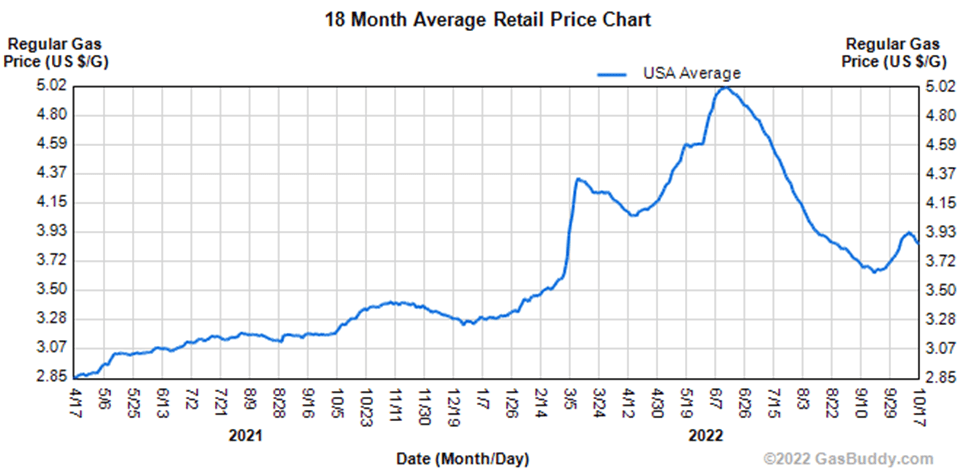
This chart (from Gasbuddy.com) shows that we made it to $5.02 last June. Still, with November and December yet to come, and the OPEC cuts coming next month, I’m betting we’ll go higher.
As I look at the cost of energy, and reflect that it’s the cost of travel, I look for an energy source that can replace gasoline in my neighborhood. The basic problems are storage and density. It’s fairly easy to use electricity to separate hydrogen from water – but the challenge is that hydrogen produces about a quarter of the energy that gasoline does – so if my pickup gets 12 miles per gallon on gasoline, it would drop to 3 mpg on hydrogen. Then we have to add in the fact that hydrogen is the smallest molecule that exists. In other words, no matter what we put it in, it leaks. So a trip to Kalispell and back would take something like a 40 gallon fuel tank. Gasoline has had some great advantages.
Most of our electrical production still comes from steam – usually steam turbines. Back in the old days – 75 years ago – the explanation was that it took a cup of water and 2 ounces of coal to move a ton for one mile along rails.
Here, wood is a naturally occurring product of solar energy. Burning wood heats my house. A century ago, there was a car called the Stanley Steamer. Steam tractors broke the sod on the Great Plains, getting the fields into something that horses could handle (I once broke unbroken prairie sod for a garden – the rototiller couldn’t handle it until I used a shovel first. I have a lot of respect for the old sod-busters.)
We could make carbon monoxide gas from wood – my father spoke of these units. Still, I have a hunch that the amount of pitch I encounter in our trees would gum up carburetors, fuel injectors and valves. We may be stuck returning to steam engines. The future doesn’t seem to hold all that I once expected.
-
Daylight Saving time began in March this year (2022) and will end on the sixth of November. Depending on whether the Sunshine Protection Act becomes law, we may spring forward next March, and then, not spring back.
Daylight Saving time comes out of WWI Germany, and part of the reason it has been widely adopted is the potential energy savings. Ostensibly the United States saves about half a percent on energy, which is at least somewhat significant at the national level, if not on any individual pocketbook.
Of course- Montana already has a law doing that (as of 2021). Unfortunately, while Montana wouldn’t need federal authorization to skip daylight saving time altogether (like Hawaii and Arizona), it’s a requirement for permanent daylight savings time. Montana isn’t the only state to vote for year round daylight saving time- Washington, Oregon, Idaho and Wyoming have done so as well. However, unless the department of transportation approves it- or the Sunshine protection act becomes law- having the law at the state level changes nothing.
The Sunshine Protection Act would make daylight saving time permanent- no falling back. Of course, it isn’t law yet. The senate passed the bill back in March, but the house has yet to vote on it. If the bill does pass the house, it still has to be signed by the president. If the bill is passed, daylight saving time will become standard time for the United States on the 5th of November, 2023.
Until then? Who knows. The EU postponed making daylight saving time permanent for covid-19, and may postpone it further. After all, it isn’t a great time for Europe to give up on anything that saves power, even if the savings are small. Russia ended daylight saving time in 2014- citing health concerns.
Daylight saving time isn’t without those- humans don’t adjust well to sudden changes in schedule, and the “spring forward” of March comes with a number of associated health risks.
-
For most of my professional life, the English language has been a tool that I used unthinkingly, subconsciously. It’s been good to me, good for me – and now, as a retiree on the school board, I’m consciously looking at it . . . mostly because it isn’t so easy for all the kids. I think it’s a language that is easier to use subconsciously than consciously.
I don’t know if anyone else was challenged in “diagramming a sentence.” It’s something I missed – it included drawing lines under nouns and verbs and showing which was what. Somehow, I didn’t need it to get the language right, but I needed it to get passing grades. I finally got in the habit of translating the sentence into Spanish, diagramming the Spanish sentence, then moving the lines back onto the assignment page. I genuinely feel for the kids who have problems with English.
The Philologist folks provide a lot of data that shows why the English language isn’t all that consistent. The island had a lot of invasions over the past couple or three millenia, and those invasions and word exchanges are still providing challenges in elementary schools across the English-speaking world. One example might be the words “shirt” and “skirt” – originally, the terms were interchangeable – “shirt” grew from the Germanic Anglo-Saxon, while skirt developed from the Norse (think Vikings) occupation. I’ve seen estimates that we still use somewhere on the light side of a thousand words that came in from the Viking occupation. Writing from memory, until the Vikings added the g sound to the end, there wasn’t a distinguishable difference between eye and egg. Husband is a word from those Vikings (though wife remains stubbornly Anglo-Saxon). Club was a Norse addition. The Vikings gave us the term “sky.” Our pronouns “they and them” came from old Norse, letting us pick Viking pronouns for our “preferred pronouns.”
Still only about a third of English words have Anglo-Saxon origins – about 40% were originally French (but brought in by the Norman French, with their Norse roots and accents). Another 15% of our language comes from the Italians (Romans) who occupied the island earlier. Very little remains from the original British inhabitants, and the Gaelic of Scotland and Ireland never influenced English all that much.
Our teachers provide an alphabet of 26 letters – but (if I recall correctly) in the days before printing presses you needed about 35 letters to write English . . . phrases like “Ye Olde Public House” only came about when printers no longer had the letter for “th” and substituted a “y” for a no longer existing letter that resembled a lollipop. It never had a Y sound . . . it was just a 2 letter way of writing “the.” Kind of like the texting abbreviations that have grown because of text messaging on the cell phone. When a European invention (the printing press) removed a quarter of the letters from the alphabet, it’s no wonder that standardized spelling has taken a long time to catch up – and still is hard for our schoolkids to master. It is painful to see that students continue to pay that price of progress in D and F letter grades in Spelling.
So our classrooms teach about synonyms and homonyms – and the first real explanation I recall was when I studied Sapir’s writings on linguistics as a senior in college. Like the kids I notice today, I just suffered with partial explanations. I think the most frustrating thing this week is realizing that I lack the ability to explain the challenges any better than I have in this article. Obviously, our language doesn’t stand still.
-
I spent 15 years with an office adjacent to this building (but never with a window looking at it). I would really like to know what they were trying to move into the tower when someone caught the fail (fall?) on the cell phone camera.

-
After emailing the Secretary of State, and sending a written letter certified mail, both explaining how unlawfully ignoring subsection 7 reduced choices in Lincoln County elections to something approximating zero, I had a brief thrill when I saw mail from the Secretary of State in the PO box.
The thrill didn’t last – I might not get a reply to my concerns, but I did receive government-funded junkmail from Christi Jacobsen. The first was a card with the message “MAKE YOUR VOTE COUNT!” printed large across the top. I’ve been trying to point out that because election administrators are allowed to ignore subsection 7 and not count write-in candidates my vote didn’t, hasn’t, doesn’t count. Ah, well, at least I can document that she has my address, and the ability to reply.
The other was a document identified as a voter information pamphlet. The note said that printing it cost $59,593 and that “Distribution costs were paid for by county governments.” It appears to be easier to spend public funds than to answer why subsection 7 is ignored.
13-10-211. Declaration of intent for write-in candidates. (1) Except as provided in subsection (7), a person seeking to become a write-in candidate for an office in any election shall file a declaration of intent . . .
(7) Except as provided in 13-38-201(4)(b), the requirements in subsection (1) do not apply if:
(a) an election is held;|
(b) a person’s name is written in on the ballot;|
(c) the person is qualified for and seeks election to the office for which the person’s name was written in; and|
(d) no other candidate has filed a declaration or petition for nomination or a declaration of intent. -
Renata told me Sunday morning that OPEC’s decision to reduce oil production by 2 million barrels daily cost 13 cents per gallon – and the reduction doesn’t start until November comes around. So I went looking for a chart that could bring everything into perspective and I found this one:
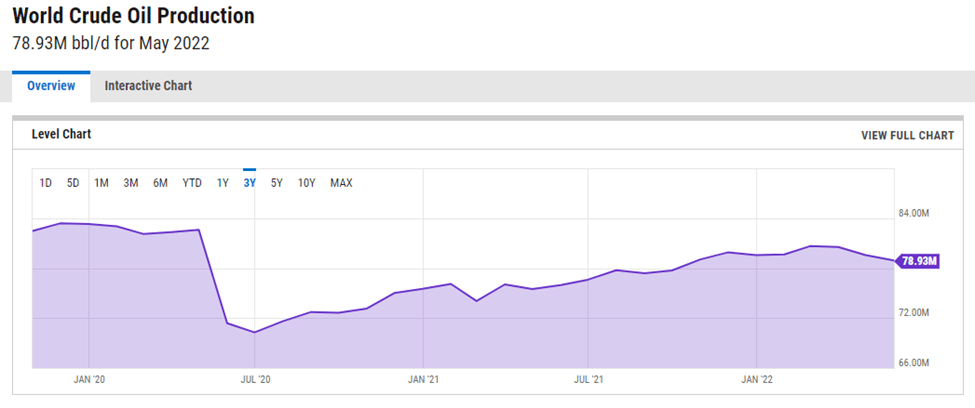
I like that I could look back to what was essentially the pre-covid oil production – roughly 84 million barrels per day, watch the drop to 70 million barrels a day, then the increasing normalization bring oil production back to almost 79 barrels daily back in March. Once we have data, we can come closer in anticipating how much the 2 million barrel reduction will affect how we live.
In rough terms, we’re probably close to 80 million barrels per day, world-wide. Taking that as our base number, we’re looking at something like a 2½ percent decrease in available oil – and, if Renata’s experience at the gas pumps is typical, 13 cents increase on $4.80 is about 2.7%. Close – but the reduced production hasn’t kicked in yet. (Yeah, I’m buying premium because I’m afraid that 15% ethanol might run high)
The strategic petroleum reserve stood at 638 million barrels when Biden was inaugurated. On October 6, it reached a 38-year low of 416 million barrels. Since March 31, the strategic reserve has been releasing a million barrels a day to help lower fuel prices – which may explain why OPEC chose the 2 million figure over the 1 million figure.
As long as our politicians have 400 million barrels to play with, I don’t have the numbers to calculate the effect of the OPEC cut. My guess is that the plan is to get people paying enough for gas on election day that They will vote to replace the democrat majorities in the house and senate. Here in Lincoln county, our votes won’t make any difference – between the bastards in power Montana and the bastards in OPEC, reduced production isn’t something that we can vote about. Our only option is to pay more.
-
This installment describes the strengths and weaknesses of each group in the Lincoln Electric member uprising, as I saw them at the time it became apparent that the Lincoln Electric board and management was unwilling to back down. It is important to stress that while InterBel’s trustees were different from Lincoln Electric’s, management at the time was virtually indistinguishable – over the past generation, the two cooperatives have separated further and further. Probably the biggest indicator came from the InterBel board (Mountain Ear, 10/10/1988).
“InterBel’s meeting last Monday showed that they aren’t trying the same methods of crowd gathering as Lincoln Electric’s board of trustees uses. Although there were almost as many angry members present as started the vigilantes down in Virginia City, the InterBel board didn’t start any fights.
Instead the InterBel trustees chose to use suspense and secrecy to keep members interest up over just what’s happening. Kind of like ‘Let’s Make a Deal’, only Vanna White doesn’t show what’s behind door number 3, and the individual cooperative member doesn’t get to watch the deal made – the member just gets to pay for it. Unfortunately, none of the members will walk off the stage with the goodies.
It didn’t have to be that way. Trustee Mike Workman moved to adopt the same policies that the State of Montana accepts for holding executive sessions. It wasn’t to be.
Workman’s motion for open meetings died, with no other trustee willing to second that motion. InterBel trustees preferred secrecy. InterBel’s lawyer didn’t point out that they were conducting business contrary to Robert’s Rules of Order.
Chapter Two
Another secret meeting was held last Friday night. The Lincoln Electric Board chairman Charlie Cope met us before we got to the sidewalk, as other trustees dashed behind closed curtains. Charlie explained that this was a closed meeting so the two boards could discuss all the phone calls they’ve been receiving. He didn’t explain the phone calls, but I assumed they were about the manager’s 2 year, 100 G’s, golden parachute.
Charlie explained, “You people just don’t understand.” He’s right. I don’t understand. What are they hiding? If the trustees are willing to admit they’ve made mistakes, why must they correct them in secret meetings. How many more skeletons are waiting to be uncovered?
In the spirit of openness, I’ll tell Charlie why we keep ‘picking on’ the electric co-op.
First of all, there’s every indication that the members have been and are being taken to the cleaners. Second it looks like the board hasn’t done doodly squat to look out for the members. Obviously, the trustees aren’t proud of themselves. They passed the golden parachute in a secret meeting a year ago – yet we didn’t hear about it until this August. Even then, it was leaked to us, not released to the public. Beyond that, it’s beginning to look like Monk’s 100 G’s is the tip of the iceberg when it comes to trustees helping shaft members.
What else have you guys done, that you can’t meet in the open?
Chapter 3
According to our information, the LEC board is keeping the results of the Friday secret meeting secret – at least until their regular meeting on October 17, when they will allegedly satisfy everyone.
Let’s all go there – it should be a heck of a performance.”
From here, I write from memory – the loose organization of LEC members who would become known as CREAM (Concerned REA Members) weren’t keeping a lot of records of their meetings, so there may be some omissions or blunders in my details – but I’ll get them as correct as I can. CREAM looked at the members uprising tactically, assessing our strengths and weaknesses in the upcoming conflict with the LEC board and management.
We had what the board termed a “snitch” among the LEC employees and two board members providing us information. Craig heard from his father – but Duke Baney attended each CREAM meeting and reported what was going on. I won’t be naming the ‘snitch’ – a promise is a promise. The conclusion here is that despite LEC’s executive sessions and secret meetings, CREAM had better intelligence (in the espionage use of the word).
Both Kenny Gwynn and Al Luciano had previously attempted to change the board’s membership and conduct in the annual meetings. They brought invaluable information of attempts that had failed in the past. The consensus was that the only option for success was to call for a special, single purpose meeting as permitted by the cooperative’s bylaws. LEC’s management had never failed in an annual meeting – in this situation, Al and Kenny had learned from the experience of failing, while LEC management had not learned from success.
Lincoln Electric had lots of cash and made large advertising purchases in the Tobacco Valley News . . . I’m fairly certain that the non-profit electric cooperative was the largest single advertiser. On our side, we had the Mountain Ear – a desk-top advertiser printed on a photocopier that had never exceeded 300 copies per week. On the other hand, the conflict and the story was boosting readership, and more photocopier time resulted in more copies. In retrospect, the special meeting and the Ear were essential. Both were new, and LEC management didn’t come up with effective strategies to negate them. We planned a larger member turnout than had ever happened before.
The petition for a special meeting required member signatures – and because CREAM was collecting the signatures, we had a better idea of how large the opposition to Lincoln Electric’s management was. We had donation jars out, where supporters could throw in change to support CREAM – when people sign petitions and contribute funds, it gives an idea about how large the support is.
Finally, LEC’s management had been in power long enough to build up a lot of member animosity, one at a time . . . and those feelings accumulated rather than dissipated.
It was time – I recall looking at our assets and tactics, pencil-whipping the numbers, and calculating that a special meeting would vote out the old board by a 52 – 48 margin if we could get a turnout of 400. The events in the next installment demonstrate that my calculations were a bit conservative.
I recall my comment at an LEC board meeting: “This is our last chance – if we leave without coming to an agreement, we won’t be playing the game, the game will be playing us.” The reply from one of the trustees was “Are you threatening us?” When we left the meeting, the game was playing all of us.
Next Installment: Force 8: Fresh Gale – Twigs break off trees, generally impedes progress CREAM’s petition and first advertising page.
-
In a world of perfect polling – and there are spots where polling sample correlation with reality approaches perfection – there would be no suspense or surprises on election day. As I look at today’s polls, I recall an election where the polls showed South Dakota voters supported a very restrictive law on abortion – but that proposed law failed miserably at the polls. Since I worked with populations and polls, I heard the question “Why?”
Simply enough, a poll samples a population. If we ask about eye color, our poll responses will reflect reality within the population we have sampled – plus or minus our statistical margin of error. So what happens to make political polling less reliable?
Political polls don’t sample a single cohesive population. If I were to oversimplify the challenge, I would say they sample two somewhat different populations that are intermingled. Both the response rates and the answers differ by ideology. The South Dakota polls that showed great support for limiting abortion access were telephone polls – and a significant number of respondents were untruthful. I joked that it was because they couldn’t be sure that the pollster wouldn’t tell Aunt Mary their answers – but it was joking on the square. We do have people that will answer a question one way at Thanksgiving dinner and the opposite in the privacy of the voting booth.
Usually, I hang up on pollsters. Caller ID has made that even easier. Over a lifetime, I’ve learned that telephone pollsters take my time and provide me no benefit. When you read the poll numbers, they don’t include the folks who didn’t answer the phone – whatever the reason. My general assumption is that the folks who respond to pollsters are somewhat more likely to support the democrat ideology. Folks who reject both ideologies, or support the republican ideology are a bit more likely to let the phone ring until the answering machine comes on, and then ignore the message.
Political polls sample at least 3 intermingled populations – potential democrat voter, potential republican voters, and folks who despise both groups of candidates. Think back 6 years – it was Donald Trump v. Hillary Clinton. It took ideological purity to wholeheartedly support either . . . kind of like the Disraeli quote: “Damn your principles! Stick to your party.” The not-so-ideologically pure said, “I guess I’ll hold my nose and vote for * .”
We have plenty of differences between the two dominant parties – age, education, income, employment, race all come to mind – yet when the polling results come out, they are presented as if a single population answered the question. If I were tasked with developing an accurate polling method, I’d be using an intensely selected focus group, and getting the answers would cost more than anyone is willing to pay. So I have to accept that inaccurate polls are the best I can get.
Still, there is precision and there is accuracy. If a rifle puts all the bullets into the same spot, even if I can’t adjust the sights to the bull, I can use Kentucky windage – I sight in on the spot that will put my bullets into the bull. Same thing with political polls. Most are precise, yielding similar results with each new poll. The models are fairly good. The spot we have troubles is in how we adjust that model to infer reality.
In most cases, this year it doesn’t make a whole lot of difference. The entire House of Representatives, all 435 of them, are up for election. (Here in Montana, the chance of getting a democrat representative is somewhere between slim and none) The US Senate is a bit different: 34 seats are up in 2022 – and by my count, only 14 seats are held by democrats. This is the spot where we can look at polling results. RealClearPolitics shows:
As you look at these numbers, the highest democrat senator (Murray) is +8.7% (and projected to win) while the highest republican is Rubio at +4.7% (and projected to win). Vance at +1.2 is the lowest republican projected to win, while Warnock, at +3.8 is the lowest dem projected to win.
As a guesstimate, RealClearPolitics regards a +3.5 polling lead for a democrat candidate as somewhere approaching a tie. Every pollster creates a model, but the model samples several distinctly different populations with the same questions.
Polling results, of course, can’t lead us astray in Lincoln County, where the bastards have taken choice away from the voters who participate in the general election this November.
-
There are two statewide ballot measures we’ll see in November. One’s a constitutional amendment and the other is a state statute.
The Constitution, after the Amendment (Article II, Section 11) would read:
The people shall be secure in their persons, papers, electronic data and communications, homes and effects from unreasonable searches and seizures. No warrant to search any place,
orto seize any person or thing, or to access electronic data or communications shall issue without describing the place to be searched or the person or thing to be seized, or without probable cause, supported by oath or affirmation reduced to writing”This is C-38, and the purpose is to add protection from electronic search and seizure, to the already existing protections against unreasonable search and seizure in the Montana Constitution.
The state statute: LR-131 is also known as the Born-Alive Infant Protection Act
An act adopting the born-alive infant protection act; providing that infants born alive, including infants born alive after an abortion, are legal persons; requiring health care providers to take necessary actions to preserve the life of a born-alive infant; providing a penalty; providing that the proposed act be submitted to the qualified electors of Montana; and providing an effective date.”
Additionally, voters in Lewis and Clark Counties will consider adding a 3% local tax on recreational marijuana.
Want to tell us something or ask a question? Get in touch.

Recent Posts
- The Density of Water Explains When Dickey Lake Freezes
- Watching Iran
- The Quality of Numbers
- Robert Treat Payne Had Traveled To Greenland
- 75 Years Ago in New York
- Recovery Time for a Retiree
- Venn Diagram and DSM
- When Castro Was Cool
- You Have To Beat Darwin Every Day
- Computer Repair by Mussolini
- Getting Alberta Oil to Market
- Parties On Economics
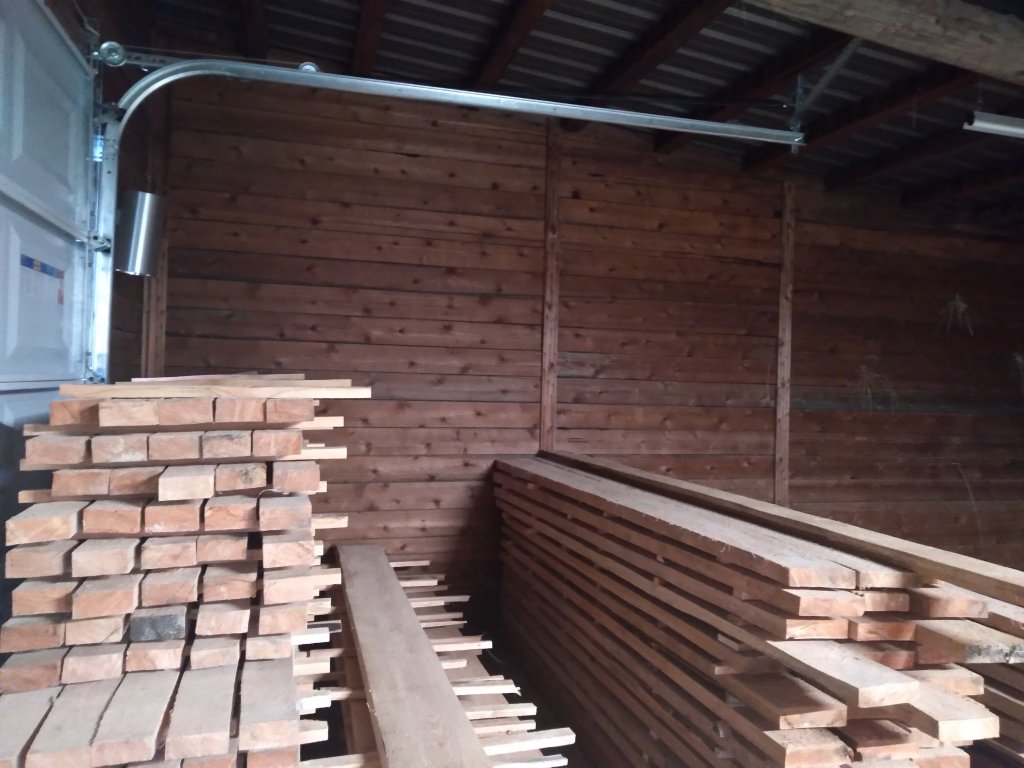
Rough Cut Lumber
Harvested as part of thinning to reduce fire danger.
$0.75 per board foot.
Call Mike (406-882-4835) or Sam (406-882-4597)
Popular Posts
Ask The Entomologist Bears Books Canada Census Community Decay Covid Covid-19 Data Deer Demography Education Elections family Firearms Game Cameras Geese Government Guns History Inflation life Lincoln County Board of Health Lincoln County MT Lincoln Electric Cooperative Montana nature News Patches' Pieces Pest Control Politics Pond Recipe School School Board Snow Taxes Teaching travel Trego Trego Montana Trego School Weather Wildlife writing
 Trego's Mountain Ear