-
Greetings Paula –
On June 10th, three days after our most recent election, you sent me these words:
“We likely won’t have the write-in name information available for a few days.
I will send you the info once we have it available.”
As I type this, it is the Fourth of July – a day with some significance to our republic, as well as 27 days past the election, and 24 days past your commitment to send “the info once we have it available.”
I understand the word “few” to mean not many, but more than one. We have moved into a time frame where you have taken many days and not yet sent me the information as you committed to do. I assume that you are an honest official and do not yet have the count of write-in votes available . . . this charitable view carries with it the implication that the count is yet incomplete, for if it had been completed it would be available.
Because of the power difference between your position as the county election administrator and myself as a lone citizen, I see no alternative but to make the following request under the Freedom of Information Act (https://www.foia.gov/how-to.html) :
Please send me the names and numbers of all write-in votes on Lincoln County ballots, by party and position, as well as the date those write-in votes were counted, and the name or names of anyone who has filed as a write-in candidate, from the recent primary election last June, at your earliest opportunity.
Sending the data in electronic format is acceptable to me.
Michael McCurry
-
We spotted the remains of a fawn kill – most likely by a coyote. On one hand, the tall grass has provided a better spot for the does to leave the fawns, and on the other hand, our resident coyote is new to the area – the old, macho coyote and his one-eyed mate aren’t here any more, and the youngster isn’t so confident. We may wind up with better fawn survival than last year (there were a lot of leg bones with tiny hooves). As rainy as things have been, the haying season will be a little later this year, and safer for the fawns.
Turtles are still active in the egg-laying business. They get a long way from water, and those eggs have a 67 to 75 day incubation time. Call it 10 weeks for easy calculation – the turtle hatchlings will be trying to get back to water between the first and the middle of September. I hadn’t looked at the data to realize just how much our late Spring and early Fall serves as a limit on turtles – but I’ve been looking for the hatchlings too early.
The island in the pond makes for safe nesting for the lesser Canada geese, mallards, goldeneyes, and ruddy ducks. The coots haven’t figured it out, so it looks like their nesting has failed. To be fair, as much as I like coots, they aren’t anywhere close to the smartest of birds.

Nor are they particularly good at getting airborne. I’m reminded that they are no type of duck – looking more like a chicken when they walk, and genetically closer to the Sandhills crane.
The raven predation on the turkey hatchlings seems to be less than last year – last year, we had two turkey hens together protecting the single surviving hatchling. This year, it looks like we’re back to large flocks, but fewer ravens. The red-wing blackbird continues to harass any raven that dares fly over his pond.
We have several feral cats hunting by the house – there is the argument that feral cats are rough on the bird population, but the other argument is that they are rough on the rodent population.
-
I had this guy on my porch (Fortine Creek and Brimstone) at 5am trying to get in my empty trash can. Scared him off only to come back at 10pm that night.
That day I called the bear biologist (Wildlife Conflict Specialist? Grizzly Bear Technician? Something official sounding), Justine, and told her I was awakened by my ring doorbell saying I had motion at my back door at 5 am. I shouted at him and then my big dog barked. He ran off. She said probably he won’t come back if there was no food. I didn’t know what kind he was. So when I was alerted at 10 pm I sent this picture and she said it was a grizzly!
It’s that time of the year again. Be bear aware. Don’t leave trash or other bear attractants near your home. (Grizzly visits aren’t that uncommon anymore- we wrote up one of our more exciting experiences last year. -Sam
-
If you’ve purchased groceries in Whitefish, you’ve probably noticed that there is a sales tax. Except, Whitefish doesn’t have a sales tax, not technically. What it does have is a resort tax on “luxuries”. In Whitefish, clothes are a luxury. This seems patently absurd, given how low the temperatures can fall during some parts of the year.
Assuming that anything taxed as a luxury (3%) is something that Whitefish considers a luxury, and that everything except from the luxury tax is not:
In Whitefish
- Purchasing a bicycle to get to work is luxury. An exercise bike is not.
- Purchasing a camera is a luxury. Having photos developed is not.
- Pet food is a luxury. Veterinary care is not.
- Candles are a luxury. Light bulbs are not.
- Videos and DVDs are a luxury. Cable TV is not.
- Second hand store items are a luxury. Appliances are not.
- Crafted items, including those sold at arts and crafts fairs are luxuries. Computers are not.
More next week on when this happened (which state laws allow it) and what other areas have similar taxes. In the meantime, I’ll be saving my shopping for somewhere that doesn’t specifically tax clothes as a luxury item.
-
This season’s Supreme Court decisions that center on the second amendment have been a reversal of the trend that passed GCA68 back when I was an underclassman at Bozeman. To me, the second amendment centers on the words “shall not be infringed.” For my entire life, I have watched legislation and court decisions that seemed to have an entirely different view, a different definition of those words.
Even now, as I watch Bruen struck down, after being established New York law for over a century, and remand 21-902 BIANCHI, DOMINIC, ET AL. V. FROSH, ATT’Y GEN. OF MD, ET AL., 20-1507 ASSN. OF NJ RIFLE, ET AL. V. BRUCK, ATT’Y GEN. OF NJ, ET AL., 20-1639 YOUNG, GEORGE K. V. HAWAII, ET AL., and 21-1194 DUNCAN, VIRGINIA, ET AL. V. BONTA, ATT’Y GEN. OF CA back to the District Courts with instructions that basically say “Get it right this time.” I wonder.
Obviously, the Trump appointees shifted the balance on the Supreme Court. I like the explanation that the second amendment is not a second-class right. Yet I wonder – will West Virginia v. Environmental Protection Agency wind up having more effect on gun owners than the five other cases? None of them affect me in Montana . . . but in the EPA case, the Court determined that EPA is not authorized to enforce a rule (from back when Obama was a president) that lacks specific congressional approval.
If the West Virginia v EPA can be expanded to cover ATF rules . . . and, while I see no reason it can’t, I am not an attorney . . . the rewrite of rules to cover bump stocks changes. Re-writing the rules that change pistols with braces to short-barreled rifles changes. Redefining a receiver may well be equally disallowed. I don’t know – but I wonder if this ruling isn’t the most significant change that the Supreme Court has opened. If an agency is not allowed to enforce rules that lack specific congressional approval – it’s a game changer.
The one area of the constitution where I am familiar is Article 1 Section 2, which authorizes the decennial Census for the purpose of apportioning the house of representatives. As it exists today, the house is apportioned by population, not by population of citizens. That given, the average California congresscritter represents a population that is 14.1% non-citizens. A Montana congresscritter represents a population that is 1% non-citizen. The speculation is simple – should the court hold that the principle of one-man, one vote affects this, California, the nation’s leading source of left wing politicians would lose somewhere around an eighth of its congress representation. Should a post 2022 Republican landslide take over the house, and get past 60% in the senate, they could pass legislation mandating that the house of representatives be apportioned based on citizen population (instead of total population).
As I said, I’m no attorney – and even if I were, usually there is an attorney on each side of an issue – but West Virginia v EPA may have a lot more effect for a lot longer than any of the other decisions we have seen. The future appears very differently to an old man than it did to a college sophomore.
-
Years back, one of my Dakota students commented “Well, I’m assimilated.” Living in a state where the largest minority population is American Indian does give some understanding of assimilation – yet as a paleface who taught “Indians of North America”, I have to recognize how much the Native Americans assimilated my European ancestors. In many ways, my tribal neighbors are culturally much closer than the European relatives left behind when my ancestors shipped off to North America.
Food – across the planet – shows places where the American Indian developments assimilated everyone. Zucchini – the long, green squash traveled from America to Italy, where it acquired its name (translation is little gourd) and then returned to the Americas to be planted in my garden. The Italians also incorporated the green bean and the kidney bean in their cuisine, then returned them to my garden. The red bean – so common in Cajun and Creole dishes – came from the local Indian cuisine in Louisiana.
Corn? The American Indian staple – we assimilated the Algonquin word “pone” as we assimilated the fried cornbread we term cornpone. The other term, johnnycake, likely came from “Shawnee” cake. Hushpuppies came from dropping a spoon of cornmeal mush into hot bear fat – I never did learn which Native language contributed that phrase.
Virtually all peppers were developed by American Indian agriculturists – only black pepper (Piper nigrum) existed in European diets when Columbus came to the Americas. Not a botanist, Chris figured the Caribbean islanders were flavoring their food with Piper, not Capsicum. Personally, I think the early explorers may just have been looking for better food – think about cooking without corn, potatoes, chili peppers, sweet peppers, tomatoes, peanuts, vanilla, chocolate and the many other plants that were domesticated by the Indian gardeners of the Americas.
Popcorn and peanuts – occasionally mixed with maple syrup – the recipe may have changed a bit, but I can still go into the store and buy a box of Cracker Jacks.
True, rhubarb is mentioned in Roman documents. Along with the asparagus (developed in Europe and Asia) rhubarb takes up a perennial niche in my garden. Like me, it has been assimilated.
Nearly fifty types of American berries have been identified – Europeans had to land to discover over twenty varieties of blueberries, over a dozen different gooseberries. Cashews came from northern Brazil and southern Argentina . . . here we only get the seeds, but they grow in a fruit that is consumed around the equator (or fermented and distilled into feni across the world in India).
My national government is patterned after that of the Iroquois League – as presented by Benjamin Franklin in 1754. Looking at Washington DC today, I have to admit that we never incorporated the principles as completely as Benjamin Franklin suggested, and we seem to have drifted further from them. My nation, my garden, my dinner plate – all European immigrants assimilated by the American Indians.
-
A two-party political system is only one party away from becoming a single-party system. Now a single-party political system doesn’t have to be a bad thing. North Korea, China, and Iraq all have a single party. The Soviet Union had but one political party. I’m fairly certain that the Taliban is the only party in Afghanistan today. Cuba has just one system – the list goes on.
Our last Primary Election did a pretty good job of showing a party on the way out – the Dems had no candidates within the county. Now one of the things about one-party systems is that they have a tendency to outlaw the opposition. That’s kind of authoritarian.
Machiavelli described the forms of government:
I must at the beginning observe that some of the writers on politics distinguished 3 kinds of government, the monarchical, the aristocratic and the democratic; and maintain that the legislators of a people must choose from these three the one that seems most suitable. Other authors, wiser according to the opinion of many, count six kinds of government, three of which are very bad, and three good in themselves, but so liable to be corrupted that they become absolutely bad. The three good ones are those we just named, the three bad ones result from the degradation of the other three, and each of them resembles its corresponding original, so that the transition from one to the other is very easy.
Thus monarchy becomes tyranny, aristocracy degenerates into oligarchy, and the popular government lapses readily into licentiousness. So that a legislator who gives to a state which he founds, either of these 3 forms of government, constitutes it but for a brief time; for no precautions can prevent either one of the three that are reputed good, from degenerating into its opposite kind; so great are in these the attractions and resemblances between the good and the evil.”
Niccolo Machiavell, The DiscoursesOld Niccolo didn’t directly address how a two-party system can lapse into a single-party system, nor did he explain that the tyranny of a majority is more pervasive than the tyranny of a minority. Personally, I regard Section 7 (MCA 13-10-211-7) as a part of the law that exists to preserve a two-party system. If Section 7 is omitted, Lincoln County lapses, degenerates, into a single-party system.
If Section 7 says what I think it says, a few dozen people, organized with telephone trees (well, figure internet – that way the list of folks to write in can be printed). The filing fees make running as a protest candidate an expensive gesture – and while filing fees are demanded of write-in candidates, if no one has paid the filing fee, Section 7 kicks in, and write-in candidates who haven’t paid the fees can count. A dozen people willing to run as write-in candidates, and 40 or 50 people writing them in, and we can recover the 2 party system.
Time was when the political system included Rockefeller Republicans and Blue Dog Democrats – both groups who were closer to each other, and to the middle of the spectrum, than what we see today. Moving the middle out – as with the blank ballot in the Democratic primary – creates a vacuum where the more extreme, the true believers, wind up controlling the local party committees. If I read Section 7 right, we have a tool that, with a small amount of organization, can help keep the two party system surviving.
-
Cowboy Hamburger Stew
1-1 1/2 lbs ground beef or game meat
3 stalks celery
1 can whole corn
3-4 potatoes
2-3 carrots
2 zucchini
Granulated garlic powder
Salt
PepperBrown meat with diced up celery and season with garlic salt and pepper. DO NOT DRAIN When meat is done add the can of corn juice and all. I sometimes peel my potatoes and carrots and sometimes I don’t. But cut potatoes in 1” cubes and carrots in 1/2” rounds add to pot. Simmer for about 15 minutes then add cut up zucchini since it doesn’t take as long to cook. Cook till tender. The meat fat and corn juice makes enough moisture to call it a stew.
Serve this way or my kids like shredded cheese over the top!! Also for a spin you can add diced onions at the time of browning meat and also a can of diced tomatoes at the time you add the corn. This is a family favorite!!
Tastes great the next day.
-
With the Biden decision to raise the ethanol limit in gasoline to 15%, the question of getting the ethanol out becomes significant to folks who drive older cars, run small engines, etc. Fifteen years back, I was at SDSU, and rumors were running that the 10% ethanol maximum wasn’t a reality if you filled up in Minnesota. There was a lot of ethanol production, and it was cheaper than gas – and I have no idea if it was true. I could buy ethanol free regular then, so that was my solution.
Still, I did a little research for the sake of my lawnmowers and chainsaw – if I’m remembering correctly 22% ethanol is the most corrosive, most damaging to the little engines and the old engines. Multifuel engines can handle anything – but lawnmowers, weedeaters, generators and chainsaws are a bit more finicky. If you want to believe that Joe Biden wouldn’t hurt your chainsaw, fine. If you don’t want his decisions affecting your small engines, stick with me.
I’m fairly certain that I can actually measure the amount of ethanol in the gasoline I buy. Frankly, I think I can take the ethanol out of gas and make clean gasoline for my small engines. So far it seems cheaper just to buy ethanol-free premium – but things may change – and removing ethanol from gasoline is just adapting old technology.
Time was – still is – when our gas tanks would extract water from the air . . . cool, humid air, then the added heat of sunlight, and water would condense on the inside of the tank’s top, form beads, then drop to the bottom. Once there, it would be picked up by the fuel pump, get into the carb, and with cold weather freeze, block the flow of gas, and stop the car. The correct response was to add a can of ethanol – I think the brand name was Heet – to the gas. Since water blends with ethanol much easier than it blends with gas, the ice would lower the ethanol proof a little, move through the carb, then burn up in the engine with slightly decreased efficiency. It was a cheap and effective way of keeping things going.
Removing the mixed in ethanol just means we do it the other way, and make use of that ancient mechanical device called the settling bowl. I already have ethanol in my gas – so I can add water to remove it. Since both water and ethanol are heavier than gasoline, the stuff is going to sink to the bottom of the tank. Here’s where having a small conical tank, a valve, and a settling bowl can be used to take the ethanol out – and I just realized I don’t have to theorize about how to do it, I can probably google the technique (most of the time someone comes up with my idea before I do).
The search was great:
Chemists have an old axiom that “like dissolves like” with regard to polarity. That is, polar compounds dissolve other polar compounds and nonpolar compounds dissolve other nonpolar compounds. Water is polar, whereas gasoline is nonpolar. Ethanol exhibits moderate polarity and mixes with gasoline. The ethanol, however, dissolves better in water. Thus, if a person mixes gasoline and water, the two liquids will separate into layers with the water on the bottom. Vigorous mixing of the mixture, however, will transfer the ethanol from the gasoline to the water, where it is more soluble. The separation is then just a matter of “pouring off” the gasoline. Chemists perform this operation somewhat more elegantly with a piece of glassware called a separatory funnel, which simply consists of a cone-shaped flask with a rotating valve at the bottom. Fill the separatory funnel about one-fourth full with water, making sure the stopcock is closed so no liquid flows out the bottom of the funnel.”
The others have similar descriptions – the technique is basically as I theorized (I did move into the social sciences because I didn’t enjoy organic chemistry).
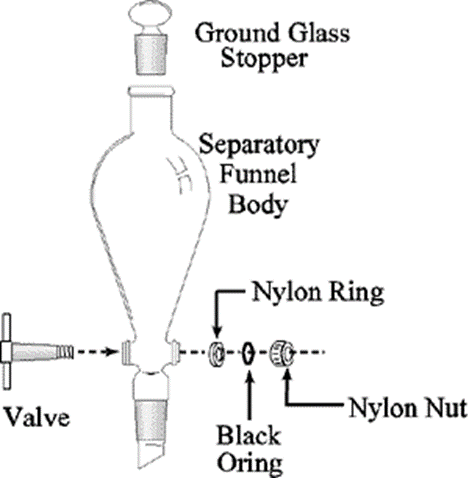
schematron.org/separatory-funnel-diagram.htm The technology really isn’t a lot different than the settling bowls on the old tractors I used as a kid. We have the power to restore purity in our gas tanks.
-
This Summer is a special time for watching wildlife. Some old friends, like the goose and the red-wing blackbird have passed on, and the different behavior of their replacements reminds me that they are no longer with us.
The improved vision after the cataract surgery brings vivid colors and acuity that departed about sixty years ago. Instead of seeing things through the equivalent of dirty, scratched lenses, the colors are back – and small creatures . . . the chicks that accompany the turkey hens . . . are no longer just blurs of motion, but are distinct little birds. Gander has returned with a replacement goose – she moves young, without the hitches that his old mate had. The replacement red-wing blackbird takes up the same perch that his predecessor did – but doesn’t fly by Gander. The little diving ducks – Golden Eyes and Ruddy’s show their independence within a few days of hatching, while the Canada Geese continue to move in their disciplined family groups. This year, Gander is beginning to train not just his flock of goslings, but 4 additional flocks of grand-goslings. Frankly, 5 hatches make the pond a spot to walk carefully.
The bluish purple of the grass seed heads – it has been a long while since I could notice that color – the yellowing of the lenses obscured it. I notice again the slightly different colors of Kentucky bluegrass, of the smooth brome, the timothy, the creeping meadow foxtail. The grass is tall – and the near vertical goose necks walking through show clearly – motion, vertical, and identifiable. I am glad I didn’t put the surgery off.
The improved color perception made our visiting cow elk easy to spot – she comes by late in the Spring for about 5 days, to have a calf she can hide on the hill, graze the hay field, and water at the pond. The fawns are more distinct – and the better vision makes them easy to spot, where a year ago they were well hidden. The marsh hawk has always been visible because of its flight pattern – but now the color pattern is visible again.
Want to tell us something or ask a question? Get in touch.

Recent Posts
- A Few Charts and Trends
- The Density of Water Explains When Dickey Lake Freezes
- Watching Iran
- The Quality of Numbers
- Robert Treat Payne Had Traveled To Greenland
- 75 Years Ago in New York
- Recovery Time for a Retiree
- Venn Diagram and DSM
- When Castro Was Cool
- You Have To Beat Darwin Every Day
- Computer Repair by Mussolini
- Getting Alberta Oil to Market

Rough Cut Lumber
Harvested as part of thinning to reduce fire danger.
$0.75 per board foot.
Call Mike (406-882-4835) or Sam (406-882-4597)
Popular Posts
Ask The Entomologist Bears Books Canada Census Community Decay Covid Covid-19 Data Deer Demography Education Elections family Firearms Game Cameras Geese Government Guns History Inflation life Lincoln County Board of Health Lincoln County MT Lincoln Electric Cooperative Montana nature News Patches' Pieces Pest Control Politics Pond Recipe School School Board Snow Taxes Teaching travel Trego Trego Montana Trego School Weather Wildlife writing
 Trego's Mountain Ear