-
Around this time last year, we were collecting headlines from the Canadian news and documenting the freedom rally that took place in Eureka.
Saturday’s Freedom Rally was Crowded
The amount of vehicles reminded me of Rendezvous, or similarly crowded events. Cars went up the hill, out of sight from its base, filled the historical village, and spilled over across the railroad. There were flags, signs (many homemade), noise, and people waving and cheering on the street. It started without much fanfare, and took about half an hour for everyone to get going. It was rather brisk, and for the most part, people stayed in their vehicles while they waited for it to begin. Mostly, people seemed to have a lot of fun- if not quite as much fun…
Blockades at the Border
Slow Roll Protests have emerged at several crossings over the past month, as well as full and partial blockades. Protests are against the new vaccine mandates for crossing the border, and in support of the Freedom Convoy in Ottowa protesting the same. A Slow Roll Protest began at 3 in the morning, Monday January 17th on the US Manitoba border at the Crossing between Pembina, North Dakota and Emerson, Manitoba. The Pembina/Emerson crossing is a 24 hour port of entry, with three commercial lanes and 4 auto lanes. It is the most heavily traveled border crossing in North Dakota. Between…
Following the Freedom Convoy
Following events as they are happening takes a bit of work, and this more so than most. It has the advantage of being stretched out in time, so the reader isn’t overwhelmed by a bunch of things happening all at once, but finding what, and why and when proved more difficult. Here’s what I have found (incomplete, both due to the sheer amount of information, and my inability to read French). Headlines Friday Jan. 14- Freedom Convoy Facebook Page Created Sunday Jan. 16- GoFundMe page created by Tamara Lich Canadian Health Minister Defends the need for Trucker Vaccine Mandates (Global…
The internet being what it is, the headlines we’ve written are conserved, though not all of the original hyperlinks and pictures have been.
-
If you can solve a problem by writing a check, you have an expense. If writing a check won’t solve the problem . . . well, maybe the problem should be addressed directly instead of by writing checks.
On Friday the 13th, Janet Yellen sent a letter to the Speaker of the House saying that “Public Law 117-73 increased the statutory debt limit to approximately $32.381 trillion . . . I am writing to inform you that beginning on Thursday, January 19, 2023, the outstanding debt of the United States is projected to reach the statutory limit.”
A month ago, I wrote about the 1.7 trillion dollar budget – it came out to $5,151 for each individual living in the USA. The national debt is about 19 times larger – so we could pay it off if each of us wrote a check for $100,000. If we had the ability to do so, the national debt would indeed just be an expense. Since we don’t it’s a problem.
Secretary Yellen continues, “Once the limit is reached, Treasury will need to start taking certain extraordinary measures to prevent the United States from defaulting on its obligations.
The two extraordinary measures Treasury anticipates implementing this month are (1) redeeming existing, and suspending new investments of the Civil Service Retirement and Disability Fund (CSRDF) and the Postal Service Retiree Health Benefits Fund (Postal Fund) and (2) suspending reinvestment of the Government Securities Investment Fund (Gfund) of the Federal Employees Thrift Savings Plan.”
I’m not an economist. I’m particularly not a Keynesian economist. Somehow, it seems to me that, if you can’t write a check to solve today’s problem, increasing the debt limit, in the hope that a couple years down the road you’ll be able to write a larger check, is not a rational solution. There are government services and expenses that I can live without –
“In 2022, the Biden administration and the U.S. Congress have directed nearly $50 billion in assistance to Ukraine, which includes humanitarian, financial, and military support, according to the Kiel Institute for the World Economy, a German research institute.”
https://www.cfr.org/article/how-much-aid-has-us-sent-ukraine-here-are-six-chartsNothing personal, but I was kind of glad when the Cold War ended – and I’m not convinced that funding Ukraine isn’t just getting it back for some jackasses who profited from it.
I’m looking at the BATF rules on pistol braces – maybe we could just amend the 1934 National Firearms Act to cut out the wording on short barreled rifles and shotguns, give that agency less rules to administer, and save half the budget. Heck, they might even work on real crimes, with real victims and make a safer country.
If the first “extraordinary measures” are just cutting out retirement obligations, what might we discover if we just looked at cutting out foreign aid until the budget is balanced, and creating a federal employment ceiling to cut every time the debt gets out of control? If we can’t write a check to turn the problem into an expense, we need a solution.
One of my solutions would slightly change Congress – a small dormitory, with single rooms and a cafeteria for each elected member of Congress. Drop the pay to the US average wage, provide a coach ticket home and back each week, and see if that wouldn’t change the quality of government.
If you can’t write a check to cover your expenses, you have a problem.
-
A friend shared an article about an ideal rifle cartridge. The thought brought back to mind a brief lecture delivered by Leonard Bull at Trinidad State – hearing his students arguing on the merits of different cartridges, Leonard was explaining why gunsmiths shouldn’t have favorite cartridges – “Everyone has the cartridge he likes. Your concerns are to do a good job, build a good rifle, and get paid for it.”
Leonard was probably the best gunsmithing instructor we had when it came to precision work with hand tools. Others may have been better with mills and lathes – but he had learned his trade in Kenya, and as a professional hunter as well as a gunsmith. His work sniping during the Mau-mau uprisings had left him permanently unable to return to Kenya – the country that he had represented in (I believe) three Olympic competitions. And he was a friend of John Buhmiller – Eureka’s top barrelmaker.
TSJC probably had the finest academic library on firearms in the nation back in the mid-eighties, so I dug out Cartridges of the World, read a bit, and decided I needed more information. Leonard pointed out that brass cartridges came along in the 1860’s, and rifle bores shrunk to about 45 caliber, and that smokeless powder was first loaded in 1888 in the French 8mm Lebel. In England, they had compressed black powder, increased the velocity, and developed the 303 British cartridge.
Leonard was slightly too polite to assert that the US moving to thirty caliber rifles was due to British research – but the timeline makes it look like the calculated ideal caliber did come from Enfield – unsatisfied with the 303 performance, they developed the 276 Enfield in 1909, using a .282 bullet weighing from 144 to 190 grains. World War I came along, and the Royal Army’s quest for the perfect cartridge was put aside, and they soldiered on with the old 303 Brit.
At the end of the first World War, the US Army wasn’t satisfied that the 30/06 was their ideal cartridge either. John D. Pedersen did the calculations for the ideal US Army cartridge, and the book lists the 276 Pedersen – with bullets weighing from 120 grains to 150. In 1932, with the Great Depression underway, and millions of 30/06 rounds left over from the brief US involvement in the first World War, General MacArthur ended the army’s search for the perfect cartridge . . . but that isn’t the end of the story.
The US entered the second World War with the only semiautomatic rifle fielded as standard – the M1 (Garand). Both Pedersen and Garand had been doing their development work with the 276 Pedersen . . . and the M1 (Garand) was accepted and changed to 30/06. The action was plenty strong enough for the 30/06 cartridge – but the operating rod, designed for that ideal 276 Pederson, wasn’t. The 30/06 cartridge used in WWII was the “Cartridge, Ball, caliber 30,M2 – downloaded to 150 grains and 200 feet per second slower. The reduced cartridge didn’t bend the op rods. Of course it had another consequence – the older 172 grain cartridge gave the 30 caliber machine guns a maximum range close to 6,000 yards. When the 30/06 was downloaded to the M2 cartridge, maximum range dropped to about 3,500 yards.
Which is where the 308 Winchester comes in – it didn’t compete with the full 30/06 – its competitor was the weakened M2 cartridge – and besides, the M14 had more or less the same operating rod as the M1.
I guess Leonard left me knowing that the big developments in cartridges occurred before I was born – and, from what I’ve seen, all of my choices are pretty good.
-
The concept of linguistic relativity has its origin in the Sapir-Whorf hypothesis – a concept appearing a little before the second world war. While Edward Sapir was a noted linguist and anthropologist, Benjamin Whorf was a chemical engineer, who melded Sapir’s linguistic expertise along with the early studies of quantum physics to come up with the idea that our language strongly influences how we view the world . . . which affects how we do research. Whorf was definitely not the sort of scholar who publishes in today’s professional journals.
At the extreme, our reality is constructed by the language we speak, and different languages result in different realities. The structure and lexicon of your language influences how you observe and conceptualize the world, and does that in a systematic way.
Sapir wrote (1929): “Human beings do not live in the objective world alone, nor alone in the world of social activity as normally understood, but are very much at the mercy of the particular language that has become the medium of expression for their society. It is quite an illusion to imagine that one adjusts to reality essentially without the use of language and that language is merely an incidental means of solving specific problems of communication or reflection. Even comparatively simple acts of perception are very much more at the mercy of the social patterns called words that we might understand. . . We see and otherwise experience very largely because the language habits of our community predispose certain choices of interpretation.”
Whorf reversed the western view of language. Instead of language following the rules of logic, he showed that western logic conforms to the necessities of western grammar. According to Whorf, the Hopi language, with its three tenses of present-past, future and generalized, is better equipped to describe modern (quantum) physics, while English imposes the two Newtonian universal forms of static universal three dimensional space and perpetually flowing single-dimensional time. (Makes it hard to describe the Big Bang in English)
Fortunately, Alibris exists – and MIT published Language, Thought and Reality: the collected writings of Benjamin Whorf back in 1964. It’s worth reading.
-
As the price of eggs continues to climb, thoughts about chicken farming continue to increase. I don’t recall any Extension Chicken specialists from my time with MSU Extension – though I did meet SDSU’s last Chicken Specialist around 2000. He was 80 then, and hadn’t retired as a chicken specialist.
Chicken specialists don’t get a lot of respect. I met a Hutterite school teacher – had his degree, his teaching certificate and all . . . a minister from another colony (more conservative) had met him, learned of his credentials, and opined “Your colony is missing a good chicken man.”
Still, thinking of South Dakota’s Hutterites and poultry does lead me to pointing out one of the advantages to raising chickens in northwest Montana. We’re not in the flyway, with huge flocks of migrating birds bringing bird flu to our farms and ranches. I recall bird flu ravaging the local chicken operations twice in the 15 years I was there. Here, we can probably get bird flu, but vastly fewer migratory birds reduces the odds.
I’ve just written most of my knowledge on chickens – but for the essential item in my yard: I have predators, some airborne and some four-legged. Open range should not be part of a chicken operation for me. Eagles and coyotes would both be a significant risk to any flock I let run loose. Fortunately, Minnesota’s Extension Service had Extension Educator Betsy Wieland on staff, and before she left, she published an article on raising chickens at extension.umn.edu


You can order chicken tractors on Amazon, or from Wayfair. It might just be the way to keep eggs on your plate.
-
The garden is still covered in snow. We will find out how the blackberries handled the -29 temperatures this coming summer – they are a bit more cold sensitive than our other brambles – but they have had several years for the roots to grow. Hopefully they have survived.
In January, it’s a good time to see what NOAA projects to be in store for us – temperature and precipitation.

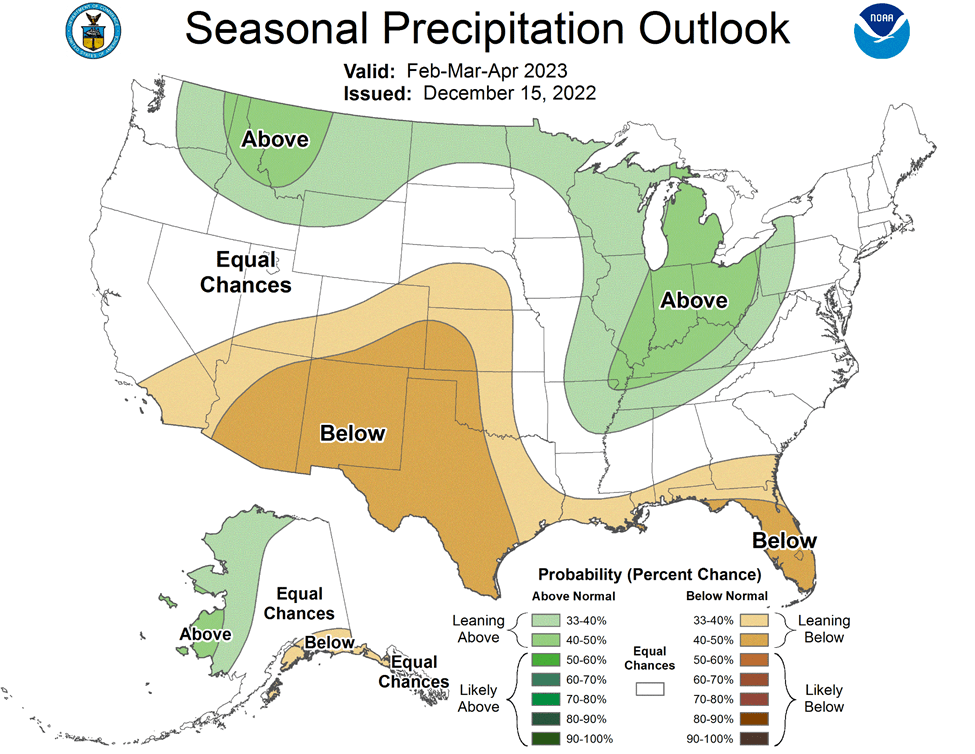
So, it appears we’re looking at a colder Spring with more precipitation coming in. As we grab the next outlook, we see temperature outlooks returning more toward normal and


The Summer outlook maps suggest plenty of growing degrees, and a good time for irrigation:


So, it looks like it will be time to plan on a good corn crop, and it is probably time to order some short-season melons and cantaloupes. January and February are times to make sure we have the seeds on hand for planting – but I’m not ready to predict the last Spring frost date . . . yet.
-
There are times when I realize that I’m wrong. Sometimes in a discussion where, all of a sudden, a single, well-reasoned statement demonstrates where I made a logic blunder or an omission. When this occurs, the rational response is to abandon the argument.
When I saw this quotation, it kind of hit me as an explanation:

I’d been talking with a friend about the “Never Trumpers” and the “Only Trumpers.” In a nation of 330 million people, it is highly unlikely that I can’t find someone better fitted for the presidency than Donald Trump. It’s equally unlikely that I won’t be able to find someone worse for the job than Donald Trump. You can substitute names like Mitch McConnell and Nancy Pelosi and their jobs if you want. Probability says that there are poorer choices than Joe Biden.
I think Doctor Who might have hit it right about folks who alter the facts to fit their views. I read an intriguing comment on global warming/climate change – the writer suggested that all of our climate and weather data be charted in degrees Kelvin. If you’ve forgotten the Kelvin thermometer, it starts at absolute zero . . . if I remember correctly, back in my high school days Mr. Calvert explained that absolute zero was about 273 degrees below zero Celsius. I listened to the argument that it is the point where all motion ceases, and then I think I took it on faith that Mr. Calvert knew more than I.
“The coldest theoretical temperature is called absolute zero, at which the thermal motion of atoms and molecules reaches its minimum. This is a state at which the enthalpy and entropy of a cooled ideal gas reaches its minimum value, taken as 0. Classically, this would be a state of motionlessness, but quantum uncertainty dictates that the particles still possess a finite zero-point energy. Absolute zero is denoted as 0 K on the Kelvin scale, −273.15 °C on the Celsius scale, and −459.67 °F on the Fahrenheit scale.”
https://www.thermal-engineering.org/what-is-absolute-zero-temperature-definition/Still, I have the nagging uncertainty – how could we tell if things got colder than absolute zero? I accept absolute zero as the best factual explanation we have. I can see why graphs from absolute zero might be a bit less confusing. And I suspect that political disagreements stem from “My mind is made up. Stop confusing me with facts.”
I think back to the presidential election of 1964 – I kind of liked Goldwater, probably for his black rimmed glasses . . . yet Dick Sharp explained to me that Goldwater would start a nuclear war – a matter more serious than the black rimmed glasses. Goldwater lost – but Lyndon Johnson’s foreign policy efforts in Southeast Asia led to several deaths among our classmates. We were using propaganda and advertisements instead of facts.
On October 15, 1969, as I cut through the Student Union between classes, I heard a few sentences from a speaker for the VietNam Moratorium. As I recall he said, “You don’t need to be concerned about Ho Chi Minh. It’s your own politicians that can hurt you.” A simple statement – and I think we need to look at the potential harm each elected and appointed political can do.
-
Judith Curry posted “Something frightening poses a perceived risk. Something dangerous poses a real risk.” – Swedish physician Hans Rosling. It seems a significant distinction, regardless of which side of the arguments about climate change you support.
My home is a little above 3,000 feet elevation, and a little below the 49th parallel. My views on the risk of climate change would probably be a bit different if my home were in Paramaribo, at 5 degrees north and 10 feet above sea level.
A couple months ago, Dr. Curry responded to Reilly Neill, a writer and marginally successful politician out of Livingston in an article posted at Glacier saga: Climate Etc. It’s worth reading just for the data about Montana’s climate and weather – and here are some teasers to get you to click the link:
“The total area of Glacier National Park covered by glaciers shrank 70% from the1850s to 2015, according to US Geological Survey. Melting began at the end of the Little Ice Age (circa 1850) when scientists believe 146 glaciers covered the region, as opposed to 26 in 2019.”
“Looking much further back, Glacier National Park was virtually ice free 11,000 years ago. Glaciers have been present within the boundaries of present-day Glacier National Park since about 6,500 years ago. [link] These glaciers have varied in size, tracking climatic variations, but did not grow to their recent maximum size until the end of the Little Ice Age, around 1850. An 80-year period (~1770-1840) of cool, wet summers and above-average winter snowfall led to a rapid growth of glaciers just prior to the end of the Little Ice Age. So, the recent loss of glacier mass must be understood in light of the fact the glaciers reached their largest mass for the past 11,000 years during the 19th century. [link]”
“Now consider summertime temperatures. Shown here are Montana state averages from the NOAA State Climate Summary for Montana (2022).[link] While the two decades in the 21st century have overall been the warmest for Montana since 1900, there has been no trend in extreme summer temperatures. Montana’s warmest summer temperatures were in the 1930s.
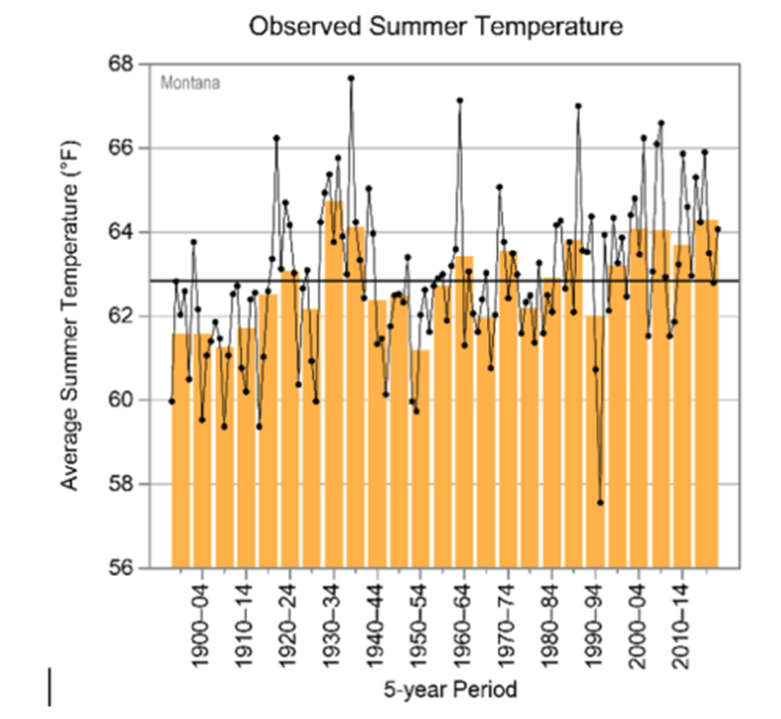
The number of very hot days (≥95 oF) and warm nights (≥70 oF) was highest in the 1930s.”
“The “greed” part of Reilly Neill’s twitter rant seems to have something to do with fossil fuels. If there is ever a place you might want to be kept warm by fossil fuels (or nuclear), Montana during winter is it. Montana is one of the coldest states in the U.S. Of particular concern are wintertime “Arctic outbreaks,” which occur multiple times each winter with varying magnitudes and durations. “Arctic outbreaks” periodically bring exceptionally cold temperatures to large regions of the continental U.S., even in this era of global warming.”
The whole article is worth reading. Checking her webpage every couple of months is worth doing.
-
The Buffalo in Transition
(Data from Rorabacher)
•The American Buffalo (Bison bison) was once the most widely distributed animal in the world. Estimates range from 60 million to 150 million.
•How could the species be hunted to near extinction in just a few years?

The Near Extermination
•The most important factor was “the development of our American civilization.”
•The second factor was the abundance of buffalo – they seemed to be everywhere and in unending numbers.
•The third factor was a combination of the animal’s physical characteristics and its nature.
East of the Mississippi
•Disappearance was a slow, gradual process, caused by too many settler/hunters in search of food, and relatively few buffalo.
•The last free roaming buffalo east of the Mississippi was killed in the early 1830’s.
•Hunting pressure was low in the 17th and through most of the 18th century due to massive depopulation in virgin field epidemics. Then the White population grew
West of the Mississippi
•1820 – the Red River Settlement’s hunt filled over 500 Metis carts with buffalo robes. (near US Canada Border)
•1840 – the American Fur Company sent 67,000 robes to St. Louis (Missouri River)
•1848 – a total of 110,000 robes received in St. Louis.
•In the years following the 1818 Selkirk land grant, the Red River Metis make themselves the lords of the plains – harvesting bison at will, and, with “lager’s” made from their “metis carts” defeating all “Sioux” attempts to defeat them militarily between 1827 and 1851.
•Another competitor is the growing Lakota and Lakota horse population – around 1824 the Lower Brule and Brule split, with one of the reasons that the buffalo were no longer coming close to the Missouri River in large enough numbers to supply all the peoples needs. With 20/20 hindsight, we realize that large horse herds competed with the buffalo.
•1840’s – the Red River Settlement was bringing in 500,000 robes annually
•By 1847, nearly all the buffalo had been killed in the northern Dakota Territory, northern Minnesota, Manitoba and parts of Saskatchewan. Traders abandon the Red River Settlements around 1850.
1847 – Journal of a Trapper
•Osborne Russell wrote, “The continual increasing demand for robes in the civilised world has already and is still contributing in no small degree to their destruction, whilst on the other hand the continual increase of wolves and other 4 footed enemies far exceeds that of the Buffaloe when these combined efforts for its destruction is taken into consideration , it will not be doubted for a moment that this noble race of animals, so useful in supplying the wants of man, will at no far distant period become extinct in North America.”
•Continued . . . “The Buffaloe is already a stranger, altho so numerous 10 years ago, in that part of the country which is drained by the sources of the Colerado, Bear and Snake Rivers and occuppied by the Snake and Bonnack Indians.” (pp.138-139)
•When Russell refers to the Snake Indians, he refers to the Shoshone.
West of the Mississippi
•Overhunting moves to the southern part of Dakota Territory, SW Minnesota, and Northern Nebraska – items offered by white traders induced many tribes to join in killing buffalo for the robe trade – by 1870, buffalo were almost gone from this region.
Technology Changes in Pennsylvania
•1871 – Industrial tanning method developed for tanning buffalo hides into commercially valuable leather. Finest hides made into coats, poorest hides are made into machinery belting and can be obtained any time of year. Hides from cows continue to be more easily worked and are preferred.
West of the Mississippi
•The most intense killing of buffalo occurred between 1871 and 1874, with professional hunters. Colonel Dodge’s estimates suggest 6,750,000 buffalo killed by white hunters in 1872 and 73 (each year). Indians are estimated to have killed 350,00, and white settlers, farmers and ranchers another 200,000.
Doing the Math
•The buffalo herd is unlike the cattle on a ranch. On the ranch, a three-hundred cow operation will have 300 cows, ten bulls, and usually sell most of the calves in the fall. Most of the animals in a ranch herd are reproducing cows. The wild bison herd wasn’t the same.
•Out of 60 million Buffalo, it is reasonable to assume that a quarter of the herd would be juveniles – nobody was hauling them to market.
•That presumes a total cow population of 22.5 million – and we can assume that no more than 20 million would be reproducing each year.
•Since buffalo cows were the preferred targets, whether for eating or for hides, virtually all of the initial hunting pressure focuses on those 20 million cows – most of the bulls continue to graze with little disturbance until 1871.
•Hunting prior to 1871 reduced the size of the reproducing cows more than the size of the herd.
West of the Mississippi
•By 1876, commercial hunting of the southern herd was no longer possible. By 1880, the last buffalo of the southern herd had been killed.
•Between 1880 and 1883, 12 million animals killed from the northern herd.
•1884, one carload of buffalo hides shipped from Dickinson, ND – the last carload shipped.
Almost the End
•1887 – 541 Buffalo left in the United States
–85 living in the wild
–256 in captivity
–200 in Yellowstone Park
•Approximately 180 poached in Yellowstone between 1887 and 1894
•60 more poached in Colorado
•1894 – 300 buffalo remained
West of the Mississippi
•Flathead Michel Pablo preserved over 300 buffalo in NW Montana, on land that is now the National Bison Range. By the time the US Government bought the Range, Pablo had sold the Buffalo to Canada.
•Charles Conrad, a banker from Kalispell, kept a small Buffalo herd – parent stock for Moiese, and Big Medicine.
Big Medicine – (mount)

-
I’ve been asked “What are you doing with the log building?” – and the questions increased when I added a door to the south wall. Writing an answer might even clarify my thoughts – or at least give me a rehearsed reply.
First, it’s not really a log building – it’s a building made from the old railroad’s telegraph poles, salvaged as the rails along the Kootenai came out before Koocanusa Reservoir filled. A guy named Goldsberry had the contract and figured the cedar telegraph poles would have value – so he cut them at ground level and hauled them into the little flat below the old service station, and, when they didn’t sell, left them there.
Dad liked to have a project going on, so in the mid-eighties put a small mill in, and Pat Eustice (AKA Mac’s Hippy) milled the poles flat on three sides, mixed cement for a slab, and laid up the building. As I emptied the building, a glance showed that one of the old cedar poles in the east wall had started to roll – so I needed to strengthen that wall. Then I realized that the doors on the west were essentially levers, prying the walls apart each time they were opened and closed.
There’s no doubt those doors are rustic and even attractive. They’re also destructive, so they’re due to be replaced by some standard roll-up garage doors that won’t lever the walls apart – I’ll be ordering them soon, and installing the new doors this Spring or Summer. The door on the south wall gives an accessible spot to enter, and I’ll continue reinforcing that wall so that the (lesser) leverage of a 36-inch door doesn’t harm that wall.
I guess it’s historical – the telegraph poles came in along with the railroad before 1910 – were removed after 65 years of service, then repurposed. I guess it would be just about as accurate to call it a telegraph pole shack as a log building. Once the doors are changed and the building is strong again we’ll probably figure out what to do next.


Want to tell us something or ask a question? Get in touch.

Recent Posts
- The Density of Water Explains When Dickey Lake Freezes
- Watching Iran
- The Quality of Numbers
- Robert Treat Payne Had Traveled To Greenland
- 75 Years Ago in New York
- Recovery Time for a Retiree
- Venn Diagram and DSM
- When Castro Was Cool
- You Have To Beat Darwin Every Day
- Computer Repair by Mussolini
- Getting Alberta Oil to Market
- Parties On Economics

Rough Cut Lumber
Harvested as part of thinning to reduce fire danger.
$0.75 per board foot.
Call Mike (406-882-4835) or Sam (406-882-4597)
Popular Posts
Ask The Entomologist Bears Books Canada Census Community Decay Covid Covid-19 Data Deer Demography Education Elections family Firearms Game Cameras Geese Government Guns History Inflation life Lincoln County Board of Health Lincoln County MT Lincoln Electric Cooperative Montana nature News Patches' Pieces Pest Control Politics Pond Recipe School School Board Snow Taxes Teaching travel Trego Trego Montana Trego School Weather Wildlife writing
 Trego's Mountain Ear